


 Home
HomeLi Feifei's ESI-Bench: AI Evolves From Observers to Actors
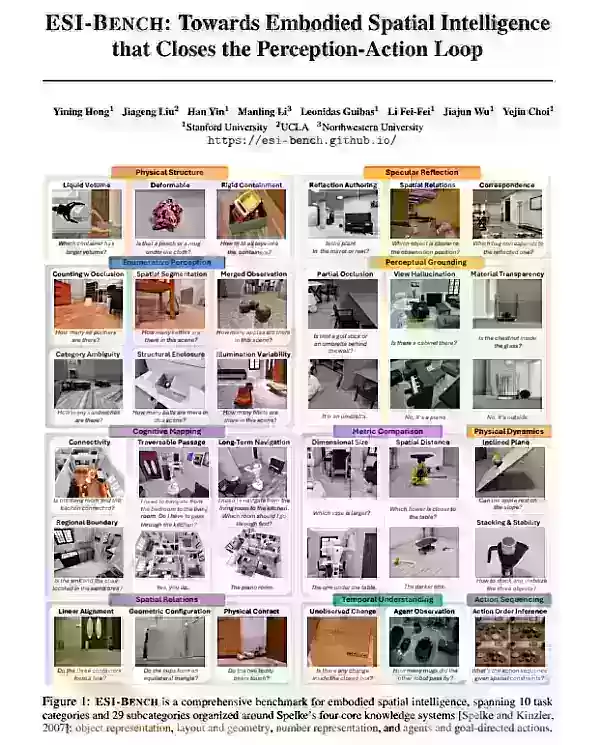
Recently, the ESI-Bench (Embodied Spatial Intelligence Benchmark) released by Fei-Fei Li’s team has drawn significant attention. Considered the “ImageNet of embodied intelligence,” this benchmark reveals critical shortcomings of top large models when interacting with physical space.
Why ESI-Bench Marks a New Standard for Embodied Intelligence
Earlier AI spatial intelligence evaluations largely relied on “passive perception”: feeding a few optimal-view images and letting the model reason logically. That approach essentially tests the model’s “vision” rather than its “spatial cognition.”
The core breakthrough of ESI-Bench is its enforcement of the perception-action loop.
Observers become actors: In ESI-Bench, the model cannot remain stationary and judge from given images; it must actively decide where to go, what to look at, which objects to pick up, and which mechanical structures to operate, uncovering hidden spatial information through a series of interactive actions.
Design foundation: The benchmark is grounded in cognitive psychologist Elizabeth Spelke’s “core knowledge system of human infants,” covering four dimensions: object representation, layout and geometry, quantity representation, and goal-directed action.
Scale and platform: It includes 10 categories, 29 subcategories, and 3,081 task instances, built on the OmniGibson simulation platform with materials from the BEHAVIOR-1K scene library.
Three Core Truths Exposed by the Evaluation
The research team conducted in-depth tests on cutting-edge multimodal models like GPT-5 and the Gemini series. The results are thought-provoking:
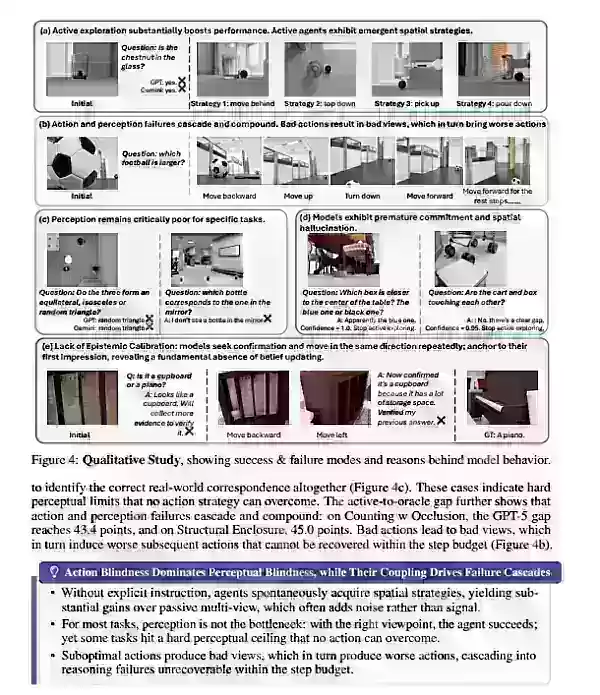
1. Perception Isn’t the Bottleneck—Action Strategy Is
When given the optimal view, models often provide accurate answers—accuracy can jump from 14.6% to 95.1%. But when they must actively find the view, accuracy drops dramatically.
Action blindness: Models lack navigation and manipulation strategies; incorrect actions lead to poor views, which trigger cascading errors in subsequent judgments.
2. Imperfect 3D Reconstruction Is More Misleading Than 2D Images
The study overturns the assumption that “3D maps are a universal solution.”
When fed perfect overhead 3D ground truth, reasoning performance is excellent. However, using current advanced VGGT for real-time reconstruction introduces geometric artifacts, occlusion errors, and depth deviations—essentially feeding the reasoning model toxic data, which yields worse performance than simply viewing 2D images.
3. Metacognitive Deficit: AI Doesn’t Know It “Hasn’t Seen Enough”
This is the biggest cognitive gap between humans and AI:
Difference in cognitive caution: Humans actively seek disconfirming perspectives when information is ambiguous and reduce confidence under uncertainty.
Model hallucination: Models often stop exploring too early, even with extremely limited information, and confidently provide incorrect conclusions. The team calls this “metacognitive deficit”—the model lacks an internal doubt mechanism and cannot assess whether current information is sufficient.
Where Embodied Intelligence Heads Next
ESI-Bench signals a paradigm shift from “static image-text matching” to “real physical interaction” in embodied intelligence evaluation. As the Fei-Fei Li team notes, achieving true spatial intelligence requires more than stacking visual encoders or increasing computing power.
Future embodied intelligence research must focus on giving models:
Active exploration sequence decision-making ability, rather than simple image recognition;
Stronger robustness, to maintain logical judgment even with imperfect scene observations;
An embedded metacognitive loop, so that AI learns to explore when it lacks answers, instead of producing false hallucinations.
Related article
 Apple, Google Partner With Anthropic to Address 27-Year-Old Vulnerability via Glass Wing Protection
As artificial intelligence advances rapidly in code generation and logical reasoning, the cybersecurity landscape faces unprecedented challenges. Recently, the prominent AI startup Anthropic officially launched a cross-industry collaboration called *
OpenAI Chief Scientist Addresses AI Reasoning Transparency Debate: Complexity Steady, No Sudden Jump
On September 2, Jakub Pachocki, OpenAI’s Chief Scientist, addressed public concerns on X regarding the AI model Astra, clarifying claims that it operates without oversight and lacks transparent reasoning.Why the Controversy Erupted: Deep Recurrence O
U.S. Navy Selects Blue Water Autonomy for Deep-Sea Survey Missions
Blue Water Autonomy’s Liberty Class is a 190-foot steel autonomous ship. | Source: Blue Water AutonomyBoston-based technology and shipbuilding firm Blue Water Autonomy has secured a multiple-award contract with the Naval Oceanographic Office (NAVOCEA
Related Special Topic Recommendations
Text-to-speech
Apple, Google Partner With Anthropic to Address 27-Year-Old Vulnerability via Glass Wing Protection
As artificial intelligence advances rapidly in code generation and logical reasoning, the cybersecurity landscape faces unprecedented challenges. Recently, the prominent AI startup Anthropic officially launched a cross-industry collaboration called *
OpenAI Chief Scientist Addresses AI Reasoning Transparency Debate: Complexity Steady, No Sudden Jump
On September 2, Jakub Pachocki, OpenAI’s Chief Scientist, addressed public concerns on X regarding the AI model Astra, clarifying claims that it operates without oversight and lacks transparent reasoning.Why the Controversy Erupted: Deep Recurrence O
U.S. Navy Selects Blue Water Autonomy for Deep-Sea Survey Missions
Blue Water Autonomy’s Liberty Class is a 190-foot steel autonomous ship. | Source: Blue Water AutonomyBoston-based technology and shipbuilding firm Blue Water Autonomy has secured a multiple-award contract with the Naval Oceanographic Office (NAVOCEA
Related Special Topic Recommendations
Text-to-speech
 Best AI Text to Speech Tools for Online Courses
2026 Latest Best Top-rated AI Text to Speech Tools for Online Courses are curated by XIX.AI based on rigorous real-world tests and weekly updated rankings. These powerful tools help creators deliver crystal-clear audio content effortlessly, boosting writing efficiency and streamlining course production. Check out the free vs paid comparison to find your perfect fit. Explore now to unlock your AI edge in online education.
 10 tools
 xix.ai
writing
AI Blog Title Tools for Higher Click Through Rates
xix.ai
writing
AI Blog Title Tools for Higher Click Through Rates
2026 Latest Best Top-Rated AI Blog Title Tools for Higher Click Through Rates! XIX.AI has carefully curated a powerful, game-changing collection of top tools that go through rigorous real-world tests. You’ll find a free vs paid comparison, weekly updated rankings, and detailed insights to help you boost your blog’s traffic efficiently. Must-try options are highlighted to help you unlock your AI edge. Explore now!
10 tools
xix.ai
automation
Best AI Task Routing Tools for Support Workflows
2026 Latest Best Top-rated AI Task Routing Tools for Support Workflows! XIX.AI has curated a highly powerful game-changing collection of must-try solutions, all undergoing rigorous real-world tests and updated weekly. These tools streamline workflows, boost productivity, and help teams deliver faster, more efficient support. Explore now to discover your perfect tool and unlock your AI edge!
17 tools
xix.ai
Academic Research
AI Citation and Paper Summary Tools
2026 Latest Best Top-Rated AI Citation and Paper Summary Tools Curated by XIX.AI. Get powerful game-changing solutions for quick content creation, improved writing efficiency, and boosting productivity. We offer a free vs paid comparison along with real-world tests and weekly updated rankings to help you find the must-try tool that fits your needs perfectly. Explore now to Unlock your AI edge.
10 tools
xix.ai
Productivity
Best AI Productivity Tools for Daily Work
2026 Latest Best Top-Rated AI Productivity Tools for Daily Work! XIX.AI has curated a powerful, game-changing selection based on rigorous weekly updated rankings and real-world tests. You’ll find must-try options that boost writing efficiency, streamline content creation, and help you overcome daily work challenges. Get a free vs paid comparison to find the perfect fit for your needs. Explore now to unlock your AI edge!
9 tools
xix.ai
Academic Research
AI Systematic Review Tools for Research Screening
2026 Latest Best Top-Rated AI Systematic Review Tools for Research Screening are here on XIX.AI! This curated collection includes powerful, game-changing solutions that go through rigorous real-world tests to deliver accurate results. We also offer a free vs paid comparison along with weekly updated rankings to help you find the must-try option that boosts your research efficiency significantly. Explore now to unlock your AI edge in academic work!
11 tools
xix.ai

 Comments (0)
0/500
Comments (0)
0/500
Recently, the ESI-Bench (Embodied Spatial Intelligence Benchmark) released by Fei-Fei Li’s team has drawn significant attention. Considered the “ImageNet of embodied intelligence,” this benchmark reveals critical shortcomings of top large models when interacting with physical space.
Why ESI-Bench Marks a New Standard for Embodied Intelligence
Earlier AI spatial intelligence evaluations largely relied on “passive perception”: feeding a few optimal-view images and letting the model reason logically. That approach essentially tests the model’s “vision” rather than its “spatial cognition.”
The core breakthrough of ESI-Bench is its enforcement of the perception-action loop.
Observers become actors: In ESI-Bench, the model cannot remain stationary and judge from given images; it must actively decide where to go, what to look at, which objects to pick up, and which mechanical structures to operate, uncovering hidden spatial information through a series of interactive actions.
Design foundation: The benchmark is grounded in cognitive psychologist Elizabeth Spelke’s “core knowledge system of human infants,” covering four dimensions: object representation, layout and geometry, quantity representation, and goal-directed action.
Scale and platform: It includes 10 categories, 29 subcategories, and 3,081 task instances, built on the OmniGibson simulation platform with materials from the BEHAVIOR-1K scene library.
Three Core Truths Exposed by the Evaluation
The research team conducted in-depth tests on cutting-edge multimodal models like GPT-5 and the Gemini series. The results are thought-provoking:
1. Perception Isn’t the Bottleneck—Action Strategy Is
When given the optimal view, models often provide accurate answers—accuracy can jump from 14.6% to 95.1%. But when they must actively find the view, accuracy drops dramatically.
Action blindness: Models lack navigation and manipulation strategies; incorrect actions lead to poor views, which trigger cascading errors in subsequent judgments.
2. Imperfect 3D Reconstruction Is More Misleading Than 2D Images
The study overturns the assumption that “3D maps are a universal solution.”
When fed perfect overhead 3D ground truth, reasoning performance is excellent. However, using current advanced VGGT for real-time reconstruction introduces geometric artifacts, occlusion errors, and depth deviations—essentially feeding the reasoning model toxic data, which yields worse performance than simply viewing 2D images.
3. Metacognitive Deficit: AI Doesn’t Know It “Hasn’t Seen Enough”
This is the biggest cognitive gap between humans and AI:
Difference in cognitive caution: Humans actively seek disconfirming perspectives when information is ambiguous and reduce confidence under uncertainty.
Model hallucination: Models often stop exploring too early, even with extremely limited information, and confidently provide incorrect conclusions. The team calls this “metacognitive deficit”—the model lacks an internal doubt mechanism and cannot assess whether current information is sufficient.
Where Embodied Intelligence Heads Next
ESI-Bench signals a paradigm shift from “static image-text matching” to “real physical interaction” in embodied intelligence evaluation. As the Fei-Fei Li team notes, achieving true spatial intelligence requires more than stacking visual encoders or increasing computing power.
Future embodied intelligence research must focus on giving models:
Active exploration sequence decision-making ability, rather than simple image recognition;
Stronger robustness, to maintain logical judgment even with imperfect scene observations;
An embedded metacognitive loop, so that AI learns to explore when it lacks answers, instead of producing false hallucinations.








 Apple, Google Partner With Anthropic to Address 27-Year-Old Vulnerability via Glass Wing Protection
As artificial intelligence advances rapidly in code generation and logical reasoning, the cybersecurity landscape faces unprecedented challenges. Recently, the prominent AI startup Anthropic officially launched a cross-industry collaboration called *
Apple, Google Partner With Anthropic to Address 27-Year-Old Vulnerability via Glass Wing Protection
As artificial intelligence advances rapidly in code generation and logical reasoning, the cybersecurity landscape faces unprecedented challenges. Recently, the prominent AI startup Anthropic officially launched a cross-industry collaboration called *
 OpenAI Chief Scientist Addresses AI Reasoning Transparency Debate: Complexity Steady, No Sudden Jump
On September 2, Jakub Pachocki, OpenAI’s Chief Scientist, addressed public concerns on X regarding the AI model Astra, clarifying claims that it operates without oversight and lacks transparent reasoning.Why the Controversy Erupted: Deep Recurrence O
OpenAI Chief Scientist Addresses AI Reasoning Transparency Debate: Complexity Steady, No Sudden Jump
On September 2, Jakub Pachocki, OpenAI’s Chief Scientist, addressed public concerns on X regarding the AI model Astra, clarifying claims that it operates without oversight and lacks transparent reasoning.Why the Controversy Erupted: Deep Recurrence O
 U.S. Navy Selects Blue Water Autonomy for Deep-Sea Survey Missions
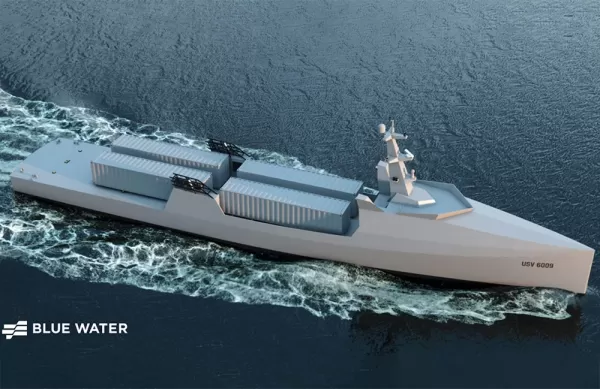
Blue Water Autonomy’s Liberty Class is a 190-foot steel autonomous ship. | Source: Blue Water AutonomyBoston-based technology and shipbuilding firm Blue Water Autonomy has secured a multiple-award contract with the Naval Oceanographic Office (NAVOCEA
U.S. Navy Selects Blue Water Autonomy for Deep-Sea Survey Missions
Blue Water Autonomy’s Liberty Class is a 190-foot steel autonomous ship. | Source: Blue Water AutonomyBoston-based technology and shipbuilding firm Blue Water Autonomy has secured a multiple-award contract with the Naval Oceanographic Office (NAVOCEA

2026 Latest Best Top-rated AI Text to Speech Tools for Online Courses are curated by XIX.AI based on rigorous real-world tests and weekly updated rankings. These powerful tools help creators deliver crystal-clear audio content effortlessly, boosting writing efficiency and streamlining course production. Check out the free vs paid comparison to find your perfect fit. Explore now to unlock your AI edge in online education.
10 tools
xix.ai

2026 Latest Best Top-Rated AI Blog Title Tools for Higher Click Through Rates! XIX.AI has carefully curated a powerful, game-changing collection of top tools that go through rigorous real-world tests. You’ll find a free vs paid comparison, weekly updated rankings, and detailed insights to help you boost your blog’s traffic efficiently. Must-try options are highlighted to help you unlock your AI edge. Explore now!
10 tools
xix.ai

2026 Latest Best Top-rated AI Task Routing Tools for Support Workflows! XIX.AI has curated a highly powerful game-changing collection of must-try solutions, all undergoing rigorous real-world tests and updated weekly. These tools streamline workflows, boost productivity, and help teams deliver faster, more efficient support. Explore now to discover your perfect tool and unlock your AI edge!
17 tools
xix.ai

2026 Latest Best Top-Rated AI Citation and Paper Summary Tools Curated by XIX.AI. Get powerful game-changing solutions for quick content creation, improved writing efficiency, and boosting productivity. We offer a free vs paid comparison along with real-world tests and weekly updated rankings to help you find the must-try tool that fits your needs perfectly. Explore now to Unlock your AI edge.
10 tools
xix.ai

2026 Latest Best Top-Rated AI Productivity Tools for Daily Work! XIX.AI has curated a powerful, game-changing selection based on rigorous weekly updated rankings and real-world tests. You’ll find must-try options that boost writing efficiency, streamline content creation, and help you overcome daily work challenges. Get a free vs paid comparison to find the perfect fit for your needs. Explore now to unlock your AI edge!
9 tools
xix.ai

2026 Latest Best Top-Rated AI Systematic Review Tools for Research Screening are here on XIX.AI! This curated collection includes powerful, game-changing solutions that go through rigorous real-world tests to deliver accurate results. We also offer a free vs paid comparison along with weekly updated rankings to help you find the must-try option that boosts your research efficiency significantly. Explore now to unlock your AI edge in academic work!
11 tools
xix.ai












