


 Home
HomeLFM2.5 DSpark Draft Model Released: Inference Speed Boosted 3.18x
Liquid AI and Hugging Face have officially released the DSpark draft model checkpoints for the LFM2.5 series, covering LFM2.5-1.2B-Instruct, LFM2.5-2.6B, and LFM2.5-8B-A1B. This innovation introduces a novel speculative decoding path that significantly boosts inference throughput while preserving output quality.
Key Performance Gains and Real-World Applications
Real-world tests demonstrate DSpark’s impressive acceleration. On GPUs, throughput increases by up to 3.18x, while edge devices see improvements of up to 2.87x.
In edge agent inference, LFM2.5-2.6B reduces function call latency by an average of 57%. Tested on an M4 Max MacBook Pro, it achieves speeds up to 139 tokens per second, lowering the barrier for local agent deployment and delivering a user experience that rivals proprietary cloud models.
Understanding DSpark’s Architecture and Mechanism
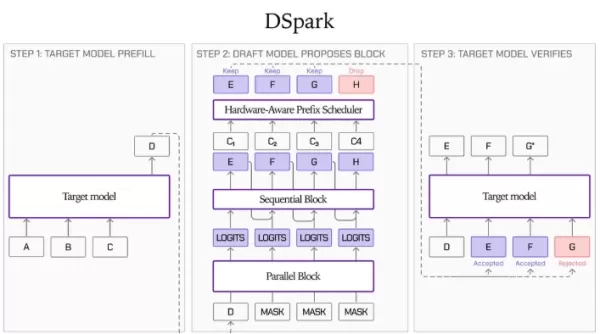
Traditional LLM inference is bottlenecked by memory bandwidth, as most time is spent streaming weights from DRAM to SRAM. Speculative decoding addresses this by using a lightweight draft model to generate candidate tokens, which are then validated in a single forward pass by the target model, effectively distributing weight-loading costs.
DSpark integrates existing methods through three core components:
Parallel Backbone Network: Similar to DFlash, it generates hidden states for all draft tokens in one forward pass based on the target model’s context features.Sequential Head (Markov Head): By simulating Markov chains between adjacent tokens, it enhances dependencies and improves the acceptance rate for subsequent positions.Confidence Scheduling Validator: It predicts each token’s survival probability, automatically discarding low-confidence suffixes when validation costs outweigh savings.For training, the draft model utilizes a diverse dataset mix including SFT, chat, code, and function calls. After rigorous ablation studies, the initial version features an attention-only architecture with 5 layers and 9 blocks, keeping parameters around 300 million.
Quality Assurance and Ecosystem Integration
Due to speculative decoding, greedy decoding only accepts draft tokens that perfectly match the target model’s distribution. Rejected tokens are replaced by the target model’s output, ensuring the generated sequence matches baseline greedy decoding structure with no accuracy loss in benchmarks.
On release, DSpark achieved compatibility with mainstream inference frameworks:
SGLang: Supports execution on accelerators via dedicated integration and startup configurations.llama.cpp: Offers official build support, enabling users to load corresponding GGUF weights and draft model files through the command line.
Related article
 How Unitree is Shaping the Future of Humanoid Robotics
Unitree’s New Creature of Embodied AI with ultra-wide 4D LiDAR technology for advanced real-world navigation. Credit: UnitreeWang Xingxing, CEO of Unitree, targets world model breakthroughs to help humanoid machines execute 80% of tasks when placed i
Why Abnormal AI Partnered With OpenAI on Daybreak
Michael Aiello, Head of Product for Cyber at OpenAI | Credit: Michael Aiello/LinkedInAbnormal AI joins OpenAI’s Daybreak programme, as Mike Aiello says the partnership will accelerate the adoption of practical defences for enterprisesLeading frontier
AI Agent Elements Claw Completes Superconducting Material Development
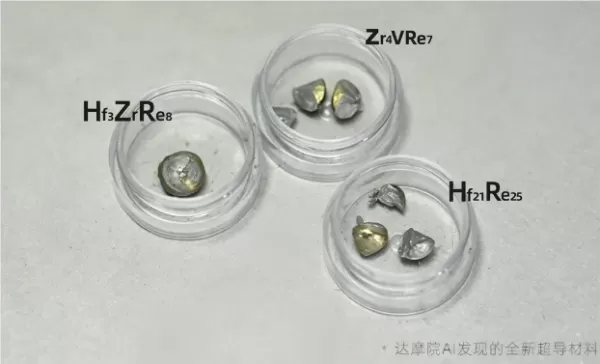
As artificial intelligence pushes the boundaries of scientific exploration, a significant milestone has been achieved. On July 3, Alibaba DAMO Academy, in partnership with Renmin University of China and the University of Chinese Academy of Sciences,
Related Special Topic Recommendations
Health & Wellness
How Unitree is Shaping the Future of Humanoid Robotics
Unitree’s New Creature of Embodied AI with ultra-wide 4D LiDAR technology for advanced real-world navigation. Credit: UnitreeWang Xingxing, CEO of Unitree, targets world model breakthroughs to help humanoid machines execute 80% of tasks when placed i
Why Abnormal AI Partnered With OpenAI on Daybreak
Michael Aiello, Head of Product for Cyber at OpenAI | Credit: Michael Aiello/LinkedInAbnormal AI joins OpenAI’s Daybreak programme, as Mike Aiello says the partnership will accelerate the adoption of practical defences for enterprisesLeading frontier
AI Agent Elements Claw Completes Superconducting Material Development
As artificial intelligence pushes the boundaries of scientific exploration, a significant milestone has been achieved. On July 3, Alibaba DAMO Academy, in partnership with Renmin University of China and the University of Chinese Academy of Sciences,
Related Special Topic Recommendations
Health & Wellness
 Best AI Sleep Coaching Tools for Shift Workers, Jet Lag Recovery, and Better Routines
2026 Latest Best AI Sleep Coaching Tools for Shift Workers, Jet Lag Recovery, and Better Routines! XIX.AI has curated a top-rated list of powerful game-changing tools that go through real-world tests to deliver accurate guidance. You can find detailed free vs paid comparison info and see how these must-try solutions help boost sleep quality, speed up jet lag recovery, and build healthier routines. Explore now to discover your perfect tool!
 7 tools
 xix.ai
code
ChatGPT Debugging Tools for Python Errors, API Logs, and Stack Trace Triage
xix.ai
code
ChatGPT Debugging Tools for Python Errors, API Logs, and Stack Trace Triage
2026 Latest Best ChatGPT debugging tools for Python errors, API logs, and stack trace triage are here on XIX.AI. This curated list of top-rated solutions offers a free vs paid comparison, real-world tests, and detailed rankings to help you find the most powerful tool that can significantly boost your productivity and help you solve complex technical issues faster. Explore now to discover your perfect solution!
9 tools
xix.ai
Text-to-speech
AI Voiceover Tools for Product Demo Videos
2026 Latest Best Top-Rated AI Voiceover Tools for Product Demo Videos are here on XIX.AI! This curated list features powerful, game-changing options that help you create professional-quality audio content fast, boosting your demo efficiency significantly. We conduct real-world tests and provide a free vs paid comparison along with weekly updated rankings to help you find the perfect fit. Explore now to Unlock your AI edge!
10 tools
xix.ai
Business
AI Business Plan Tools for Startup Validation
2026 Latest Best AI Business Plan Tools for Startup Validation! XIX.AI has curated a top-rated list of powerful game-changing tools that go through real-world tests to deliver accurate results. You’ll find a free vs paid comparison, detailed rankings, and easy-to-understand insights to help you choose the perfect solution and boost your startup’s success rate. Explore now to Unlock your AI edge!
9 tools
xix.ai
chatbot
AI Chat Apps for Roleplay and Conversation Practice
2026 Latest Best AI Chat Apps for Roleplay and Conversation Practice! XIX.AI curates a top-rated list of powerful must-try tools that go through rigorous real-world tests to deliver exceptional results. You’ll find detailed free vs paid comparison, comprehensive rankings, and insights into how these apps can boost your language skills and communication confidence effectively. Explore now to discover your perfect tool for practice!
10 tools
xix.ai
design
Best AI Wireframe Tools for Product Teams
2026 Latest Best Top-rated AI Wireframe Tools for Product Teams! This curated list showcases powerful, game-changing solutions that significantly boost productivity through real-world tests and rigorous rankings. It includes a detailed free vs paid comparison to help you find the perfect fit. XIX.AI provides expert insights to guide your decision. Explore now to Discover your perfect tool and Unlock your AI edge in product development!
8 tools
xix.ai

 Comments (0)
0/500
Comments (0)
0/500
Liquid AI and Hugging Face have officially released the DSpark draft model checkpoints for the LFM2.5 series, covering LFM2.5-1.2B-Instruct, LFM2.5-2.6B, and LFM2.5-8B-A1B. This innovation introduces a novel speculative decoding path that significantly boosts inference throughput while preserving output quality.
Key Performance Gains and Real-World Applications
Real-world tests demonstrate DSpark’s impressive acceleration. On GPUs, throughput increases by up to 3.18x, while edge devices see improvements of up to 2.87x.
In edge agent inference, LFM2.5-2.6B reduces function call latency by an average of 57%. Tested on an M4 Max MacBook Pro, it achieves speeds up to 139 tokens per second, lowering the barrier for local agent deployment and delivering a user experience that rivals proprietary cloud models.
Understanding DSpark’s Architecture and Mechanism
Traditional LLM inference is bottlenecked by memory bandwidth, as most time is spent streaming weights from DRAM to SRAM. Speculative decoding addresses this by using a lightweight draft model to generate candidate tokens, which are then validated in a single forward pass by the target model, effectively distributing weight-loading costs.
DSpark integrates existing methods through three core components:
Parallel Backbone Network: Similar to DFlash, it generates hidden states for all draft tokens in one forward pass based on the target model’s context features.Sequential Head (Markov Head): By simulating Markov chains between adjacent tokens, it enhances dependencies and improves the acceptance rate for subsequent positions.Confidence Scheduling Validator: It predicts each token’s survival probability, automatically discarding low-confidence suffixes when validation costs outweigh savings.For training, the draft model utilizes a diverse dataset mix including SFT, chat, code, and function calls. After rigorous ablation studies, the initial version features an attention-only architecture with 5 layers and 9 blocks, keeping parameters around 300 million.
Quality Assurance and Ecosystem Integration
Due to speculative decoding, greedy decoding only accepts draft tokens that perfectly match the target model’s distribution. Rejected tokens are replaced by the target model’s output, ensuring the generated sequence matches baseline greedy decoding structure with no accuracy loss in benchmarks.
On release, DSpark achieved compatibility with mainstream inference frameworks:
SGLang: Supports execution on accelerators via dedicated integration and startup configurations.llama.cpp: Offers official build support, enabling users to load corresponding GGUF weights and draft model files through the command line.








 How Unitree is Shaping the Future of Humanoid Robotics
Unitree’s New Creature of Embodied AI with ultra-wide 4D LiDAR technology for advanced real-world navigation. Credit: UnitreeWang Xingxing, CEO of Unitree, targets world model breakthroughs to help humanoid machines execute 80% of tasks when placed i
How Unitree is Shaping the Future of Humanoid Robotics
Unitree’s New Creature of Embodied AI with ultra-wide 4D LiDAR technology for advanced real-world navigation. Credit: UnitreeWang Xingxing, CEO of Unitree, targets world model breakthroughs to help humanoid machines execute 80% of tasks when placed i
 Why Abnormal AI Partnered With OpenAI on Daybreak
Michael Aiello, Head of Product for Cyber at OpenAI | Credit: Michael Aiello/LinkedInAbnormal AI joins OpenAI’s Daybreak programme, as Mike Aiello says the partnership will accelerate the adoption of practical defences for enterprisesLeading frontier
Why Abnormal AI Partnered With OpenAI on Daybreak
Michael Aiello, Head of Product for Cyber at OpenAI | Credit: Michael Aiello/LinkedInAbnormal AI joins OpenAI’s Daybreak programme, as Mike Aiello says the partnership will accelerate the adoption of practical defences for enterprisesLeading frontier
 AI Agent Elements Claw Completes Superconducting Material Development
As artificial intelligence pushes the boundaries of scientific exploration, a significant milestone has been achieved. On July 3, Alibaba DAMO Academy, in partnership with Renmin University of China and the University of Chinese Academy of Sciences,
AI Agent Elements Claw Completes Superconducting Material Development
As artificial intelligence pushes the boundaries of scientific exploration, a significant milestone has been achieved. On July 3, Alibaba DAMO Academy, in partnership with Renmin University of China and the University of Chinese Academy of Sciences,

2026 Latest Best AI Sleep Coaching Tools for Shift Workers, Jet Lag Recovery, and Better Routines! XIX.AI has curated a top-rated list of powerful game-changing tools that go through real-world tests to deliver accurate guidance. You can find detailed free vs paid comparison info and see how these must-try solutions help boost sleep quality, speed up jet lag recovery, and build healthier routines. Explore now to discover your perfect tool!
7 tools
xix.ai

2026 Latest Best ChatGPT debugging tools for Python errors, API logs, and stack trace triage are here on XIX.AI. This curated list of top-rated solutions offers a free vs paid comparison, real-world tests, and detailed rankings to help you find the most powerful tool that can significantly boost your productivity and help you solve complex technical issues faster. Explore now to discover your perfect solution!
9 tools
xix.ai

2026 Latest Best Top-Rated AI Voiceover Tools for Product Demo Videos are here on XIX.AI! This curated list features powerful, game-changing options that help you create professional-quality audio content fast, boosting your demo efficiency significantly. We conduct real-world tests and provide a free vs paid comparison along with weekly updated rankings to help you find the perfect fit. Explore now to Unlock your AI edge!
10 tools
xix.ai

2026 Latest Best AI Business Plan Tools for Startup Validation! XIX.AI has curated a top-rated list of powerful game-changing tools that go through real-world tests to deliver accurate results. You’ll find a free vs paid comparison, detailed rankings, and easy-to-understand insights to help you choose the perfect solution and boost your startup’s success rate. Explore now to Unlock your AI edge!
9 tools
xix.ai

2026 Latest Best AI Chat Apps for Roleplay and Conversation Practice! XIX.AI curates a top-rated list of powerful must-try tools that go through rigorous real-world tests to deliver exceptional results. You’ll find detailed free vs paid comparison, comprehensive rankings, and insights into how these apps can boost your language skills and communication confidence effectively. Explore now to discover your perfect tool for practice!
10 tools
xix.ai

2026 Latest Best Top-rated AI Wireframe Tools for Product Teams! This curated list showcases powerful, game-changing solutions that significantly boost productivity through real-world tests and rigorous rankings. It includes a detailed free vs paid comparison to help you find the perfect fit. XIX.AI provides expert insights to guide your decision. Explore now to Discover your perfect tool and Unlock your AI edge in product development!
8 tools
xix.ai












