


 Home
HomeJohnson & Johnson Concludes OTTAVA Robotic Surgery System Trial
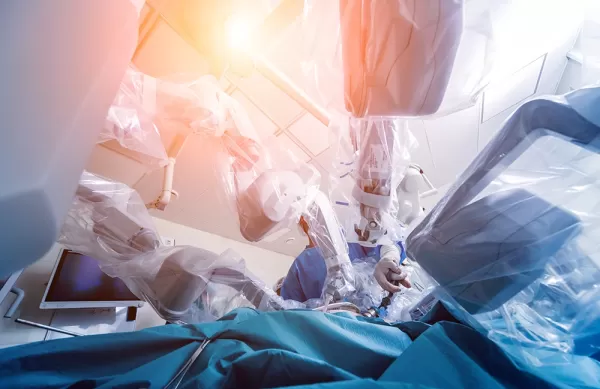
Johnson & Johnson developed OTTAVA for procedures like gastric bypass surgery. Source: Adobe Stock
Johnson & Johnson has announced the results from the first clinical study of its investigational OTTAVA robotic surgical system. This prospective, multicenter study assessed the system's safety and performance in Roux-en-Y gastric bypass procedures.
In the 30-patient study, the primary safety and performance goals were met at the 30-day post-operative mark, according to J&J. Surgeons completed all procedures robotically using OTTAVA without needing to switch to a non-robotic technique. Patients experienced an average weight loss of 30 pounds (13.6 kg) within 30 days after surgery.
“The data provides encouraging evidence for the safety and performance of the OTTAVA Robotic Surgical System in Roux-en-Y gastric bypass procedures,” said Dr. Erik Wilson. Dr. Wilson is chief of minimally invasive and elective general surgery at UTHealth Houston, director of bariatric surgery at Memorial Hermann-Texas Medical Center, and the lead investigator for the clinical study.
“Continued innovation in bariatric surgery is crucial for patient care, and I am pleased to share these initial clinical findings,” he added.
The company has used this clinical data, along with preclinical testing, to support an application to the U.S. Food and Drug Administration (FDA) for De Novo classification. J&J is seeking an indication that covers multiple general surgery procedures within the upper abdomen, including gastric bypass, gastric sleeve, small bowel resection, and hiatal hernia repair.
The New Brunswick, N.J.-based company presented these results at the 2026 American Society for Metabolic and Bariatric Surgery (ASMBS) Annual Meeting (Abstract 4153).
OTTAVA's development was delayed by the COVID-19 pandemic. The FDA granted the system an investigational device exemption (IDE) in late 2024, and it completed its first surgical cases approximately one year ago.
J&J targets soft-tissue surgery with its latest system
Johnson & Johnson designed OTTAVA as a multi-specialty robotic system for soft-tissue surgery. The company states it enables a wide range of procedures across various surgical specialties, with multiple clinical trials planned to support these applications.
The system features a novel architecture that integrates four robotic arms directly into a standard-sized surgical table, eliminating the need for separate booms or equipment carts.
In this study, OTTAVA was successfully installed and used in operating rooms across six participating hospitals. The OR sizes varied from approximately 243 to 694 square feet (22.5 to 64.4 square meters).
At five of the six sites, procedures were performed in operating rooms that had not previously been used for robotic surgery, including spaces historically considered challenging for robotic systems due to size limitations.
“Our progress with OTTAVA is built on rigorous preclinical work, disciplined clinical data collection, and close collaboration with the surgeons using it—particularly the investigators in the FORTE clinical study,” said Dr. Peter Schulam, Ph.D., chief scientific officer for MedTech at Johnson & Johnson. “These results further demonstrate how its novel architecture supports a differentiated approach where it matters most: in real operating rooms with real patients.”
“At every stage—from bench testing to preclinical and now human trials—we have seen that this system can enable more hospital ORs to incorporate robotics,” he noted. “These findings show the novel architecture can integrate into existing infrastructure and help overcome practical barriers to wider adoption.”
Inside the FORTE study of OTTAVA
In the United States alone, over 40% of adults have obesity. Johnson & Johnson notes that metabolic and bariatric surgical procedures are effective, long-term treatment options for weight management.
Many of these procedures, including Roux-en-Y gastric bypass, are increasingly performed with robotic assistance. Roux-en-Y gastric bypass is a critical intervention for managing obesity, with recent research indicating it is among the most effective and durable treatments for severe obesity.
The operation is technically demanding compared to other bariatric procedures. It requires both restrictive and reconstructive steps that typically involve multiple abdominal quadrants and a broad spectrum of surgical tasks.
The Safety and Performance of the OTTAVA Robotic System: A Prospective Multi-Center Evaluation (FORTE) Study (NCT06709261) is a single-arm, open-label clinical trial conducted across six U.S. study sites.
The study aims to evaluate the safety and performance of OTTAVA up to 30 days after Roux-en-Y gastric bypass surgery. J&J included data from the FORTE study, along with supporting preclinical testing, in its application to the FDA for De Novo classification.
The OTTAVA Robotic Surgical System is currently under development and is not yet authorized for marketing or sale in any market, the company stated.
Editor’s note: The Robotics Summit & Expo this month is co-located with DeviceTalks Boston. Register now to attend.
Related article
 ByteDance Boosts Core AI Incentives as Doubao Surges 14.6%
ByteDance recently convened a DouBao equity briefing to unveil fresh incentive policies for staff involved in the DouBao division. The strike price for DouBao shares has been lifted from $14.85 in June 2026 to $17.02, marking an approximate 14.6% inc
MiniMax Unveils 10x Team Program to Incentivize Global AI Experts
MiniMax (Xiyu Technology), the General Artificial Intelligence Lab, has officially launched "10x Team," a global talent collaboration initiative. This program aims to recruit top experts across industries to explore the deep application of large mode
South Korea Breaks Ground on National AI Computing Center, Investing 2.5 Trillion Won with 2028 Target
South Korean outlet EtNews reports that groundbreaking for the Korea AI Computing Center (KOACC) took place on August 3 at the Solar City data center park in Sunan, Jeollanam-do. Backed by a total investment of 2.5 trillion KRW (roughly 11.838 billio
Related Special Topic Recommendations
Education and Learning
ByteDance Boosts Core AI Incentives as Doubao Surges 14.6%
ByteDance recently convened a DouBao equity briefing to unveil fresh incentive policies for staff involved in the DouBao division. The strike price for DouBao shares has been lifted from $14.85 in June 2026 to $17.02, marking an approximate 14.6% inc
MiniMax Unveils 10x Team Program to Incentivize Global AI Experts
MiniMax (Xiyu Technology), the General Artificial Intelligence Lab, has officially launched "10x Team," a global talent collaboration initiative. This program aims to recruit top experts across industries to explore the deep application of large mode
South Korea Breaks Ground on National AI Computing Center, Investing 2.5 Trillion Won with 2028 Target
South Korean outlet EtNews reports that groundbreaking for the Korea AI Computing Center (KOACC) took place on August 3 at the Solar City data center park in Sunan, Jeollanam-do. Backed by a total investment of 2.5 trillion KRW (roughly 11.838 billio
Related Special Topic Recommendations
Education and Learning
 AI Study Tools for Homework and Exam Prep
2026 Latest Best AI Study Tools for Homework and Exam Prep! XIX.AI curates a top-rated list of powerful, game-changing tools that help students boost productivity, streamline homework completion, and ace exams through real-world tests. Get a free vs paid comparison, detailed rankings, and must-try options to unlock your AI edge. Explore now!
 10 tools
 xix.ai
Music composition
AI Vocal Demo Tools for Songwriters, Hooks, Toplines, and Multilingual Draft Sessions
xix.ai
Music composition
AI Vocal Demo Tools for Songwriters, Hooks, Toplines, and Multilingual Draft Sessions
2026 Latest Best AI Vocal Demo Tools for Songwriters, Hook Creators, and Multi-Language Content Teams! XIX.AI has curated a top-rated list of powerful game-changing tools that go through rigorous real-world tests. You’ll find detailed free vs paid comparison data, comprehensive rankings, and must-try options to help you boost writing efficiency and unlock your creative potential. Explore now to discover your perfect tool for all your content needs!
9 tools
xix.ai
Business
Best AI Competitive Research Tools for Small Businesses
2026 Latest Best Top-rated AI Competitive Research Tools for Small Businesses! XIX.AI has curated a highly powerful game-changing collection, updated weekly with rigorous real-world tests and detailed rankings. You can find a comprehensive free vs paid comparison to help you identify the must-try tools that boost your productivity and give you a competitive edge. Explore now to discover your perfect tool!
9 tools
xix.ai
Image editing
Photoshop AI Retouch Tools for Ecommerce Apparel, Skin Cleanup, and Color Consistency
2026 Latest Best Photoshop AI retouch tools for ecommerce apparel, skin cleanup, and color consistency! This top-rated curated list features powerful game-changing solutions that help you boost writing efficiency, streamline content creation, and achieve perfect visual results effortlessly. Each tool has undergone real-world tests through weekly updated rankings, complete with free vs paid comparison details. Backed by XIX.AI, it’s the must-try guide for anyone aiming to unlock your AI edge. Explore now!
10 tools
xix.ai
Prompt
Best AI Prompt Libraries for ChatGPT Workflows
2026 Latest Best Top-Rated AI Prompt Libraries for optimizing all types of ChatGPT workflows. XIX.AI has curated a powerful, game-changing collection that goes through rigorous real-world tests to ensure top performance. You can find detailed free vs paid comparisons and expert rankings to help you choose the must-try tools that boost your productivity and unlock your AI edge. Explore now!
11 tools
xix.ai
Education and Learning
AI Quiz Builder Platforms for Teachers, Tutors, and Cohort-Based Learning Programs
2026 Latest Best AI Quiz Builder Platforms for Teachers, Tutors, and Cohort-Based Learning Programs! XIX.AI has curated a top-rated list of powerful game-changing tools that go through real-world tests to deliver accurate rankings. These must-try platforms help boost writing efficiency, streamline content creation, and simplify quiz design across all learning scenarios. Explore now to discover your perfect tool for unlocking your AI edge in teaching!
13 tools
xix.ai

 Comments (1)
0/500
Comments (1)
0/500
![JasonKing]()
Finally some real-world data on this system! The idea of a robotic arm handling gastric bypass sounds both futuristic and slightly terrifying. 😅 But if it improves precision and recovery time, I'm all for it. Wonder how it compares to da Vinci though...
Johnson & Johnson developed OTTAVA for procedures like gastric bypass surgery. Source: Adobe Stock
Johnson & Johnson has announced the results from the first clinical study of its investigational OTTAVA robotic surgical system. This prospective, multicenter study assessed the system's safety and performance in Roux-en-Y gastric bypass procedures.
In the 30-patient study, the primary safety and performance goals were met at the 30-day post-operative mark, according to J&J. Surgeons completed all procedures robotically using OTTAVA without needing to switch to a non-robotic technique. Patients experienced an average weight loss of 30 pounds (13.6 kg) within 30 days after surgery.
“The data provides encouraging evidence for the safety and performance of the OTTAVA Robotic Surgical System in Roux-en-Y gastric bypass procedures,” said Dr. Erik Wilson. Dr. Wilson is chief of minimally invasive and elective general surgery at UTHealth Houston, director of bariatric surgery at Memorial Hermann-Texas Medical Center, and the lead investigator for the clinical study.
“Continued innovation in bariatric surgery is crucial for patient care, and I am pleased to share these initial clinical findings,” he added.
The company has used this clinical data, along with preclinical testing, to support an application to the U.S. Food and Drug Administration (FDA) for De Novo classification. J&J is seeking an indication that covers multiple general surgery procedures within the upper abdomen, including gastric bypass, gastric sleeve, small bowel resection, and hiatal hernia repair.
The New Brunswick, N.J.-based company presented these results at the 2026 American Society for Metabolic and Bariatric Surgery (ASMBS) Annual Meeting (Abstract 4153).
OTTAVA's development was delayed by the COVID-19 pandemic. The FDA granted the system an investigational device exemption (IDE) in late 2024, and it completed its first surgical cases approximately one year ago.
J&J targets soft-tissue surgery with its latest system
Johnson & Johnson designed OTTAVA as a multi-specialty robotic system for soft-tissue surgery. The company states it enables a wide range of procedures across various surgical specialties, with multiple clinical trials planned to support these applications.
The system features a novel architecture that integrates four robotic arms directly into a standard-sized surgical table, eliminating the need for separate booms or equipment carts.
In this study, OTTAVA was successfully installed and used in operating rooms across six participating hospitals. The OR sizes varied from approximately 243 to 694 square feet (22.5 to 64.4 square meters).
At five of the six sites, procedures were performed in operating rooms that had not previously been used for robotic surgery, including spaces historically considered challenging for robotic systems due to size limitations.
“Our progress with OTTAVA is built on rigorous preclinical work, disciplined clinical data collection, and close collaboration with the surgeons using it—particularly the investigators in the FORTE clinical study,” said Dr. Peter Schulam, Ph.D., chief scientific officer for MedTech at Johnson & Johnson. “These results further demonstrate how its novel architecture supports a differentiated approach where it matters most: in real operating rooms with real patients.”
“At every stage—from bench testing to preclinical and now human trials—we have seen that this system can enable more hospital ORs to incorporate robotics,” he noted. “These findings show the novel architecture can integrate into existing infrastructure and help overcome practical barriers to wider adoption.”
Inside the FORTE study of OTTAVA
In the United States alone, over 40% of adults have obesity. Johnson & Johnson notes that metabolic and bariatric surgical procedures are effective, long-term treatment options for weight management.
Many of these procedures, including Roux-en-Y gastric bypass, are increasingly performed with robotic assistance. Roux-en-Y gastric bypass is a critical intervention for managing obesity, with recent research indicating it is among the most effective and durable treatments for severe obesity.
The operation is technically demanding compared to other bariatric procedures. It requires both restrictive and reconstructive steps that typically involve multiple abdominal quadrants and a broad spectrum of surgical tasks.
The Safety and Performance of the OTTAVA Robotic System: A Prospective Multi-Center Evaluation (FORTE) Study (NCT06709261) is a single-arm, open-label clinical trial conducted across six U.S. study sites.
The study aims to evaluate the safety and performance of OTTAVA up to 30 days after Roux-en-Y gastric bypass surgery. J&J included data from the FORTE study, along with supporting preclinical testing, in its application to the FDA for De Novo classification.
The OTTAVA Robotic Surgical System is currently under development and is not yet authorized for marketing or sale in any market, the company stated.
Editor’s note: The Robotics Summit & Expo this month is co-located with DeviceTalks Boston. Register now to attend.








 ByteDance Boosts Core AI Incentives as Doubao Surges 14.6%
ByteDance recently convened a DouBao equity briefing to unveil fresh incentive policies for staff involved in the DouBao division. The strike price for DouBao shares has been lifted from $14.85 in June 2026 to $17.02, marking an approximate 14.6% inc
ByteDance Boosts Core AI Incentives as Doubao Surges 14.6%
ByteDance recently convened a DouBao equity briefing to unveil fresh incentive policies for staff involved in the DouBao division. The strike price for DouBao shares has been lifted from $14.85 in June 2026 to $17.02, marking an approximate 14.6% inc
 MiniMax Unveils 10x Team Program to Incentivize Global AI Experts
MiniMax (Xiyu Technology), the General Artificial Intelligence Lab, has officially launched "10x Team," a global talent collaboration initiative. This program aims to recruit top experts across industries to explore the deep application of large mode
MiniMax Unveils 10x Team Program to Incentivize Global AI Experts
MiniMax (Xiyu Technology), the General Artificial Intelligence Lab, has officially launched "10x Team," a global talent collaboration initiative. This program aims to recruit top experts across industries to explore the deep application of large mode
 South Korea Breaks Ground on National AI Computing Center, Investing 2.5 Trillion Won with 2028 Target
South Korean outlet EtNews reports that groundbreaking for the Korea AI Computing Center (KOACC) took place on August 3 at the Solar City data center park in Sunan, Jeollanam-do. Backed by a total investment of 2.5 trillion KRW (roughly 11.838 billio
South Korea Breaks Ground on National AI Computing Center, Investing 2.5 Trillion Won with 2028 Target
South Korean outlet EtNews reports that groundbreaking for the Korea AI Computing Center (KOACC) took place on August 3 at the Solar City data center park in Sunan, Jeollanam-do. Backed by a total investment of 2.5 trillion KRW (roughly 11.838 billio

2026 Latest Best AI Study Tools for Homework and Exam Prep! XIX.AI curates a top-rated list of powerful, game-changing tools that help students boost productivity, streamline homework completion, and ace exams through real-world tests. Get a free vs paid comparison, detailed rankings, and must-try options to unlock your AI edge. Explore now!
10 tools
xix.ai

2026 Latest Best AI Vocal Demo Tools for Songwriters, Hook Creators, and Multi-Language Content Teams! XIX.AI has curated a top-rated list of powerful game-changing tools that go through rigorous real-world tests. You’ll find detailed free vs paid comparison data, comprehensive rankings, and must-try options to help you boost writing efficiency and unlock your creative potential. Explore now to discover your perfect tool for all your content needs!
9 tools
xix.ai

2026 Latest Best Top-rated AI Competitive Research Tools for Small Businesses! XIX.AI has curated a highly powerful game-changing collection, updated weekly with rigorous real-world tests and detailed rankings. You can find a comprehensive free vs paid comparison to help you identify the must-try tools that boost your productivity and give you a competitive edge. Explore now to discover your perfect tool!
9 tools
xix.ai

2026 Latest Best Photoshop AI retouch tools for ecommerce apparel, skin cleanup, and color consistency! This top-rated curated list features powerful game-changing solutions that help you boost writing efficiency, streamline content creation, and achieve perfect visual results effortlessly. Each tool has undergone real-world tests through weekly updated rankings, complete with free vs paid comparison details. Backed by XIX.AI, it’s the must-try guide for anyone aiming to unlock your AI edge. Explore now!
10 tools
xix.ai

2026 Latest Best Top-Rated AI Prompt Libraries for optimizing all types of ChatGPT workflows. XIX.AI has curated a powerful, game-changing collection that goes through rigorous real-world tests to ensure top performance. You can find detailed free vs paid comparisons and expert rankings to help you choose the must-try tools that boost your productivity and unlock your AI edge. Explore now!
11 tools
xix.ai

2026 Latest Best AI Quiz Builder Platforms for Teachers, Tutors, and Cohort-Based Learning Programs! XIX.AI has curated a top-rated list of powerful game-changing tools that go through real-world tests to deliver accurate rankings. These must-try platforms help boost writing efficiency, streamline content creation, and simplify quiz design across all learning scenarios. Explore now to discover your perfect tool for unlocking your AI edge in teaching!
13 tools
xix.ai

Finally some real-world data on this system! The idea of a robotic arm handling gastric bypass sounds both futuristic and slightly terrifying. 😅 But if it improves precision and recovery time, I'm all for it. Wonder how it compares to da Vinci though...












