


 Home
HomeJapan Launches World’s First National AI Infrastructure with NVIDIA
# China
# chips
# robotics
# us
# hardware
# asia
# physical ai
# Japan
# data centre
# AI Applications
![]()
Japan's Ministry of Economy, Trade and Industry plans to deploy approximately 10 million AI-powered robots across 18 industries by 2040, addressing the country's growing labor shortage, according to NHK. Credit: NVIDIA
The Japanese government, along with industry leaders and NVIDIA, has launched what it calls the "world's first national AI infrastructure," designed to support physical AI applications.
NVIDIA has announced a partnership with the Japanese AI consortium Noetra to launch an NVIDIA Vera Rubin AI factory, supporting the Japanese government's ambitions for physical AI.
The initiative is backed by Japan's Ministry of Economy, Trade and Industry (METI) under its FRONTia Project.
NVIDIA states that this represents the world's first national AI infrastructure for physical AI, aimed at strengthening Japan's AI ecosystem—supporting AI agents, digital twins, and Japan's newly released targets for industrial robotics.
Japan's AI Robotics Strategy, released in March 2026, sets a target for the country to capture over 30% of the global AI robotics market by 2040, representing an estimated US$133 billion opportunity.
Japan is the world's leading industrial robot manufacturer, delivering 45% of the global supply, according to the International Federation of Robotics (IFR). However, China is emerging as a key player, now the world's largest robotics market, representing 54% of global deployments.
“Japan has launched the FRONTia Project, which will serve as the core of the country's physical AI ecosystem.” — Ryosei Akazawa, Japan's Minister of Economy, Trade and Industry
Data Center Capacity for Physical AI
NVIDIA announced a partnership with Noetra to build the NVIDIA Vera Rubin AI factory, featuring 13,750 Vera CPUs and 27,500 Rubin GPUs.
Noetra is an AI consortium backed by the Japanese government, with private sector supporters including Honda and Softbank. NVIDIA is providing the hardware and compute foundation for the project, which is set to accelerate Japan's AI ambitions.
Physical AI applications, such as robotics, require substantial electrical grid power to support the advanced AI chips needed to run them. The project is expected to deliver 140 MW of data center capacity based on NVIDIA's DSX platform.
Jensen Huang, founder and CEO of NVIDIA, says: “Japan invented modern manufacturing. Now, it is building the AI factories that will power the next industrial revolution.”
Jensen Huang, CEO of NVIDIA, at GTC 2026 (Credit: NVIDIA)
“NVIDIA is honored to partner with Japan and its industrial leaders to build the AI infrastructure that will power the country's industries, its economy, and a new generation of innovation.”
The initiative aims to strengthen the country's AI ecosystem across a wide range of industries, including manufacturing, logistics, healthcare, and telecommunications.
The Computing Foundation
The new AI factory, established by Japan's Noetra, will be built with NVIDIA Vera Rubin NVL72 racks using the NVIDIA DSX platform, connected and scaled with NVIDIA Spectrum-X Ethernet networking.
It will enable the development of open multimodal foundation models that power AI agents, digital twins, robotics, and other physical AI applications.
The NVIDIA Vera Rubin AI factory will serve as the computing foundation for Japan's FRONTia Project.
“Bringing physical AI into the real world requires enormous computing power, data, and foundational technologies—challenges no single company can solve alone,” says Hironobu Tamba, CEO of Noetra.
Key Facts
- 295,000 industrial robots were installed in China in 2024
- Japan plans to introduce approximately 10 million AI-powered robots across 18 sectors by 2040
- Japan installed 44,500 industrial robots in 2024
- Japan aims to capture 30% of the global AI robotics market by 2040
- Japan is the world's leading industrial robot manufacturer, delivering 45% of the global supply
The FRONTia Project
The FRONTia project refers to the project titled Development of Multimodal Foundation Models with a View to AI Robotics and Physical AI, launched by METI.
Speaking about the collaboration with NVIDIA, Ryosei Akazawa, Japan's Minister of Economy, Trade and Industry, says: “Japan has launched the FRONTia Project, which will serve as the core of the country's physical AI ecosystem.
Ryosei Akazawa, Japan's Minister of Economy, Trade and Industry. Credit: Prime Minister's Office of Japan
"By fostering collaboration between Japan and leading global innovators, including NVIDIA, and leveraging Japan's strengths—such as its onsite expertise and manufacturing technology infrastructure—we will build highly reliable multimodal foundation models and contribute to solving global social challenges."
According to the Japanese news service NHK, the Ministry of Economy, Trade and Industry has decided to commission the project, worth ¥380 billion (US$2.3 billion), to Noetra and the National Institute of Advanced Industrial Science and Technology.
Japan's Physical AI Ambitions
As Japan builds the computing and hardware capacity needed to power physical AI applications, its robotics strategy states that the country aims to capture over 30% of the global AI robotics market by 2040.
According to NHK, Japan's Ministry of Economy, Trade and Industry plans to introduce approximately 10 million AI-powered robots across 18 sectors by 2040, addressing the country's growing labor shortage.
Japanese robotics manufacturer FANUC says that automation and robotization are actively promoted at its facilities. Credit: FANUC
While Japan remains the largest robot manufacturer, China leads in installations. The latest IFR figures show that 295,000 industrial robots were installed in China, while Japan, the second largest market for industrial robots, installed 44,500 units in 2024.
China's domestic manufacturing is also growing. According to the IFR's World Robotics 2025 Report, for the first time in 2024, Chinese manufacturers sold more factory robots than foreign manufacturers at home, with their market share climbing to 57% across industries, up from 47% in 2023.
Japan remains a major robotics exporter to China, with 36% of its exports of robotics and automation technology destined for China in 2020, according to the IFR.
Related article
 XPeng Motors’ Dogotix Secures $900M Funding
XPeng’s Dogotix unit is developing the IRON humanoid robot. Source: XPengFollowing the lead of other major global automakers, XPeng Motors is expanding its operations into the humanoid robotics sector. The electric vehicle maker announced today that
Khosla-backed Genesis AI Unveils Full-Stack Robotics Solution
Genesis AI, a startup that secured a $105 million seed round to develop foundational AI for robotics, has launched its inaugural model, GENE-26.5, featuring unexpectedly dexterous hands. In a demonstration video, the company highlighted various advan
Three AI pioneers argue for keeping big models open as safety worries grow
Initiatives like Pacing the Frontier aim to ensure AI safety by partnering with major labs, yet open-source models remain a contentious issue within the industry. Due to their free distribution and lack of usage control, open-weight models are diffic
Related Special Topic Recommendations
Text-to-speech
XPeng Motors’ Dogotix Secures $900M Funding
XPeng’s Dogotix unit is developing the IRON humanoid robot. Source: XPengFollowing the lead of other major global automakers, XPeng Motors is expanding its operations into the humanoid robotics sector. The electric vehicle maker announced today that
Khosla-backed Genesis AI Unveils Full-Stack Robotics Solution
Genesis AI, a startup that secured a $105 million seed round to develop foundational AI for robotics, has launched its inaugural model, GENE-26.5, featuring unexpectedly dexterous hands. In a demonstration video, the company highlighted various advan
Three AI pioneers argue for keeping big models open as safety worries grow
Initiatives like Pacing the Frontier aim to ensure AI safety by partnering with major labs, yet open-source models remain a contentious issue within the industry. Due to their free distribution and lack of usage control, open-weight models are diffic
Related Special Topic Recommendations
Text-to-speech
 Best AI Text to Speech Tools for Online Courses
2026 Latest Best Top-rated AI Text to Speech Tools for Online Courses are curated by XIX.AI based on rigorous real-world tests and weekly updated rankings. These powerful tools help creators deliver crystal-clear audio content effortlessly, boosting writing efficiency and streamlining course production. Check out the free vs paid comparison to find your perfect fit. Explore now to unlock your AI edge in online education.
 10 tools
 xix.ai
writing
AI Blog Title Tools for Higher Click Through Rates
xix.ai
writing
AI Blog Title Tools for Higher Click Through Rates
2026 Latest Best Top-Rated AI Blog Title Tools for Higher Click Through Rates! XIX.AI has carefully curated a powerful, game-changing collection of top tools that go through rigorous real-world tests. You’ll find a free vs paid comparison, weekly updated rankings, and detailed insights to help you boost your blog’s traffic efficiently. Must-try options are highlighted to help you unlock your AI edge. Explore now!
10 tools
xix.ai
automation
Best AI Task Routing Tools for Support Workflows
2026 Latest Best Top-rated AI Task Routing Tools for Support Workflows! XIX.AI has curated a highly powerful game-changing collection of must-try solutions, all undergoing rigorous real-world tests and updated weekly. These tools streamline workflows, boost productivity, and help teams deliver faster, more efficient support. Explore now to discover your perfect tool and unlock your AI edge!
17 tools
xix.ai
Academic Research
AI Citation and Paper Summary Tools
2026 Latest Best Top-Rated AI Citation and Paper Summary Tools Curated by XIX.AI. Get powerful game-changing solutions for quick content creation, improved writing efficiency, and boosting productivity. We offer a free vs paid comparison along with real-world tests and weekly updated rankings to help you find the must-try tool that fits your needs perfectly. Explore now to Unlock your AI edge.
10 tools
xix.ai
Productivity
Best AI Productivity Tools for Daily Work
2026 Latest Best Top-Rated AI Productivity Tools for Daily Work! XIX.AI has curated a powerful, game-changing selection based on rigorous weekly updated rankings and real-world tests. You’ll find must-try options that boost writing efficiency, streamline content creation, and help you overcome daily work challenges. Get a free vs paid comparison to find the perfect fit for your needs. Explore now to unlock your AI edge!
9 tools
xix.ai
Academic Research
AI Systematic Review Tools for Research Screening
2026 Latest Best Top-Rated AI Systematic Review Tools for Research Screening are here on XIX.AI! This curated collection includes powerful, game-changing solutions that go through rigorous real-world tests to deliver accurate results. We also offer a free vs paid comparison along with weekly updated rankings to help you find the must-try option that boosts your research efficiency significantly. Explore now to unlock your AI edge in academic work!
11 tools
xix.ai

 Comments (0)
0/500
Comments (0)
0/500
Japan's Ministry of Economy, Trade and Industry plans to deploy approximately 10 million AI-powered robots across 18 industries by 2040, addressing the country's growing labor shortage, according to NHK. Credit: NVIDIA
The Japanese government, along with industry leaders and NVIDIA, has launched what it calls the "world's first national AI infrastructure," designed to support physical AI applications.
NVIDIA has announced a partnership with the Japanese AI consortium Noetra to launch an NVIDIA Vera Rubin AI factory, supporting the Japanese government's ambitions for physical AI.
The initiative is backed by Japan's Ministry of Economy, Trade and Industry (METI) under its FRONTia Project.
NVIDIA states that this represents the world's first national AI infrastructure for physical AI, aimed at strengthening Japan's AI ecosystem—supporting AI agents, digital twins, and Japan's newly released targets for industrial robotics.
Japan's AI Robotics Strategy, released in March 2026, sets a target for the country to capture over 30% of the global AI robotics market by 2040, representing an estimated US$133 billion opportunity.
Japan is the world's leading industrial robot manufacturer, delivering 45% of the global supply, according to the International Federation of Robotics (IFR). However, China is emerging as a key player, now the world's largest robotics market, representing 54% of global deployments.
“Japan has launched the FRONTia Project, which will serve as the core of the country's physical AI ecosystem.” — Ryosei Akazawa, Japan's Minister of Economy, Trade and Industry
Data Center Capacity for Physical AI
NVIDIA announced a partnership with Noetra to build the NVIDIA Vera Rubin AI factory, featuring 13,750 Vera CPUs and 27,500 Rubin GPUs.
Noetra is an AI consortium backed by the Japanese government, with private sector supporters including Honda and Softbank. NVIDIA is providing the hardware and compute foundation for the project, which is set to accelerate Japan's AI ambitions.
Physical AI applications, such as robotics, require substantial electrical grid power to support the advanced AI chips needed to run them. The project is expected to deliver 140 MW of data center capacity based on NVIDIA's DSX platform.
Jensen Huang, founder and CEO of NVIDIA, says: “Japan invented modern manufacturing. Now, it is building the AI factories that will power the next industrial revolution.”
Jensen Huang, CEO of NVIDIA, at GTC 2026 (Credit: NVIDIA)
“NVIDIA is honored to partner with Japan and its industrial leaders to build the AI infrastructure that will power the country's industries, its economy, and a new generation of innovation.”
The initiative aims to strengthen the country's AI ecosystem across a wide range of industries, including manufacturing, logistics, healthcare, and telecommunications.
The Computing Foundation
The new AI factory, established by Japan's Noetra, will be built with NVIDIA Vera Rubin NVL72 racks using the NVIDIA DSX platform, connected and scaled with NVIDIA Spectrum-X Ethernet networking.
It will enable the development of open multimodal foundation models that power AI agents, digital twins, robotics, and other physical AI applications.
The NVIDIA Vera Rubin AI factory will serve as the computing foundation for Japan's FRONTia Project.
“Bringing physical AI into the real world requires enormous computing power, data, and foundational technologies—challenges no single company can solve alone,” says Hironobu Tamba, CEO of Noetra.
Key Facts
- 295,000 industrial robots were installed in China in 2024
- Japan plans to introduce approximately 10 million AI-powered robots across 18 sectors by 2040
- Japan installed 44,500 industrial robots in 2024
- Japan aims to capture 30% of the global AI robotics market by 2040
- Japan is the world's leading industrial robot manufacturer, delivering 45% of the global supply
The FRONTia Project
The FRONTia project refers to the project titled Development of Multimodal Foundation Models with a View to AI Robotics and Physical AI, launched by METI.
Speaking about the collaboration with NVIDIA, Ryosei Akazawa, Japan's Minister of Economy, Trade and Industry, says: “Japan has launched the FRONTia Project, which will serve as the core of the country's physical AI ecosystem.
Ryosei Akazawa, Japan's Minister of Economy, Trade and Industry. Credit: Prime Minister's Office of Japan
"By fostering collaboration between Japan and leading global innovators, including NVIDIA, and leveraging Japan's strengths—such as its onsite expertise and manufacturing technology infrastructure—we will build highly reliable multimodal foundation models and contribute to solving global social challenges."
According to the Japanese news service NHK, the Ministry of Economy, Trade and Industry has decided to commission the project, worth ¥380 billion (US$2.3 billion), to Noetra and the National Institute of Advanced Industrial Science and Technology.
Japan's Physical AI Ambitions
As Japan builds the computing and hardware capacity needed to power physical AI applications, its robotics strategy states that the country aims to capture over 30% of the global AI robotics market by 2040.
According to NHK, Japan's Ministry of Economy, Trade and Industry plans to introduce approximately 10 million AI-powered robots across 18 sectors by 2040, addressing the country's growing labor shortage.
Japanese robotics manufacturer FANUC says that automation and robotization are actively promoted at its facilities. Credit: FANUC
While Japan remains the largest robot manufacturer, China leads in installations. The latest IFR figures show that 295,000 industrial robots were installed in China, while Japan, the second largest market for industrial robots, installed 44,500 units in 2024.
China's domestic manufacturing is also growing. According to the IFR's World Robotics 2025 Report, for the first time in 2024, Chinese manufacturers sold more factory robots than foreign manufacturers at home, with their market share climbing to 57% across industries, up from 47% in 2023.
Japan remains a major robotics exporter to China, with 36% of its exports of robotics and automation technology destined for China in 2020, according to the IFR.








 XPeng Motors’ Dogotix Secures $900M Funding
XPeng’s Dogotix unit is developing the IRON humanoid robot. Source: XPengFollowing the lead of other major global automakers, XPeng Motors is expanding its operations into the humanoid robotics sector. The electric vehicle maker announced today that
XPeng Motors’ Dogotix Secures $900M Funding
XPeng’s Dogotix unit is developing the IRON humanoid robot. Source: XPengFollowing the lead of other major global automakers, XPeng Motors is expanding its operations into the humanoid robotics sector. The electric vehicle maker announced today that
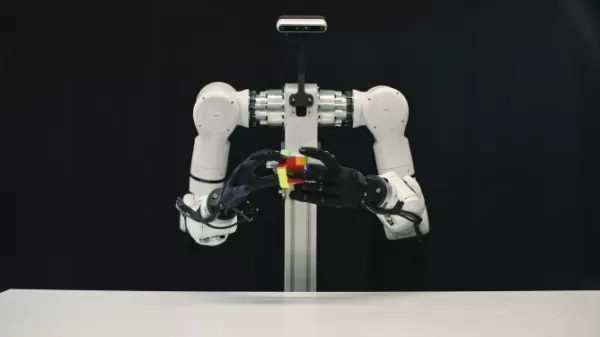 Khosla-backed Genesis AI Unveils Full-Stack Robotics Solution
Genesis AI, a startup that secured a $105 million seed round to develop foundational AI for robotics, has launched its inaugural model, GENE-26.5, featuring unexpectedly dexterous hands. In a demonstration video, the company highlighted various advan
Khosla-backed Genesis AI Unveils Full-Stack Robotics Solution
Genesis AI, a startup that secured a $105 million seed round to develop foundational AI for robotics, has launched its inaugural model, GENE-26.5, featuring unexpectedly dexterous hands. In a demonstration video, the company highlighted various advan
 Three AI pioneers argue for keeping big models open as safety worries grow
Initiatives like Pacing the Frontier aim to ensure AI safety by partnering with major labs, yet open-source models remain a contentious issue within the industry. Due to their free distribution and lack of usage control, open-weight models are diffic
Three AI pioneers argue for keeping big models open as safety worries grow
Initiatives like Pacing the Frontier aim to ensure AI safety by partnering with major labs, yet open-source models remain a contentious issue within the industry. Due to their free distribution and lack of usage control, open-weight models are diffic

2026 Latest Best Top-rated AI Text to Speech Tools for Online Courses are curated by XIX.AI based on rigorous real-world tests and weekly updated rankings. These powerful tools help creators deliver crystal-clear audio content effortlessly, boosting writing efficiency and streamlining course production. Check out the free vs paid comparison to find your perfect fit. Explore now to unlock your AI edge in online education.
10 tools
xix.ai

2026 Latest Best Top-Rated AI Blog Title Tools for Higher Click Through Rates! XIX.AI has carefully curated a powerful, game-changing collection of top tools that go through rigorous real-world tests. You’ll find a free vs paid comparison, weekly updated rankings, and detailed insights to help you boost your blog’s traffic efficiently. Must-try options are highlighted to help you unlock your AI edge. Explore now!
10 tools
xix.ai

2026 Latest Best Top-rated AI Task Routing Tools for Support Workflows! XIX.AI has curated a highly powerful game-changing collection of must-try solutions, all undergoing rigorous real-world tests and updated weekly. These tools streamline workflows, boost productivity, and help teams deliver faster, more efficient support. Explore now to discover your perfect tool and unlock your AI edge!
17 tools
xix.ai

2026 Latest Best Top-Rated AI Citation and Paper Summary Tools Curated by XIX.AI. Get powerful game-changing solutions for quick content creation, improved writing efficiency, and boosting productivity. We offer a free vs paid comparison along with real-world tests and weekly updated rankings to help you find the must-try tool that fits your needs perfectly. Explore now to Unlock your AI edge.
10 tools
xix.ai

2026 Latest Best Top-Rated AI Productivity Tools for Daily Work! XIX.AI has curated a powerful, game-changing selection based on rigorous weekly updated rankings and real-world tests. You’ll find must-try options that boost writing efficiency, streamline content creation, and help you overcome daily work challenges. Get a free vs paid comparison to find the perfect fit for your needs. Explore now to unlock your AI edge!
9 tools
xix.ai

2026 Latest Best Top-Rated AI Systematic Review Tools for Research Screening are here on XIX.AI! This curated collection includes powerful, game-changing solutions that go through rigorous real-world tests to deliver accurate results. We also offer a free vs paid comparison along with weekly updated rankings to help you find the must-try option that boosts your research efficiency significantly. Explore now to unlock your AI edge in academic work!
11 tools
xix.ai












