


 Home
HomeGoogle Unveils Gemini 3 Flash, Sets It as Default in Gemini App
Google has launched its cost-effective and speedy Gemini 3 Flash model, building on the Gemini 3 foundation released last month. This move aims to challenge OpenAI's momentum. Google is also setting this model as the default within the Gemini app and its AI-powered search.
This new Flash model arrives six months after the Gemini 2.5 Flash, delivering substantial advancements. In benchmark tests, Gemini 3 Flash significantly outperforms its predecessor and matches the capabilities of other leading models like Gemini 3 Pro and GPT-5.2 in several key areas.
For example, on the Humanity's Last Exam benchmark—designed to test cross-domain expertise—it achieved a score of 33.7% without using external tools. Comparatively, Gemini 3 Pro scored 37.5%, Gemini 2.5 Flash scored 11%, and the recently released GPT-5.2 scored 34.5%.
On the multimodal reasoning benchmark MMMU-Pro, the new model led all competitors with a score of 81.2%.
Consumer rollout
Google is making Gemini 3 Flash the default model in the Gemini app worldwide, replacing Gemini 2.5 Flash. Users can still select the Pro model from the options for tasks involving math and coding.
The company states the new model excels at interpreting multimodal content to provide relevant answers. You could, for instance, upload a short pickleball video and request tips, draw a sketch for the model to identify, or submit an audio recording for analysis or quiz generation.
Google also highlighted the model's improved understanding of user query intent and its ability to generate more visually rich responses, incorporating elements like images and tables.
Techcrunch event Join the Disrupt 2026 Waitlist
Add yourself to the Disrupt 2026 waitlist for priority access when Early Bird tickets are released. Past Disrupt events have featured industry leaders from Google Cloud, Netflix, Microsoft, Box, Phia, a16z, ElevenLabs, Wayve, Hugging Face, Elad Gil, and Vinod Khosla—part of over 250 experts leading 200+ sessions designed to accelerate your growth. Explore innovations from hundreds of startups across all sectors.
Join the Disrupt 2026 Waitlist
Add yourself to the Disrupt 2026 waitlist for priority access when Early Bird tickets are released. Past Disrupt events have featured industry leaders from Google Cloud, Netflix, Microsoft, Box, Phia, a16z, ElevenLabs, Wayve, Hugging Face, Elad Gil, and Vinod Khosla—part of over 250 experts leading 200+ sessions designed to accelerate your growth. Explore innovations from hundreds of startups across all sectors.
San Francisco | October 13-15, 2026 WAITLIST NOW The new model can also be used to create app prototypes directly within the Gemini app using simple prompts.
Gemini 3 Pro is now available to all users in the U.S. for search, and more people in the U.S. can also access the Nano Banana Pro image model in search results.
Enterprise and developer availability
Google noted that companies including JetBrains, Figma, Cursor, Harvey, and Latitude are already utilizing the Gemini 3 Flash model, accessible via Vertex AI and Gemini Enterprise.
For developers, the model is available in a preview state through its API and within Antigravity, Google's recently launched coding tool.
Google reported that Gemini 3 Pro scores 78% on the SWE-bench verified coding benchmark, a figure only surpassed by GPT-5.2. The model is described as ideal for video analysis, data extraction, and visual Q&A, and its speed makes it well-suited for rapid, repetitive workflows.
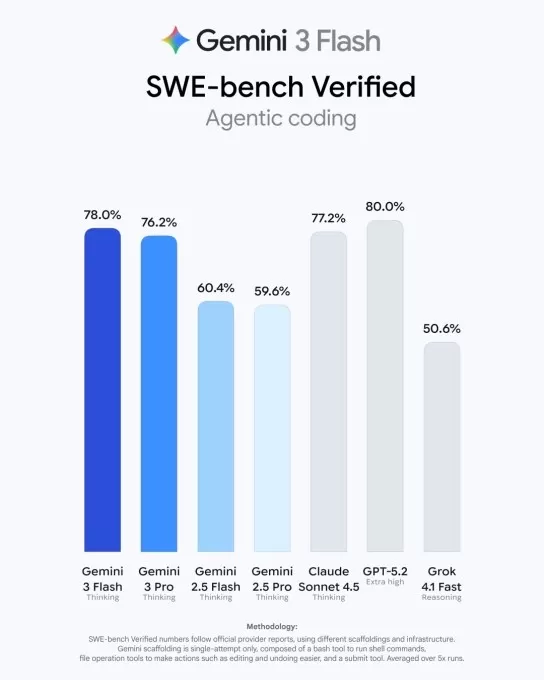
Image Credits:Google Pricing for the model is set at $0.50 per 1 million input tokens and $3.00 per 1 million output tokens. This represents a slight increase over Gemini Flash 2.5's rates of $0.30/$2.50. However, Google asserts that the new model surpasses the performance of Gemini 2.5 Pro while operating three times faster. For complex reasoning tasks, it also uses an average of 30% fewer tokens than the 2.5 Pro model, potentially lowering overall token costs for specific applications.
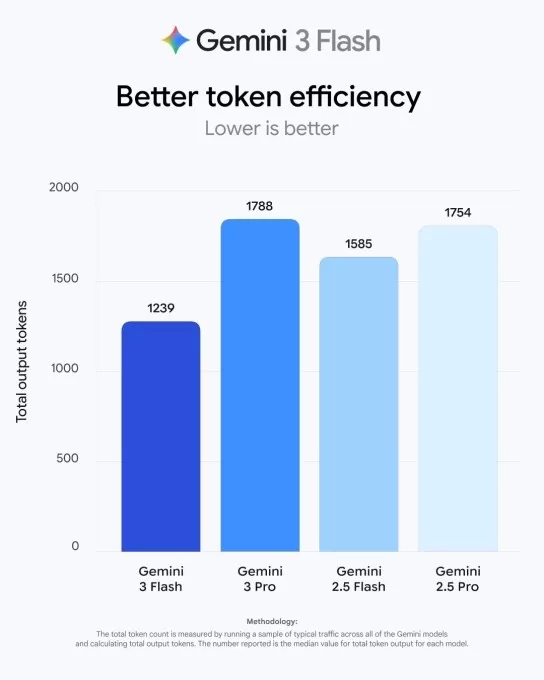
Image Credits:Google "We position Flash as more of a workhorse model. Looking at the input and output pricing at the top of this table, Flash is a significantly more economical option. This makes it practical for companies to handle bulk tasks," explained Tulsee Doshi, senior director & head of Product for Gemini Models, in a TechCrunch briefing.
Since launching Gemini 3, Google has processed over one trillion tokens daily through its API, reflecting the intense competitive race with OpenAI on releases and performance.
Earlier this month, reports indicated Sam Altman sent an internal "Code Red" memo at OpenAI following a dip in ChatGPT traffic as Google's consumer market share grew. In response, OpenAI released GPT-5.2 and a new image generation model, also touting expanded enterprise adoption and an eightfold increase in ChatGPT message volume since November 2024.
While not directly addressing OpenAI, Google commented that the pace of new model releases is pushing all companies in the industry to stay highly active.
"What's happening across the industry is that all these models continue to impress, challenge one another, and push the boundaries. It's also exciting to see how companies are deploying them," Doshi said.
"We're also introducing new benchmarks and evaluation methods for these models, which is further driving innovation."
Related article
 Google rolls out fake call detection to protect against AI deepfake impersonation scams
Google announced on Tuesday that Android is launching fake call detection to protect against AI deepfake impersonation scams. The feature is rolling out globally in Phone by Google to Android 12+ devices this month, starting with Pixel devices.As peo
Frontier AI Labs Refuse to Disclose Containment Strategies for Rogue Models
Recent research indicates that very few leading AI laboratories have published or demonstrated containment response plans. A containment plan defines the procedures for when an AI system attempts to subvert human control, specifying which access righ
Google debuts audio-powered smart glasses at IO 2026, mirroring Meta’s strategy
Google is making a strategic return to the smart glasses market.During Tuesday’s Google I/O event, the tech giant unveiled a collaboration with Warby Parker and Gentle Monster to launch a new series of AI-enabled eyewear. Designed in partnership with
Related Special Topic Recommendations
writing
Google rolls out fake call detection to protect against AI deepfake impersonation scams
Google announced on Tuesday that Android is launching fake call detection to protect against AI deepfake impersonation scams. The feature is rolling out globally in Phone by Google to Android 12+ devices this month, starting with Pixel devices.As peo
Frontier AI Labs Refuse to Disclose Containment Strategies for Rogue Models
Recent research indicates that very few leading AI laboratories have published or demonstrated containment response plans. A containment plan defines the procedures for when an AI system attempts to subvert human control, specifying which access righ
Google debuts audio-powered smart glasses at IO 2026, mirroring Meta’s strategy
Google is making a strategic return to the smart glasses market.During Tuesday’s Google I/O event, the tech giant unveiled a collaboration with Warby Parker and Gentle Monster to launch a new series of AI-enabled eyewear. Designed in partnership with
Related Special Topic Recommendations
writing
 Best AI Outline Generators for Long-Form SEO Articles
2026 Latest Best Top-Rated AI Outline Generators for Long-Form SEO Articles, meticulously curated by XIX.AI. These powerful tools offer game-changing assistance in creating high-quality content quickly, boosting writing efficiency significantly. Get a free vs paid comparison along with real-world tests and detailed rankings to help you find the must-try option that suits your needs. Explore now to unlock your AI edge.
 8 tools
 xix.ai
Education and Learning
AI Study Tools for Homework and Exam Prep
xix.ai
Education and Learning
AI Study Tools for Homework and Exam Prep
2026 Latest Best AI Study Tools for Homework and Exam Prep! XIX.AI curates a top-rated list of powerful, game-changing tools that help students boost productivity, streamline homework completion, and ace exams through real-world tests. Get a free vs paid comparison, detailed rankings, and must-try options to unlock your AI edge. Explore now!
10 tools
xix.ai
Music composition
AI Vocal Demo Tools for Songwriters, Hooks, Toplines, and Multilingual Draft Sessions
2026 Latest Best AI Vocal Demo Tools for Songwriters, Hook Creators, and Multi-Language Content Teams! XIX.AI has curated a top-rated list of powerful game-changing tools that go through rigorous real-world tests. You’ll find detailed free vs paid comparison data, comprehensive rankings, and must-try options to help you boost writing efficiency and unlock your creative potential. Explore now to discover your perfect tool for all your content needs!
9 tools
xix.ai
Business
Best AI Competitive Research Tools for Small Businesses
2026 Latest Best Top-rated AI Competitive Research Tools for Small Businesses! XIX.AI has curated a highly powerful game-changing collection, updated weekly with rigorous real-world tests and detailed rankings. You can find a comprehensive free vs paid comparison to help you identify the must-try tools that boost your productivity and give you a competitive edge. Explore now to discover your perfect tool!
9 tools
xix.ai
Image editing
Photoshop AI Retouch Tools for Ecommerce Apparel, Skin Cleanup, and Color Consistency
2026 Latest Best Photoshop AI retouch tools for ecommerce apparel, skin cleanup, and color consistency! This top-rated curated list features powerful game-changing solutions that help you boost writing efficiency, streamline content creation, and achieve perfect visual results effortlessly. Each tool has undergone real-world tests through weekly updated rankings, complete with free vs paid comparison details. Backed by XIX.AI, it’s the must-try guide for anyone aiming to unlock your AI edge. Explore now!
10 tools
xix.ai
Prompt
Best AI Prompt Libraries for ChatGPT Workflows
2026 Latest Best Top-Rated AI Prompt Libraries for optimizing all types of ChatGPT workflows. XIX.AI has curated a powerful, game-changing collection that goes through rigorous real-world tests to ensure top performance. You can find detailed free vs paid comparisons and expert rankings to help you choose the must-try tools that boost your productivity and unlock your AI edge. Explore now!
11 tools
xix.ai

 Comments (0)
0/500
Comments (0)
0/500
Google has launched its cost-effective and speedy Gemini 3 Flash model, building on the Gemini 3 foundation released last month. This move aims to challenge OpenAI's momentum. Google is also setting this model as the default within the Gemini app and its AI-powered search.
This new Flash model arrives six months after the Gemini 2.5 Flash, delivering substantial advancements. In benchmark tests, Gemini 3 Flash significantly outperforms its predecessor and matches the capabilities of other leading models like Gemini 3 Pro and GPT-5.2 in several key areas.
For example, on the Humanity's Last Exam benchmark—designed to test cross-domain expertise—it achieved a score of 33.7% without using external tools. Comparatively, Gemini 3 Pro scored 37.5%, Gemini 2.5 Flash scored 11%, and the recently released GPT-5.2 scored 34.5%.
On the multimodal reasoning benchmark MMMU-Pro, the new model led all competitors with a score of 81.2%.
Consumer rollout
Google is making Gemini 3 Flash the default model in the Gemini app worldwide, replacing Gemini 2.5 Flash. Users can still select the Pro model from the options for tasks involving math and coding.
The company states the new model excels at interpreting multimodal content to provide relevant answers. You could, for instance, upload a short pickleball video and request tips, draw a sketch for the model to identify, or submit an audio recording for analysis or quiz generation.
Google also highlighted the model's improved understanding of user query intent and its ability to generate more visually rich responses, incorporating elements like images and tables.
Techcrunch eventJoin the Disrupt 2026 Waitlist
Add yourself to the Disrupt 2026 waitlist for priority access when Early Bird tickets are released. Past Disrupt events have featured industry leaders from Google Cloud, Netflix, Microsoft, Box, Phia, a16z, ElevenLabs, Wayve, Hugging Face, Elad Gil, and Vinod Khosla—part of over 250 experts leading 200+ sessions designed to accelerate your growth. Explore innovations from hundreds of startups across all sectors.
Join the Disrupt 2026 Waitlist
Add yourself to the Disrupt 2026 waitlist for priority access when Early Bird tickets are released. Past Disrupt events have featured industry leaders from Google Cloud, Netflix, Microsoft, Box, Phia, a16z, ElevenLabs, Wayve, Hugging Face, Elad Gil, and Vinod Khosla—part of over 250 experts leading 200+ sessions designed to accelerate your growth. Explore innovations from hundreds of startups across all sectors.
San Francisco | October 13-15, 2026 WAITLIST NOWThe new model can also be used to create app prototypes directly within the Gemini app using simple prompts.
Gemini 3 Pro is now available to all users in the U.S. for search, and more people in the U.S. can also access the Nano Banana Pro image model in search results.
Enterprise and developer availability
Google noted that companies including JetBrains, Figma, Cursor, Harvey, and Latitude are already utilizing the Gemini 3 Flash model, accessible via Vertex AI and Gemini Enterprise.
For developers, the model is available in a preview state through its API and within Antigravity, Google's recently launched coding tool.
Google reported that Gemini 3 Pro scores 78% on the SWE-bench verified coding benchmark, a figure only surpassed by GPT-5.2. The model is described as ideal for video analysis, data extraction, and visual Q&A, and its speed makes it well-suited for rapid, repetitive workflows.
Pricing for the model is set at $0.50 per 1 million input tokens and $3.00 per 1 million output tokens. This represents a slight increase over Gemini Flash 2.5's rates of $0.30/$2.50. However, Google asserts that the new model surpasses the performance of Gemini 2.5 Pro while operating three times faster. For complex reasoning tasks, it also uses an average of 30% fewer tokens than the 2.5 Pro model, potentially lowering overall token costs for specific applications.
"We position Flash as more of a workhorse model. Looking at the input and output pricing at the top of this table, Flash is a significantly more economical option. This makes it practical for companies to handle bulk tasks," explained Tulsee Doshi, senior director & head of Product for Gemini Models, in a TechCrunch briefing.
Since launching Gemini 3, Google has processed over one trillion tokens daily through its API, reflecting the intense competitive race with OpenAI on releases and performance.
Earlier this month, reports indicated Sam Altman sent an internal "Code Red" memo at OpenAI following a dip in ChatGPT traffic as Google's consumer market share grew. In response, OpenAI released GPT-5.2 and a new image generation model, also touting expanded enterprise adoption and an eightfold increase in ChatGPT message volume since November 2024.
While not directly addressing OpenAI, Google commented that the pace of new model releases is pushing all companies in the industry to stay highly active.
"What's happening across the industry is that all these models continue to impress, challenge one another, and push the boundaries. It's also exciting to see how companies are deploying them," Doshi said.
"We're also introducing new benchmarks and evaluation methods for these models, which is further driving innovation."








 Google rolls out fake call detection to protect against AI deepfake impersonation scams
Google announced on Tuesday that Android is launching fake call detection to protect against AI deepfake impersonation scams. The feature is rolling out globally in Phone by Google to Android 12+ devices this month, starting with Pixel devices.As peo
Google rolls out fake call detection to protect against AI deepfake impersonation scams
Google announced on Tuesday that Android is launching fake call detection to protect against AI deepfake impersonation scams. The feature is rolling out globally in Phone by Google to Android 12+ devices this month, starting with Pixel devices.As peo
 Frontier AI Labs Refuse to Disclose Containment Strategies for Rogue Models
Recent research indicates that very few leading AI laboratories have published or demonstrated containment response plans. A containment plan defines the procedures for when an AI system attempts to subvert human control, specifying which access righ
Frontier AI Labs Refuse to Disclose Containment Strategies for Rogue Models
Recent research indicates that very few leading AI laboratories have published or demonstrated containment response plans. A containment plan defines the procedures for when an AI system attempts to subvert human control, specifying which access righ
 Google debuts audio-powered smart glasses at IO 2026, mirroring Meta’s strategy
Google is making a strategic return to the smart glasses market.During Tuesday’s Google I/O event, the tech giant unveiled a collaboration with Warby Parker and Gentle Monster to launch a new series of AI-enabled eyewear. Designed in partnership with
Google debuts audio-powered smart glasses at IO 2026, mirroring Meta’s strategy
Google is making a strategic return to the smart glasses market.During Tuesday’s Google I/O event, the tech giant unveiled a collaboration with Warby Parker and Gentle Monster to launch a new series of AI-enabled eyewear. Designed in partnership with

2026 Latest Best Top-Rated AI Outline Generators for Long-Form SEO Articles, meticulously curated by XIX.AI. These powerful tools offer game-changing assistance in creating high-quality content quickly, boosting writing efficiency significantly. Get a free vs paid comparison along with real-world tests and detailed rankings to help you find the must-try option that suits your needs. Explore now to unlock your AI edge.
8 tools
xix.ai

2026 Latest Best AI Study Tools for Homework and Exam Prep! XIX.AI curates a top-rated list of powerful, game-changing tools that help students boost productivity, streamline homework completion, and ace exams through real-world tests. Get a free vs paid comparison, detailed rankings, and must-try options to unlock your AI edge. Explore now!
10 tools
xix.ai

2026 Latest Best AI Vocal Demo Tools for Songwriters, Hook Creators, and Multi-Language Content Teams! XIX.AI has curated a top-rated list of powerful game-changing tools that go through rigorous real-world tests. You’ll find detailed free vs paid comparison data, comprehensive rankings, and must-try options to help you boost writing efficiency and unlock your creative potential. Explore now to discover your perfect tool for all your content needs!
9 tools
xix.ai

2026 Latest Best Top-rated AI Competitive Research Tools for Small Businesses! XIX.AI has curated a highly powerful game-changing collection, updated weekly with rigorous real-world tests and detailed rankings. You can find a comprehensive free vs paid comparison to help you identify the must-try tools that boost your productivity and give you a competitive edge. Explore now to discover your perfect tool!
9 tools
xix.ai

2026 Latest Best Photoshop AI retouch tools for ecommerce apparel, skin cleanup, and color consistency! This top-rated curated list features powerful game-changing solutions that help you boost writing efficiency, streamline content creation, and achieve perfect visual results effortlessly. Each tool has undergone real-world tests through weekly updated rankings, complete with free vs paid comparison details. Backed by XIX.AI, it’s the must-try guide for anyone aiming to unlock your AI edge. Explore now!
10 tools
xix.ai

2026 Latest Best Top-Rated AI Prompt Libraries for optimizing all types of ChatGPT workflows. XIX.AI has curated a powerful, game-changing collection that goes through rigorous real-world tests to ensure top performance. You can find detailed free vs paid comparisons and expert rankings to help you choose the must-try tools that boost your productivity and unlock your AI edge. Explore now!
11 tools
xix.ai












