


 Home
HomeGoogle Gemma 4 Released as Open Source, Rivaling Top Models with 31B Parameters
At 4:03 AM on April 3, Google DeepMind officially launched its new open-source model series, Gemma4. This release marks exactly one year since the previous version. Google not only achieved a "generational leap" in performance but also made a significant move in its open-source commitment: switching the license from its own proprietary agreement to the widely adopted Apache 2.0. This change allows developers to freely use and modify the models for commercial purposes.
Complete Lineup: Four Models for Mobile to Workstation
Gemma4 launches with four distinct models to cover all scenarios:
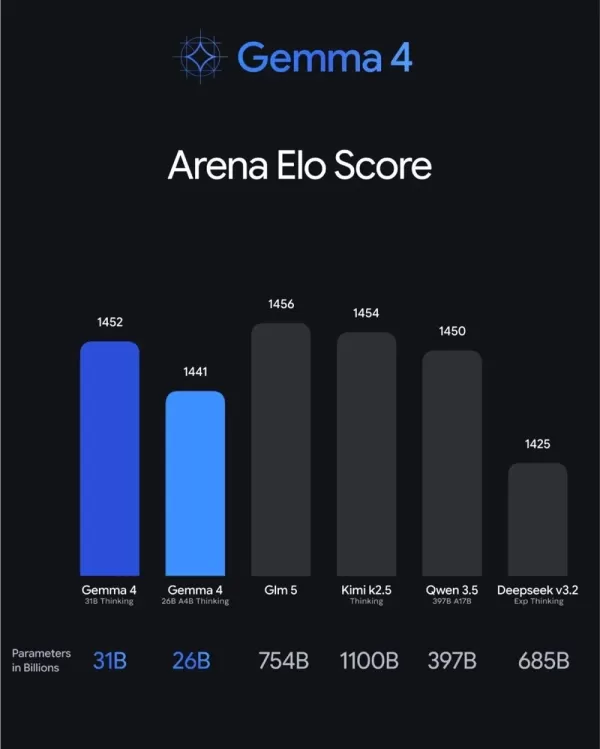
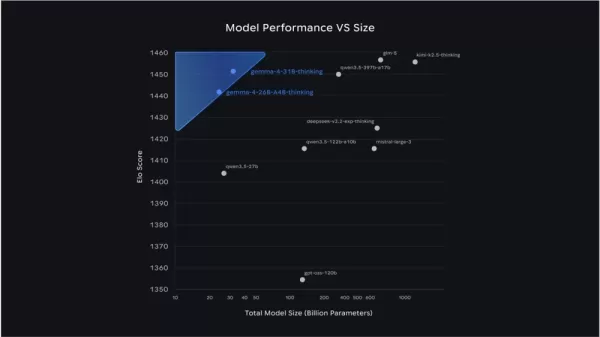
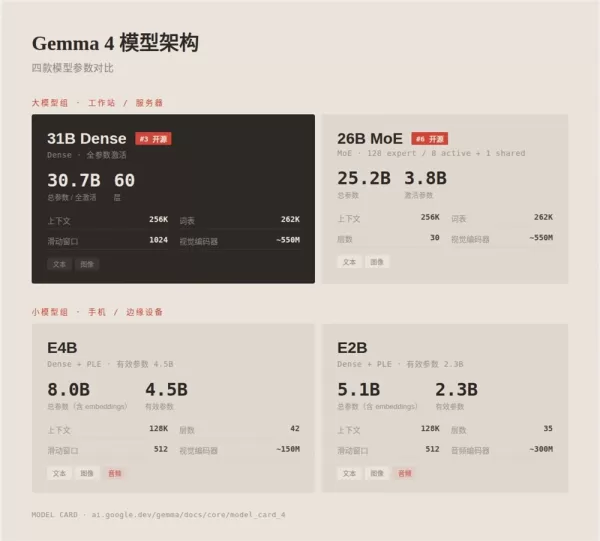
31B Dense (Flagship): Features 31 billion fully activated parameters and supports an ultra-long 256K context. It ranks third on the Arena AI open-source leaderboard. The unquantized version can run on a single H100 GPU.
26B A4B MoE (Value Leader): Utilizes a Mixture-of-Experts architecture with 25.2 billion total parameters, of which only 3.8 billion are activated per inference. Its reasoning speed is comparable to a 4B model, yet its quality surpasses similar offerings, securing sixth place on the leaderboard.
E4B & E2B (Edge Elite): Optimized for mobile and embedded devices. Using Per-Layer Embeddings technology, effective parameters are compressed to 4.5 billion and 2.3 billion, respectively. The E2B model can reduce memory usage to under 1.5GB on certain devices.
Performance Leap: Code and Math Capabilities See Major Gains
Compared to the previous generation Gemma327B, Gemma4 shows dramatic improvements in core benchmarks:
Math Competitions: Scores on the AIME2026 test surged from 20.8% to 89.2%.
Programming Prowess: Its Codeforces ELO rating increased from 110 to 2150. On LiveCodeBench, performance rose from 29.1% to 80.0%, making it one of the most capable open-source programming assistants available.
Comprehensive Reasoning: Scores on graduate-level science questions (GPQA Diamond) nearly doubled, jumping from 42.4% to 84.3%.
Multilingual Ability: Natively supports over 140 languages, achieving an 88.4% score on MMMLU.
Core Features: Built-in "Thinking Mode" and Agent Capabilities
Gemma4 isn't just about more parameters; it aligns its interaction logic with the flagship Gemini models:
Thinking Mode: Includes an internal reasoning mode that allows the model to process multi-step plans before delivering an answer, significantly improving accuracy on complex tasks.
Native Agent Support: Supports function calling and structured JSON output. Google simultaneously released an open-source Agent Development Kit (ADK), enabling on-device models to act as "intelligent agents."
Deep Multimodal: All versions support image and video input. Even the smaller models include an additional audio encoder for speech recognition and translation.
Industry Perspective: A "Power Reorganization" in Open Source
Over the past year, domestic open-source models (like DeepSeek, Qwen, and GLM) have evolved rapidly, somewhat diminishing Google's influence in the open-source arena. The release of Gemma4 signals Google's return to the forefront through "extreme edge-side engineering" and "more thorough licensing openness."
Conclusion: When Tech Giants Start Talking "Sincerity"
Related article
 ByteDance Boosts Core AI Incentives as Doubao Surges 14.6%
ByteDance recently convened a DouBao equity briefing to unveil fresh incentive policies for staff involved in the DouBao division. The strike price for DouBao shares has been lifted from $14.85 in June 2026 to $17.02, marking an approximate 14.6% inc
MiniMax Unveils 10x Team Program to Incentivize Global AI Experts
MiniMax (Xiyu Technology), the General Artificial Intelligence Lab, has officially launched "10x Team," a global talent collaboration initiative. This program aims to recruit top experts across industries to explore the deep application of large mode
South Korea Breaks Ground on National AI Computing Center, Investing 2.5 Trillion Won with 2028 Target
South Korean outlet EtNews reports that groundbreaking for the Korea AI Computing Center (KOACC) took place on August 3 at the Solar City data center park in Sunan, Jeollanam-do. Backed by a total investment of 2.5 trillion KRW (roughly 11.838 billio
Related Special Topic Recommendations
Education and Learning
ByteDance Boosts Core AI Incentives as Doubao Surges 14.6%
ByteDance recently convened a DouBao equity briefing to unveil fresh incentive policies for staff involved in the DouBao division. The strike price for DouBao shares has been lifted from $14.85 in June 2026 to $17.02, marking an approximate 14.6% inc
MiniMax Unveils 10x Team Program to Incentivize Global AI Experts
MiniMax (Xiyu Technology), the General Artificial Intelligence Lab, has officially launched "10x Team," a global talent collaboration initiative. This program aims to recruit top experts across industries to explore the deep application of large mode
South Korea Breaks Ground on National AI Computing Center, Investing 2.5 Trillion Won with 2028 Target
South Korean outlet EtNews reports that groundbreaking for the Korea AI Computing Center (KOACC) took place on August 3 at the Solar City data center park in Sunan, Jeollanam-do. Backed by a total investment of 2.5 trillion KRW (roughly 11.838 billio
Related Special Topic Recommendations
Education and Learning
 AI Study Tools for Homework and Exam Prep
2026 Latest Best AI Study Tools for Homework and Exam Prep! XIX.AI curates a top-rated list of powerful, game-changing tools that help students boost productivity, streamline homework completion, and ace exams through real-world tests. Get a free vs paid comparison, detailed rankings, and must-try options to unlock your AI edge. Explore now!
 10 tools
 xix.ai
Music composition
AI Vocal Demo Tools for Songwriters, Hooks, Toplines, and Multilingual Draft Sessions
xix.ai
Music composition
AI Vocal Demo Tools for Songwriters, Hooks, Toplines, and Multilingual Draft Sessions
2026 Latest Best AI Vocal Demo Tools for Songwriters, Hook Creators, and Multi-Language Content Teams! XIX.AI has curated a top-rated list of powerful game-changing tools that go through rigorous real-world tests. You’ll find detailed free vs paid comparison data, comprehensive rankings, and must-try options to help you boost writing efficiency and unlock your creative potential. Explore now to discover your perfect tool for all your content needs!
9 tools
xix.ai
Business
Best AI Competitive Research Tools for Small Businesses
2026 Latest Best Top-rated AI Competitive Research Tools for Small Businesses! XIX.AI has curated a highly powerful game-changing collection, updated weekly with rigorous real-world tests and detailed rankings. You can find a comprehensive free vs paid comparison to help you identify the must-try tools that boost your productivity and give you a competitive edge. Explore now to discover your perfect tool!
9 tools
xix.ai
Image editing
Photoshop AI Retouch Tools for Ecommerce Apparel, Skin Cleanup, and Color Consistency
2026 Latest Best Photoshop AI retouch tools for ecommerce apparel, skin cleanup, and color consistency! This top-rated curated list features powerful game-changing solutions that help you boost writing efficiency, streamline content creation, and achieve perfect visual results effortlessly. Each tool has undergone real-world tests through weekly updated rankings, complete with free vs paid comparison details. Backed by XIX.AI, it’s the must-try guide for anyone aiming to unlock your AI edge. Explore now!
10 tools
xix.ai
Prompt
Best AI Prompt Libraries for ChatGPT Workflows
2026 Latest Best Top-Rated AI Prompt Libraries for optimizing all types of ChatGPT workflows. XIX.AI has curated a powerful, game-changing collection that goes through rigorous real-world tests to ensure top performance. You can find detailed free vs paid comparisons and expert rankings to help you choose the must-try tools that boost your productivity and unlock your AI edge. Explore now!
11 tools
xix.ai
Education and Learning
AI Quiz Builder Platforms for Teachers, Tutors, and Cohort-Based Learning Programs
2026 Latest Best AI Quiz Builder Platforms for Teachers, Tutors, and Cohort-Based Learning Programs! XIX.AI has curated a top-rated list of powerful game-changing tools that go through real-world tests to deliver accurate rankings. These must-try platforms help boost writing efficiency, streamline content creation, and simplify quiz design across all learning scenarios. Explore now to discover your perfect tool for unlocking your AI edge in teaching!
13 tools
xix.ai

 Comments (0)
0/500
Comments (0)
0/500
At 4:03 AM on April 3, Google DeepMind officially launched its new open-source model series, Gemma4. This release marks exactly one year since the previous version. Google not only achieved a "generational leap" in performance but also made a significant move in its open-source commitment: switching the license from its own proprietary agreement to the widely adopted Apache 2.0. This change allows developers to freely use and modify the models for commercial purposes.
Complete Lineup: Four Models for Mobile to Workstation
Gemma4 launches with four distinct models to cover all scenarios:
31B Dense (Flagship): Features 31 billion fully activated parameters and supports an ultra-long 256K context. It ranks third on the Arena AI open-source leaderboard. The unquantized version can run on a single H100 GPU.
26B A4B MoE (Value Leader): Utilizes a Mixture-of-Experts architecture with 25.2 billion total parameters, of which only 3.8 billion are activated per inference. Its reasoning speed is comparable to a 4B model, yet its quality surpasses similar offerings, securing sixth place on the leaderboard.
E4B & E2B (Edge Elite): Optimized for mobile and embedded devices. Using Per-Layer Embeddings technology, effective parameters are compressed to 4.5 billion and 2.3 billion, respectively. The E2B model can reduce memory usage to under 1.5GB on certain devices.
Performance Leap: Code and Math Capabilities See Major Gains
Compared to the previous generation Gemma327B, Gemma4 shows dramatic improvements in core benchmarks:
Math Competitions: Scores on the AIME2026 test surged from 20.8% to 89.2%.
Programming Prowess: Its Codeforces ELO rating increased from 110 to 2150. On LiveCodeBench, performance rose from 29.1% to 80.0%, making it one of the most capable open-source programming assistants available.
Comprehensive Reasoning: Scores on graduate-level science questions (GPQA Diamond) nearly doubled, jumping from 42.4% to 84.3%.
Multilingual Ability: Natively supports over 140 languages, achieving an 88.4% score on MMMLU.
Core Features: Built-in "Thinking Mode" and Agent Capabilities
Gemma4 isn't just about more parameters; it aligns its interaction logic with the flagship Gemini models:
Thinking Mode: Includes an internal reasoning mode that allows the model to process multi-step plans before delivering an answer, significantly improving accuracy on complex tasks.
Native Agent Support: Supports function calling and structured JSON output. Google simultaneously released an open-source Agent Development Kit (ADK), enabling on-device models to act as "intelligent agents."
Deep Multimodal: All versions support image and video input. Even the smaller models include an additional audio encoder for speech recognition and translation.
Industry Perspective: A "Power Reorganization" in Open Source
Over the past year, domestic open-source models (like DeepSeek, Qwen, and GLM) have evolved rapidly, somewhat diminishing Google's influence in the open-source arena. The release of Gemma4 signals Google's return to the forefront through "extreme edge-side engineering" and "more thorough licensing openness."
Conclusion: When Tech Giants Start Talking "Sincerity"








 ByteDance Boosts Core AI Incentives as Doubao Surges 14.6%
ByteDance recently convened a DouBao equity briefing to unveil fresh incentive policies for staff involved in the DouBao division. The strike price for DouBao shares has been lifted from $14.85 in June 2026 to $17.02, marking an approximate 14.6% inc
ByteDance Boosts Core AI Incentives as Doubao Surges 14.6%
ByteDance recently convened a DouBao equity briefing to unveil fresh incentive policies for staff involved in the DouBao division. The strike price for DouBao shares has been lifted from $14.85 in June 2026 to $17.02, marking an approximate 14.6% inc
 MiniMax Unveils 10x Team Program to Incentivize Global AI Experts
MiniMax (Xiyu Technology), the General Artificial Intelligence Lab, has officially launched "10x Team," a global talent collaboration initiative. This program aims to recruit top experts across industries to explore the deep application of large mode
MiniMax Unveils 10x Team Program to Incentivize Global AI Experts
MiniMax (Xiyu Technology), the General Artificial Intelligence Lab, has officially launched "10x Team," a global talent collaboration initiative. This program aims to recruit top experts across industries to explore the deep application of large mode
 South Korea Breaks Ground on National AI Computing Center, Investing 2.5 Trillion Won with 2028 Target
South Korean outlet EtNews reports that groundbreaking for the Korea AI Computing Center (KOACC) took place on August 3 at the Solar City data center park in Sunan, Jeollanam-do. Backed by a total investment of 2.5 trillion KRW (roughly 11.838 billio
South Korea Breaks Ground on National AI Computing Center, Investing 2.5 Trillion Won with 2028 Target
South Korean outlet EtNews reports that groundbreaking for the Korea AI Computing Center (KOACC) took place on August 3 at the Solar City data center park in Sunan, Jeollanam-do. Backed by a total investment of 2.5 trillion KRW (roughly 11.838 billio

2026 Latest Best AI Study Tools for Homework and Exam Prep! XIX.AI curates a top-rated list of powerful, game-changing tools that help students boost productivity, streamline homework completion, and ace exams through real-world tests. Get a free vs paid comparison, detailed rankings, and must-try options to unlock your AI edge. Explore now!
10 tools
xix.ai

2026 Latest Best AI Vocal Demo Tools for Songwriters, Hook Creators, and Multi-Language Content Teams! XIX.AI has curated a top-rated list of powerful game-changing tools that go through rigorous real-world tests. You’ll find detailed free vs paid comparison data, comprehensive rankings, and must-try options to help you boost writing efficiency and unlock your creative potential. Explore now to discover your perfect tool for all your content needs!
9 tools
xix.ai

2026 Latest Best Top-rated AI Competitive Research Tools for Small Businesses! XIX.AI has curated a highly powerful game-changing collection, updated weekly with rigorous real-world tests and detailed rankings. You can find a comprehensive free vs paid comparison to help you identify the must-try tools that boost your productivity and give you a competitive edge. Explore now to discover your perfect tool!
9 tools
xix.ai

2026 Latest Best Photoshop AI retouch tools for ecommerce apparel, skin cleanup, and color consistency! This top-rated curated list features powerful game-changing solutions that help you boost writing efficiency, streamline content creation, and achieve perfect visual results effortlessly. Each tool has undergone real-world tests through weekly updated rankings, complete with free vs paid comparison details. Backed by XIX.AI, it’s the must-try guide for anyone aiming to unlock your AI edge. Explore now!
10 tools
xix.ai

2026 Latest Best Top-Rated AI Prompt Libraries for optimizing all types of ChatGPT workflows. XIX.AI has curated a powerful, game-changing collection that goes through rigorous real-world tests to ensure top performance. You can find detailed free vs paid comparisons and expert rankings to help you choose the must-try tools that boost your productivity and unlock your AI edge. Explore now!
11 tools
xix.ai

2026 Latest Best AI Quiz Builder Platforms for Teachers, Tutors, and Cohort-Based Learning Programs! XIX.AI has curated a top-rated list of powerful game-changing tools that go through real-world tests to deliver accurate rankings. These must-try platforms help boost writing efficiency, streamline content creation, and simplify quiz design across all learning scenarios. Explore now to discover your perfect tool for unlocking your AI edge in teaching!
13 tools
xix.ai












