


 Home
HomeBond uses AI to help users break their doomscrolling habit
Traditional social media platforms were designed to keep users glued to their devices, endlessly scrolling through eye-straining feeds of memes and low-quality videos, all to create more engaging spaces for ads. In recent years, however, a growing number of companies have capitalized on user burnout by promoting real-world experiences or removing addictive features like infinite scroll.
Bond, which officially launched on Tuesday, is one such platform. Co-founder and CEO Dino Becirovic says the site offers an AI-powered solution to America's screen addiction.
Here's how it works: much like a standard social network, users post about their recent activities. Bond allows them to update their profiles with what it calls "memories" through photos, videos, and audio files.
Unlike other platforms, Bond is designed to act as an idea generator for what users should do in the real world.
Experiences stored in Bond feed its AI system, which learns to provide personalized, event-based recommendations, according to Becirovic.
For example, if you frequently post about loving pho and craving it, Bond might recommend a nearby Vietnamese restaurant with good reviews. Or if you're into heavy metal, it could alert you that Iron Maiden is playing in your city next week.
The more you share your experiences, the better the system's recommendations become, Becirovic says.
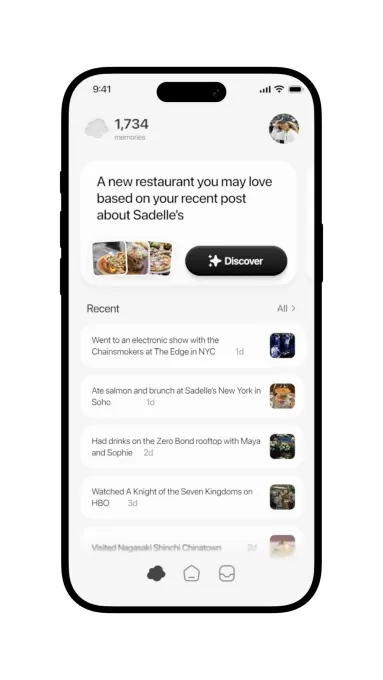
Image Credits:Bond
The layout resembles Instagram, but without a traditional feed. Instead, user profiles are displayed in a cluster format. Clicking a profile reveals the user's current stories, which disappear from the public profile after 24 hours, Becirovic said, but remain stored in a private archive. Users can search their memory archive anytime.
Bond's team includes people who previously built major social media apps like TikTok, Twitter, and Facebook, the company says. Becirovic previously worked at Kleiner Perkins and Index Ventures, while founding researcher Arthur Bražinskas co-led user signal integration at Google Gemini.
What's the revenue path for a company like this? Most social media platforms are essentially giant ad vehicles, generating the bulk of their revenue from advertising. Bond has no ads, so how will it make money?
Interestingly, Becirovic envisions a future where users can license their data from Bond's archives to companies for AI training. In this model, Bond would take a small licensing fee, creating ongoing revenue and positioning itself as a data provider for AI companies refining their models.
"The idea behind this licensing model is that you can monetize your memories," he said. "If we become a platform with the right incentive structure to get billions of people to share about their daily lives, we'll naturally become a very attractive place for training GPT‑6, GPT‑7, and all the variants that will come in the future."

Processed with DarkroomImage Credits:Bond
In another scenario, Bond would use its accumulated data as a product recommendation tool integrated with e‑commerce sites. "Our users would opt into this experience. If we are able to do this, we believe we could capture some value from the transaction with merchants by enabling a better user experience, driving conversion, and/or increasing throughput," Becirovic told TechCrunch in an email.
Becirovic said Bond would never sell user data for advertising purposes, and users can "delete any memories by either deleting them in the Memory tab or using natural language in Memory chat." He added: "Users can also delete their profile if they are not getting value from Bond. As the product grows, we will introduce more privacy control features to our users for them to manage their data."
Becirovic said Bond will improve its encryption over time, though he was somewhat vague about the platform's current protections: "E2EE encryption is a priority for us in the near future after launch. In the meantime, we store all user data securely in our database and ensure it is protected," he said.
For now, Becirovic seems primarily focused on making Bond appealing. "Monetization is not a short-term priority," he said. "Our initial focus is on creating an application where users get more value the more they capture their memories."
Related article
 Google Tests Remy AI Agent for Gemini as Focus Shifts to User Control
According to Business Insider, Google is testing Remy, a new AI personal agent for Gemini. This tool aims to execute tasks on behalf of users, streamlining both professional workflows and daily routines.Currently, Remy is undergoing testing in an int
Ollie bets privacy focus to win AI assistant race
To be genuinely helpful, an AI assistant must understand its user deeply. Ollie, a personal assistant designed for daily life, operates on the premise that this doesn’t require surrendering your data or compromising your privacy.While certain enterpr
How AI LIVE: London Will Explore AI & Industrial Automation
The summit will convene C-suite executives from around the globe to address pressing challenges in global industries, ranging from AI-driven disruption to economic volatility.AI LIVE: The London Summit will gather over 2,000 international leaders und
Related Special Topic Recommendations
writing
Google Tests Remy AI Agent for Gemini as Focus Shifts to User Control
According to Business Insider, Google is testing Remy, a new AI personal agent for Gemini. This tool aims to execute tasks on behalf of users, streamlining both professional workflows and daily routines.Currently, Remy is undergoing testing in an int
Ollie bets privacy focus to win AI assistant race
To be genuinely helpful, an AI assistant must understand its user deeply. Ollie, a personal assistant designed for daily life, operates on the premise that this doesn’t require surrendering your data or compromising your privacy.While certain enterpr
How AI LIVE: London Will Explore AI & Industrial Automation
The summit will convene C-suite executives from around the globe to address pressing challenges in global industries, ranging from AI-driven disruption to economic volatility.AI LIVE: The London Summit will gather over 2,000 international leaders und
Related Special Topic Recommendations
writing
 Best AI Outline Generators for Long-Form SEO Articles
2026 Latest Best Top-Rated AI Outline Generators for Long-Form SEO Articles, meticulously curated by XIX.AI. These powerful tools offer game-changing assistance in creating high-quality content quickly, boosting writing efficiency significantly. Get a free vs paid comparison along with real-world tests and detailed rankings to help you find the must-try option that suits your needs. Explore now to unlock your AI edge.
 8 tools
 xix.ai
Education and Learning
AI Study Tools for Homework and Exam Prep
xix.ai
Education and Learning
AI Study Tools for Homework and Exam Prep
2026 Latest Best AI Study Tools for Homework and Exam Prep! XIX.AI curates a top-rated list of powerful, game-changing tools that help students boost productivity, streamline homework completion, and ace exams through real-world tests. Get a free vs paid comparison, detailed rankings, and must-try options to unlock your AI edge. Explore now!
10 tools
xix.ai
Music composition
AI Vocal Demo Tools for Songwriters, Hooks, Toplines, and Multilingual Draft Sessions
2026 Latest Best AI Vocal Demo Tools for Songwriters, Hook Creators, and Multi-Language Content Teams! XIX.AI has curated a top-rated list of powerful game-changing tools that go through rigorous real-world tests. You’ll find detailed free vs paid comparison data, comprehensive rankings, and must-try options to help you boost writing efficiency and unlock your creative potential. Explore now to discover your perfect tool for all your content needs!
9 tools
xix.ai
Business
Best AI Competitive Research Tools for Small Businesses
2026 Latest Best Top-rated AI Competitive Research Tools for Small Businesses! XIX.AI has curated a highly powerful game-changing collection, updated weekly with rigorous real-world tests and detailed rankings. You can find a comprehensive free vs paid comparison to help you identify the must-try tools that boost your productivity and give you a competitive edge. Explore now to discover your perfect tool!
9 tools
xix.ai
Image editing
Photoshop AI Retouch Tools for Ecommerce Apparel, Skin Cleanup, and Color Consistency
2026 Latest Best Photoshop AI retouch tools for ecommerce apparel, skin cleanup, and color consistency! This top-rated curated list features powerful game-changing solutions that help you boost writing efficiency, streamline content creation, and achieve perfect visual results effortlessly. Each tool has undergone real-world tests through weekly updated rankings, complete with free vs paid comparison details. Backed by XIX.AI, it’s the must-try guide for anyone aiming to unlock your AI edge. Explore now!
10 tools
xix.ai
Prompt
Best AI Prompt Libraries for ChatGPT Workflows
2026 Latest Best Top-Rated AI Prompt Libraries for optimizing all types of ChatGPT workflows. XIX.AI has curated a powerful, game-changing collection that goes through rigorous real-world tests to ensure top performance. You can find detailed free vs paid comparisons and expert rankings to help you choose the must-try tools that boost your productivity and unlock your AI edge. Explore now!
11 tools
xix.ai

 Comments (0)
0/500
Comments (0)
0/500
Traditional social media platforms were designed to keep users glued to their devices, endlessly scrolling through eye-straining feeds of memes and low-quality videos, all to create more engaging spaces for ads. In recent years, however, a growing number of companies have capitalized on user burnout by promoting real-world experiences or removing addictive features like infinite scroll.
Bond, which officially launched on Tuesday, is one such platform. Co-founder and CEO Dino Becirovic says the site offers an AI-powered solution to America's screen addiction.
Here's how it works: much like a standard social network, users post about their recent activities. Bond allows them to update their profiles with what it calls "memories" through photos, videos, and audio files.
Unlike other platforms, Bond is designed to act as an idea generator for what users should do in the real world.
Experiences stored in Bond feed its AI system, which learns to provide personalized, event-based recommendations, according to Becirovic.
For example, if you frequently post about loving pho and craving it, Bond might recommend a nearby Vietnamese restaurant with good reviews. Or if you're into heavy metal, it could alert you that Iron Maiden is playing in your city next week.
The more you share your experiences, the better the system's recommendations become, Becirovic says.
Image Credits:Bond
The layout resembles Instagram, but without a traditional feed. Instead, user profiles are displayed in a cluster format. Clicking a profile reveals the user's current stories, which disappear from the public profile after 24 hours, Becirovic said, but remain stored in a private archive. Users can search their memory archive anytime.
Bond's team includes people who previously built major social media apps like TikTok, Twitter, and Facebook, the company says. Becirovic previously worked at Kleiner Perkins and Index Ventures, while founding researcher Arthur Bražinskas co-led user signal integration at Google Gemini.
What's the revenue path for a company like this? Most social media platforms are essentially giant ad vehicles, generating the bulk of their revenue from advertising. Bond has no ads, so how will it make money?
Interestingly, Becirovic envisions a future where users can license their data from Bond's archives to companies for AI training. In this model, Bond would take a small licensing fee, creating ongoing revenue and positioning itself as a data provider for AI companies refining their models.
"The idea behind this licensing model is that you can monetize your memories," he said. "If we become a platform with the right incentive structure to get billions of people to share about their daily lives, we'll naturally become a very attractive place for training GPT‑6, GPT‑7, and all the variants that will come in the future."
Processed with DarkroomImage Credits:Bond
In another scenario, Bond would use its accumulated data as a product recommendation tool integrated with e‑commerce sites. "Our users would opt into this experience. If we are able to do this, we believe we could capture some value from the transaction with merchants by enabling a better user experience, driving conversion, and/or increasing throughput," Becirovic told TechCrunch in an email.
Becirovic said Bond would never sell user data for advertising purposes, and users can "delete any memories by either deleting them in the Memory tab or using natural language in Memory chat." He added: "Users can also delete their profile if they are not getting value from Bond. As the product grows, we will introduce more privacy control features to our users for them to manage their data."
Becirovic said Bond will improve its encryption over time, though he was somewhat vague about the platform's current protections: "E2EE encryption is a priority for us in the near future after launch. In the meantime, we store all user data securely in our database and ensure it is protected," he said.
For now, Becirovic seems primarily focused on making Bond appealing. "Monetization is not a short-term priority," he said. "Our initial focus is on creating an application where users get more value the more they capture their memories."







 Google Tests Remy AI Agent for Gemini as Focus Shifts to User Control
According to Business Insider, Google is testing Remy, a new AI personal agent for Gemini. This tool aims to execute tasks on behalf of users, streamlining both professional workflows and daily routines.Currently, Remy is undergoing testing in an int
Google Tests Remy AI Agent for Gemini as Focus Shifts to User Control
According to Business Insider, Google is testing Remy, a new AI personal agent for Gemini. This tool aims to execute tasks on behalf of users, streamlining both professional workflows and daily routines.Currently, Remy is undergoing testing in an int
 Ollie bets privacy focus to win AI assistant race
To be genuinely helpful, an AI assistant must understand its user deeply. Ollie, a personal assistant designed for daily life, operates on the premise that this doesn’t require surrendering your data or compromising your privacy.While certain enterpr
Ollie bets privacy focus to win AI assistant race
To be genuinely helpful, an AI assistant must understand its user deeply. Ollie, a personal assistant designed for daily life, operates on the premise that this doesn’t require surrendering your data or compromising your privacy.While certain enterpr
 How AI LIVE: London Will Explore AI & Industrial Automation
The summit will convene C-suite executives from around the globe to address pressing challenges in global industries, ranging from AI-driven disruption to economic volatility.AI LIVE: The London Summit will gather over 2,000 international leaders und
How AI LIVE: London Will Explore AI & Industrial Automation
The summit will convene C-suite executives from around the globe to address pressing challenges in global industries, ranging from AI-driven disruption to economic volatility.AI LIVE: The London Summit will gather over 2,000 international leaders und

2026 Latest Best Top-Rated AI Outline Generators for Long-Form SEO Articles, meticulously curated by XIX.AI. These powerful tools offer game-changing assistance in creating high-quality content quickly, boosting writing efficiency significantly. Get a free vs paid comparison along with real-world tests and detailed rankings to help you find the must-try option that suits your needs. Explore now to unlock your AI edge.
8 tools
xix.ai

2026 Latest Best AI Study Tools for Homework and Exam Prep! XIX.AI curates a top-rated list of powerful, game-changing tools that help students boost productivity, streamline homework completion, and ace exams through real-world tests. Get a free vs paid comparison, detailed rankings, and must-try options to unlock your AI edge. Explore now!
10 tools
xix.ai

2026 Latest Best AI Vocal Demo Tools for Songwriters, Hook Creators, and Multi-Language Content Teams! XIX.AI has curated a top-rated list of powerful game-changing tools that go through rigorous real-world tests. You’ll find detailed free vs paid comparison data, comprehensive rankings, and must-try options to help you boost writing efficiency and unlock your creative potential. Explore now to discover your perfect tool for all your content needs!
9 tools
xix.ai

2026 Latest Best Top-rated AI Competitive Research Tools for Small Businesses! XIX.AI has curated a highly powerful game-changing collection, updated weekly with rigorous real-world tests and detailed rankings. You can find a comprehensive free vs paid comparison to help you identify the must-try tools that boost your productivity and give you a competitive edge. Explore now to discover your perfect tool!
9 tools
xix.ai

2026 Latest Best Photoshop AI retouch tools for ecommerce apparel, skin cleanup, and color consistency! This top-rated curated list features powerful game-changing solutions that help you boost writing efficiency, streamline content creation, and achieve perfect visual results effortlessly. Each tool has undergone real-world tests through weekly updated rankings, complete with free vs paid comparison details. Backed by XIX.AI, it’s the must-try guide for anyone aiming to unlock your AI edge. Explore now!
10 tools
xix.ai

2026 Latest Best Top-Rated AI Prompt Libraries for optimizing all types of ChatGPT workflows. XIX.AI has curated a powerful, game-changing collection that goes through rigorous real-world tests to ensure top performance. You can find detailed free vs paid comparisons and expert rankings to help you choose the must-try tools that boost your productivity and unlock your AI edge. Explore now!
11 tools
xix.ai












