


 Home
HomeAzure OpenAI Advances Text Summarization: Key Methods & Uses
Navigating today's data-driven landscape demands efficient text summarization tools that transform complex information into digestible insights. Azure OpenAI delivers powerful AI-driven solutions for this purpose, offering sophisticated tools to distill essential information from extensive texts. This exploration covers Azure OpenAI's text summarization fundamentals, operational models, practical implementations, and ethical deployment strategies.
Core Insights
Master generative AI fundamentals and their connection to machine/deep learning.
Discover Azure OpenAI's advanced text summarization features.
Compare OpenAI models like GPT-3 and Codex with their specialized applications.
Understand responsible AI principles for ethical technology development.
Explore practical text summarization implementations across industries.
Understanding Generative AI
Generative AI Explained
Azure OpenAI's text summarization capabilities stem from broader Generative AI concepts.
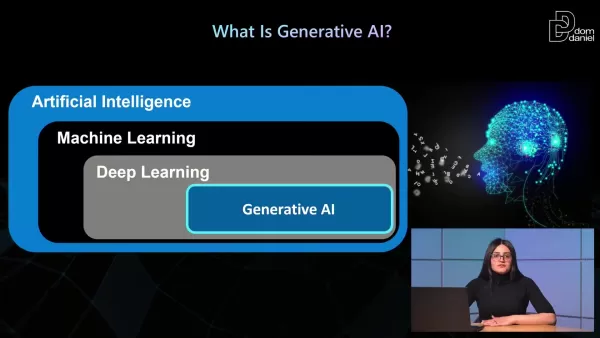
Generative AI represents a specialized deep learning domain focused on original content creation across text, code, and visuals. This technology occupies a distinct position within the AI hierarchy, situated beneath machine learning - itself a subset of artificial intelligence.
Artificial Intelligence encompasses systems replicating human cognitive functions through automated learning and task execution. While machine learning utilizes data for predictive analysis, deep learning employs multi-layered neural networks for complex scenarios. Generative AI advances these capabilities to produce novel, creative outputs.
The AI technology hierarchy:
- Artificial Intelligence (AI): Comprehensive field developing intelligent systems
- Machine Learning (ML): AI subset leveraging data-driven pattern recognition
- Deep Learning (DL): ML branch utilizing complex neural networks
- Generative AI: DL specialization focused on original content generation
Azure OpenAI's Generative AI Contribution
Microsoft's collaboration with OpenAI delivers cutting-edge AI models via Azure OpenAI Service.
This partnership empowers developers with accessible generative AI tools, including advanced text summarization capabilities. Azure OpenAI facilitates seamless generative AI integration, enabling businesses to leverage sophisticated technology without requiring deep AI expertise. The platform supports diverse content generation including text, code, and images.
Azure AI Services and OpenAI Integration
Azure AI Service Categories
Azure AI solutions fall into three primary domains: Machine Learning Platform, Cognitive Services, and Applied AI.
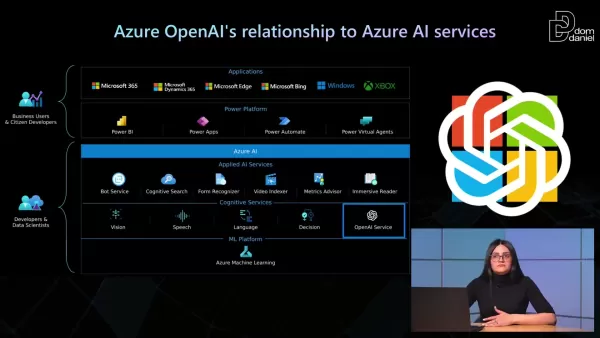
Azure OpenAI Service operates within Cognitive Services while maintaining unique capabilities compared to other Azure AI offerings. Some functionality overlaps exist between standard Cognitive Services and OpenAI's specialized solutions.
- Azure Machine Learning Platform: Comprehensive environment for ML model development and deployment
- Cognitive Services: Pre-trained AI models for vision, speech, language processing
- Applied AI Services: Business-specific solutions building on Cognitive Services
Selection depends on specific requirements and customization needs. Presenter Julia references previous discussions on cognitive services available across social platforms.
Cognitive Services vs Azure OpenAI Comparison
Azure AI offerings comprise Machine Learning Platform, Cognitive Services, and Applied AI Solutions.
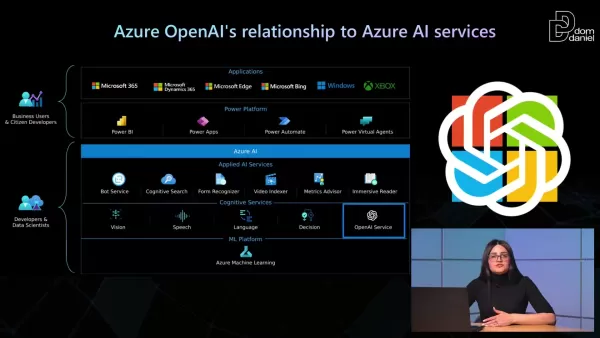
Cognitive Services Language and OpenAI Service share some functionality but serve distinct purposes. The Language service excels at standardized applications requiring minimal customization, while OpenAI specializes in tailored generative AI implementations.
Azure OpenAI Model Varieties
OpenAI models primarily fall into three families: GPT-3, Codex, and DALL-E.
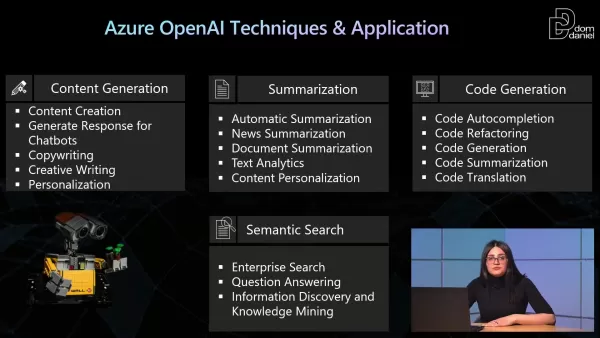
GPT-4 support expands these options. The transformer-based GPT-3 demonstrates particular strength for natural language applications. Model hierarchy includes:
- Ada: Basic, economical solution
- Babbage: Intermediate complexity option
- Curie: Advanced conversational applications
- Davinci: Premium model for sophisticated language tasks
Accessing and Using Azure OpenAI
Azure OpenAI Service Access
Microsoft maintains controlled access to Azure OpenAI Service through registration.
Prospective users must complete registration forms for experimental or production use. Content filter implementation requires separate registration.
Azure OpenAI Implementation Steps
Follow this process for Azure OpenAI Service deployment:
- Submit service access request via registration form
- Complete content filter registration if applicable
- Await service approval
- Establish Azure portal resource
OpenAI Pricing and Plans
Current Pricing Structure
2025 pricing varies by model and usage volume. Cost information sources include:
The OpenAI website pricing pageThe Azure OpenAI Service's pricing documentation.
A free tier remains available for preliminary testing.
Azure OpenAI Text Summarization: Advantages and Limitations
Benefits
Operational time reduction
Processing efficiency gains
Large-scale application
Customizable outputs
Challenges
Context interpretation
Ambiguous content handling
Complex language processing
Specialized domain knowledge
Output evaluation
Azure OpenAI Core Capabilities
Primary Features
Key functionalities covered in this presentation:
- Content generation - Powers chatbots, copywriting, creative content
- Code generation - Enables code optimization and autocompletion
- Text summarization - Supports analytics, news digests, document abstraction
- Semantic search - Facilitates information retrieval and Q&A systems
Industry Applications
Cross-Sector Implementations
Azure OpenAI's text summarization serves diverse industries:
- Media: Condensing news articles for rapid dissemination
- Finance: Abstracting reports for efficient analysis
- Academia: Research paper summarization
- Healthcare: Medical record abstraction
Applications continue expanding across sectors.
Frequently Asked Questions
What models does Azure OpenAI use for text summarization?
Azure OpenAI employs GPT-3 models for both abstractive and extractive summarization.
What is responsible AI?
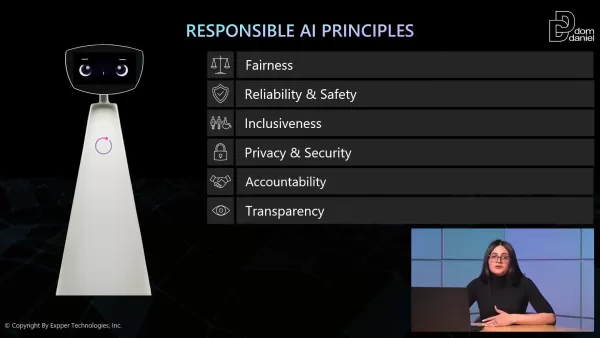
Responsible AI constitutes ethical development practices ensuring safety, fairness, and reliability. Microsoft's framework includes six pillars: Fairness, Safety, Inclusivity, Security, Accountability, and Transparency.
What is generative AI?
Generative AI represents deep learning technology creating novel content. Azure OpenAI specializes in predictive generation across textual, coding, and visual domains.
Related Questions
What are the benefits of using Azure OpenAI text summarization?
Azure OpenAI summarization delivers multiple advantages:
Efficiency gains through rapid text condensation
Enhanced productivity via key insight extraction
Scalability handling substantial document volumes
Customizable outputs meeting specific requirements
Related article
 South Korea Breaks Ground on National AI Computing Center, Investing 2.5 Trillion Won with 2028 Target
South Korean outlet EtNews reports that groundbreaking for the Korea AI Computing Center (KOACC) took place on August 3 at the Solar City data center park in Sunan, Jeollanam-do. Backed by a total investment of 2.5 trillion KRW (roughly 11.838 billio
Six Tech Giants Back Linux Foundation With $12.5M to Tackle AI Vulnerability Noise
To tackle the flood of low-quality security reports produced by AI automation tools, six major tech companies—Anthropic, Amazon (AWS), GitHub, Google, Microsoft, and OpenAI—have collectively contributed $12.5 million in funding to Linux Foundation in
Musk Considered Leaving OpenAI to His Kids as Altman Testifies
This morning, OpenAI CEO Sam Altman took the stand to address former co-founder Elon Musk’s lawsuit challenging the company’s corporate structure.When asked about Musk’s claim that other founders “stole a charity” by launching a for-profit subsidiary
Related Special Topic Recommendations
Music composition
South Korea Breaks Ground on National AI Computing Center, Investing 2.5 Trillion Won with 2028 Target
South Korean outlet EtNews reports that groundbreaking for the Korea AI Computing Center (KOACC) took place on August 3 at the Solar City data center park in Sunan, Jeollanam-do. Backed by a total investment of 2.5 trillion KRW (roughly 11.838 billio
Six Tech Giants Back Linux Foundation With $12.5M to Tackle AI Vulnerability Noise
To tackle the flood of low-quality security reports produced by AI automation tools, six major tech companies—Anthropic, Amazon (AWS), GitHub, Google, Microsoft, and OpenAI—have collectively contributed $12.5 million in funding to Linux Foundation in
Musk Considered Leaving OpenAI to His Kids as Altman Testifies
This morning, OpenAI CEO Sam Altman took the stand to address former co-founder Elon Musk’s lawsuit challenging the company’s corporate structure.When asked about Musk’s claim that other founders “stole a charity” by launching a for-profit subsidiary
Related Special Topic Recommendations
Music composition
 AI Vocal Demo Tools for Songwriters, Hooks, Toplines, and Multilingual Draft Sessions
2026 Latest Best AI Vocal Demo Tools for Songwriters, Hook Creators, and Multi-Language Content Teams! XIX.AI has curated a top-rated list of powerful game-changing tools that go through rigorous real-world tests. You’ll find detailed free vs paid comparison data, comprehensive rankings, and must-try options to help you boost writing efficiency and unlock your creative potential. Explore now to discover your perfect tool for all your content needs!
 9 tools
 xix.ai
Business
Best AI Competitive Research Tools for Small Businesses
xix.ai
Business
Best AI Competitive Research Tools for Small Businesses
2026 Latest Best Top-rated AI Competitive Research Tools for Small Businesses! XIX.AI has curated a highly powerful game-changing collection, updated weekly with rigorous real-world tests and detailed rankings. You can find a comprehensive free vs paid comparison to help you identify the must-try tools that boost your productivity and give you a competitive edge. Explore now to discover your perfect tool!
9 tools
xix.ai
Image editing
Photoshop AI Retouch Tools for Ecommerce Apparel, Skin Cleanup, and Color Consistency
2026 Latest Best Photoshop AI retouch tools for ecommerce apparel, skin cleanup, and color consistency! This top-rated curated list features powerful game-changing solutions that help you boost writing efficiency, streamline content creation, and achieve perfect visual results effortlessly. Each tool has undergone real-world tests through weekly updated rankings, complete with free vs paid comparison details. Backed by XIX.AI, it’s the must-try guide for anyone aiming to unlock your AI edge. Explore now!
10 tools
xix.ai
Prompt
Best AI Prompt Libraries for ChatGPT Workflows
2026 Latest Best Top-Rated AI Prompt Libraries for optimizing all types of ChatGPT workflows. XIX.AI has curated a powerful, game-changing collection that goes through rigorous real-world tests to ensure top performance. You can find detailed free vs paid comparisons and expert rankings to help you choose the must-try tools that boost your productivity and unlock your AI edge. Explore now!
11 tools
xix.ai
Education and Learning
AI Quiz Builder Platforms for Teachers, Tutors, and Cohort-Based Learning Programs
2026 Latest Best AI Quiz Builder Platforms for Teachers, Tutors, and Cohort-Based Learning Programs! XIX.AI has curated a top-rated list of powerful game-changing tools that go through real-world tests to deliver accurate rankings. These must-try platforms help boost writing efficiency, streamline content creation, and simplify quiz design across all learning scenarios. Explore now to discover your perfect tool for unlocking your AI edge in teaching!
13 tools
xix.ai
code
AI Pull Request Review Tools for GitHub Teams Handling Refactors, Bugs, and Security Gaps
2026 Latest Best AI Pull Request Review Tools for GitHub Teams are here on XIX.AI! This top-rated curated list showcases powerful game-changing solutions that streamline refactoring, bug fixing, and security gap detection across all team workflows. Enjoy a free vs paid comparison along with real-world tests and detailed rankings to help you find the perfect tool that boosts productivity significantly. Explore now to unlock your AI edge!
12 tools
xix.ai

 Comments (1)
0/500
Comments (1)
0/500
![NicholasRoberts]()
Interesting! This article outlines Azure OpenAI's approach to text summarization. While it's undoubtedly powerful, I really wonder how it compares to other models in terms of cost-effectiveness for small businesses? 🤔 The data-driven world definitely needs better tools like these. Hope they release more real-world use case studies soon!
Navigating today's data-driven landscape demands efficient text summarization tools that transform complex information into digestible insights. Azure OpenAI delivers powerful AI-driven solutions for this purpose, offering sophisticated tools to distill essential information from extensive texts. This exploration covers Azure OpenAI's text summarization fundamentals, operational models, practical implementations, and ethical deployment strategies.
Core Insights
Master generative AI fundamentals and their connection to machine/deep learning.
Discover Azure OpenAI's advanced text summarization features.
Compare OpenAI models like GPT-3 and Codex with their specialized applications.
Understand responsible AI principles for ethical technology development.
Explore practical text summarization implementations across industries.
Understanding Generative AI
Generative AI Explained
Azure OpenAI's text summarization capabilities stem from broader Generative AI concepts.
Generative AI represents a specialized deep learning domain focused on original content creation across text, code, and visuals. This technology occupies a distinct position within the AI hierarchy, situated beneath machine learning - itself a subset of artificial intelligence.
Artificial Intelligence encompasses systems replicating human cognitive functions through automated learning and task execution. While machine learning utilizes data for predictive analysis, deep learning employs multi-layered neural networks for complex scenarios. Generative AI advances these capabilities to produce novel, creative outputs.
The AI technology hierarchy:
- Artificial Intelligence (AI): Comprehensive field developing intelligent systems
- Machine Learning (ML): AI subset leveraging data-driven pattern recognition
- Deep Learning (DL): ML branch utilizing complex neural networks
- Generative AI: DL specialization focused on original content generation
Azure OpenAI's Generative AI Contribution
Microsoft's collaboration with OpenAI delivers cutting-edge AI models via Azure OpenAI Service.
This partnership empowers developers with accessible generative AI tools, including advanced text summarization capabilities. Azure OpenAI facilitates seamless generative AI integration, enabling businesses to leverage sophisticated technology without requiring deep AI expertise. The platform supports diverse content generation including text, code, and images.
Azure AI Services and OpenAI Integration
Azure AI Service Categories
Azure AI solutions fall into three primary domains: Machine Learning Platform, Cognitive Services, and Applied AI.
Azure OpenAI Service operates within Cognitive Services while maintaining unique capabilities compared to other Azure AI offerings. Some functionality overlaps exist between standard Cognitive Services and OpenAI's specialized solutions.
- Azure Machine Learning Platform: Comprehensive environment for ML model development and deployment
- Cognitive Services: Pre-trained AI models for vision, speech, language processing
- Applied AI Services: Business-specific solutions building on Cognitive Services
Selection depends on specific requirements and customization needs. Presenter Julia references previous discussions on cognitive services available across social platforms.
Cognitive Services vs Azure OpenAI Comparison
Azure AI offerings comprise Machine Learning Platform, Cognitive Services, and Applied AI Solutions.
Cognitive Services Language and OpenAI Service share some functionality but serve distinct purposes. The Language service excels at standardized applications requiring minimal customization, while OpenAI specializes in tailored generative AI implementations.
Azure OpenAI Model Varieties
OpenAI models primarily fall into three families: GPT-3, Codex, and DALL-E.
GPT-4 support expands these options. The transformer-based GPT-3 demonstrates particular strength for natural language applications. Model hierarchy includes:
- Ada: Basic, economical solution
- Babbage: Intermediate complexity option
- Curie: Advanced conversational applications
- Davinci: Premium model for sophisticated language tasks
Accessing and Using Azure OpenAI
Azure OpenAI Service Access
Microsoft maintains controlled access to Azure OpenAI Service through registration.
Prospective users must complete registration forms for experimental or production use. Content filter implementation requires separate registration.
Azure OpenAI Implementation Steps
Follow this process for Azure OpenAI Service deployment:
- Submit service access request via registration form
- Complete content filter registration if applicable
- Await service approval
- Establish Azure portal resource
OpenAI Pricing and Plans
Current Pricing Structure
2025 pricing varies by model and usage volume. Cost information sources include:
The OpenAI website pricing pageThe Azure OpenAI Service's pricing documentation.
A free tier remains available for preliminary testing.
Azure OpenAI Text Summarization: Advantages and Limitations
Benefits
Operational time reduction
Processing efficiency gains
Large-scale application
Customizable outputs
Challenges
Context interpretation
Ambiguous content handling
Complex language processing
Specialized domain knowledge
Output evaluation
Azure OpenAI Core Capabilities
Primary Features
Key functionalities covered in this presentation:
- Content generation - Powers chatbots, copywriting, creative content
- Code generation - Enables code optimization and autocompletion
- Text summarization - Supports analytics, news digests, document abstraction
- Semantic search - Facilitates information retrieval and Q&A systems
Industry Applications
Cross-Sector Implementations
Azure OpenAI's text summarization serves diverse industries:
- Media: Condensing news articles for rapid dissemination
- Finance: Abstracting reports for efficient analysis
- Academia: Research paper summarization
- Healthcare: Medical record abstraction
Applications continue expanding across sectors.
Frequently Asked Questions
What models does Azure OpenAI use for text summarization?
Azure OpenAI employs GPT-3 models for both abstractive and extractive summarization.
What is responsible AI?
Responsible AI constitutes ethical development practices ensuring safety, fairness, and reliability. Microsoft's framework includes six pillars: Fairness, Safety, Inclusivity, Security, Accountability, and Transparency.
What is generative AI?
Generative AI represents deep learning technology creating novel content. Azure OpenAI specializes in predictive generation across textual, coding, and visual domains.
Related Questions
What are the benefits of using Azure OpenAI text summarization?
Azure OpenAI summarization delivers multiple advantages: Efficiency gains through rapid text condensation Enhanced productivity via key insight extraction Scalability handling substantial document volumes Customizable outputs meeting specific requirements








 South Korea Breaks Ground on National AI Computing Center, Investing 2.5 Trillion Won with 2028 Target
South Korean outlet EtNews reports that groundbreaking for the Korea AI Computing Center (KOACC) took place on August 3 at the Solar City data center park in Sunan, Jeollanam-do. Backed by a total investment of 2.5 trillion KRW (roughly 11.838 billio
South Korea Breaks Ground on National AI Computing Center, Investing 2.5 Trillion Won with 2028 Target
South Korean outlet EtNews reports that groundbreaking for the Korea AI Computing Center (KOACC) took place on August 3 at the Solar City data center park in Sunan, Jeollanam-do. Backed by a total investment of 2.5 trillion KRW (roughly 11.838 billio
 Six Tech Giants Back Linux Foundation With $12.5M to Tackle AI Vulnerability Noise
To tackle the flood of low-quality security reports produced by AI automation tools, six major tech companies—Anthropic, Amazon (AWS), GitHub, Google, Microsoft, and OpenAI—have collectively contributed $12.5 million in funding to Linux Foundation in
Six Tech Giants Back Linux Foundation With $12.5M to Tackle AI Vulnerability Noise
To tackle the flood of low-quality security reports produced by AI automation tools, six major tech companies—Anthropic, Amazon (AWS), GitHub, Google, Microsoft, and OpenAI—have collectively contributed $12.5 million in funding to Linux Foundation in
 Musk Considered Leaving OpenAI to His Kids as Altman Testifies
This morning, OpenAI CEO Sam Altman took the stand to address former co-founder Elon Musk’s lawsuit challenging the company’s corporate structure.When asked about Musk’s claim that other founders “stole a charity” by launching a for-profit subsidiary
Musk Considered Leaving OpenAI to His Kids as Altman Testifies
This morning, OpenAI CEO Sam Altman took the stand to address former co-founder Elon Musk’s lawsuit challenging the company’s corporate structure.When asked about Musk’s claim that other founders “stole a charity” by launching a for-profit subsidiary

2026 Latest Best AI Vocal Demo Tools for Songwriters, Hook Creators, and Multi-Language Content Teams! XIX.AI has curated a top-rated list of powerful game-changing tools that go through rigorous real-world tests. You’ll find detailed free vs paid comparison data, comprehensive rankings, and must-try options to help you boost writing efficiency and unlock your creative potential. Explore now to discover your perfect tool for all your content needs!
9 tools
xix.ai

2026 Latest Best Top-rated AI Competitive Research Tools for Small Businesses! XIX.AI has curated a highly powerful game-changing collection, updated weekly with rigorous real-world tests and detailed rankings. You can find a comprehensive free vs paid comparison to help you identify the must-try tools that boost your productivity and give you a competitive edge. Explore now to discover your perfect tool!
9 tools
xix.ai

2026 Latest Best Photoshop AI retouch tools for ecommerce apparel, skin cleanup, and color consistency! This top-rated curated list features powerful game-changing solutions that help you boost writing efficiency, streamline content creation, and achieve perfect visual results effortlessly. Each tool has undergone real-world tests through weekly updated rankings, complete with free vs paid comparison details. Backed by XIX.AI, it’s the must-try guide for anyone aiming to unlock your AI edge. Explore now!
10 tools
xix.ai
2026 Latest Best Top-Rated AI Prompt Libraries for optimizing all types of ChatGPT workflows. XIX.AI has curated a powerful, game-changing collection that goes through rigorous real-world tests to ensure top performance. You can find detailed free vs paid comparisons and expert rankings to help you choose the must-try tools that boost your productivity and unlock your AI edge. Explore now!
11 tools
xix.ai

2026 Latest Best AI Quiz Builder Platforms for Teachers, Tutors, and Cohort-Based Learning Programs! XIX.AI has curated a top-rated list of powerful game-changing tools that go through real-world tests to deliver accurate rankings. These must-try platforms help boost writing efficiency, streamline content creation, and simplify quiz design across all learning scenarios. Explore now to discover your perfect tool for unlocking your AI edge in teaching!
13 tools
xix.ai

2026 Latest Best AI Pull Request Review Tools for GitHub Teams are here on XIX.AI! This top-rated curated list showcases powerful game-changing solutions that streamline refactoring, bug fixing, and security gap detection across all team workflows. Enjoy a free vs paid comparison along with real-world tests and detailed rankings to help you find the perfect tool that boosts productivity significantly. Explore now to unlock your AI edge!
12 tools
xix.ai

Interesting! This article outlines Azure OpenAI's approach to text summarization. While it's undoubtedly powerful, I really wonder how it compares to other models in terms of cost-effectiveness for small businesses? 🤔 The data-driven world definitely needs better tools like these. Hope they release more real-world use case studies soon!












