


 Home
HomeAReaL 2.0 Open Source: RL Infrastructure for Self-Evolving Agents Through Use
On July 2, the open-source reinforcement learning infrastructure project AReaL officially released version 2.0. AReaL is designed to bridge the gap between foundational model training and modern agent applications, delivering efficient reinforcement learning training support for agent scenarios.
The newly launched AReaL 2.0 targets agents operating in real-world business environments, providing a system infrastructure that enables continuous learning while agents are in use. Through AReaL 2.0, the interaction processes generated by agents as they complete real tasks can be recorded, organized, and integrated into subsequent training cycles. These processes are used to continuously refine the underlying models, allowing agents to become stronger while remaining safe and controllable.
Currently, agents are entering real production environments—writing code, searching for information, and calling tools to complete increasingly complex tasks within enterprise systems. However, a problem has emerged: agents work every day but rarely grow from their experiences.
In real business scenarios, agents generate a large amount of valuable experience: which tasks were completed well, where tool calls failed, why users were dissatisfied, and whether a certain decision was on the wrong track. Yet, this information is mostly stored in logs, making it difficult to transform it stably and safely into the next step of capability improvement.
AReaL 2.0 aims to solve the problem of how agents continue to grow after deployment. Developers do not need to redevelop agents; they simply need to route the requests that agents normally send to large models through AReaL 2.0's unified inference endpoint to integrate into the online reinforcement learning process.
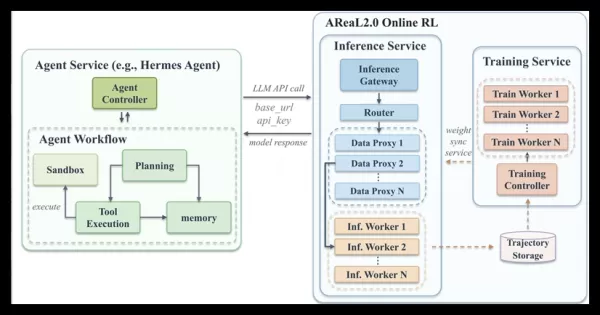
Figure: AReaL 2.0 Online Reinforcement Learning (Online RL) Architecture Diagram
Take Hermes Agent as an example. Hermes continues to receive tasks, plan steps, and call models as usual. AReaL 2.0 records the key interaction processes when Hermes completes tasks in the background and uses these real trajectories, combined with feedback or reward signals after task completion, for subsequent training. Developers can also replace Hermes with their own agent and task environment, using the same approach to build an online reinforcement learning process for agents.
This means that an agent's capability improvement no longer relies solely on manually constructed data, offline training, and redeployment. Multi-turn conversations, tool calls, execution results, and feedback signals from real tasks can all become materials for model learning.
This point is especially important in enterprise scenarios. Agents in enterprise workflows face real, complex, and constantly changing tasks: code repositories may update, business processes may change, user needs may shift, and tools and systems may also change. If an agent's capabilities are fixed once deployed, it will struggle to adapt to the real environment over time. AReaL 2.0 aims to fill the missing link between "being able to use tools" and "being able to learn from usage."
At the same time, continuous learning in real business scenarios cannot simply be about "collecting data and retraining." Agents may access code, customer information, enterprise knowledge bases, and internal systems, so the training pipeline must consider requirements such as access control, data anonymization, isolation, and audit. AReaL 2.0 introduces a data proxy mechanism for agent traces in its system design, allowing real task data to be managed and used in a more secure and controllable way when entering the training process.
The AReaL team pointed out in their technical report that the key bottleneck for self-evolving agents is not just how strong the model is or whether the reinforcement learning algorithm is advanced, but the lack of an online reinforcement learning infrastructure that serves real agents. AReaL 2.0 is an architectural upgrade aimed at the next generation of agent applications: connecting agent services, real task traces, data governance, and online reinforcement learning training, giving agents the practical engineering foundation to continue learning after deployment.
From a longer-term perspective, AReaL 2.0 points to the evolution paradigm of the next generation of agent applications: agents are no longer one-time trained and deployed tools, but rather continuously gain feedback in real environments, transforming both success and failure into experience, and continuously improving their capabilities within a safe boundary.
The AReaL project was initiated by teams including Ant Group, Tsinghua University, and the Hong Kong University of Science and Technology in 2024. In May 2026, AReaL officially exited the Ant InclusionAI incubation program and became an independent open-source community, joining the PyTorch Foundation Ecosystem project, further integrating into the mainstream reinforcement learning infrastructure ecosystem.
As the community develops independently, AReaL has also continued to receive participation and support from industry and open-source ecological partners, including the Huawei Cloud team and MindLab. In the future, AReaL will continue to iterate around areas such as online reinforcement learning, automated evaluation, and multimodal agent training, working with the community to advance the development of self-evolving agent ecosystems.
Currently, the AReaL 2.0 technical report and code have been open-sourced.
· GitHub Repository: https://github.com/areal-project/AReaL
· Technical Report: https://arxiv.org/abs/2607.01120
Related article
 Six Tech Giants Back Linux Foundation With $12.5M to Tackle AI Vulnerability Noise
To tackle the flood of low-quality security reports produced by AI automation tools, six major tech companies—Anthropic, Amazon (AWS), GitHub, Google, Microsoft, and OpenAI—have collectively contributed $12.5 million in funding to Linux Foundation in
Musk Considered Leaving OpenAI to His Kids as Altman Testifies
This morning, OpenAI CEO Sam Altman took the stand to address former co-founder Elon Musk’s lawsuit challenging the company’s corporate structure.When asked about Musk’s claim that other founders “stole a charity” by launching a for-profit subsidiary
Sam Altman Sparks Debate Over AI's Deceleration
Listen onApple PodcastsListen onSpotifyOpenAI CEO Sam Altman recently suggested that it may be time to “pace the rate of AI development” to allow society to “harden around some of these new capability levels.”On the latest episode of TechCrunch’s Equ
Related Special Topic Recommendations
Business
Six Tech Giants Back Linux Foundation With $12.5M to Tackle AI Vulnerability Noise
To tackle the flood of low-quality security reports produced by AI automation tools, six major tech companies—Anthropic, Amazon (AWS), GitHub, Google, Microsoft, and OpenAI—have collectively contributed $12.5 million in funding to Linux Foundation in
Musk Considered Leaving OpenAI to His Kids as Altman Testifies
This morning, OpenAI CEO Sam Altman took the stand to address former co-founder Elon Musk’s lawsuit challenging the company’s corporate structure.When asked about Musk’s claim that other founders “stole a charity” by launching a for-profit subsidiary
Sam Altman Sparks Debate Over AI's Deceleration
Listen onApple PodcastsListen onSpotifyOpenAI CEO Sam Altman recently suggested that it may be time to “pace the rate of AI development” to allow society to “harden around some of these new capability levels.”On the latest episode of TechCrunch’s Equ
Related Special Topic Recommendations
Business
 Best AI Competitive Research Tools for Small Businesses
2026 Latest Best Top-rated AI Competitive Research Tools for Small Businesses! XIX.AI has curated a highly powerful game-changing collection, updated weekly with rigorous real-world tests and detailed rankings. You can find a comprehensive free vs paid comparison to help you identify the must-try tools that boost your productivity and give you a competitive edge. Explore now to discover your perfect tool!
 9 tools
 xix.ai
Image editing
Photoshop AI Retouch Tools for Ecommerce Apparel, Skin Cleanup, and Color Consistency
xix.ai
Image editing
Photoshop AI Retouch Tools for Ecommerce Apparel, Skin Cleanup, and Color Consistency
2026 Latest Best Photoshop AI retouch tools for ecommerce apparel, skin cleanup, and color consistency! This top-rated curated list features powerful game-changing solutions that help you boost writing efficiency, streamline content creation, and achieve perfect visual results effortlessly. Each tool has undergone real-world tests through weekly updated rankings, complete with free vs paid comparison details. Backed by XIX.AI, it’s the must-try guide for anyone aiming to unlock your AI edge. Explore now!
10 tools
xix.ai
Prompt
Best AI Prompt Libraries for ChatGPT Workflows
2026 Latest Best Top-Rated AI Prompt Libraries for optimizing all types of ChatGPT workflows. XIX.AI has curated a powerful, game-changing collection that goes through rigorous real-world tests to ensure top performance. You can find detailed free vs paid comparisons and expert rankings to help you choose the must-try tools that boost your productivity and unlock your AI edge. Explore now!
11 tools
xix.ai
Education and Learning
AI Quiz Builder Platforms for Teachers, Tutors, and Cohort-Based Learning Programs
2026 Latest Best AI Quiz Builder Platforms for Teachers, Tutors, and Cohort-Based Learning Programs! XIX.AI has curated a top-rated list of powerful game-changing tools that go through real-world tests to deliver accurate rankings. These must-try platforms help boost writing efficiency, streamline content creation, and simplify quiz design across all learning scenarios. Explore now to discover your perfect tool for unlocking your AI edge in teaching!
13 tools
xix.ai
code
AI Pull Request Review Tools for GitHub Teams Handling Refactors, Bugs, and Security Gaps
2026 Latest Best AI Pull Request Review Tools for GitHub Teams are here on XIX.AI! This top-rated curated list showcases powerful game-changing solutions that streamline refactoring, bug fixing, and security gap detection across all team workflows. Enjoy a free vs paid comparison along with real-world tests and detailed rankings to help you find the perfect tool that boosts productivity significantly. Explore now to unlock your AI edge!
12 tools
xix.ai
Text-to-speech
Best AI Text to Speech Tools for Natural Voiceovers
2026 Latest Best Top-rated AI Text to Speech Tools for Natural Voiceovers are here on XIX.AI! This curated list features powerful, game-changing options that deliver crystal-clear voices for every use case, backed by real-world tests and weekly updated rankings. Get a free vs paid comparison to find the must-try solution that boosts your productivity instantly. Explore now to Unlock your AI edge!
11 tools
xix.ai

 Comments (0)
0/500
Comments (0)
0/500
On July 2, the open-source reinforcement learning infrastructure project AReaL officially released version 2.0. AReaL is designed to bridge the gap between foundational model training and modern agent applications, delivering efficient reinforcement learning training support for agent scenarios.
The newly launched AReaL 2.0 targets agents operating in real-world business environments, providing a system infrastructure that enables continuous learning while agents are in use. Through AReaL 2.0, the interaction processes generated by agents as they complete real tasks can be recorded, organized, and integrated into subsequent training cycles. These processes are used to continuously refine the underlying models, allowing agents to become stronger while remaining safe and controllable.
Currently, agents are entering real production environments—writing code, searching for information, and calling tools to complete increasingly complex tasks within enterprise systems. However, a problem has emerged: agents work every day but rarely grow from their experiences.
In real business scenarios, agents generate a large amount of valuable experience: which tasks were completed well, where tool calls failed, why users were dissatisfied, and whether a certain decision was on the wrong track. Yet, this information is mostly stored in logs, making it difficult to transform it stably and safely into the next step of capability improvement.
AReaL 2.0 aims to solve the problem of how agents continue to grow after deployment. Developers do not need to redevelop agents; they simply need to route the requests that agents normally send to large models through AReaL 2.0's unified inference endpoint to integrate into the online reinforcement learning process.
Figure: AReaL 2.0 Online Reinforcement Learning (Online RL) Architecture Diagram
Take Hermes Agent as an example. Hermes continues to receive tasks, plan steps, and call models as usual. AReaL 2.0 records the key interaction processes when Hermes completes tasks in the background and uses these real trajectories, combined with feedback or reward signals after task completion, for subsequent training. Developers can also replace Hermes with their own agent and task environment, using the same approach to build an online reinforcement learning process for agents.
This means that an agent's capability improvement no longer relies solely on manually constructed data, offline training, and redeployment. Multi-turn conversations, tool calls, execution results, and feedback signals from real tasks can all become materials for model learning.
This point is especially important in enterprise scenarios. Agents in enterprise workflows face real, complex, and constantly changing tasks: code repositories may update, business processes may change, user needs may shift, and tools and systems may also change. If an agent's capabilities are fixed once deployed, it will struggle to adapt to the real environment over time. AReaL 2.0 aims to fill the missing link between "being able to use tools" and "being able to learn from usage."
At the same time, continuous learning in real business scenarios cannot simply be about "collecting data and retraining." Agents may access code, customer information, enterprise knowledge bases, and internal systems, so the training pipeline must consider requirements such as access control, data anonymization, isolation, and audit. AReaL 2.0 introduces a data proxy mechanism for agent traces in its system design, allowing real task data to be managed and used in a more secure and controllable way when entering the training process.
The AReaL team pointed out in their technical report that the key bottleneck for self-evolving agents is not just how strong the model is or whether the reinforcement learning algorithm is advanced, but the lack of an online reinforcement learning infrastructure that serves real agents. AReaL 2.0 is an architectural upgrade aimed at the next generation of agent applications: connecting agent services, real task traces, data governance, and online reinforcement learning training, giving agents the practical engineering foundation to continue learning after deployment.
From a longer-term perspective, AReaL 2.0 points to the evolution paradigm of the next generation of agent applications: agents are no longer one-time trained and deployed tools, but rather continuously gain feedback in real environments, transforming both success and failure into experience, and continuously improving their capabilities within a safe boundary.
The AReaL project was initiated by teams including Ant Group, Tsinghua University, and the Hong Kong University of Science and Technology in 2024. In May 2026, AReaL officially exited the Ant InclusionAI incubation program and became an independent open-source community, joining the PyTorch Foundation Ecosystem project, further integrating into the mainstream reinforcement learning infrastructure ecosystem.
As the community develops independently, AReaL has also continued to receive participation and support from industry and open-source ecological partners, including the Huawei Cloud team and MindLab. In the future, AReaL will continue to iterate around areas such as online reinforcement learning, automated evaluation, and multimodal agent training, working with the community to advance the development of self-evolving agent ecosystems.
Currently, the AReaL 2.0 technical report and code have been open-sourced.
· GitHub Repository: https://github.com/areal-project/AReaL
· Technical Report: https://arxiv.org/abs/2607.01120








 Six Tech Giants Back Linux Foundation With $12.5M to Tackle AI Vulnerability Noise
To tackle the flood of low-quality security reports produced by AI automation tools, six major tech companies—Anthropic, Amazon (AWS), GitHub, Google, Microsoft, and OpenAI—have collectively contributed $12.5 million in funding to Linux Foundation in
Six Tech Giants Back Linux Foundation With $12.5M to Tackle AI Vulnerability Noise
To tackle the flood of low-quality security reports produced by AI automation tools, six major tech companies—Anthropic, Amazon (AWS), GitHub, Google, Microsoft, and OpenAI—have collectively contributed $12.5 million in funding to Linux Foundation in
 Musk Considered Leaving OpenAI to His Kids as Altman Testifies
This morning, OpenAI CEO Sam Altman took the stand to address former co-founder Elon Musk’s lawsuit challenging the company’s corporate structure.When asked about Musk’s claim that other founders “stole a charity” by launching a for-profit subsidiary
Musk Considered Leaving OpenAI to His Kids as Altman Testifies
This morning, OpenAI CEO Sam Altman took the stand to address former co-founder Elon Musk’s lawsuit challenging the company’s corporate structure.When asked about Musk’s claim that other founders “stole a charity” by launching a for-profit subsidiary
 Sam Altman Sparks Debate Over AI's Deceleration
Listen onApple PodcastsListen onSpotifyOpenAI CEO Sam Altman recently suggested that it may be time to “pace the rate of AI development” to allow society to “harden around some of these new capability levels.”On the latest episode of TechCrunch’s Equ
Sam Altman Sparks Debate Over AI's Deceleration
Listen onApple PodcastsListen onSpotifyOpenAI CEO Sam Altman recently suggested that it may be time to “pace the rate of AI development” to allow society to “harden around some of these new capability levels.”On the latest episode of TechCrunch’s Equ

2026 Latest Best Top-rated AI Competitive Research Tools for Small Businesses! XIX.AI has curated a highly powerful game-changing collection, updated weekly with rigorous real-world tests and detailed rankings. You can find a comprehensive free vs paid comparison to help you identify the must-try tools that boost your productivity and give you a competitive edge. Explore now to discover your perfect tool!
9 tools
xix.ai

2026 Latest Best Photoshop AI retouch tools for ecommerce apparel, skin cleanup, and color consistency! This top-rated curated list features powerful game-changing solutions that help you boost writing efficiency, streamline content creation, and achieve perfect visual results effortlessly. Each tool has undergone real-world tests through weekly updated rankings, complete with free vs paid comparison details. Backed by XIX.AI, it’s the must-try guide for anyone aiming to unlock your AI edge. Explore now!
10 tools
xix.ai

2026 Latest Best Top-Rated AI Prompt Libraries for optimizing all types of ChatGPT workflows. XIX.AI has curated a powerful, game-changing collection that goes through rigorous real-world tests to ensure top performance. You can find detailed free vs paid comparisons and expert rankings to help you choose the must-try tools that boost your productivity and unlock your AI edge. Explore now!
11 tools
xix.ai

2026 Latest Best AI Quiz Builder Platforms for Teachers, Tutors, and Cohort-Based Learning Programs! XIX.AI has curated a top-rated list of powerful game-changing tools that go through real-world tests to deliver accurate rankings. These must-try platforms help boost writing efficiency, streamline content creation, and simplify quiz design across all learning scenarios. Explore now to discover your perfect tool for unlocking your AI edge in teaching!
13 tools
xix.ai
2026 Latest Best AI Pull Request Review Tools for GitHub Teams are here on XIX.AI! This top-rated curated list showcases powerful game-changing solutions that streamline refactoring, bug fixing, and security gap detection across all team workflows. Enjoy a free vs paid comparison along with real-world tests and detailed rankings to help you find the perfect tool that boosts productivity significantly. Explore now to unlock your AI edge!
12 tools
xix.ai

2026 Latest Best Top-rated AI Text to Speech Tools for Natural Voiceovers are here on XIX.AI! This curated list features powerful, game-changing options that deliver crystal-clear voices for every use case, backed by real-world tests and weekly updated rankings. Get a free vs paid comparison to find the must-try solution that boosts your productivity instantly. Explore now to Unlock your AI edge!
11 tools
xix.ai












