


 Home
HomeApptronik launches Apollo 2 and flagship data collection and training hub
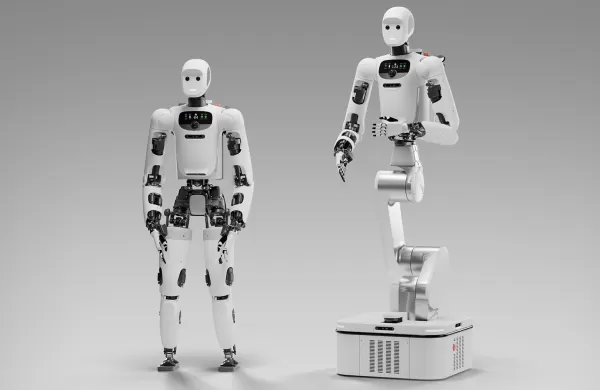
Apptronik provides a bipedal configuration for navigating spaces designed for people, while a wheeled base ensures stability and efficiency in high-throughput environments. | Source: Apptronik
Apptronik made two major announcements yesterday. First, it launched Apollo 2, an updated humanoid robot. Second, it opened its newly expanded Robot Park, a flagship data-collection and training facility for humanoid robots in Austin, Texas.
Apollo 2 is available in both bipedal and wheeled-base configurations. Apptronik stated that the robot was designed to learn real-world tasks through large-scale data collection. This allows the company to gather varied data across a wide range of tasks and environments.
As part of Apptronik's research partnership with Google DeepMind, the data collected by Apollo 2 helps advance Gemini Robotics, Google DeepMind's foundation models for robotics.
The Austin facility joins a growing network of Apptronik Robot Parks at customer and partner sites worldwide. The company stated that the facility, Apollo 2, and its research partnership create an integrated system for rapidly developing and deploying humanoid robot intelligence.
“The industry has spent years demonstrating what robots can do in demos. We're focused on what they can do every day on the job,” said Jeff Cardenas, co-founder and CEO of Apptronik. “What we're building is a continuous learning loop with the Google DeepMind Robotics team: robots working, collecting data, and improving with every cycle, in real environments, on real tasks.”
“Robot Park enables the data collection that fuels that, and Apollo 2 is the machine that makes it possible,” he added. “That's how you move from early prototypes to real, deployable humanoid robots.”
Apptronik stated that Apollo is built on nearly a decade of development across 15 previous robots, including NASA's Valkyrie. The company originated from the Human Centered Robotics Lab at the University of Texas at Austin and now employs nearly 300 people. Earlier this year, it raised $520 million in funding, bringing its total capital raised to nearly $1 billion.
Apptronik prioritizes modularity in Apollo 2
Apollo 2 is a modular AI-powered humanoid that has served as the workhorse behind Robot Park for over a year. The robot enables continuous learning through deployment across Robot Park locations and at customer and partner sites.
By offering Apollo in modular configurations, Apptronik said it can optimize data collection across a variety of operational environments. The company designed the wheeled base to comply with existing safety standards for industrial mobile robots. This allows it to integrate easily into existing customer operations, the company said.
The bipedal configuration offers maximum adaptability for complex environments. This allows Apptronik to continuously improve the safety and reliability of its walking platform in real-world scenarios.
“For truly useful humanoid robots, safety and reliability must advance alongside capability,” said Barry Phillips, chief commercial officer at Apptronik. “The modular design of Apollo is a direct response to customer demand for adaptable automation.”
“By developing Apollo as a modular platform, we're able to deploy the same core humanoid technology across different configurations, including wheeled robots that align with current industrial safety standards and bipedal robots for maximum adaptability,” he said. “This approach helps us build better robots for customers today while laying the groundwork for broad adoption of humanoid systems in the future.”
Apptronik stated that everything it is proving and learning through the Apollo 2 platform is directly fueling the development of its commercial product, Apollo 3.
Scalable data collection fuels humanoid intelligence
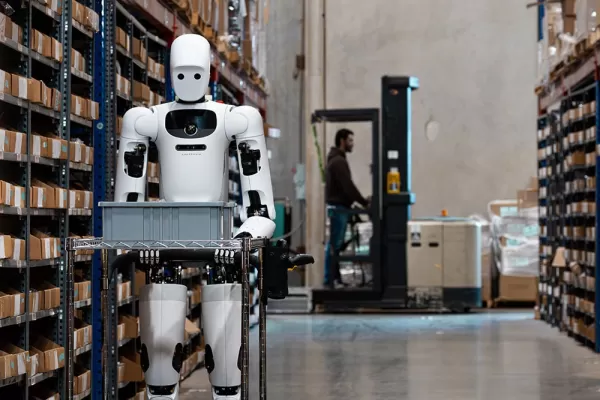
Apollo 2 includes an expressive LED mouth along with coordinated lighting, speech, and listening capabilities for more natural interactions with people. | Source: Apptronik
Apptronik stated that humanoid robots like Apollo require large amounts of real-world data to train the embodied AI models that will enable them to operate autonomously. Robot Park is where much of that data is generated.
Inside the newly expanded nearly 90,000-square-foot (8,361.2 sq. m) facility in Austin, both bipedal and wheeled Apollo 2 systems learn across a range of customer use cases. The robots perform tasks in logistics, manufacturing, retail, and other customer-driven activities.
To capture diverse real-world experience at scale, Apptronik said it deployed similar data-collection workflows across a growing network of Robot Parks. This includes its research partner, Google DeepMind, and customers such as Mercedes-Benz and GXO, a global leader in high-tech, high-volume logistics.
Through a combination of teleoperation and autonomous execution, Apollo 2 continuously generates significant amounts of high-quality training data, said Apptronik. It uses this growing dataset to train and refine the Gemini Robotics AI models. The company added that these models will prepare its commercial fleet for real-world deployment.
Robot Park provides the foundation of physical experience, Apptronik said. The company captures high-quality data through teleoperation and high-fidelity physics simulations. This allows it to accelerate both hardware design and algorithmic development.
Apptronik stated that its multi-modal approach allows its robots to learn from a wide variety of experiences. This further ensures the platform scales alongside the latest advancements in embodied AI.
Related article
 AI music generator ProducerAI joins Google Labs
On Tuesday, Google announced that ProducerAI, its generative AI music tool, is being integrated into Google Labs.Backed by The Chainsmokers, ProducerAI enables users to generate music through natural language prompts, such as “make a lofi beat.” The
MODEX 2026: Key Takeaways and Industry Insights
The show floor on the first day of MODEX 2026. Credit: Eugene DemaitreNews of the weekSkild acquires Fetch Robotics assets from ZebraSkild AI has purchased the robotics division of Zebra Technologies, previously known as Fetch Robotics. According to
Boston Dynamics and Google DeepMind Integrate Gemini to Enhance Spot's Intelligence
Boston Dynamics' Spot quadruped robot equipped with AIVI-Learning. | Source: Boston DynamicsBoston Dynamics has announced a partnership with Google Cloud and Google DeepMind to integrate Gemini and Gemini Robotics ER 1.6 into its Orbit AIVI-Learning
Related Special Topic Recommendations
Data Analysis
AI music generator ProducerAI joins Google Labs
On Tuesday, Google announced that ProducerAI, its generative AI music tool, is being integrated into Google Labs.Backed by The Chainsmokers, ProducerAI enables users to generate music through natural language prompts, such as “make a lofi beat.” The
MODEX 2026: Key Takeaways and Industry Insights
The show floor on the first day of MODEX 2026. Credit: Eugene DemaitreNews of the weekSkild acquires Fetch Robotics assets from ZebraSkild AI has purchased the robotics division of Zebra Technologies, previously known as Fetch Robotics. According to
Boston Dynamics and Google DeepMind Integrate Gemini to Enhance Spot's Intelligence
Boston Dynamics' Spot quadruped robot equipped with AIVI-Learning. | Source: Boston DynamicsBoston Dynamics has announced a partnership with Google Cloud and Google DeepMind to integrate Gemini and Gemini Robotics ER 1.6 into its Orbit AIVI-Learning
Related Special Topic Recommendations
Data Analysis
 Best AI Anomaly Detection Tools for KPI Monitoring across SaaS and Ecommerce Teams
2026 Latest Best Top-rated AI Anomaly Detection Tools for KPI Monitoring in SaaS and Ecommerce teams! XIX.AI has curated a powerful, game-changing collection based on rigorous real-world tests and weekly updated rankings. You’ll find detailed free vs paid comparison insights to help you identify the must-try solution that boosts productivity and unlocks your AI edge. Explore now!
 10 tools
 xix.ai
writing
Best AI Outline Generators for Long-Form SEO Articles
xix.ai
writing
Best AI Outline Generators for Long-Form SEO Articles
2026 Latest Best Top-Rated AI Outline Generators for Long-Form SEO Articles, meticulously curated by XIX.AI. These powerful tools offer game-changing assistance in creating high-quality content quickly, boosting writing efficiency significantly. Get a free vs paid comparison along with real-world tests and detailed rankings to help you find the must-try option that suits your needs. Explore now to unlock your AI edge.
8 tools
xix.ai
Education and Learning
AI Study Tools for Homework and Exam Prep
2026 Latest Best AI Study Tools for Homework and Exam Prep! XIX.AI curates a top-rated list of powerful, game-changing tools that help students boost productivity, streamline homework completion, and ace exams through real-world tests. Get a free vs paid comparison, detailed rankings, and must-try options to unlock your AI edge. Explore now!
10 tools
xix.ai
Music composition
AI Vocal Demo Tools for Songwriters, Hooks, Toplines, and Multilingual Draft Sessions
2026 Latest Best AI Vocal Demo Tools for Songwriters, Hook Creators, and Multi-Language Content Teams! XIX.AI has curated a top-rated list of powerful game-changing tools that go through rigorous real-world tests. You’ll find detailed free vs paid comparison data, comprehensive rankings, and must-try options to help you boost writing efficiency and unlock your creative potential. Explore now to discover your perfect tool for all your content needs!
9 tools
xix.ai
Business
Best AI Competitive Research Tools for Small Businesses
2026 Latest Best Top-rated AI Competitive Research Tools for Small Businesses! XIX.AI has curated a highly powerful game-changing collection, updated weekly with rigorous real-world tests and detailed rankings. You can find a comprehensive free vs paid comparison to help you identify the must-try tools that boost your productivity and give you a competitive edge. Explore now to discover your perfect tool!
9 tools
xix.ai
Image editing
Photoshop AI Retouch Tools for Ecommerce Apparel, Skin Cleanup, and Color Consistency
2026 Latest Best Photoshop AI retouch tools for ecommerce apparel, skin cleanup, and color consistency! This top-rated curated list features powerful game-changing solutions that help you boost writing efficiency, streamline content creation, and achieve perfect visual results effortlessly. Each tool has undergone real-world tests through weekly updated rankings, complete with free vs paid comparison details. Backed by XIX.AI, it’s the must-try guide for anyone aiming to unlock your AI edge. Explore now!
10 tools
xix.ai

 Comments (0)
0/500
Comments (0)
0/500
Apptronik provides a bipedal configuration for navigating spaces designed for people, while a wheeled base ensures stability and efficiency in high-throughput environments. | Source: Apptronik
Apptronik made two major announcements yesterday. First, it launched Apollo 2, an updated humanoid robot. Second, it opened its newly expanded Robot Park, a flagship data-collection and training facility for humanoid robots in Austin, Texas.
Apollo 2 is available in both bipedal and wheeled-base configurations. Apptronik stated that the robot was designed to learn real-world tasks through large-scale data collection. This allows the company to gather varied data across a wide range of tasks and environments.
As part of Apptronik's research partnership with Google DeepMind, the data collected by Apollo 2 helps advance Gemini Robotics, Google DeepMind's foundation models for robotics.
The Austin facility joins a growing network of Apptronik Robot Parks at customer and partner sites worldwide. The company stated that the facility, Apollo 2, and its research partnership create an integrated system for rapidly developing and deploying humanoid robot intelligence.
“The industry has spent years demonstrating what robots can do in demos. We're focused on what they can do every day on the job,” said Jeff Cardenas, co-founder and CEO of Apptronik. “What we're building is a continuous learning loop with the Google DeepMind Robotics team: robots working, collecting data, and improving with every cycle, in real environments, on real tasks.”
“Robot Park enables the data collection that fuels that, and Apollo 2 is the machine that makes it possible,” he added. “That's how you move from early prototypes to real, deployable humanoid robots.”
Apptronik stated that Apollo is built on nearly a decade of development across 15 previous robots, including NASA's Valkyrie. The company originated from the Human Centered Robotics Lab at the University of Texas at Austin and now employs nearly 300 people. Earlier this year, it raised $520 million in funding, bringing its total capital raised to nearly $1 billion.
Apptronik prioritizes modularity in Apollo 2
Apollo 2 is a modular AI-powered humanoid that has served as the workhorse behind Robot Park for over a year. The robot enables continuous learning through deployment across Robot Park locations and at customer and partner sites.
By offering Apollo in modular configurations, Apptronik said it can optimize data collection across a variety of operational environments. The company designed the wheeled base to comply with existing safety standards for industrial mobile robots. This allows it to integrate easily into existing customer operations, the company said.
The bipedal configuration offers maximum adaptability for complex environments. This allows Apptronik to continuously improve the safety and reliability of its walking platform in real-world scenarios.
“For truly useful humanoid robots, safety and reliability must advance alongside capability,” said Barry Phillips, chief commercial officer at Apptronik. “The modular design of Apollo is a direct response to customer demand for adaptable automation.”
“By developing Apollo as a modular platform, we're able to deploy the same core humanoid technology across different configurations, including wheeled robots that align with current industrial safety standards and bipedal robots for maximum adaptability,” he said. “This approach helps us build better robots for customers today while laying the groundwork for broad adoption of humanoid systems in the future.”
Apptronik stated that everything it is proving and learning through the Apollo 2 platform is directly fueling the development of its commercial product, Apollo 3.
Scalable data collection fuels humanoid intelligence
Apollo 2 includes an expressive LED mouth along with coordinated lighting, speech, and listening capabilities for more natural interactions with people. | Source: Apptronik
Apptronik stated that humanoid robots like Apollo require large amounts of real-world data to train the embodied AI models that will enable them to operate autonomously. Robot Park is where much of that data is generated.
Inside the newly expanded nearly 90,000-square-foot (8,361.2 sq. m) facility in Austin, both bipedal and wheeled Apollo 2 systems learn across a range of customer use cases. The robots perform tasks in logistics, manufacturing, retail, and other customer-driven activities.
To capture diverse real-world experience at scale, Apptronik said it deployed similar data-collection workflows across a growing network of Robot Parks. This includes its research partner, Google DeepMind, and customers such as Mercedes-Benz and GXO, a global leader in high-tech, high-volume logistics.
Through a combination of teleoperation and autonomous execution, Apollo 2 continuously generates significant amounts of high-quality training data, said Apptronik. It uses this growing dataset to train and refine the Gemini Robotics AI models. The company added that these models will prepare its commercial fleet for real-world deployment.
Robot Park provides the foundation of physical experience, Apptronik said. The company captures high-quality data through teleoperation and high-fidelity physics simulations. This allows it to accelerate both hardware design and algorithmic development.
Apptronik stated that its multi-modal approach allows its robots to learn from a wide variety of experiences. This further ensures the platform scales alongside the latest advancements in embodied AI.








 AI music generator ProducerAI joins Google Labs
On Tuesday, Google announced that ProducerAI, its generative AI music tool, is being integrated into Google Labs.Backed by The Chainsmokers, ProducerAI enables users to generate music through natural language prompts, such as “make a lofi beat.” The
MODEX 2026: Key Takeaways and Industry Insights
The show floor on the first day of MODEX 2026. Credit: Eugene DemaitreNews of the weekSkild acquires Fetch Robotics assets from ZebraSkild AI has purchased the robotics division of Zebra Technologies, previously known as Fetch Robotics. According to
AI music generator ProducerAI joins Google Labs
On Tuesday, Google announced that ProducerAI, its generative AI music tool, is being integrated into Google Labs.Backed by The Chainsmokers, ProducerAI enables users to generate music through natural language prompts, such as “make a lofi beat.” The
MODEX 2026: Key Takeaways and Industry Insights
The show floor on the first day of MODEX 2026. Credit: Eugene DemaitreNews of the weekSkild acquires Fetch Robotics assets from ZebraSkild AI has purchased the robotics division of Zebra Technologies, previously known as Fetch Robotics. According to
 Boston Dynamics and Google DeepMind Integrate Gemini to Enhance Spot's Intelligence
Boston Dynamics' Spot quadruped robot equipped with AIVI-Learning. | Source: Boston DynamicsBoston Dynamics has announced a partnership with Google Cloud and Google DeepMind to integrate Gemini and Gemini Robotics ER 1.6 into its Orbit AIVI-Learning
Boston Dynamics and Google DeepMind Integrate Gemini to Enhance Spot's Intelligence
Boston Dynamics' Spot quadruped robot equipped with AIVI-Learning. | Source: Boston DynamicsBoston Dynamics has announced a partnership with Google Cloud and Google DeepMind to integrate Gemini and Gemini Robotics ER 1.6 into its Orbit AIVI-Learning

2026 Latest Best Top-rated AI Anomaly Detection Tools for KPI Monitoring in SaaS and Ecommerce teams! XIX.AI has curated a powerful, game-changing collection based on rigorous real-world tests and weekly updated rankings. You’ll find detailed free vs paid comparison insights to help you identify the must-try solution that boosts productivity and unlocks your AI edge. Explore now!
10 tools
xix.ai

2026 Latest Best Top-Rated AI Outline Generators for Long-Form SEO Articles, meticulously curated by XIX.AI. These powerful tools offer game-changing assistance in creating high-quality content quickly, boosting writing efficiency significantly. Get a free vs paid comparison along with real-world tests and detailed rankings to help you find the must-try option that suits your needs. Explore now to unlock your AI edge.
8 tools
xix.ai

2026 Latest Best AI Study Tools for Homework and Exam Prep! XIX.AI curates a top-rated list of powerful, game-changing tools that help students boost productivity, streamline homework completion, and ace exams through real-world tests. Get a free vs paid comparison, detailed rankings, and must-try options to unlock your AI edge. Explore now!
10 tools
xix.ai

2026 Latest Best AI Vocal Demo Tools for Songwriters, Hook Creators, and Multi-Language Content Teams! XIX.AI has curated a top-rated list of powerful game-changing tools that go through rigorous real-world tests. You’ll find detailed free vs paid comparison data, comprehensive rankings, and must-try options to help you boost writing efficiency and unlock your creative potential. Explore now to discover your perfect tool for all your content needs!
9 tools
xix.ai

2026 Latest Best Top-rated AI Competitive Research Tools for Small Businesses! XIX.AI has curated a highly powerful game-changing collection, updated weekly with rigorous real-world tests and detailed rankings. You can find a comprehensive free vs paid comparison to help you identify the must-try tools that boost your productivity and give you a competitive edge. Explore now to discover your perfect tool!
9 tools
xix.ai

2026 Latest Best Photoshop AI retouch tools for ecommerce apparel, skin cleanup, and color consistency! This top-rated curated list features powerful game-changing solutions that help you boost writing efficiency, streamline content creation, and achieve perfect visual results effortlessly. Each tool has undergone real-world tests through weekly updated rankings, complete with free vs paid comparison details. Backed by XIX.AI, it’s the must-try guide for anyone aiming to unlock your AI edge. Explore now!
10 tools
xix.ai












