


 Home
Home
Ant Group Open Sources Ring-2.5-1T, World's First Trillion-Parameter Thinking Model with Mixture of Linear Architecture
On February 13, Ant Group made the world's first trillion-parameter reasoning model, Ring-2.5-1T, based on a hybrid linear architecture, available as open source. It delivers state-of-the-art open-source performance in long-text generation, mathematical reasoning, and agent task execution, offering a high-performance foundation for handling complex tasks in the agent era.
For generation efficiency, in long-text scenarios beyond 32K, Ring-2.5-1T's memory access is over 10 times lower than the previous generation, while throughput is more than three times higher. In deep reasoning, the model achieved gold-medal-level scores (35 for IMO, 105 for CMO) in self-testing for the International Mathematical Olympiad (IMO2025) and the Chinese Mathematical Olympiad (CMO2025). It also integrates seamlessly with agent frameworks such as Claude Code and OpenClaw personal AI assistants, enabling multi-step planning and tool calling.
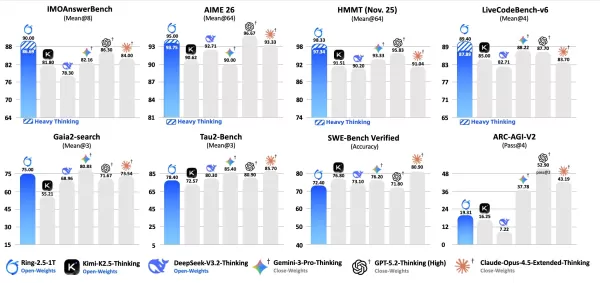
(Figure caption: Ring-2.5-1T achieves open-source leading performance in high-difficulty reasoning tasks like mathematics, code, and logic, as well as in long-term execution tasks such as agent search, software engineering, and tool calling.)
Across multiple authoritative benchmarks, Ring-2.5-1T was systematically compared with leading open-source and closed-source models, including DeepSeek-v3.2-Thinking, Kimi-K2.5-Thinking, GPT-5.2-thinking-high, Gemini-3.0-Pro-preview-thinking, and Claude-Opus-4.5-Extended-Thinking. It achieved open-source-leading performance in high-difficulty scenarios like mathematical reasoning, code generation, logical reasoning, and agent task execution. Particularly in Heavy Thinking mode, it outperformed all compared models on mathematical competition benchmarks such as IMOAnswerBench and HMMT-25, as well as on the LiveCodeBench-v6 code generation benchmark, demonstrating strong complex reasoning and cross-task generalization.
Ring-2.5-1T is based on the Ling2.5 architecture. By optimizing the attention mechanism, it significantly improves the efficiency and stability of long-text reasoning. The number of activated parameters increased from 51B in the previous generation to 63B. Supported by the hybrid linear attention architecture, the reasoning efficiency is significantly improved over the previous generation. Compared to the KIMI K2 architecture, which has only 32B activated parameters, the Ling2.5 architecture demonstrates significant throughput advantages for long-sequence reasoning tasks at a total parameter count of 1T, and this efficiency advantage grows with increasing generation length.
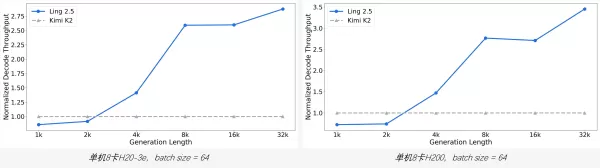
(Figure caption: Efficiency comparison across different generation lengths. The longer the generation, the more pronounced the throughput advantage.)
As AI large model applications expand from short conversations to long document processing, cross-file code understanding, and complex task planning, Ring-2.5-1T effectively addresses the challenges of high computational costs and slow reasoning speed in long output scenarios. The open-sourcing of this model also highlights the Ant Bailing team's comprehensive capabilities in large-scale training infrastructure, algorithm optimization, and engineering implementation, offering the industry a new choice for high-performance, high-efficiency foundation models in the agent era.
Currently, the model weights and inference code for Ring-2.5-1T have been released on major open-source platforms like Hugging Face and ModelScope. The official platform's Chat experience page and API service will be available soon.
Related article
 Swedish AI Startup Lovable Eyes $13.2 Billion Valuation After Major Funding Round
As AI-driven coding tools gain traction, Swedish startup Lovable has secured a major funding round. The company aims to raise $3 billion, potentially boosting its valuation to $13.2 billion—double the $6.6 billion recorded last December. Menlo Ventur
Google Tests Remy AI Agent for Gemini as Focus Shifts to User Control
According to Business Insider, Google is testing Remy, a new AI personal agent for Gemini. This tool aims to execute tasks on behalf of users, streamlining both professional workflows and daily routines.Currently, Remy is undergoing testing in an int
How to fix Core Web Vitals for better SEO rankings
Streamline Report Card Comments with AI ToolsIntroductionAI Tools for Generating Report Card CommentsMagic SchoolAlmanac AIChat GPTUsing Magic School to Generate Report Card CommentsLogging into Magic SchoolSelecting the Report Card Comments ToolCust
Related Special Topic Recommendations
writing
Swedish AI Startup Lovable Eyes $13.2 Billion Valuation After Major Funding Round
As AI-driven coding tools gain traction, Swedish startup Lovable has secured a major funding round. The company aims to raise $3 billion, potentially boosting its valuation to $13.2 billion—double the $6.6 billion recorded last December. Menlo Ventur
Google Tests Remy AI Agent for Gemini as Focus Shifts to User Control
According to Business Insider, Google is testing Remy, a new AI personal agent for Gemini. This tool aims to execute tasks on behalf of users, streamlining both professional workflows and daily routines.Currently, Remy is undergoing testing in an int
How to fix Core Web Vitals for better SEO rankings
Streamline Report Card Comments with AI ToolsIntroductionAI Tools for Generating Report Card CommentsMagic SchoolAlmanac AIChat GPTUsing Magic School to Generate Report Card CommentsLogging into Magic SchoolSelecting the Report Card Comments ToolCust
Related Special Topic Recommendations
writing
 Best AI Outline Generators for Long-Form SEO Articles
2026 Latest Best Top-Rated AI Outline Generators for Long-Form SEO Articles, meticulously curated by XIX.AI. These powerful tools offer game-changing assistance in creating high-quality content quickly, boosting writing efficiency significantly. Get a free vs paid comparison along with real-world tests and detailed rankings to help you find the must-try option that suits your needs. Explore now to unlock your AI edge.
 8 tools
 xix.ai
Education and Learning
AI Study Tools for Homework and Exam Prep
xix.ai
Education and Learning
AI Study Tools for Homework and Exam Prep
2026 Latest Best AI Study Tools for Homework and Exam Prep! XIX.AI curates a top-rated list of powerful, game-changing tools that help students boost productivity, streamline homework completion, and ace exams through real-world tests. Get a free vs paid comparison, detailed rankings, and must-try options to unlock your AI edge. Explore now!
10 tools
xix.ai
Music composition
AI Vocal Demo Tools for Songwriters, Hooks, Toplines, and Multilingual Draft Sessions
2026 Latest Best AI Vocal Demo Tools for Songwriters, Hook Creators, and Multi-Language Content Teams! XIX.AI has curated a top-rated list of powerful game-changing tools that go through rigorous real-world tests. You’ll find detailed free vs paid comparison data, comprehensive rankings, and must-try options to help you boost writing efficiency and unlock your creative potential. Explore now to discover your perfect tool for all your content needs!
9 tools
xix.ai
Business
Best AI Competitive Research Tools for Small Businesses
2026 Latest Best Top-rated AI Competitive Research Tools for Small Businesses! XIX.AI has curated a highly powerful game-changing collection, updated weekly with rigorous real-world tests and detailed rankings. You can find a comprehensive free vs paid comparison to help you identify the must-try tools that boost your productivity and give you a competitive edge. Explore now to discover your perfect tool!
9 tools
xix.ai
Image editing
Photoshop AI Retouch Tools for Ecommerce Apparel, Skin Cleanup, and Color Consistency
2026 Latest Best Photoshop AI retouch tools for ecommerce apparel, skin cleanup, and color consistency! This top-rated curated list features powerful game-changing solutions that help you boost writing efficiency, streamline content creation, and achieve perfect visual results effortlessly. Each tool has undergone real-world tests through weekly updated rankings, complete with free vs paid comparison details. Backed by XIX.AI, it’s the must-try guide for anyone aiming to unlock your AI edge. Explore now!
10 tools
xix.ai
Prompt
Best AI Prompt Libraries for ChatGPT Workflows
2026 Latest Best Top-Rated AI Prompt Libraries for optimizing all types of ChatGPT workflows. XIX.AI has curated a powerful, game-changing collection that goes through rigorous real-world tests to ensure top performance. You can find detailed free vs paid comparisons and expert rankings to help you choose the must-try tools that boost your productivity and unlock your AI edge. Explore now!
11 tools
xix.ai

 Comments (0)
0/500
Comments (0)
0/500
On February 13, Ant Group made the world's first trillion-parameter reasoning model, Ring-2.5-1T, based on a hybrid linear architecture, available as open source. It delivers state-of-the-art open-source performance in long-text generation, mathematical reasoning, and agent task execution, offering a high-performance foundation for handling complex tasks in the agent era.
For generation efficiency, in long-text scenarios beyond 32K, Ring-2.5-1T's memory access is over 10 times lower than the previous generation, while throughput is more than three times higher. In deep reasoning, the model achieved gold-medal-level scores (35 for IMO, 105 for CMO) in self-testing for the International Mathematical Olympiad (IMO2025) and the Chinese Mathematical Olympiad (CMO2025). It also integrates seamlessly with agent frameworks such as Claude Code and OpenClaw personal AI assistants, enabling multi-step planning and tool calling.
(Figure caption: Ring-2.5-1T achieves open-source leading performance in high-difficulty reasoning tasks like mathematics, code, and logic, as well as in long-term execution tasks such as agent search, software engineering, and tool calling.)
Across multiple authoritative benchmarks, Ring-2.5-1T was systematically compared with leading open-source and closed-source models, including DeepSeek-v3.2-Thinking, Kimi-K2.5-Thinking, GPT-5.2-thinking-high, Gemini-3.0-Pro-preview-thinking, and Claude-Opus-4.5-Extended-Thinking. It achieved open-source-leading performance in high-difficulty scenarios like mathematical reasoning, code generation, logical reasoning, and agent task execution. Particularly in Heavy Thinking mode, it outperformed all compared models on mathematical competition benchmarks such as IMOAnswerBench and HMMT-25, as well as on the LiveCodeBench-v6 code generation benchmark, demonstrating strong complex reasoning and cross-task generalization.
Ring-2.5-1T is based on the Ling2.5 architecture. By optimizing the attention mechanism, it significantly improves the efficiency and stability of long-text reasoning. The number of activated parameters increased from 51B in the previous generation to 63B. Supported by the hybrid linear attention architecture, the reasoning efficiency is significantly improved over the previous generation. Compared to the KIMI K2 architecture, which has only 32B activated parameters, the Ling2.5 architecture demonstrates significant throughput advantages for long-sequence reasoning tasks at a total parameter count of 1T, and this efficiency advantage grows with increasing generation length.
(Figure caption: Efficiency comparison across different generation lengths. The longer the generation, the more pronounced the throughput advantage.)
As AI large model applications expand from short conversations to long document processing, cross-file code understanding, and complex task planning, Ring-2.5-1T effectively addresses the challenges of high computational costs and slow reasoning speed in long output scenarios. The open-sourcing of this model also highlights the Ant Bailing team's comprehensive capabilities in large-scale training infrastructure, algorithm optimization, and engineering implementation, offering the industry a new choice for high-performance, high-efficiency foundation models in the agent era.
Currently, the model weights and inference code for Ring-2.5-1T have been released on major open-source platforms like Hugging Face and ModelScope. The official platform's Chat experience page and API service will be available soon.








 Swedish AI Startup Lovable Eyes $13.2 Billion Valuation After Major Funding Round
As AI-driven coding tools gain traction, Swedish startup Lovable has secured a major funding round. The company aims to raise $3 billion, potentially boosting its valuation to $13.2 billion—double the $6.6 billion recorded last December. Menlo Ventur
Google Tests Remy AI Agent for Gemini as Focus Shifts to User Control
According to Business Insider, Google is testing Remy, a new AI personal agent for Gemini. This tool aims to execute tasks on behalf of users, streamlining both professional workflows and daily routines.Currently, Remy is undergoing testing in an int
Swedish AI Startup Lovable Eyes $13.2 Billion Valuation After Major Funding Round
As AI-driven coding tools gain traction, Swedish startup Lovable has secured a major funding round. The company aims to raise $3 billion, potentially boosting its valuation to $13.2 billion—double the $6.6 billion recorded last December. Menlo Ventur
Google Tests Remy AI Agent for Gemini as Focus Shifts to User Control
According to Business Insider, Google is testing Remy, a new AI personal agent for Gemini. This tool aims to execute tasks on behalf of users, streamlining both professional workflows and daily routines.Currently, Remy is undergoing testing in an int
 How to fix Core Web Vitals for better SEO rankings
Streamline Report Card Comments with AI ToolsIntroductionAI Tools for Generating Report Card CommentsMagic SchoolAlmanac AIChat GPTUsing Magic School to Generate Report Card CommentsLogging into Magic SchoolSelecting the Report Card Comments ToolCust
How to fix Core Web Vitals for better SEO rankings
Streamline Report Card Comments with AI ToolsIntroductionAI Tools for Generating Report Card CommentsMagic SchoolAlmanac AIChat GPTUsing Magic School to Generate Report Card CommentsLogging into Magic SchoolSelecting the Report Card Comments ToolCust

2026 Latest Best Top-Rated AI Outline Generators for Long-Form SEO Articles, meticulously curated by XIX.AI. These powerful tools offer game-changing assistance in creating high-quality content quickly, boosting writing efficiency significantly. Get a free vs paid comparison along with real-world tests and detailed rankings to help you find the must-try option that suits your needs. Explore now to unlock your AI edge.
8 tools
xix.ai

2026 Latest Best AI Study Tools for Homework and Exam Prep! XIX.AI curates a top-rated list of powerful, game-changing tools that help students boost productivity, streamline homework completion, and ace exams through real-world tests. Get a free vs paid comparison, detailed rankings, and must-try options to unlock your AI edge. Explore now!
10 tools
xix.ai

2026 Latest Best AI Vocal Demo Tools for Songwriters, Hook Creators, and Multi-Language Content Teams! XIX.AI has curated a top-rated list of powerful game-changing tools that go through rigorous real-world tests. You’ll find detailed free vs paid comparison data, comprehensive rankings, and must-try options to help you boost writing efficiency and unlock your creative potential. Explore now to discover your perfect tool for all your content needs!
9 tools
xix.ai

2026 Latest Best Top-rated AI Competitive Research Tools for Small Businesses! XIX.AI has curated a highly powerful game-changing collection, updated weekly with rigorous real-world tests and detailed rankings. You can find a comprehensive free vs paid comparison to help you identify the must-try tools that boost your productivity and give you a competitive edge. Explore now to discover your perfect tool!
9 tools
xix.ai

2026 Latest Best Photoshop AI retouch tools for ecommerce apparel, skin cleanup, and color consistency! This top-rated curated list features powerful game-changing solutions that help you boost writing efficiency, streamline content creation, and achieve perfect visual results effortlessly. Each tool has undergone real-world tests through weekly updated rankings, complete with free vs paid comparison details. Backed by XIX.AI, it’s the must-try guide for anyone aiming to unlock your AI edge. Explore now!
10 tools
xix.ai
2026 Latest Best Top-Rated AI Prompt Libraries for optimizing all types of ChatGPT workflows. XIX.AI has curated a powerful, game-changing collection that goes through rigorous real-world tests to ensure top performance. You can find detailed free vs paid comparisons and expert rankings to help you choose the must-try tools that boost your productivity and unlock your AI edge. Explore now!
11 tools
xix.ai












