


 Home
HomeYouTube bolsters AI deepfake protections for politicians, officials, and journalists
YouTube is extending access to its likeness detection technology, designed to identify AI-generated deepfakes, to a pilot program for government officials, political candidates, and journalists, the company announced on Tuesday. Participants in this pilot will be able to use a tool that finds unauthorized AI-generated content featuring their likeness and submit requests for its removal if it violates YouTube's policies.
This technology was initially rolled out last year to approximately 4 million creators in YouTube's Partner Program, building on earlier tests.
Functioning similarly to YouTube's established Content ID system for copyrighted material, this likeness detection feature scans for AI-simulated faces. Such AI tools are occasionally exploited to disseminate misinformation by creating convincing deepfakes of public figures—such as politicians or officials—portraying them saying or doing things that never occurred.
Through this new pilot, YouTube seeks to find a balance between protecting free expression and addressing the risks posed by AI technology that can produce realistic impersonations of individuals in the public eye.
"This expansion is fundamentally about safeguarding the integrity of public discourse," stated Leslie Miller, YouTube's Vice President of Government Affairs and Public Policy, in a press briefing. "We recognize the heightened risks of AI impersonation for those in civic roles. While offering this new protection, we are implementing it with careful consideration," she added.
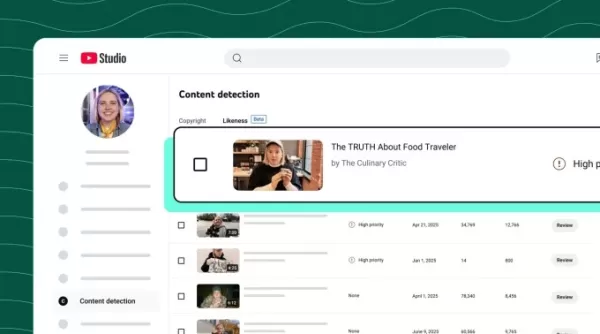
Image Credits:YouTube
Miller clarified that not every detected match will be automatically removed upon request. YouTube will assess each case against its existing privacy policy to determine if the content constitutes protected expression, such as parody or political critique.
The company also stated its support for federal-level protections, endorsing legislation like the proposed NO FAKES Act in Washington, D.C., which aims to regulate the unauthorized AI replication of a person's voice and visual likeness.
Eligible pilot testers must verify their identity by providing a selfie and a government-issued ID to use the tool. They can then set up a profile, review detected matches, and choose to request removals. YouTube plans to eventually allow users to block violating content before it's published or, potentially, to claim monetization rights, mirroring the functionality of its Content ID system.
YouTube did not disclose the specific individuals included in the initial pilot group but indicated the goal is to make the technology widely available in the future.
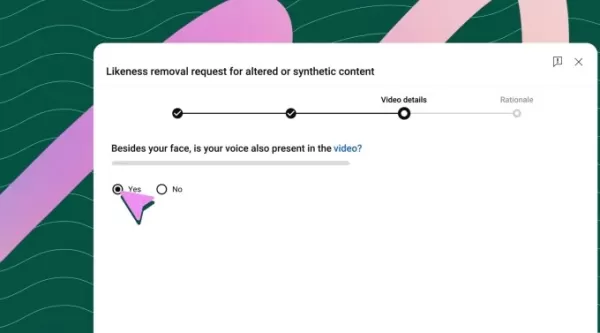
Image Credits:YouTube
Videos identified as AI-generated will carry a label, though its placement will vary. For some content, the label will appear in the video description, while videos on more "sensitive topics" will feature a more prominent label directly on the video player. This approach is consistent with YouTube's labeling for all AI-generated content.
"A significant amount of content is produced with AI, but that fact isn't always central to the content's purpose," explained Amjad Hanif, YouTube's Vice President of Creator Products, regarding label placement. "It could be an AI-generated cartoon, for instance. We use judgment to decide which categories might benefit from a highly visible disclaimer."
YouTube has not disclosed the exact number of AI deepfake removals facilitated by this technology since its release to creators but notes the volume taken down so far has been "minimal."
"For many creators, the primary benefit has been increased awareness of what's being uploaded. The actual number of removal requests remains very low, as most content is fairly benign or even complementary to their channel," Hanif said.
This dynamic may differ for deepfakes targeting government officials, politicians, or journalists.
Looking ahead, YouTube aims to expand its deepfake detection technology to cover other areas, including recognizable voices and intellectual property such as popular fictional characters.
Related article
 Google Tests Remy AI Agent for Gemini as Focus Shifts to User Control
According to Business Insider, Google is testing Remy, a new AI personal agent for Gemini. This tool aims to execute tasks on behalf of users, streamlining both professional workflows and daily routines.Currently, Remy is undergoing testing in an int
Ollie bets privacy focus to win AI assistant race
To be genuinely helpful, an AI assistant must understand its user deeply. Ollie, a personal assistant designed for daily life, operates on the premise that this doesn’t require surrendering your data or compromising your privacy.While certain enterpr
How AI LIVE: London Will Explore AI & Industrial Automation
The summit will convene C-suite executives from around the globe to address pressing challenges in global industries, ranging from AI-driven disruption to economic volatility.AI LIVE: The London Summit will gather over 2,000 international leaders und
Related Special Topic Recommendations
SEO
Google Tests Remy AI Agent for Gemini as Focus Shifts to User Control
According to Business Insider, Google is testing Remy, a new AI personal agent for Gemini. This tool aims to execute tasks on behalf of users, streamlining both professional workflows and daily routines.Currently, Remy is undergoing testing in an int
Ollie bets privacy focus to win AI assistant race
To be genuinely helpful, an AI assistant must understand its user deeply. Ollie, a personal assistant designed for daily life, operates on the premise that this doesn’t require surrendering your data or compromising your privacy.While certain enterpr
How AI LIVE: London Will Explore AI & Industrial Automation
The summit will convene C-suite executives from around the globe to address pressing challenges in global industries, ranging from AI-driven disruption to economic volatility.AI LIVE: The London Summit will gather over 2,000 international leaders und
Related Special Topic Recommendations
SEO
 Best AI SERP Analysis Tools for Search Strategy
2026 Latest Best Top-rated AI SERP Analysis Tools for Search Strategy are curated by XIX.AI through rigorous real-world tests and weekly updated rankings. These powerful tools help you unlock hidden optimization opportunities, boost content performance, and gain a competitive edge in search. Discover your perfect tool to elevate your search strategy today. Explore now!
 13 tools
 xix.ai
Data Analysis
Best AI Anomaly Detection Tools for KPI Monitoring across SaaS and Ecommerce Teams
xix.ai
Data Analysis
Best AI Anomaly Detection Tools for KPI Monitoring across SaaS and Ecommerce Teams
2026 Latest Best Top-rated AI Anomaly Detection Tools for KPI Monitoring in SaaS and Ecommerce teams! XIX.AI has curated a powerful, game-changing collection based on rigorous real-world tests and weekly updated rankings. You’ll find detailed free vs paid comparison insights to help you identify the must-try solution that boosts productivity and unlocks your AI edge. Explore now!
10 tools
xix.ai
writing
Best AI Outline Generators for Long-Form SEO Articles
2026 Latest Best Top-Rated AI Outline Generators for Long-Form SEO Articles, meticulously curated by XIX.AI. These powerful tools offer game-changing assistance in creating high-quality content quickly, boosting writing efficiency significantly. Get a free vs paid comparison along with real-world tests and detailed rankings to help you find the must-try option that suits your needs. Explore now to unlock your AI edge.
8 tools
xix.ai
Education and Learning
AI Study Tools for Homework and Exam Prep
2026 Latest Best AI Study Tools for Homework and Exam Prep! XIX.AI curates a top-rated list of powerful, game-changing tools that help students boost productivity, streamline homework completion, and ace exams through real-world tests. Get a free vs paid comparison, detailed rankings, and must-try options to unlock your AI edge. Explore now!
10 tools
xix.ai
Music composition
AI Vocal Demo Tools for Songwriters, Hooks, Toplines, and Multilingual Draft Sessions
2026 Latest Best AI Vocal Demo Tools for Songwriters, Hook Creators, and Multi-Language Content Teams! XIX.AI has curated a top-rated list of powerful game-changing tools that go through rigorous real-world tests. You’ll find detailed free vs paid comparison data, comprehensive rankings, and must-try options to help you boost writing efficiency and unlock your creative potential. Explore now to discover your perfect tool for all your content needs!
9 tools
xix.ai
Business
Best AI Competitive Research Tools for Small Businesses
2026 Latest Best Top-rated AI Competitive Research Tools for Small Businesses! XIX.AI has curated a highly powerful game-changing collection, updated weekly with rigorous real-world tests and detailed rankings. You can find a comprehensive free vs paid comparison to help you identify the must-try tools that boost your productivity and give you a competitive edge. Explore now to discover your perfect tool!
9 tools
xix.ai

 Comments (0)
0/500
Comments (0)
0/500
YouTube is extending access to its likeness detection technology, designed to identify AI-generated deepfakes, to a pilot program for government officials, political candidates, and journalists, the company announced on Tuesday. Participants in this pilot will be able to use a tool that finds unauthorized AI-generated content featuring their likeness and submit requests for its removal if it violates YouTube's policies.
This technology was initially rolled out last year to approximately 4 million creators in YouTube's Partner Program, building on earlier tests.
Functioning similarly to YouTube's established Content ID system for copyrighted material, this likeness detection feature scans for AI-simulated faces. Such AI tools are occasionally exploited to disseminate misinformation by creating convincing deepfakes of public figures—such as politicians or officials—portraying them saying or doing things that never occurred.
Through this new pilot, YouTube seeks to find a balance between protecting free expression and addressing the risks posed by AI technology that can produce realistic impersonations of individuals in the public eye.
"This expansion is fundamentally about safeguarding the integrity of public discourse," stated Leslie Miller, YouTube's Vice President of Government Affairs and Public Policy, in a press briefing. "We recognize the heightened risks of AI impersonation for those in civic roles. While offering this new protection, we are implementing it with careful consideration," she added.
Image Credits:YouTube
Miller clarified that not every detected match will be automatically removed upon request. YouTube will assess each case against its existing privacy policy to determine if the content constitutes protected expression, such as parody or political critique.
The company also stated its support for federal-level protections, endorsing legislation like the proposed NO FAKES Act in Washington, D.C., which aims to regulate the unauthorized AI replication of a person's voice and visual likeness.
Eligible pilot testers must verify their identity by providing a selfie and a government-issued ID to use the tool. They can then set up a profile, review detected matches, and choose to request removals. YouTube plans to eventually allow users to block violating content before it's published or, potentially, to claim monetization rights, mirroring the functionality of its Content ID system.
YouTube did not disclose the specific individuals included in the initial pilot group but indicated the goal is to make the technology widely available in the future.
Image Credits:YouTube
Videos identified as AI-generated will carry a label, though its placement will vary. For some content, the label will appear in the video description, while videos on more "sensitive topics" will feature a more prominent label directly on the video player. This approach is consistent with YouTube's labeling for all AI-generated content.
"A significant amount of content is produced with AI, but that fact isn't always central to the content's purpose," explained Amjad Hanif, YouTube's Vice President of Creator Products, regarding label placement. "It could be an AI-generated cartoon, for instance. We use judgment to decide which categories might benefit from a highly visible disclaimer."
YouTube has not disclosed the exact number of AI deepfake removals facilitated by this technology since its release to creators but notes the volume taken down so far has been "minimal."
"For many creators, the primary benefit has been increased awareness of what's being uploaded. The actual number of removal requests remains very low, as most content is fairly benign or even complementary to their channel," Hanif said.
This dynamic may differ for deepfakes targeting government officials, politicians, or journalists.
Looking ahead, YouTube aims to expand its deepfake detection technology to cover other areas, including recognizable voices and intellectual property such as popular fictional characters.







 Google Tests Remy AI Agent for Gemini as Focus Shifts to User Control
According to Business Insider, Google is testing Remy, a new AI personal agent for Gemini. This tool aims to execute tasks on behalf of users, streamlining both professional workflows and daily routines.Currently, Remy is undergoing testing in an int
Google Tests Remy AI Agent for Gemini as Focus Shifts to User Control
According to Business Insider, Google is testing Remy, a new AI personal agent for Gemini. This tool aims to execute tasks on behalf of users, streamlining both professional workflows and daily routines.Currently, Remy is undergoing testing in an int
 Ollie bets privacy focus to win AI assistant race
To be genuinely helpful, an AI assistant must understand its user deeply. Ollie, a personal assistant designed for daily life, operates on the premise that this doesn’t require surrendering your data or compromising your privacy.While certain enterpr
Ollie bets privacy focus to win AI assistant race
To be genuinely helpful, an AI assistant must understand its user deeply. Ollie, a personal assistant designed for daily life, operates on the premise that this doesn’t require surrendering your data or compromising your privacy.While certain enterpr
 How AI LIVE: London Will Explore AI & Industrial Automation
The summit will convene C-suite executives from around the globe to address pressing challenges in global industries, ranging from AI-driven disruption to economic volatility.AI LIVE: The London Summit will gather over 2,000 international leaders und
How AI LIVE: London Will Explore AI & Industrial Automation
The summit will convene C-suite executives from around the globe to address pressing challenges in global industries, ranging from AI-driven disruption to economic volatility.AI LIVE: The London Summit will gather over 2,000 international leaders und

2026 Latest Best Top-rated AI SERP Analysis Tools for Search Strategy are curated by XIX.AI through rigorous real-world tests and weekly updated rankings. These powerful tools help you unlock hidden optimization opportunities, boost content performance, and gain a competitive edge in search. Discover your perfect tool to elevate your search strategy today. Explore now!
13 tools
xix.ai

2026 Latest Best Top-rated AI Anomaly Detection Tools for KPI Monitoring in SaaS and Ecommerce teams! XIX.AI has curated a powerful, game-changing collection based on rigorous real-world tests and weekly updated rankings. You’ll find detailed free vs paid comparison insights to help you identify the must-try solution that boosts productivity and unlocks your AI edge. Explore now!
10 tools
xix.ai

2026 Latest Best Top-Rated AI Outline Generators for Long-Form SEO Articles, meticulously curated by XIX.AI. These powerful tools offer game-changing assistance in creating high-quality content quickly, boosting writing efficiency significantly. Get a free vs paid comparison along with real-world tests and detailed rankings to help you find the must-try option that suits your needs. Explore now to unlock your AI edge.
8 tools
xix.ai

2026 Latest Best AI Study Tools for Homework and Exam Prep! XIX.AI curates a top-rated list of powerful, game-changing tools that help students boost productivity, streamline homework completion, and ace exams through real-world tests. Get a free vs paid comparison, detailed rankings, and must-try options to unlock your AI edge. Explore now!
10 tools
xix.ai

2026 Latest Best AI Vocal Demo Tools for Songwriters, Hook Creators, and Multi-Language Content Teams! XIX.AI has curated a top-rated list of powerful game-changing tools that go through rigorous real-world tests. You’ll find detailed free vs paid comparison data, comprehensive rankings, and must-try options to help you boost writing efficiency and unlock your creative potential. Explore now to discover your perfect tool for all your content needs!
9 tools
xix.ai

2026 Latest Best Top-rated AI Competitive Research Tools for Small Businesses! XIX.AI has curated a highly powerful game-changing collection, updated weekly with rigorous real-world tests and detailed rankings. You can find a comprehensive free vs paid comparison to help you identify the must-try tools that boost your productivity and give you a competitive edge. Explore now to discover your perfect tool!
9 tools
xix.ai












