


 Home
HomeWordPress launches browser-based private workspace via new my.WordPress.net service
WordPress publishing software now runs entirely within a web browser, the organization behind the open source platform announced Wednesday. With the new my.WordPress.net service, users can set up a site and start publishing without signing up, arranging hosting, or registering a domain. Instead, it uses the same technology that powers WordPress demos, offering it as a permanent, personal publishing environment.
There’s one major catch to running WordPress this way: sites created on my.WordPress.net are private by default and cannot be accessed from the public internet.
“They aren’t optimized for traffic, discovery, or presentation, and they don’t need to be,” a blog post introducing the service explains. “WordPress instead becomes a personal space where ideas can exist before they’re ready to share—or where they may never be shared at all.”
Sites built through this service are tied to your browser, with data stored locally in the browser’s storage. That means you can’t access the site from another device. However, you can move your site to a dedicated WordPress host if you ever decide to make it public.
This positions WordPress as a personal workspace for activities such as private writing, journaling, drafting, research, and learning, or for building tools for personal use. For the latter, my.WordPress.net includes an App Catalog with a variety of tools built using WordPress plugins, including a Personal CRM, Personal RSS Reader, bookmarking tool, AI Workspace, and more.
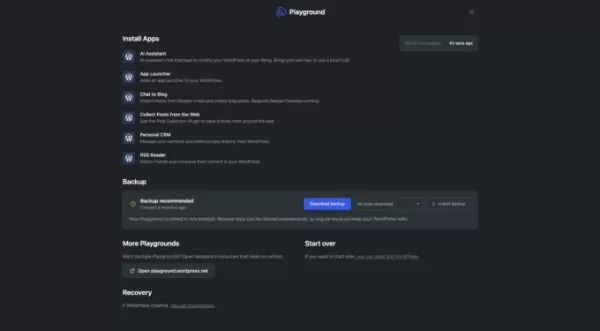
Image credit: WordPress.org
The post notes that my.WordPress.net is powered by WordPress Playground, an open source project that lets you install WordPress on any device with a single click, and also integrates with OpenAI and CLI apps to create new tools. As a result, you can use an AI assistant to modify my.WordPress.net, for example to tweak a plugin or build a new one.
You can also ask the assistant about data stored in WordPress, which it remembers, effectively turning WordPress into a personal knowledge base accessed by AI.
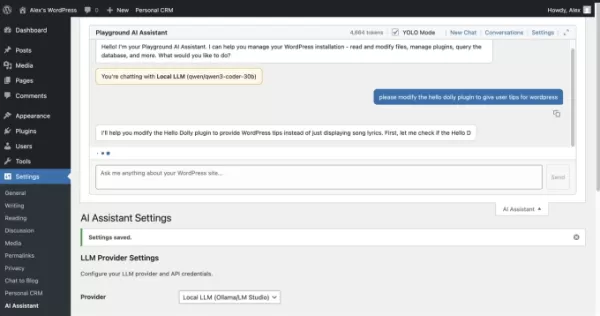
Image credit: WordPress.org
The service takes longer to load on first use, the post cautions, and recommends regularly saving backups. Storage starts at roughly 100 MB, making it better suited for smaller, personal apps and use cases.
If you ever want to delete your current work, you can click a button to reset the site. Alternatively, you can set up new temporary instances that reset themselves when the browser is refreshed.
The service launch follows the formation of a WordPress AI team last year, focused on delivering new AI products for the developer community. The commercial hosting platform WordPress.com also introduced an AI website builder last year, allowing users to design a site through an AI chatbot-style interface.
Related article
 Majority of U.S. consumers find 'AI' in brand messaging off-putting, survey shows
According to a new report from WordPress VIP, the Automattic-owned company offering an enterprise version of the WordPress publishing platform, getting cited by AI is easier than earning consumer trust. As brands race to have their links appear in AI
WordPress.com now allows AI agents to write and publish posts, plus more
WordPress.com, the popular web hosting and publishing platform, is now embracing AI agents—a move that could reshape the look and feel of the web. The company announced Friday that it will allow AI agents to draft, edit, and publish content on custom
U.S. Stocks Hit Historic Milestone as AI and Aerospace Giants Prepare for Trillion-Dollar Debut
Elon Musk, Sam Altman, and Dario Amodei, three titans of the technology sector, are advancing toward initial public offerings for their respective ventures. With SpaceX, OpenAI, and Anthropic—three industry behemoths nearing trillion-dollar valuation
Related Special Topic Recommendations
Data Analysis
Majority of U.S. consumers find 'AI' in brand messaging off-putting, survey shows
According to a new report from WordPress VIP, the Automattic-owned company offering an enterprise version of the WordPress publishing platform, getting cited by AI is easier than earning consumer trust. As brands race to have their links appear in AI
WordPress.com now allows AI agents to write and publish posts, plus more
WordPress.com, the popular web hosting and publishing platform, is now embracing AI agents—a move that could reshape the look and feel of the web. The company announced Friday that it will allow AI agents to draft, edit, and publish content on custom
U.S. Stocks Hit Historic Milestone as AI and Aerospace Giants Prepare for Trillion-Dollar Debut
Elon Musk, Sam Altman, and Dario Amodei, three titans of the technology sector, are advancing toward initial public offerings for their respective ventures. With SpaceX, OpenAI, and Anthropic—three industry behemoths nearing trillion-dollar valuation
Related Special Topic Recommendations
Data Analysis
 Best AI Anomaly Detection Tools for KPI Monitoring across SaaS and Ecommerce Teams
2026 Latest Best Top-rated AI Anomaly Detection Tools for KPI Monitoring in SaaS and Ecommerce teams! XIX.AI has curated a powerful, game-changing collection based on rigorous real-world tests and weekly updated rankings. You’ll find detailed free vs paid comparison insights to help you identify the must-try solution that boosts productivity and unlocks your AI edge. Explore now!
 10 tools
 xix.ai
writing
Best AI Outline Generators for Long-Form SEO Articles
xix.ai
writing
Best AI Outline Generators for Long-Form SEO Articles
2026 Latest Best Top-Rated AI Outline Generators for Long-Form SEO Articles, meticulously curated by XIX.AI. These powerful tools offer game-changing assistance in creating high-quality content quickly, boosting writing efficiency significantly. Get a free vs paid comparison along with real-world tests and detailed rankings to help you find the must-try option that suits your needs. Explore now to unlock your AI edge.
8 tools
xix.ai
Education and Learning
AI Study Tools for Homework and Exam Prep
2026 Latest Best AI Study Tools for Homework and Exam Prep! XIX.AI curates a top-rated list of powerful, game-changing tools that help students boost productivity, streamline homework completion, and ace exams through real-world tests. Get a free vs paid comparison, detailed rankings, and must-try options to unlock your AI edge. Explore now!
10 tools
xix.ai
Music composition
AI Vocal Demo Tools for Songwriters, Hooks, Toplines, and Multilingual Draft Sessions
2026 Latest Best AI Vocal Demo Tools for Songwriters, Hook Creators, and Multi-Language Content Teams! XIX.AI has curated a top-rated list of powerful game-changing tools that go through rigorous real-world tests. You’ll find detailed free vs paid comparison data, comprehensive rankings, and must-try options to help you boost writing efficiency and unlock your creative potential. Explore now to discover your perfect tool for all your content needs!
9 tools
xix.ai
Business
Best AI Competitive Research Tools for Small Businesses
2026 Latest Best Top-rated AI Competitive Research Tools for Small Businesses! XIX.AI has curated a highly powerful game-changing collection, updated weekly with rigorous real-world tests and detailed rankings. You can find a comprehensive free vs paid comparison to help you identify the must-try tools that boost your productivity and give you a competitive edge. Explore now to discover your perfect tool!
9 tools
xix.ai
Image editing
Photoshop AI Retouch Tools for Ecommerce Apparel, Skin Cleanup, and Color Consistency
2026 Latest Best Photoshop AI retouch tools for ecommerce apparel, skin cleanup, and color consistency! This top-rated curated list features powerful game-changing solutions that help you boost writing efficiency, streamline content creation, and achieve perfect visual results effortlessly. Each tool has undergone real-world tests through weekly updated rankings, complete with free vs paid comparison details. Backed by XIX.AI, it’s the must-try guide for anyone aiming to unlock your AI edge. Explore now!
10 tools
xix.ai

 Comments (1)
0/500
Comments (1)
0/500
![DavidGonzalez]()
Wow, this is actually pretty neat! I love that you can start publishing without signing up - it removes so much friction. But wait, if there's no account, how do they save your work? Is it all local storage? 🤔 Seems like a great move for quick prototyping though. Might give it a try!
WordPress publishing software now runs entirely within a web browser, the organization behind the open source platform announced Wednesday. With the new my.WordPress.net service, users can set up a site and start publishing without signing up, arranging hosting, or registering a domain. Instead, it uses the same technology that powers WordPress demos, offering it as a permanent, personal publishing environment.
There’s one major catch to running WordPress this way: sites created on my.WordPress.net are private by default and cannot be accessed from the public internet.
“They aren’t optimized for traffic, discovery, or presentation, and they don’t need to be,” a blog post introducing the service explains. “WordPress instead becomes a personal space where ideas can exist before they’re ready to share—or where they may never be shared at all.”
Sites built through this service are tied to your browser, with data stored locally in the browser’s storage. That means you can’t access the site from another device. However, you can move your site to a dedicated WordPress host if you ever decide to make it public.
This positions WordPress as a personal workspace for activities such as private writing, journaling, drafting, research, and learning, or for building tools for personal use. For the latter, my.WordPress.net includes an App Catalog with a variety of tools built using WordPress plugins, including a Personal CRM, Personal RSS Reader, bookmarking tool, AI Workspace, and more.
Image credit: WordPress.org
The post notes that my.WordPress.net is powered by WordPress Playground, an open source project that lets you install WordPress on any device with a single click, and also integrates with OpenAI and CLI apps to create new tools. As a result, you can use an AI assistant to modify my.WordPress.net, for example to tweak a plugin or build a new one.
You can also ask the assistant about data stored in WordPress, which it remembers, effectively turning WordPress into a personal knowledge base accessed by AI.
Image credit: WordPress.org
The service takes longer to load on first use, the post cautions, and recommends regularly saving backups. Storage starts at roughly 100 MB, making it better suited for smaller, personal apps and use cases.
If you ever want to delete your current work, you can click a button to reset the site. Alternatively, you can set up new temporary instances that reset themselves when the browser is refreshed.
The service launch follows the formation of a WordPress AI team last year, focused on delivering new AI products for the developer community. The commercial hosting platform WordPress.com also introduced an AI website builder last year, allowing users to design a site through an AI chatbot-style interface.








 Majority of U.S. consumers find 'AI' in brand messaging off-putting, survey shows
According to a new report from WordPress VIP, the Automattic-owned company offering an enterprise version of the WordPress publishing platform, getting cited by AI is easier than earning consumer trust. As brands race to have their links appear in AI
Majority of U.S. consumers find 'AI' in brand messaging off-putting, survey shows
According to a new report from WordPress VIP, the Automattic-owned company offering an enterprise version of the WordPress publishing platform, getting cited by AI is easier than earning consumer trust. As brands race to have their links appear in AI
 WordPress.com now allows AI agents to write and publish posts, plus more
WordPress.com, the popular web hosting and publishing platform, is now embracing AI agents—a move that could reshape the look and feel of the web. The company announced Friday that it will allow AI agents to draft, edit, and publish content on custom
WordPress.com now allows AI agents to write and publish posts, plus more
WordPress.com, the popular web hosting and publishing platform, is now embracing AI agents—a move that could reshape the look and feel of the web. The company announced Friday that it will allow AI agents to draft, edit, and publish content on custom
 U.S. Stocks Hit Historic Milestone as AI and Aerospace Giants Prepare for Trillion-Dollar Debut
Elon Musk, Sam Altman, and Dario Amodei, three titans of the technology sector, are advancing toward initial public offerings for their respective ventures. With SpaceX, OpenAI, and Anthropic—three industry behemoths nearing trillion-dollar valuation
U.S. Stocks Hit Historic Milestone as AI and Aerospace Giants Prepare for Trillion-Dollar Debut
Elon Musk, Sam Altman, and Dario Amodei, three titans of the technology sector, are advancing toward initial public offerings for their respective ventures. With SpaceX, OpenAI, and Anthropic—three industry behemoths nearing trillion-dollar valuation

2026 Latest Best Top-rated AI Anomaly Detection Tools for KPI Monitoring in SaaS and Ecommerce teams! XIX.AI has curated a powerful, game-changing collection based on rigorous real-world tests and weekly updated rankings. You’ll find detailed free vs paid comparison insights to help you identify the must-try solution that boosts productivity and unlocks your AI edge. Explore now!
10 tools
xix.ai

2026 Latest Best Top-Rated AI Outline Generators for Long-Form SEO Articles, meticulously curated by XIX.AI. These powerful tools offer game-changing assistance in creating high-quality content quickly, boosting writing efficiency significantly. Get a free vs paid comparison along with real-world tests and detailed rankings to help you find the must-try option that suits your needs. Explore now to unlock your AI edge.
8 tools
xix.ai

2026 Latest Best AI Study Tools for Homework and Exam Prep! XIX.AI curates a top-rated list of powerful, game-changing tools that help students boost productivity, streamline homework completion, and ace exams through real-world tests. Get a free vs paid comparison, detailed rankings, and must-try options to unlock your AI edge. Explore now!
10 tools
xix.ai

2026 Latest Best AI Vocal Demo Tools for Songwriters, Hook Creators, and Multi-Language Content Teams! XIX.AI has curated a top-rated list of powerful game-changing tools that go through rigorous real-world tests. You’ll find detailed free vs paid comparison data, comprehensive rankings, and must-try options to help you boost writing efficiency and unlock your creative potential. Explore now to discover your perfect tool for all your content needs!
9 tools
xix.ai

2026 Latest Best Top-rated AI Competitive Research Tools for Small Businesses! XIX.AI has curated a highly powerful game-changing collection, updated weekly with rigorous real-world tests and detailed rankings. You can find a comprehensive free vs paid comparison to help you identify the must-try tools that boost your productivity and give you a competitive edge. Explore now to discover your perfect tool!
9 tools
xix.ai

2026 Latest Best Photoshop AI retouch tools for ecommerce apparel, skin cleanup, and color consistency! This top-rated curated list features powerful game-changing solutions that help you boost writing efficiency, streamline content creation, and achieve perfect visual results effortlessly. Each tool has undergone real-world tests through weekly updated rankings, complete with free vs paid comparison details. Backed by XIX.AI, it’s the must-try guide for anyone aiming to unlock your AI edge. Explore now!
10 tools
xix.ai

Wow, this is actually pretty neat! I love that you can start publishing without signing up - it removes so much friction. But wait, if there's no account, how do they save your work? Is it all local storage? 🤔 Seems like a great move for quick prototyping though. Might give it a try!












