


 Home
HomeWhy the rise of open source AI isn’t hurting Anthropic yet
On Monday, Decagon CEO Jesse Zhang unveiled a provocative new theory under the headline “Everyone is wrong about open source AI in the enterprise.” The post explores one of today’s most compelling contradictions in the AI economy: while more mature AI deployments are shifting toward lighter models—even within his own company—overall spending on expensive state-of-the-art models remains largely unchanged.
This perspective reframes the relationship between frontier and open source models. According to Zhang, they are not competitors, and the success of open source models does not come at the expense of frontier labs. Instead, they represent two phases of the same lifecycle: expensive frontier models are used to validate use cases, which are then handed off to cheaper open source alternatives as they mature.
As established use cases migrate to lighter models, new use cases continuously emerge, keeping overall spending on frontier models steady.
Although Zhang provides limited data to support his argument, the evidence is readily available. Vercel’s AI gateway dashboard reveals that over the past week, DeepSeek surged to the top for token volumes, processing just over a third of all tokens through its infrastructure. Meanwhile, Z.ai—the lab behind the popular GLM-5.2 model—climbed to a respectable fourth place during the same period.
However, when examining overall token spend, Anthropic still accounts for more than half of the total AI expenditure on the platform. Although this share has dipped slightly over the past month due to Anthropic’s own price increases, the decline is not significant.
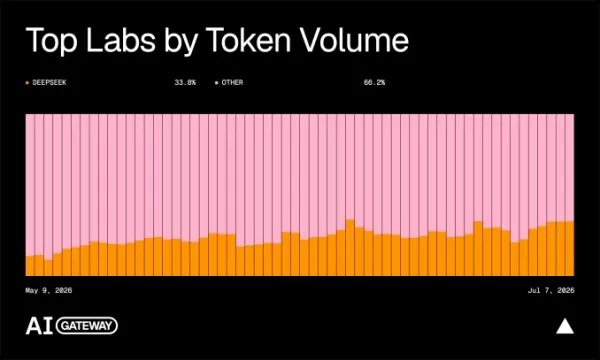
Image Credits:Vercel dashboard / data export
OpenRouter presents a similar narrative, capturing a larger (though slightly less enterprise-focused) segment of the market. DeepSeek V4 Flash leads in overall usage, processing 5.3 trillion tokens weekly. The most popular frontier model, Opus 4.8, handles just over 2 trillion tokens. While OpenRouter does not rank models by total spend, it shows that the average token cost for Opus 4.8 is roughly 23 times higher than V4 Flash ($1.37 per million tokens versus just 6 cents), suggesting that Opus still captures the majority of spending.
These figures do not even include Nvidia’s newest entry, Nemotron, which is poised to leap to the forefront thanks to Nvidia’s strong industry connections and the model’s exceptional adaptability.
While these numbers do not fully prove Zhang’s point about AI lifecycles, they do indicate that frontier labs like Anthropic are not yet suffering significantly from the rise of open source—at least not for now. One explanation is that the market for AI-addressable tasks is expanding so rapidly that top models can maintain their dominance by controlling early-stage deployments. As Zhang states, “The frontier labs will keep owning discovery. Open source will increasingly own production.” Another possibility is that, even as clients adopt open-source models, many use cases are too complex to be entirely replaced by cheaper alternatives.
Regardless, this two-tiered model economy may become a stable feature of the AI landscape.
As recently as last September, I wrote about the possibility that foundation labs would end up selling coffee beans to Starbucks—essentially serving as commodity inputs while the application layer reaped the benefits. Some aspects of this prediction have materialized: vertical AI companies have shifted to lighter models, and the economics of “GPT wrapper” startups have remained largely stable.
Yet, we are also seeing that, token for token, frontier providers have retained the most valuable segment of the marketplace: premium token pricing. This trend does not appear likely to change anytime soon.
Related article
 Ollie bets privacy focus to win AI assistant race
To be genuinely helpful, an AI assistant must understand its user deeply. Ollie, a personal assistant designed for daily life, operates on the premise that this doesn’t require surrendering your data or compromising your privacy.While certain enterpr
How AI LIVE: London Will Explore AI & Industrial Automation
The summit will convene C-suite executives from around the globe to address pressing challenges in global industries, ranging from AI-driven disruption to economic volatility.AI LIVE: The London Summit will gather over 2,000 international leaders und
Anthropic Enters AI Legal Tech Market as Competition Intensifies
Anthropic unveiled a suite of new chatbot capabilities on Tuesday, aimed at delivering automated support to legal practices. These enhancements expand upon Claude for Legal, the firm-specific platform introduced earlier this year, by adding specializ
Related Special Topic Recommendations
Text-to-speech
Ollie bets privacy focus to win AI assistant race
To be genuinely helpful, an AI assistant must understand its user deeply. Ollie, a personal assistant designed for daily life, operates on the premise that this doesn’t require surrendering your data or compromising your privacy.While certain enterpr
How AI LIVE: London Will Explore AI & Industrial Automation
The summit will convene C-suite executives from around the globe to address pressing challenges in global industries, ranging from AI-driven disruption to economic volatility.AI LIVE: The London Summit will gather over 2,000 international leaders und
Anthropic Enters AI Legal Tech Market as Competition Intensifies
Anthropic unveiled a suite of new chatbot capabilities on Tuesday, aimed at delivering automated support to legal practices. These enhancements expand upon Claude for Legal, the firm-specific platform introduced earlier this year, by adding specializ
Related Special Topic Recommendations
Text-to-speech
 Best AI Text to Speech Tools for Online Courses
2026 Latest Best Top-rated AI Text to Speech Tools for Online Courses are curated by XIX.AI based on rigorous real-world tests and weekly updated rankings. These powerful tools help creators deliver crystal-clear audio content effortlessly, boosting writing efficiency and streamlining course production. Check out the free vs paid comparison to find your perfect fit. Explore now to unlock your AI edge in online education.
 10 tools
 xix.ai
writing
AI Blog Title Tools for Higher Click Through Rates
xix.ai
writing
AI Blog Title Tools for Higher Click Through Rates
2026 Latest Best Top-Rated AI Blog Title Tools for Higher Click Through Rates! XIX.AI has carefully curated a powerful, game-changing collection of top tools that go through rigorous real-world tests. You’ll find a free vs paid comparison, weekly updated rankings, and detailed insights to help you boost your blog’s traffic efficiently. Must-try options are highlighted to help you unlock your AI edge. Explore now!
10 tools
xix.ai
automation
Best AI Task Routing Tools for Support Workflows
2026 Latest Best Top-rated AI Task Routing Tools for Support Workflows! XIX.AI has curated a highly powerful game-changing collection of must-try solutions, all undergoing rigorous real-world tests and updated weekly. These tools streamline workflows, boost productivity, and help teams deliver faster, more efficient support. Explore now to discover your perfect tool and unlock your AI edge!
17 tools
xix.ai
Academic Research
AI Citation and Paper Summary Tools
2026 Latest Best Top-Rated AI Citation and Paper Summary Tools Curated by XIX.AI. Get powerful game-changing solutions for quick content creation, improved writing efficiency, and boosting productivity. We offer a free vs paid comparison along with real-world tests and weekly updated rankings to help you find the must-try tool that fits your needs perfectly. Explore now to Unlock your AI edge.
10 tools
xix.ai
Productivity
Best AI Productivity Tools for Daily Work
2026 Latest Best Top-Rated AI Productivity Tools for Daily Work! XIX.AI has curated a powerful, game-changing selection based on rigorous weekly updated rankings and real-world tests. You’ll find must-try options that boost writing efficiency, streamline content creation, and help you overcome daily work challenges. Get a free vs paid comparison to find the perfect fit for your needs. Explore now to unlock your AI edge!
9 tools
xix.ai
Academic Research
AI Systematic Review Tools for Research Screening
2026 Latest Best Top-Rated AI Systematic Review Tools for Research Screening are here on XIX.AI! This curated collection includes powerful, game-changing solutions that go through rigorous real-world tests to deliver accurate results. We also offer a free vs paid comparison along with weekly updated rankings to help you find the must-try option that boosts your research efficiency significantly. Explore now to unlock your AI edge in academic work!
11 tools
xix.ai

 Comments (0)
0/500
Comments (0)
0/500
On Monday, Decagon CEO Jesse Zhang unveiled a provocative new theory under the headline “Everyone is wrong about open source AI in the enterprise.” The post explores one of today’s most compelling contradictions in the AI economy: while more mature AI deployments are shifting toward lighter models—even within his own company—overall spending on expensive state-of-the-art models remains largely unchanged.
This perspective reframes the relationship between frontier and open source models. According to Zhang, they are not competitors, and the success of open source models does not come at the expense of frontier labs. Instead, they represent two phases of the same lifecycle: expensive frontier models are used to validate use cases, which are then handed off to cheaper open source alternatives as they mature.
As established use cases migrate to lighter models, new use cases continuously emerge, keeping overall spending on frontier models steady.
Although Zhang provides limited data to support his argument, the evidence is readily available. Vercel’s AI gateway dashboard reveals that over the past week, DeepSeek surged to the top for token volumes, processing just over a third of all tokens through its infrastructure. Meanwhile, Z.ai—the lab behind the popular GLM-5.2 model—climbed to a respectable fourth place during the same period.
However, when examining overall token spend, Anthropic still accounts for more than half of the total AI expenditure on the platform. Although this share has dipped slightly over the past month due to Anthropic’s own price increases, the decline is not significant.
Image Credits:Vercel dashboard / data export
OpenRouter presents a similar narrative, capturing a larger (though slightly less enterprise-focused) segment of the market. DeepSeek V4 Flash leads in overall usage, processing 5.3 trillion tokens weekly. The most popular frontier model, Opus 4.8, handles just over 2 trillion tokens. While OpenRouter does not rank models by total spend, it shows that the average token cost for Opus 4.8 is roughly 23 times higher than V4 Flash ($1.37 per million tokens versus just 6 cents), suggesting that Opus still captures the majority of spending.
These figures do not even include Nvidia’s newest entry, Nemotron, which is poised to leap to the forefront thanks to Nvidia’s strong industry connections and the model’s exceptional adaptability.
While these numbers do not fully prove Zhang’s point about AI lifecycles, they do indicate that frontier labs like Anthropic are not yet suffering significantly from the rise of open source—at least not for now. One explanation is that the market for AI-addressable tasks is expanding so rapidly that top models can maintain their dominance by controlling early-stage deployments. As Zhang states, “The frontier labs will keep owning discovery. Open source will increasingly own production.” Another possibility is that, even as clients adopt open-source models, many use cases are too complex to be entirely replaced by cheaper alternatives.
Regardless, this two-tiered model economy may become a stable feature of the AI landscape.
As recently as last September, I wrote about the possibility that foundation labs would end up selling coffee beans to Starbucks—essentially serving as commodity inputs while the application layer reaped the benefits. Some aspects of this prediction have materialized: vertical AI companies have shifted to lighter models, and the economics of “GPT wrapper” startups have remained largely stable.
Yet, we are also seeing that, token for token, frontier providers have retained the most valuable segment of the marketplace: premium token pricing. This trend does not appear likely to change anytime soon.








 Ollie bets privacy focus to win AI assistant race
To be genuinely helpful, an AI assistant must understand its user deeply. Ollie, a personal assistant designed for daily life, operates on the premise that this doesn’t require surrendering your data or compromising your privacy.While certain enterpr
Ollie bets privacy focus to win AI assistant race
To be genuinely helpful, an AI assistant must understand its user deeply. Ollie, a personal assistant designed for daily life, operates on the premise that this doesn’t require surrendering your data or compromising your privacy.While certain enterpr
 How AI LIVE: London Will Explore AI & Industrial Automation
The summit will convene C-suite executives from around the globe to address pressing challenges in global industries, ranging from AI-driven disruption to economic volatility.AI LIVE: The London Summit will gather over 2,000 international leaders und
How AI LIVE: London Will Explore AI & Industrial Automation
The summit will convene C-suite executives from around the globe to address pressing challenges in global industries, ranging from AI-driven disruption to economic volatility.AI LIVE: The London Summit will gather over 2,000 international leaders und
 Anthropic Enters AI Legal Tech Market as Competition Intensifies
Anthropic unveiled a suite of new chatbot capabilities on Tuesday, aimed at delivering automated support to legal practices. These enhancements expand upon Claude for Legal, the firm-specific platform introduced earlier this year, by adding specializ
Anthropic Enters AI Legal Tech Market as Competition Intensifies
Anthropic unveiled a suite of new chatbot capabilities on Tuesday, aimed at delivering automated support to legal practices. These enhancements expand upon Claude for Legal, the firm-specific platform introduced earlier this year, by adding specializ

2026 Latest Best Top-rated AI Text to Speech Tools for Online Courses are curated by XIX.AI based on rigorous real-world tests and weekly updated rankings. These powerful tools help creators deliver crystal-clear audio content effortlessly, boosting writing efficiency and streamlining course production. Check out the free vs paid comparison to find your perfect fit. Explore now to unlock your AI edge in online education.
10 tools
xix.ai

2026 Latest Best Top-Rated AI Blog Title Tools for Higher Click Through Rates! XIX.AI has carefully curated a powerful, game-changing collection of top tools that go through rigorous real-world tests. You’ll find a free vs paid comparison, weekly updated rankings, and detailed insights to help you boost your blog’s traffic efficiently. Must-try options are highlighted to help you unlock your AI edge. Explore now!
10 tools
xix.ai

2026 Latest Best Top-rated AI Task Routing Tools for Support Workflows! XIX.AI has curated a highly powerful game-changing collection of must-try solutions, all undergoing rigorous real-world tests and updated weekly. These tools streamline workflows, boost productivity, and help teams deliver faster, more efficient support. Explore now to discover your perfect tool and unlock your AI edge!
17 tools
xix.ai
2026 Latest Best Top-Rated AI Citation and Paper Summary Tools Curated by XIX.AI. Get powerful game-changing solutions for quick content creation, improved writing efficiency, and boosting productivity. We offer a free vs paid comparison along with real-world tests and weekly updated rankings to help you find the must-try tool that fits your needs perfectly. Explore now to Unlock your AI edge.
10 tools
xix.ai

2026 Latest Best Top-Rated AI Productivity Tools for Daily Work! XIX.AI has curated a powerful, game-changing selection based on rigorous weekly updated rankings and real-world tests. You’ll find must-try options that boost writing efficiency, streamline content creation, and help you overcome daily work challenges. Get a free vs paid comparison to find the perfect fit for your needs. Explore now to unlock your AI edge!
9 tools
xix.ai

2026 Latest Best Top-Rated AI Systematic Review Tools for Research Screening are here on XIX.AI! This curated collection includes powerful, game-changing solutions that go through rigorous real-world tests to deliver accurate results. We also offer a free vs paid comparison along with weekly updated rankings to help you find the must-try option that boosts your research efficiency significantly. Explore now to unlock your AI edge in academic work!
11 tools
xix.ai












