


 Home
HomeWhy I Can’t Help Rooting for Tiny Open Source AI Maker Arcee
Arcee, a lean 26-person U.S. startup, has unveiled its latest reasoning model, Trinity Large Thinking, developed on a modest $20 million budget for a massive 400B-parameter open-source LLM. CEO Mark McQuade tells TechCrunch that this is the most capable open-weight model ever released by a non-Chinese company.
Arcee’s mission resonates with a clear objective: providing U.S. and Western enterprises with a viable alternative to Chinese-based models, eliminating the need to rely on foreign technology.
Although Chinese models are highly capable, they carry perceived risks, potentially ceding control and sensitive data to a government with differing values from the Western world.
Arcee allows companies to download the model, customize it for specific needs, and deploy it on-premises. Alternatively, businesses can access Arcee’s cloud-hosted version via API.
While Arcee’s models may not yet surpass closed-source offerings from industry giants like Anthropic or OpenAI, they offer independence from the unpredictable policies of those large providers.
For example, Claude, known for its coding prowess, was a preferred choice for users of the open-source AI agent tool OpenClaw. However, Anthropic recently changed its terms, requiring users to pay extra for OpenClaw usage. (In February, OpenClaw creator Peter Steinberger announced he was joining OpenAI, Anthropic’s main competitor.)
Conversely, McQuade highlights data from OpenRouter showing that Arcee’s model has become one of the top choices for OpenClaw users.
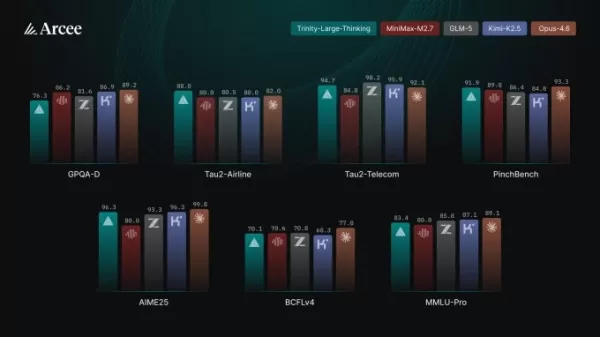
Arcee Trinity large thinking BenchmarksImage Credits:Arcee / Arcee
As previously reported, Arcee’s model is not a direct competitor to Meta’s Llama 4, the leading U.S.-built open model. However, it avoids the licensing ambiguities associated with Meta’s model. All of Arcee’s Trinity models are released under the Apache 2.0 license, widely regarded as the gold standard for open-source software.
To be clear, numerous other U.S. startups are also offering open-source models. As an advocate for startup innovation, I support their efforts as well.
Related article
 US Open Source AI Lab Arcee Says Chinese Models Are Not Inherently Dangerous
As Chinese open-weight AI models continue to gain capability and market share, debates over how to handle them have intensified once again.Rumors suggest the Trump administration may attempt to ban these models, though no action has been taken yet. M
US Signals Sanctions on Chinese AI Firms Over Intellectual Property Concerns
On Tuesday, Treasury Secretary Scott Bessent announced that the U.S. government would scrutinize open-source models from China for potential intellectual property theft, warning of sanctions against Chinese AI firms if such violations are confirmed.“
Satya Nadella issues stark warning to companies using AI
Among the many debates surrounding AI's potential drawbacks, one concern has Silicon Valley AI enthusiasts particularly worried: that major AI labs selling proprietary models may be operating like Trojan horses.The fear is that as startups and enterp
Related Special Topic Recommendations
Business
US Open Source AI Lab Arcee Says Chinese Models Are Not Inherently Dangerous
As Chinese open-weight AI models continue to gain capability and market share, debates over how to handle them have intensified once again.Rumors suggest the Trump administration may attempt to ban these models, though no action has been taken yet. M
US Signals Sanctions on Chinese AI Firms Over Intellectual Property Concerns
On Tuesday, Treasury Secretary Scott Bessent announced that the U.S. government would scrutinize open-source models from China for potential intellectual property theft, warning of sanctions against Chinese AI firms if such violations are confirmed.“
Satya Nadella issues stark warning to companies using AI
Among the many debates surrounding AI's potential drawbacks, one concern has Silicon Valley AI enthusiasts particularly worried: that major AI labs selling proprietary models may be operating like Trojan horses.The fear is that as startups and enterp
Related Special Topic Recommendations
Business
 Best AI Competitive Research Tools for Small Businesses
2026 Latest Best Top-rated AI Competitive Research Tools for Small Businesses! XIX.AI has curated a highly powerful game-changing collection, updated weekly with rigorous real-world tests and detailed rankings. You can find a comprehensive free vs paid comparison to help you identify the must-try tools that boost your productivity and give you a competitive edge. Explore now to discover your perfect tool!
 9 tools
 xix.ai
Image editing
Photoshop AI Retouch Tools for Ecommerce Apparel, Skin Cleanup, and Color Consistency
xix.ai
Image editing
Photoshop AI Retouch Tools for Ecommerce Apparel, Skin Cleanup, and Color Consistency
2026 Latest Best Photoshop AI retouch tools for ecommerce apparel, skin cleanup, and color consistency! This top-rated curated list features powerful game-changing solutions that help you boost writing efficiency, streamline content creation, and achieve perfect visual results effortlessly. Each tool has undergone real-world tests through weekly updated rankings, complete with free vs paid comparison details. Backed by XIX.AI, it’s the must-try guide for anyone aiming to unlock your AI edge. Explore now!
10 tools
xix.ai
Prompt
Best AI Prompt Libraries for ChatGPT Workflows
2026 Latest Best Top-Rated AI Prompt Libraries for optimizing all types of ChatGPT workflows. XIX.AI has curated a powerful, game-changing collection that goes through rigorous real-world tests to ensure top performance. You can find detailed free vs paid comparisons and expert rankings to help you choose the must-try tools that boost your productivity and unlock your AI edge. Explore now!
11 tools
xix.ai
Education and Learning
AI Quiz Builder Platforms for Teachers, Tutors, and Cohort-Based Learning Programs
2026 Latest Best AI Quiz Builder Platforms for Teachers, Tutors, and Cohort-Based Learning Programs! XIX.AI has curated a top-rated list of powerful game-changing tools that go through real-world tests to deliver accurate rankings. These must-try platforms help boost writing efficiency, streamline content creation, and simplify quiz design across all learning scenarios. Explore now to discover your perfect tool for unlocking your AI edge in teaching!
13 tools
xix.ai
code
AI Pull Request Review Tools for GitHub Teams Handling Refactors, Bugs, and Security Gaps
2026 Latest Best AI Pull Request Review Tools for GitHub Teams are here on XIX.AI! This top-rated curated list showcases powerful game-changing solutions that streamline refactoring, bug fixing, and security gap detection across all team workflows. Enjoy a free vs paid comparison along with real-world tests and detailed rankings to help you find the perfect tool that boosts productivity significantly. Explore now to unlock your AI edge!
12 tools
xix.ai
Text-to-speech
Best AI Text to Speech Tools for Natural Voiceovers
2026 Latest Best Top-rated AI Text to Speech Tools for Natural Voiceovers are here on XIX.AI! This curated list features powerful, game-changing options that deliver crystal-clear voices for every use case, backed by real-world tests and weekly updated rankings. Get a free vs paid comparison to find the must-try solution that boosts your productivity instantly. Explore now to Unlock your AI edge!
11 tools
xix.ai

 Comments (0)
0/500
Comments (0)
0/500
Arcee, a lean 26-person U.S. startup, has unveiled its latest reasoning model, Trinity Large Thinking, developed on a modest $20 million budget for a massive 400B-parameter open-source LLM. CEO Mark McQuade tells TechCrunch that this is the most capable open-weight model ever released by a non-Chinese company.
Arcee’s mission resonates with a clear objective: providing U.S. and Western enterprises with a viable alternative to Chinese-based models, eliminating the need to rely on foreign technology.
Although Chinese models are highly capable, they carry perceived risks, potentially ceding control and sensitive data to a government with differing values from the Western world.
Arcee allows companies to download the model, customize it for specific needs, and deploy it on-premises. Alternatively, businesses can access Arcee’s cloud-hosted version via API.
While Arcee’s models may not yet surpass closed-source offerings from industry giants like Anthropic or OpenAI, they offer independence from the unpredictable policies of those large providers.
For example, Claude, known for its coding prowess, was a preferred choice for users of the open-source AI agent tool OpenClaw. However, Anthropic recently changed its terms, requiring users to pay extra for OpenClaw usage. (In February, OpenClaw creator Peter Steinberger announced he was joining OpenAI, Anthropic’s main competitor.)
Conversely, McQuade highlights data from OpenRouter showing that Arcee’s model has become one of the top choices for OpenClaw users.
Arcee Trinity large thinking BenchmarksImage Credits:Arcee / Arcee
As previously reported, Arcee’s model is not a direct competitor to Meta’s Llama 4, the leading U.S.-built open model. However, it avoids the licensing ambiguities associated with Meta’s model. All of Arcee’s Trinity models are released under the Apache 2.0 license, widely regarded as the gold standard for open-source software.
To be clear, numerous other U.S. startups are also offering open-source models. As an advocate for startup innovation, I support their efforts as well.








 US Open Source AI Lab Arcee Says Chinese Models Are Not Inherently Dangerous
As Chinese open-weight AI models continue to gain capability and market share, debates over how to handle them have intensified once again.Rumors suggest the Trump administration may attempt to ban these models, though no action has been taken yet. M
US Open Source AI Lab Arcee Says Chinese Models Are Not Inherently Dangerous
As Chinese open-weight AI models continue to gain capability and market share, debates over how to handle them have intensified once again.Rumors suggest the Trump administration may attempt to ban these models, though no action has been taken yet. M
 US Signals Sanctions on Chinese AI Firms Over Intellectual Property Concerns
On Tuesday, Treasury Secretary Scott Bessent announced that the U.S. government would scrutinize open-source models from China for potential intellectual property theft, warning of sanctions against Chinese AI firms if such violations are confirmed.“
US Signals Sanctions on Chinese AI Firms Over Intellectual Property Concerns
On Tuesday, Treasury Secretary Scott Bessent announced that the U.S. government would scrutinize open-source models from China for potential intellectual property theft, warning of sanctions against Chinese AI firms if such violations are confirmed.“
 Satya Nadella issues stark warning to companies using AI
Among the many debates surrounding AI's potential drawbacks, one concern has Silicon Valley AI enthusiasts particularly worried: that major AI labs selling proprietary models may be operating like Trojan horses.The fear is that as startups and enterp
Satya Nadella issues stark warning to companies using AI
Among the many debates surrounding AI's potential drawbacks, one concern has Silicon Valley AI enthusiasts particularly worried: that major AI labs selling proprietary models may be operating like Trojan horses.The fear is that as startups and enterp

2026 Latest Best Top-rated AI Competitive Research Tools for Small Businesses! XIX.AI has curated a highly powerful game-changing collection, updated weekly with rigorous real-world tests and detailed rankings. You can find a comprehensive free vs paid comparison to help you identify the must-try tools that boost your productivity and give you a competitive edge. Explore now to discover your perfect tool!
9 tools
xix.ai

2026 Latest Best Photoshop AI retouch tools for ecommerce apparel, skin cleanup, and color consistency! This top-rated curated list features powerful game-changing solutions that help you boost writing efficiency, streamline content creation, and achieve perfect visual results effortlessly. Each tool has undergone real-world tests through weekly updated rankings, complete with free vs paid comparison details. Backed by XIX.AI, it’s the must-try guide for anyone aiming to unlock your AI edge. Explore now!
10 tools
xix.ai

2026 Latest Best Top-Rated AI Prompt Libraries for optimizing all types of ChatGPT workflows. XIX.AI has curated a powerful, game-changing collection that goes through rigorous real-world tests to ensure top performance. You can find detailed free vs paid comparisons and expert rankings to help you choose the must-try tools that boost your productivity and unlock your AI edge. Explore now!
11 tools
xix.ai

2026 Latest Best AI Quiz Builder Platforms for Teachers, Tutors, and Cohort-Based Learning Programs! XIX.AI has curated a top-rated list of powerful game-changing tools that go through real-world tests to deliver accurate rankings. These must-try platforms help boost writing efficiency, streamline content creation, and simplify quiz design across all learning scenarios. Explore now to discover your perfect tool for unlocking your AI edge in teaching!
13 tools
xix.ai
2026 Latest Best AI Pull Request Review Tools for GitHub Teams are here on XIX.AI! This top-rated curated list showcases powerful game-changing solutions that streamline refactoring, bug fixing, and security gap detection across all team workflows. Enjoy a free vs paid comparison along with real-world tests and detailed rankings to help you find the perfect tool that boosts productivity significantly. Explore now to unlock your AI edge!
12 tools
xix.ai

2026 Latest Best Top-rated AI Text to Speech Tools for Natural Voiceovers are here on XIX.AI! This curated list features powerful, game-changing options that deliver crystal-clear voices for every use case, backed by real-world tests and weekly updated rankings. Get a free vs paid comparison to find the must-try solution that boosts your productivity instantly. Explore now to Unlock your AI edge!
11 tools
xix.ai












