


 Home
HomeVibration Monitoring Enhances Mobile Robot Stability on Uneven Terrain
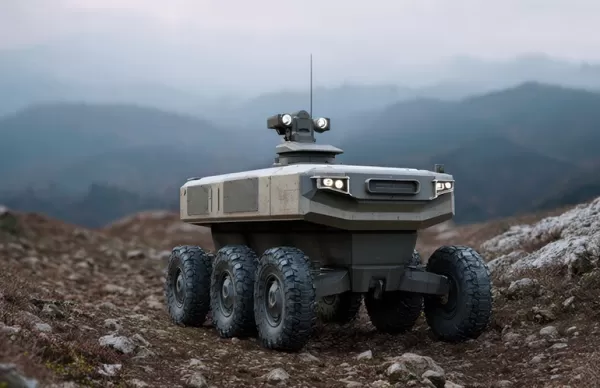
A UGV can navigate rough terrain with the help of vibration sensors. Source: ckybe, AI, via Adobe Stock
A few years ago, during a field test, we had a midsized uncrewed ground vehicle (UGV) attempting to climb a seemingly harmless patch of broken ground. The terrain wasn't extreme—just some loose stones, a bit of dust, and a gentle slope. It looked like nothing to worry about.
Halfway up, the robot paused. Then one wheel dipped slightly, the chassis leaned forward, and before anyone could intervene, it tipped over.
The odd thing? The camera feed looked normal. The lidar didn't detect any major hazards either. According to the data, the path was supposed to be "safe."
Yet the robot sensed trouble before we did. It just couldn't translate that feeling into action.
This disconnect between what a robot sees and what it physically experiences lies at the core of mobile robot stability on uneven ground.
In the real world, terrain can be deceptive. A surface may look solid but turn powdery under weight. Rocks can hide beneath a thin layer of soil. Even shallow ruts can redistribute load enough to push a UGV past its tipping point. And once that happens, recovery is rarely smooth.
Today's navigation systems are still largely vision-driven. Cameras, lidar, and SLAM are excellent for mapping. But they can't tell you how the ground will react when driven over. That's where failures occur.
Vibration monitoring offers a different approach. Instead of relying solely on external perception, the robot starts listening to its own body. Every bump, micro-slip, and impact generates data. When you treat these signals seriously, they become predictive.
Think of it like a person walking on loose gravel. You don't visually analyze every step. You feel it. Subtle shifts under your feet tell you when to slow down, adjust your balance, or change direction.
That's the kind of awareness we aim to give robots.
What follows isn't a theoretical discussion. It's based on what works in practice: how to capture vibration data, what it reveals, and how to use it to keep your robot stable when the ground becomes unpredictable.
Why vibration signals are crucial for stability
Let's start with a fundamental question engineers often ask: How do vibrations actually influence stability?
The short answer: They don't just influence it—they reveal it.
Every time a wheel interacts with the ground, it generates a force. This force isn't constant. It changes depending on whether the surface is hard, soft, uneven, or shifting. These variations travel through the robot as vibrations.
If you ignore them, they're just noise. If you analyze them, they become insight.
In one off-road test, we drove the same robot across three surfaces: compact dirt, loose gravel, and soft sand. Visually, all three looked manageable. But their vibration profiles were completely distinct.
On compact dirt, the signal was stable—low amplitude and consistent.
On gravel, it turned chaotic, with sharp spikes and high-frequency chatter.
On sand, everything slowed down. The signal became heavier, almost sluggish, with noticeable low-frequency oscillations. This distinction is critical.
High-frequency spikes typically indicate impacts—hitting rocks, debris, or hard edges. These moments can suddenly shift load distribution and trigger instability.
Low-frequency oscillations are subtler but equally dangerous. They often signal a loss of support, like a wheel sinking or slipping. You don't get a sudden jolt; instead, stability gradually erodes.
Here's the key point: you often feel these effects before you see them.
We encountered this during rover testing. A section of terrain looked smooth because a thin layer of sand covered embedded rocks. Cameras showed flat ground. Lidar detected a clean surface.
But the IMU told a different story. As soon as the wheels rolled over the hidden rocks, the vibration signal lit up with high-frequency spikes. This provided an early warning—before the robot began to destabilize.
That's the power of vibration sensing. It doesn't depend on visibility. It isn't affected by lighting or dust. It reflects the actual physics of contact.
In challenging environments, that's often the only truth that matters.
Core sensors for vibration monitoring
If vibration is the signal, sensors are your ears. And as with any sensing system, placement and quality matter more than many realize.
At the core, you work with three components: accelerometers, gyroscopes, and inertial measurement units (IMUs).
Accelerometers do the heavy lifting. They measure linear acceleration along three axes, capturing both shocks and continuous vibration. If a wheel hits a rock, the accelerometer detects it instantly. If the chassis oscillates, that shows up too.
Gyroscopes add another layer. They track angular motion—roll, pitch, and yaw. This tells you if the robot is beginning to tilt or rotate in a way that could lead to tipping.
Combine the two, and you get an IMU. Most modern systems rely on IMUs because they provide a complete picture of motion.
But real-world experience shows that sensor placement matters just as much as the sensors themselves.
Mounting an IMU at the center of mass is standard practice, and for good reason. It provides a stable reference for overall motion. However, if that's all you use, you'll miss crucial detail.
On rough terrain, most of the action happens at the wheels. We've achieved better results by adding secondary accelerometers closer to the wheel assemblies. These pick up localized impacts that don't fully propagate to the chassis center.
Another common mistake is soft mounting. It may seem minor, but it's significant. If your sensor mount flexes even slightly, you're no longer measuring true vibration—you're measuring a filtered version. This leads to incorrect conclusions.
Sampling rate is another practical consideration. For most mobile robots, a range of 100 to 500 Hz is sufficient. Too low, and you miss critical events. Too high, and you add processing overhead without meaningful benefit.
As for hardware, you don't need exotic components. Many reliable accelerometer sensors can handle harsh environments without breaking the budget. Calibration and consistency are far more important.
Real-time vibration processing techniques
Raw vibration data is messy. If you've ever plotted it directly from an IMU, you know what I mean—it looks like noise.
The trick isn't to clean it completely, but to clean it just enough to reveal patterns.
The first step is filtering. Motors, gearboxes, and even structural resonance introduce their own vibrations. If you don't address these, they'll drown out the terrain signals.
We typically start with a bandpass filter to isolate the frequency range where terrain interaction occurs. Then, if there's a known noise source like a motor spinning at a fixed frequency, we apply a notch filter to remove it.
I've seen cases where a simple notch filter turned unusable data into clear terrain signatures. Once the signal is usable, you move to analysis.
Time-domain analysis shows how the signal evolves. But frequency-domain analysis is where things get interesting. Using FFT, you can see exactly where energy is concentrated.
Different terrains leave distinct fingerprints. Gravel spreads energy across high frequencies. Grass sits in the mid-range. Sand shifts everything lower and dampens it.
From there, you extract features. Not dozens—just a few meaningful ones. RMS amplitude, spectral power, and perhaps variance. That's usually enough.
We once built a simple terrain classifier using just a handful of these features and achieved nearly 90% accuracy at low speeds. Nothing fancy—no deep learning. Just clean data and good feature selection.
The key lesson? You don't always need complex models. You need good signals.
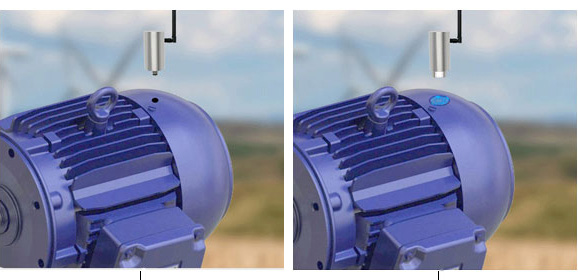
Different methods of connecting a three-axis vibration sensor. Source: ATO
Stability prediction from vibration data
This is where things get interesting. Most systems react to instability after it begins. By then, you're already in trouble. Vibration monitoring lets you shift from reaction to prediction.
Traditionally, engineers rely on metrics like stability margin or force distribution models. These work well in controlled settings but struggle when terrain behavior changes unpredictably.
Vibration data fills that gap. Instead of estimating forces purely from models, you infer them from actual interaction. This makes your stability assessment more grounded in reality.
Recently, learning-based approaches have gained traction in this space. Feed acceleration, angular velocity, and velocity data into a model, and it outputs a stability score.
What's impressive is how well these models generalize.
In one test, we trained a model on grass, gravel, and dirt. Then we ran it on mixed terrain it had never seen. It still performed well—not perfectly, but usefully.
Practically, this enables behaviors like gating.
We had a UGV with a small manipulator arm. When vibration levels crossed a threshold, the system would automatically pause arm movement. This alone prevented several near-tip incidents.
The important idea here isn't the model itself. It's that stability becomes something you monitor continuously, not something you check after the fact.
Control strategies for enhanced balance
Once you trust your vibration data, you can start using it in control. The simplest approach is speed adaptation—and it's one of the most effective. When vibration increases, slow down. That's it.
It sounds basic, but it works because most instability issues scale with speed. Lower speed means lower dynamic forces, giving your system more time to react.
Beyond that, you can feed vibration data into your control loops. PID controllers, for example, can benefit from an additional input that reflects disturbance levels. This helps reduce oscillations and improves response.
Sensor fusion also plays a role. Vibration data alone is powerful, but combining it with odometry or visual feedback makes it even more reliable.
One practical improvement we observed came from cleaning up internal noise. By filtering out mechanical vibrations from internal components, the control system became noticeably smoother—less jitter, better balance.
Sometimes, stability improvements don't come from adding complexity. They come from removing noise.
Implementation challenges and fixes
Of course, none of this is plug-and-play. Noise is the biggest challenge. Not all vibrations are useful. Some come from motors, some from structure, some from the environment. The goal is to separate signal from noise without losing important information.
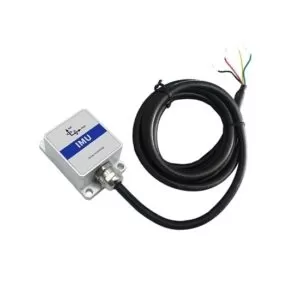
A small IMU sensor for robots and drones. Source: ATO
Sensor drift is another issue, especially with gyroscopes. Small errors accumulate over time. That's where sensor fusion techniques like Kalman filtering become essential.
Then there's variability. Change the robot's speed or payload, and your vibration profile changes too. If your system isn't designed to handle that, performance drops quickly.
The only real solution is testing—not controlled lab testing, but real terrain, real conditions, real edge cases. That's where systems prove themselves.
Robots need to feel the ground
If there's one takeaway, it's this: robots need to feel the ground, not just see it.
Mobile robot stability on uneven terrain won't be solved by better maps alone. It requires a deeper connection between the machine and its environment.
Vibration monitoring provides that connection. It turns impacts, slips, and subtle shifts into usable data. It allows robots to anticipate problems instead of merely reacting to them. In environments where a single mistake can end a mission, that makes all the difference.
The technology isn't out of reach. A solid IMU setup, thoughtful processing, and field testing can take you a long way. From there, it's iteration.
Because the terrain will always surprise you. The goal is to make sure your robot isn't surprised for long.
 About the author
Faisal Mahmood is a seasoned digital marketing and tech content strategist with extensive experience in AI, software development, and SEO-driven content. He specializes in creating deeply researched, fact-based articles that help developers, enterprises, and tech teams understand the latest trends in AI-powered tools, coding best practices, and secure software development.
Mahmood is passionate about bridging the gap between emerging technology and practical insights for global audiences. He is reachable at [email protected].
Related article
 Waze Unveils New AI Tools and Customization Options
Waze, the Google-owned navigation app, is getting new AI-powered features and customization updates, including the ability to report road updates conversationally and get personalized navigation. Some of the new features are powered by Google’s Gemin
Google Maps rolls out AI-powered 'Ask Maps' feature and enhanced immersive navigation
On Thursday, Google announced that Google Maps is adding a Gemini-powered conversational feature called "Ask Maps," along with an updated "Immersive Navigation" experience that brings 3D views, road details, natural voice guidance, and more to the ap
Swedish AI Startup Lovable Eyes $13.2 Billion Valuation After Major Funding Round
As AI-driven coding tools gain traction, Swedish startup Lovable has secured a major funding round. The company aims to raise $3 billion, potentially boosting its valuation to $13.2 billion—double the $6.6 billion recorded last December. Menlo Ventur
Related Special Topic Recommendations
writing
Waze Unveils New AI Tools and Customization Options
Waze, the Google-owned navigation app, is getting new AI-powered features and customization updates, including the ability to report road updates conversationally and get personalized navigation. Some of the new features are powered by Google’s Gemin
Google Maps rolls out AI-powered 'Ask Maps' feature and enhanced immersive navigation
On Thursday, Google announced that Google Maps is adding a Gemini-powered conversational feature called "Ask Maps," along with an updated "Immersive Navigation" experience that brings 3D views, road details, natural voice guidance, and more to the ap
Swedish AI Startup Lovable Eyes $13.2 Billion Valuation After Major Funding Round
As AI-driven coding tools gain traction, Swedish startup Lovable has secured a major funding round. The company aims to raise $3 billion, potentially boosting its valuation to $13.2 billion—double the $6.6 billion recorded last December. Menlo Ventur
Related Special Topic Recommendations
writing
 Best AI Outline Generators for Long-Form SEO Articles
2026 Latest Best Top-Rated AI Outline Generators for Long-Form SEO Articles, meticulously curated by XIX.AI. These powerful tools offer game-changing assistance in creating high-quality content quickly, boosting writing efficiency significantly. Get a free vs paid comparison along with real-world tests and detailed rankings to help you find the must-try option that suits your needs. Explore now to unlock your AI edge.
 8 tools
 xix.ai
Education and Learning
AI Study Tools for Homework and Exam Prep
xix.ai
Education and Learning
AI Study Tools for Homework and Exam Prep
2026 Latest Best AI Study Tools for Homework and Exam Prep! XIX.AI curates a top-rated list of powerful, game-changing tools that help students boost productivity, streamline homework completion, and ace exams through real-world tests. Get a free vs paid comparison, detailed rankings, and must-try options to unlock your AI edge. Explore now!
10 tools
xix.ai
Music composition
AI Vocal Demo Tools for Songwriters, Hooks, Toplines, and Multilingual Draft Sessions
2026 Latest Best AI Vocal Demo Tools for Songwriters, Hook Creators, and Multi-Language Content Teams! XIX.AI has curated a top-rated list of powerful game-changing tools that go through rigorous real-world tests. You’ll find detailed free vs paid comparison data, comprehensive rankings, and must-try options to help you boost writing efficiency and unlock your creative potential. Explore now to discover your perfect tool for all your content needs!
9 tools
xix.ai
Business
Best AI Competitive Research Tools for Small Businesses
2026 Latest Best Top-rated AI Competitive Research Tools for Small Businesses! XIX.AI has curated a highly powerful game-changing collection, updated weekly with rigorous real-world tests and detailed rankings. You can find a comprehensive free vs paid comparison to help you identify the must-try tools that boost your productivity and give you a competitive edge. Explore now to discover your perfect tool!
9 tools
xix.ai
Image editing
Photoshop AI Retouch Tools for Ecommerce Apparel, Skin Cleanup, and Color Consistency
2026 Latest Best Photoshop AI retouch tools for ecommerce apparel, skin cleanup, and color consistency! This top-rated curated list features powerful game-changing solutions that help you boost writing efficiency, streamline content creation, and achieve perfect visual results effortlessly. Each tool has undergone real-world tests through weekly updated rankings, complete with free vs paid comparison details. Backed by XIX.AI, it’s the must-try guide for anyone aiming to unlock your AI edge. Explore now!
10 tools
xix.ai
Prompt
Best AI Prompt Libraries for ChatGPT Workflows
2026 Latest Best Top-Rated AI Prompt Libraries for optimizing all types of ChatGPT workflows. XIX.AI has curated a powerful, game-changing collection that goes through rigorous real-world tests to ensure top performance. You can find detailed free vs paid comparisons and expert rankings to help you choose the must-try tools that boost your productivity and unlock your AI edge. Explore now!
11 tools
xix.ai

 Comments (1)
0/500
Comments (1)
0/500
![HenryGarcía]()
Interesting concept! But I wonder how reliable those vibration sensors are in muddy conditions? 🤔 Could be a game-changer for search and rescue though.
A UGV can navigate rough terrain with the help of vibration sensors. Source: ckybe, AI, via Adobe Stock
A few years ago, during a field test, we had a midsized uncrewed ground vehicle (UGV) attempting to climb a seemingly harmless patch of broken ground. The terrain wasn't extreme—just some loose stones, a bit of dust, and a gentle slope. It looked like nothing to worry about.
Halfway up, the robot paused. Then one wheel dipped slightly, the chassis leaned forward, and before anyone could intervene, it tipped over.
The odd thing? The camera feed looked normal. The lidar didn't detect any major hazards either. According to the data, the path was supposed to be "safe."
Yet the robot sensed trouble before we did. It just couldn't translate that feeling into action.
This disconnect between what a robot sees and what it physically experiences lies at the core of mobile robot stability on uneven ground.
In the real world, terrain can be deceptive. A surface may look solid but turn powdery under weight. Rocks can hide beneath a thin layer of soil. Even shallow ruts can redistribute load enough to push a UGV past its tipping point. And once that happens, recovery is rarely smooth.
Today's navigation systems are still largely vision-driven. Cameras, lidar, and SLAM are excellent for mapping. But they can't tell you how the ground will react when driven over. That's where failures occur.
Vibration monitoring offers a different approach. Instead of relying solely on external perception, the robot starts listening to its own body. Every bump, micro-slip, and impact generates data. When you treat these signals seriously, they become predictive.
Think of it like a person walking on loose gravel. You don't visually analyze every step. You feel it. Subtle shifts under your feet tell you when to slow down, adjust your balance, or change direction.
That's the kind of awareness we aim to give robots.
What follows isn't a theoretical discussion. It's based on what works in practice: how to capture vibration data, what it reveals, and how to use it to keep your robot stable when the ground becomes unpredictable.
Why vibration signals are crucial for stability
Let's start with a fundamental question engineers often ask: How do vibrations actually influence stability?
The short answer: They don't just influence it—they reveal it.
Every time a wheel interacts with the ground, it generates a force. This force isn't constant. It changes depending on whether the surface is hard, soft, uneven, or shifting. These variations travel through the robot as vibrations.
If you ignore them, they're just noise. If you analyze them, they become insight.
In one off-road test, we drove the same robot across three surfaces: compact dirt, loose gravel, and soft sand. Visually, all three looked manageable. But their vibration profiles were completely distinct.
On compact dirt, the signal was stable—low amplitude and consistent.
On gravel, it turned chaotic, with sharp spikes and high-frequency chatter.
On sand, everything slowed down. The signal became heavier, almost sluggish, with noticeable low-frequency oscillations. This distinction is critical.
High-frequency spikes typically indicate impacts—hitting rocks, debris, or hard edges. These moments can suddenly shift load distribution and trigger instability.
Low-frequency oscillations are subtler but equally dangerous. They often signal a loss of support, like a wheel sinking or slipping. You don't get a sudden jolt; instead, stability gradually erodes.
Here's the key point: you often feel these effects before you see them.
We encountered this during rover testing. A section of terrain looked smooth because a thin layer of sand covered embedded rocks. Cameras showed flat ground. Lidar detected a clean surface.
But the IMU told a different story. As soon as the wheels rolled over the hidden rocks, the vibration signal lit up with high-frequency spikes. This provided an early warning—before the robot began to destabilize.
That's the power of vibration sensing. It doesn't depend on visibility. It isn't affected by lighting or dust. It reflects the actual physics of contact.
In challenging environments, that's often the only truth that matters.
Core sensors for vibration monitoring
If vibration is the signal, sensors are your ears. And as with any sensing system, placement and quality matter more than many realize.
At the core, you work with three components: accelerometers, gyroscopes, and inertial measurement units (IMUs).
Accelerometers do the heavy lifting. They measure linear acceleration along three axes, capturing both shocks and continuous vibration. If a wheel hits a rock, the accelerometer detects it instantly. If the chassis oscillates, that shows up too.
Gyroscopes add another layer. They track angular motion—roll, pitch, and yaw. This tells you if the robot is beginning to tilt or rotate in a way that could lead to tipping.
Combine the two, and you get an IMU. Most modern systems rely on IMUs because they provide a complete picture of motion.
But real-world experience shows that sensor placement matters just as much as the sensors themselves.
Mounting an IMU at the center of mass is standard practice, and for good reason. It provides a stable reference for overall motion. However, if that's all you use, you'll miss crucial detail.
On rough terrain, most of the action happens at the wheels. We've achieved better results by adding secondary accelerometers closer to the wheel assemblies. These pick up localized impacts that don't fully propagate to the chassis center.
Another common mistake is soft mounting. It may seem minor, but it's significant. If your sensor mount flexes even slightly, you're no longer measuring true vibration—you're measuring a filtered version. This leads to incorrect conclusions.
Sampling rate is another practical consideration. For most mobile robots, a range of 100 to 500 Hz is sufficient. Too low, and you miss critical events. Too high, and you add processing overhead without meaningful benefit.
As for hardware, you don't need exotic components. Many reliable accelerometer sensors can handle harsh environments without breaking the budget. Calibration and consistency are far more important.
Real-time vibration processing techniques
Raw vibration data is messy. If you've ever plotted it directly from an IMU, you know what I mean—it looks like noise.
The trick isn't to clean it completely, but to clean it just enough to reveal patterns.
The first step is filtering. Motors, gearboxes, and even structural resonance introduce their own vibrations. If you don't address these, they'll drown out the terrain signals.
We typically start with a bandpass filter to isolate the frequency range where terrain interaction occurs. Then, if there's a known noise source like a motor spinning at a fixed frequency, we apply a notch filter to remove it.
I've seen cases where a simple notch filter turned unusable data into clear terrain signatures. Once the signal is usable, you move to analysis.
Time-domain analysis shows how the signal evolves. But frequency-domain analysis is where things get interesting. Using FFT, you can see exactly where energy is concentrated.
Different terrains leave distinct fingerprints. Gravel spreads energy across high frequencies. Grass sits in the mid-range. Sand shifts everything lower and dampens it.
From there, you extract features. Not dozens—just a few meaningful ones. RMS amplitude, spectral power, and perhaps variance. That's usually enough.
We once built a simple terrain classifier using just a handful of these features and achieved nearly 90% accuracy at low speeds. Nothing fancy—no deep learning. Just clean data and good feature selection.
The key lesson? You don't always need complex models. You need good signals.
Different methods of connecting a three-axis vibration sensor. Source: ATO
Stability prediction from vibration data
This is where things get interesting. Most systems react to instability after it begins. By then, you're already in trouble. Vibration monitoring lets you shift from reaction to prediction.
Traditionally, engineers rely on metrics like stability margin or force distribution models. These work well in controlled settings but struggle when terrain behavior changes unpredictably.
Vibration data fills that gap. Instead of estimating forces purely from models, you infer them from actual interaction. This makes your stability assessment more grounded in reality.
Recently, learning-based approaches have gained traction in this space. Feed acceleration, angular velocity, and velocity data into a model, and it outputs a stability score.
What's impressive is how well these models generalize.
In one test, we trained a model on grass, gravel, and dirt. Then we ran it on mixed terrain it had never seen. It still performed well—not perfectly, but usefully.
Practically, this enables behaviors like gating.
We had a UGV with a small manipulator arm. When vibration levels crossed a threshold, the system would automatically pause arm movement. This alone prevented several near-tip incidents.
The important idea here isn't the model itself. It's that stability becomes something you monitor continuously, not something you check after the fact.
Control strategies for enhanced balance
Once you trust your vibration data, you can start using it in control. The simplest approach is speed adaptation—and it's one of the most effective. When vibration increases, slow down. That's it.
It sounds basic, but it works because most instability issues scale with speed. Lower speed means lower dynamic forces, giving your system more time to react.
Beyond that, you can feed vibration data into your control loops. PID controllers, for example, can benefit from an additional input that reflects disturbance levels. This helps reduce oscillations and improves response.
Sensor fusion also plays a role. Vibration data alone is powerful, but combining it with odometry or visual feedback makes it even more reliable.
One practical improvement we observed came from cleaning up internal noise. By filtering out mechanical vibrations from internal components, the control system became noticeably smoother—less jitter, better balance.
Sometimes, stability improvements don't come from adding complexity. They come from removing noise.
Implementation challenges and fixes
Of course, none of this is plug-and-play. Noise is the biggest challenge. Not all vibrations are useful. Some come from motors, some from structure, some from the environment. The goal is to separate signal from noise without losing important information.
A small IMU sensor for robots and drones. Source: ATO
Sensor drift is another issue, especially with gyroscopes. Small errors accumulate over time. That's where sensor fusion techniques like Kalman filtering become essential.
Then there's variability. Change the robot's speed or payload, and your vibration profile changes too. If your system isn't designed to handle that, performance drops quickly.
The only real solution is testing—not controlled lab testing, but real terrain, real conditions, real edge cases. That's where systems prove themselves.
Robots need to feel the ground
If there's one takeaway, it's this: robots need to feel the ground, not just see it.
Mobile robot stability on uneven terrain won't be solved by better maps alone. It requires a deeper connection between the machine and its environment.
Vibration monitoring provides that connection. It turns impacts, slips, and subtle shifts into usable data. It allows robots to anticipate problems instead of merely reacting to them. In environments where a single mistake can end a mission, that makes all the difference.
The technology isn't out of reach. A solid IMU setup, thoughtful processing, and field testing can take you a long way. From there, it's iteration.
Because the terrain will always surprise you. The goal is to make sure your robot isn't surprised for long.
About the author
Faisal Mahmood is a seasoned digital marketing and tech content strategist with extensive experience in AI, software development, and SEO-driven content. He specializes in creating deeply researched, fact-based articles that help developers, enterprises, and tech teams understand the latest trends in AI-powered tools, coding best practices, and secure software development.
Mahmood is passionate about bridging the gap between emerging technology and practical insights for global audiences. He is reachable at [email protected].








 Waze Unveils New AI Tools and Customization Options
Waze, the Google-owned navigation app, is getting new AI-powered features and customization updates, including the ability to report road updates conversationally and get personalized navigation. Some of the new features are powered by Google’s Gemin
Waze Unveils New AI Tools and Customization Options
Waze, the Google-owned navigation app, is getting new AI-powered features and customization updates, including the ability to report road updates conversationally and get personalized navigation. Some of the new features are powered by Google’s Gemin
 Google Maps rolls out AI-powered 'Ask Maps' feature and enhanced immersive navigation
On Thursday, Google announced that Google Maps is adding a Gemini-powered conversational feature called "Ask Maps," along with an updated "Immersive Navigation" experience that brings 3D views, road details, natural voice guidance, and more to the ap
Google Maps rolls out AI-powered 'Ask Maps' feature and enhanced immersive navigation
On Thursday, Google announced that Google Maps is adding a Gemini-powered conversational feature called "Ask Maps," along with an updated "Immersive Navigation" experience that brings 3D views, road details, natural voice guidance, and more to the ap
 Swedish AI Startup Lovable Eyes $13.2 Billion Valuation After Major Funding Round
As AI-driven coding tools gain traction, Swedish startup Lovable has secured a major funding round. The company aims to raise $3 billion, potentially boosting its valuation to $13.2 billion—double the $6.6 billion recorded last December. Menlo Ventur
Swedish AI Startup Lovable Eyes $13.2 Billion Valuation After Major Funding Round
As AI-driven coding tools gain traction, Swedish startup Lovable has secured a major funding round. The company aims to raise $3 billion, potentially boosting its valuation to $13.2 billion—double the $6.6 billion recorded last December. Menlo Ventur

2026 Latest Best Top-Rated AI Outline Generators for Long-Form SEO Articles, meticulously curated by XIX.AI. These powerful tools offer game-changing assistance in creating high-quality content quickly, boosting writing efficiency significantly. Get a free vs paid comparison along with real-world tests and detailed rankings to help you find the must-try option that suits your needs. Explore now to unlock your AI edge.
8 tools
xix.ai

2026 Latest Best AI Study Tools for Homework and Exam Prep! XIX.AI curates a top-rated list of powerful, game-changing tools that help students boost productivity, streamline homework completion, and ace exams through real-world tests. Get a free vs paid comparison, detailed rankings, and must-try options to unlock your AI edge. Explore now!
10 tools
xix.ai

2026 Latest Best AI Vocal Demo Tools for Songwriters, Hook Creators, and Multi-Language Content Teams! XIX.AI has curated a top-rated list of powerful game-changing tools that go through rigorous real-world tests. You’ll find detailed free vs paid comparison data, comprehensive rankings, and must-try options to help you boost writing efficiency and unlock your creative potential. Explore now to discover your perfect tool for all your content needs!
9 tools
xix.ai

2026 Latest Best Top-rated AI Competitive Research Tools for Small Businesses! XIX.AI has curated a highly powerful game-changing collection, updated weekly with rigorous real-world tests and detailed rankings. You can find a comprehensive free vs paid comparison to help you identify the must-try tools that boost your productivity and give you a competitive edge. Explore now to discover your perfect tool!
9 tools
xix.ai

2026 Latest Best Photoshop AI retouch tools for ecommerce apparel, skin cleanup, and color consistency! This top-rated curated list features powerful game-changing solutions that help you boost writing efficiency, streamline content creation, and achieve perfect visual results effortlessly. Each tool has undergone real-world tests through weekly updated rankings, complete with free vs paid comparison details. Backed by XIX.AI, it’s the must-try guide for anyone aiming to unlock your AI edge. Explore now!
10 tools
xix.ai

2026 Latest Best Top-Rated AI Prompt Libraries for optimizing all types of ChatGPT workflows. XIX.AI has curated a powerful, game-changing collection that goes through rigorous real-world tests to ensure top performance. You can find detailed free vs paid comparisons and expert rankings to help you choose the must-try tools that boost your productivity and unlock your AI edge. Explore now!
11 tools
xix.ai

Interesting concept! But I wonder how reliable those vibration sensors are in muddy conditions? 🤔 Could be a game-changer for search and rescue though.












