


 Home
HomeTikTok Rolls Out Toggle to Limit AI-Powered Content in Feed
TikTok, originally a hub for user-created videos, is introducing a new feature that allows users to regulate how much AI-generated content appears in their 'For You' feed. The platform is also deploying more sophisticated technology to label such AI-created content.
This new AI-generated content (AIGC) control is being added to TikTok's "Manage Topics" tool, which helps users curate their feed experience.
"Manage Topics already lets users fine-tune how frequently they encounter content from over 10 categories, such as Dance, Sports, and Food & Drinks," TikTok stated in a blog post. "Similar to these options, the AIGC setting is designed to help users personalize their feed's content mix, not to eliminate or fully replace existing content."
This development aligns with a trend where companies like OpenAI and Meta are introducing dedicated AI content feeds. In September, Meta launched 'Vibes,' a feed for sharing and creating short AI videos. Shortly after, OpenAI debuted 'Sora,' a social media platform centered on AI-generated video creation and sharing.
Since Sora's release, highly realistic AI videos have surfaced on TikTok. Furthermore, many creators on the platform are using AI tools to produce imagery for posts on various topics, from history to celebrity culture.
TikTok explains that with this new control, users who prefer less AI-generated content can reduce its presence, while those who enjoy it can opt to see more.
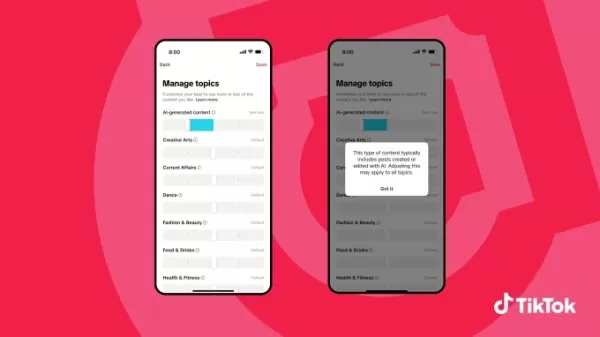
Image Credits: TikTok To access this feature, navigate to Settings, choose "Content Preferences," and then select "Manage Topics." From there, you can adjust sliders for different topics, including AI-generated content, to control how much of it you wish to see in your For You feed.
TikTok says this update will be available to users in the coming weeks.
To enhance its AI content labeling, TikTok is now testing "invisible watermarking" technology.
TikTok already mandates labeling for realistic AI content and utilizes C2PA's Content Credentials, an industry-standard technology that embeds metadata to identify AI-generated material. However, the company notes these labels can be stripped when content is re-uploaded or edited elsewhere.
The new "invisible watermarks" provide an additional safeguard by applying a watermark only detectable by TikTok's systems, making it significantly harder for others to remove.
TikTok will begin applying these invisible watermarks to AI content created with its own tools, like AI Editor Pro, as well as to content uploaded with C2PA's Content Credentials. This aims to ensure more reliable labeling. The platform will continue to read and apply C2PA credentials to AI content generated on its service.
In a related initiative, TikTok announced a $2 million AI literacy fund. This fund will support experts and organizations, such as the nonprofit Girls Who Code, in creating educational content about AI literacy and safety.
Related article
 Google Tests Remy AI Agent for Gemini as Focus Shifts to User Control
According to Business Insider, Google is testing Remy, a new AI personal agent for Gemini. This tool aims to execute tasks on behalf of users, streamlining both professional workflows and daily routines.Currently, Remy is undergoing testing in an int
Ollie bets privacy focus to win AI assistant race
To be genuinely helpful, an AI assistant must understand its user deeply. Ollie, a personal assistant designed for daily life, operates on the premise that this doesn’t require surrendering your data or compromising your privacy.While certain enterpr
How AI LIVE: London Will Explore AI & Industrial Automation
The summit will convene C-suite executives from around the globe to address pressing challenges in global industries, ranging from AI-driven disruption to economic volatility.AI LIVE: The London Summit will gather over 2,000 international leaders und
Related Special Topic Recommendations
writing
Google Tests Remy AI Agent for Gemini as Focus Shifts to User Control
According to Business Insider, Google is testing Remy, a new AI personal agent for Gemini. This tool aims to execute tasks on behalf of users, streamlining both professional workflows and daily routines.Currently, Remy is undergoing testing in an int
Ollie bets privacy focus to win AI assistant race
To be genuinely helpful, an AI assistant must understand its user deeply. Ollie, a personal assistant designed for daily life, operates on the premise that this doesn’t require surrendering your data or compromising your privacy.While certain enterpr
How AI LIVE: London Will Explore AI & Industrial Automation
The summit will convene C-suite executives from around the globe to address pressing challenges in global industries, ranging from AI-driven disruption to economic volatility.AI LIVE: The London Summit will gather over 2,000 international leaders und
Related Special Topic Recommendations
writing
 Best AI Outline Generators for Long-Form SEO Articles
2026 Latest Best Top-Rated AI Outline Generators for Long-Form SEO Articles, meticulously curated by XIX.AI. These powerful tools offer game-changing assistance in creating high-quality content quickly, boosting writing efficiency significantly. Get a free vs paid comparison along with real-world tests and detailed rankings to help you find the must-try option that suits your needs. Explore now to unlock your AI edge.
 8 tools
 xix.ai
Education and Learning
AI Study Tools for Homework and Exam Prep
xix.ai
Education and Learning
AI Study Tools for Homework and Exam Prep
2026 Latest Best AI Study Tools for Homework and Exam Prep! XIX.AI curates a top-rated list of powerful, game-changing tools that help students boost productivity, streamline homework completion, and ace exams through real-world tests. Get a free vs paid comparison, detailed rankings, and must-try options to unlock your AI edge. Explore now!
10 tools
xix.ai
Music composition
AI Vocal Demo Tools for Songwriters, Hooks, Toplines, and Multilingual Draft Sessions
2026 Latest Best AI Vocal Demo Tools for Songwriters, Hook Creators, and Multi-Language Content Teams! XIX.AI has curated a top-rated list of powerful game-changing tools that go through rigorous real-world tests. You’ll find detailed free vs paid comparison data, comprehensive rankings, and must-try options to help you boost writing efficiency and unlock your creative potential. Explore now to discover your perfect tool for all your content needs!
9 tools
xix.ai
Business
Best AI Competitive Research Tools for Small Businesses
2026 Latest Best Top-rated AI Competitive Research Tools for Small Businesses! XIX.AI has curated a highly powerful game-changing collection, updated weekly with rigorous real-world tests and detailed rankings. You can find a comprehensive free vs paid comparison to help you identify the must-try tools that boost your productivity and give you a competitive edge. Explore now to discover your perfect tool!
9 tools
xix.ai
Image editing
Photoshop AI Retouch Tools for Ecommerce Apparel, Skin Cleanup, and Color Consistency
2026 Latest Best Photoshop AI retouch tools for ecommerce apparel, skin cleanup, and color consistency! This top-rated curated list features powerful game-changing solutions that help you boost writing efficiency, streamline content creation, and achieve perfect visual results effortlessly. Each tool has undergone real-world tests through weekly updated rankings, complete with free vs paid comparison details. Backed by XIX.AI, it’s the must-try guide for anyone aiming to unlock your AI edge. Explore now!
10 tools
xix.ai
Prompt
Best AI Prompt Libraries for ChatGPT Workflows
2026 Latest Best Top-Rated AI Prompt Libraries for optimizing all types of ChatGPT workflows. XIX.AI has curated a powerful, game-changing collection that goes through rigorous real-world tests to ensure top performance. You can find detailed free vs paid comparisons and expert rankings to help you choose the must-try tools that boost your productivity and unlock your AI edge. Explore now!
11 tools
xix.ai

 Comments (0)
0/500
Comments (0)
0/500
TikTok, originally a hub for user-created videos, is introducing a new feature that allows users to regulate how much AI-generated content appears in their 'For You' feed. The platform is also deploying more sophisticated technology to label such AI-created content.
This new AI-generated content (AIGC) control is being added to TikTok's "Manage Topics" tool, which helps users curate their feed experience.
"Manage Topics already lets users fine-tune how frequently they encounter content from over 10 categories, such as Dance, Sports, and Food & Drinks," TikTok stated in a blog post. "Similar to these options, the AIGC setting is designed to help users personalize their feed's content mix, not to eliminate or fully replace existing content."
This development aligns with a trend where companies like OpenAI and Meta are introducing dedicated AI content feeds. In September, Meta launched 'Vibes,' a feed for sharing and creating short AI videos. Shortly after, OpenAI debuted 'Sora,' a social media platform centered on AI-generated video creation and sharing.
Since Sora's release, highly realistic AI videos have surfaced on TikTok. Furthermore, many creators on the platform are using AI tools to produce imagery for posts on various topics, from history to celebrity culture.
TikTok explains that with this new control, users who prefer less AI-generated content can reduce its presence, while those who enjoy it can opt to see more.
To access this feature, navigate to Settings, choose "Content Preferences," and then select "Manage Topics." From there, you can adjust sliders for different topics, including AI-generated content, to control how much of it you wish to see in your For You feed.
TikTok says this update will be available to users in the coming weeks.
To enhance its AI content labeling, TikTok is now testing "invisible watermarking" technology.
TikTok already mandates labeling for realistic AI content and utilizes C2PA's Content Credentials, an industry-standard technology that embeds metadata to identify AI-generated material. However, the company notes these labels can be stripped when content is re-uploaded or edited elsewhere.
The new "invisible watermarks" provide an additional safeguard by applying a watermark only detectable by TikTok's systems, making it significantly harder for others to remove.
TikTok will begin applying these invisible watermarks to AI content created with its own tools, like AI Editor Pro, as well as to content uploaded with C2PA's Content Credentials. This aims to ensure more reliable labeling. The platform will continue to read and apply C2PA credentials to AI content generated on its service.
In a related initiative, TikTok announced a $2 million AI literacy fund. This fund will support experts and organizations, such as the nonprofit Girls Who Code, in creating educational content about AI literacy and safety.







 Google Tests Remy AI Agent for Gemini as Focus Shifts to User Control
According to Business Insider, Google is testing Remy, a new AI personal agent for Gemini. This tool aims to execute tasks on behalf of users, streamlining both professional workflows and daily routines.Currently, Remy is undergoing testing in an int
Google Tests Remy AI Agent for Gemini as Focus Shifts to User Control
According to Business Insider, Google is testing Remy, a new AI personal agent for Gemini. This tool aims to execute tasks on behalf of users, streamlining both professional workflows and daily routines.Currently, Remy is undergoing testing in an int
 Ollie bets privacy focus to win AI assistant race
To be genuinely helpful, an AI assistant must understand its user deeply. Ollie, a personal assistant designed for daily life, operates on the premise that this doesn’t require surrendering your data or compromising your privacy.While certain enterpr
Ollie bets privacy focus to win AI assistant race
To be genuinely helpful, an AI assistant must understand its user deeply. Ollie, a personal assistant designed for daily life, operates on the premise that this doesn’t require surrendering your data or compromising your privacy.While certain enterpr
 How AI LIVE: London Will Explore AI & Industrial Automation
The summit will convene C-suite executives from around the globe to address pressing challenges in global industries, ranging from AI-driven disruption to economic volatility.AI LIVE: The London Summit will gather over 2,000 international leaders und
How AI LIVE: London Will Explore AI & Industrial Automation
The summit will convene C-suite executives from around the globe to address pressing challenges in global industries, ranging from AI-driven disruption to economic volatility.AI LIVE: The London Summit will gather over 2,000 international leaders und

2026 Latest Best Top-Rated AI Outline Generators for Long-Form SEO Articles, meticulously curated by XIX.AI. These powerful tools offer game-changing assistance in creating high-quality content quickly, boosting writing efficiency significantly. Get a free vs paid comparison along with real-world tests and detailed rankings to help you find the must-try option that suits your needs. Explore now to unlock your AI edge.
8 tools
xix.ai

2026 Latest Best AI Study Tools for Homework and Exam Prep! XIX.AI curates a top-rated list of powerful, game-changing tools that help students boost productivity, streamline homework completion, and ace exams through real-world tests. Get a free vs paid comparison, detailed rankings, and must-try options to unlock your AI edge. Explore now!
10 tools
xix.ai

2026 Latest Best AI Vocal Demo Tools for Songwriters, Hook Creators, and Multi-Language Content Teams! XIX.AI has curated a top-rated list of powerful game-changing tools that go through rigorous real-world tests. You’ll find detailed free vs paid comparison data, comprehensive rankings, and must-try options to help you boost writing efficiency and unlock your creative potential. Explore now to discover your perfect tool for all your content needs!
9 tools
xix.ai

2026 Latest Best Top-rated AI Competitive Research Tools for Small Businesses! XIX.AI has curated a highly powerful game-changing collection, updated weekly with rigorous real-world tests and detailed rankings. You can find a comprehensive free vs paid comparison to help you identify the must-try tools that boost your productivity and give you a competitive edge. Explore now to discover your perfect tool!
9 tools
xix.ai

2026 Latest Best Photoshop AI retouch tools for ecommerce apparel, skin cleanup, and color consistency! This top-rated curated list features powerful game-changing solutions that help you boost writing efficiency, streamline content creation, and achieve perfect visual results effortlessly. Each tool has undergone real-world tests through weekly updated rankings, complete with free vs paid comparison details. Backed by XIX.AI, it’s the must-try guide for anyone aiming to unlock your AI edge. Explore now!
10 tools
xix.ai
2026 Latest Best Top-Rated AI Prompt Libraries for optimizing all types of ChatGPT workflows. XIX.AI has curated a powerful, game-changing collection that goes through rigorous real-world tests to ensure top performance. You can find detailed free vs paid comparisons and expert rankings to help you choose the must-try tools that boost your productivity and unlock your AI edge. Explore now!
11 tools
xix.ai












