


 Home
HomeTaiXu-Admin V0.1.2 Unveils Unified Console Integrating LLM, RAG, and Agent Capabilities
An open-source initiative dedicated to structuring large language model capabilities has made another incremental progress. TaiXu-Admin version 0.1.2 has been released. This application management system, centered around LLM, RAG, and Agent, strives to unify dialogue, retrieval enhancement, and intelligent agent collaboration into a single backend.
The update log for this version is comprehensive. It links documentation with LLM Wiki parsing and introduces LLM Wiki search; it implements a hot compilation replacement (HCP) mechanism for modified code files, allowing adjustments to take effect without restarting; the knowledge base and knowledge graph library now support custom reconfiguration. Historical memory management has been updated, and exception handling for RAG and Agent during runtime is complete — for a platform aiming to keep multiple intelligent agents online for extended periods, these improvements have further solidified the foundation.
Examining the system itself, TaiXu-Admin is an AI technology-integrated smart system: the backend is written in Python, and the frontend uses React for interactive pages. Its capabilities include LLM conversation, RAG, and Agent. It takes LangChain and LangGraph as the core components of large model applications. The former builds modular model pipelines, while the latter runs complex state-driven multi-agent collaboration, thereby supporting RAG mode, Agent mode, Prompt engineering, tool calls, and memory management, integrating conversational interaction, knowledge retrieval-enhanced generation, and agent collaboration all together.
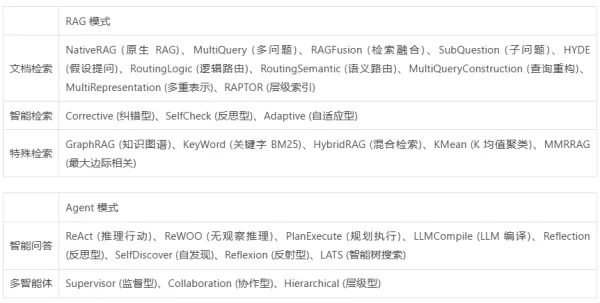
What truly demonstrates its capability is that it lists almost all mainstream practices on the market as a menu. In the RAG section, native RAG, multi-query, retrieval fusion, sub-question decomposition, hypothetical document embedding (HYDE), logical and semantic routing, query rewriting, multiple representations, and hierarchical indexing (RAPTOR) are all available. Error-correcting, self-checking, and self-adaptive agents are responsible for providing a safety net during the retrieval process. Special modes also include GraphRAG knowledge graphs, BM25 keywords, hybrid RAG, K-means clustering, and maximum marginal relevance RAG. The Agent mode is even more dynamic: ReAct's reasoning actions, ReWOO's observation-free reasoning, planning execution, LLM compilation, reflection, self-discovery, reflection, intelligent tree search, plus supervised, collaborative, and hierarchical multi-agent orchestration — almost covering all the key elements of current Agent research.
In terms of architecture, it follows a separated front-end and back-end approach with modularity. The backend is built using Python and the lightweight Flask to support RESTful API. The frontend uses React to build a responsive interface, leveraging the open-source Umi from Ant Group for project engineering and using Ant Design as the component library. The underlying database is also divided into roles: high-performance cloud-native Qdrant stores text embeddings and handles semantic similarity searches, Neo4j models complex relationships between entities and enables graph reasoning, and PostgreSQL reliably stores structured business data such as users, logs, and configurations.
Getting started isn't too heavy. The frontend dependencies are managed via npm or yarn, and the backend via pip or poetry, and then install the three essentials: Qdrant, Neo4j, and PostgreSQL. If you just want to try locally, executing the simplest configuration steps means you don't even need Qdrant and Neo4j to demonstrate the core modules. After starting, access localhost:8000, where the default username and password are both admin — a system that integrates LLM, RAG, and Agent into one door is now presented to developers.
Related article
 Swedish AI Startup Lovable Eyes $13.2 Billion Valuation After Major Funding Round
As AI-driven coding tools gain traction, Swedish startup Lovable has secured a major funding round. The company aims to raise $3 billion, potentially boosting its valuation to $13.2 billion—double the $6.6 billion recorded last December. Menlo Ventur
Google Tests Remy AI Agent for Gemini as Focus Shifts to User Control
According to Business Insider, Google is testing Remy, a new AI personal agent for Gemini. This tool aims to execute tasks on behalf of users, streamlining both professional workflows and daily routines.Currently, Remy is undergoing testing in an int
How to fix Core Web Vitals for better SEO rankings
Streamline Report Card Comments with AI ToolsIntroductionAI Tools for Generating Report Card CommentsMagic SchoolAlmanac AIChat GPTUsing Magic School to Generate Report Card CommentsLogging into Magic SchoolSelecting the Report Card Comments ToolCust
Related Special Topic Recommendations
writing
Swedish AI Startup Lovable Eyes $13.2 Billion Valuation After Major Funding Round
As AI-driven coding tools gain traction, Swedish startup Lovable has secured a major funding round. The company aims to raise $3 billion, potentially boosting its valuation to $13.2 billion—double the $6.6 billion recorded last December. Menlo Ventur
Google Tests Remy AI Agent for Gemini as Focus Shifts to User Control
According to Business Insider, Google is testing Remy, a new AI personal agent for Gemini. This tool aims to execute tasks on behalf of users, streamlining both professional workflows and daily routines.Currently, Remy is undergoing testing in an int
How to fix Core Web Vitals for better SEO rankings
Streamline Report Card Comments with AI ToolsIntroductionAI Tools for Generating Report Card CommentsMagic SchoolAlmanac AIChat GPTUsing Magic School to Generate Report Card CommentsLogging into Magic SchoolSelecting the Report Card Comments ToolCust
Related Special Topic Recommendations
writing
 Best AI Outline Generators for Long-Form SEO Articles
2026 Latest Best Top-Rated AI Outline Generators for Long-Form SEO Articles, meticulously curated by XIX.AI. These powerful tools offer game-changing assistance in creating high-quality content quickly, boosting writing efficiency significantly. Get a free vs paid comparison along with real-world tests and detailed rankings to help you find the must-try option that suits your needs. Explore now to unlock your AI edge.
 8 tools
 xix.ai
Education and Learning
AI Study Tools for Homework and Exam Prep
xix.ai
Education and Learning
AI Study Tools for Homework and Exam Prep
2026 Latest Best AI Study Tools for Homework and Exam Prep! XIX.AI curates a top-rated list of powerful, game-changing tools that help students boost productivity, streamline homework completion, and ace exams through real-world tests. Get a free vs paid comparison, detailed rankings, and must-try options to unlock your AI edge. Explore now!
10 tools
xix.ai
Music composition
AI Vocal Demo Tools for Songwriters, Hooks, Toplines, and Multilingual Draft Sessions
2026 Latest Best AI Vocal Demo Tools for Songwriters, Hook Creators, and Multi-Language Content Teams! XIX.AI has curated a top-rated list of powerful game-changing tools that go through rigorous real-world tests. You’ll find detailed free vs paid comparison data, comprehensive rankings, and must-try options to help you boost writing efficiency and unlock your creative potential. Explore now to discover your perfect tool for all your content needs!
9 tools
xix.ai
Business
Best AI Competitive Research Tools for Small Businesses
2026 Latest Best Top-rated AI Competitive Research Tools for Small Businesses! XIX.AI has curated a highly powerful game-changing collection, updated weekly with rigorous real-world tests and detailed rankings. You can find a comprehensive free vs paid comparison to help you identify the must-try tools that boost your productivity and give you a competitive edge. Explore now to discover your perfect tool!
9 tools
xix.ai
Image editing
Photoshop AI Retouch Tools for Ecommerce Apparel, Skin Cleanup, and Color Consistency
2026 Latest Best Photoshop AI retouch tools for ecommerce apparel, skin cleanup, and color consistency! This top-rated curated list features powerful game-changing solutions that help you boost writing efficiency, streamline content creation, and achieve perfect visual results effortlessly. Each tool has undergone real-world tests through weekly updated rankings, complete with free vs paid comparison details. Backed by XIX.AI, it’s the must-try guide for anyone aiming to unlock your AI edge. Explore now!
10 tools
xix.ai
Prompt
Best AI Prompt Libraries for ChatGPT Workflows
2026 Latest Best Top-Rated AI Prompt Libraries for optimizing all types of ChatGPT workflows. XIX.AI has curated a powerful, game-changing collection that goes through rigorous real-world tests to ensure top performance. You can find detailed free vs paid comparisons and expert rankings to help you choose the must-try tools that boost your productivity and unlock your AI edge. Explore now!
11 tools
xix.ai

 Comments (0)
0/500
Comments (0)
0/500
An open-source initiative dedicated to structuring large language model capabilities has made another incremental progress. TaiXu-Admin version 0.1.2 has been released. This application management system, centered around LLM, RAG, and Agent, strives to unify dialogue, retrieval enhancement, and intelligent agent collaboration into a single backend.
The update log for this version is comprehensive. It links documentation with LLM Wiki parsing and introduces LLM Wiki search; it implements a hot compilation replacement (HCP) mechanism for modified code files, allowing adjustments to take effect without restarting; the knowledge base and knowledge graph library now support custom reconfiguration. Historical memory management has been updated, and exception handling for RAG and Agent during runtime is complete — for a platform aiming to keep multiple intelligent agents online for extended periods, these improvements have further solidified the foundation.
Examining the system itself, TaiXu-Admin is an AI technology-integrated smart system: the backend is written in Python, and the frontend uses React for interactive pages. Its capabilities include LLM conversation, RAG, and Agent. It takes LangChain and LangGraph as the core components of large model applications. The former builds modular model pipelines, while the latter runs complex state-driven multi-agent collaboration, thereby supporting RAG mode, Agent mode, Prompt engineering, tool calls, and memory management, integrating conversational interaction, knowledge retrieval-enhanced generation, and agent collaboration all together.
What truly demonstrates its capability is that it lists almost all mainstream practices on the market as a menu. In the RAG section, native RAG, multi-query, retrieval fusion, sub-question decomposition, hypothetical document embedding (HYDE), logical and semantic routing, query rewriting, multiple representations, and hierarchical indexing (RAPTOR) are all available. Error-correcting, self-checking, and self-adaptive agents are responsible for providing a safety net during the retrieval process. Special modes also include GraphRAG knowledge graphs, BM25 keywords, hybrid RAG, K-means clustering, and maximum marginal relevance RAG. The Agent mode is even more dynamic: ReAct's reasoning actions, ReWOO's observation-free reasoning, planning execution, LLM compilation, reflection, self-discovery, reflection, intelligent tree search, plus supervised, collaborative, and hierarchical multi-agent orchestration — almost covering all the key elements of current Agent research.
In terms of architecture, it follows a separated front-end and back-end approach with modularity. The backend is built using Python and the lightweight Flask to support RESTful API. The frontend uses React to build a responsive interface, leveraging the open-source Umi from Ant Group for project engineering and using Ant Design as the component library. The underlying database is also divided into roles: high-performance cloud-native Qdrant stores text embeddings and handles semantic similarity searches, Neo4j models complex relationships between entities and enables graph reasoning, and PostgreSQL reliably stores structured business data such as users, logs, and configurations.
Getting started isn't too heavy. The frontend dependencies are managed via npm or yarn, and the backend via pip or poetry, and then install the three essentials: Qdrant, Neo4j, and PostgreSQL. If you just want to try locally, executing the simplest configuration steps means you don't even need Qdrant and Neo4j to demonstrate the core modules. After starting, access localhost:8000, where the default username and password are both admin — a system that integrates LLM, RAG, and Agent into one door is now presented to developers.








 Swedish AI Startup Lovable Eyes $13.2 Billion Valuation After Major Funding Round
As AI-driven coding tools gain traction, Swedish startup Lovable has secured a major funding round. The company aims to raise $3 billion, potentially boosting its valuation to $13.2 billion—double the $6.6 billion recorded last December. Menlo Ventur
Google Tests Remy AI Agent for Gemini as Focus Shifts to User Control
According to Business Insider, Google is testing Remy, a new AI personal agent for Gemini. This tool aims to execute tasks on behalf of users, streamlining both professional workflows and daily routines.Currently, Remy is undergoing testing in an int
Swedish AI Startup Lovable Eyes $13.2 Billion Valuation After Major Funding Round
As AI-driven coding tools gain traction, Swedish startup Lovable has secured a major funding round. The company aims to raise $3 billion, potentially boosting its valuation to $13.2 billion—double the $6.6 billion recorded last December. Menlo Ventur
Google Tests Remy AI Agent for Gemini as Focus Shifts to User Control
According to Business Insider, Google is testing Remy, a new AI personal agent for Gemini. This tool aims to execute tasks on behalf of users, streamlining both professional workflows and daily routines.Currently, Remy is undergoing testing in an int
 How to fix Core Web Vitals for better SEO rankings
Streamline Report Card Comments with AI ToolsIntroductionAI Tools for Generating Report Card CommentsMagic SchoolAlmanac AIChat GPTUsing Magic School to Generate Report Card CommentsLogging into Magic SchoolSelecting the Report Card Comments ToolCust
How to fix Core Web Vitals for better SEO rankings
Streamline Report Card Comments with AI ToolsIntroductionAI Tools for Generating Report Card CommentsMagic SchoolAlmanac AIChat GPTUsing Magic School to Generate Report Card CommentsLogging into Magic SchoolSelecting the Report Card Comments ToolCust

2026 Latest Best Top-Rated AI Outline Generators for Long-Form SEO Articles, meticulously curated by XIX.AI. These powerful tools offer game-changing assistance in creating high-quality content quickly, boosting writing efficiency significantly. Get a free vs paid comparison along with real-world tests and detailed rankings to help you find the must-try option that suits your needs. Explore now to unlock your AI edge.
8 tools
xix.ai

2026 Latest Best AI Study Tools for Homework and Exam Prep! XIX.AI curates a top-rated list of powerful, game-changing tools that help students boost productivity, streamline homework completion, and ace exams through real-world tests. Get a free vs paid comparison, detailed rankings, and must-try options to unlock your AI edge. Explore now!
10 tools
xix.ai

2026 Latest Best AI Vocal Demo Tools for Songwriters, Hook Creators, and Multi-Language Content Teams! XIX.AI has curated a top-rated list of powerful game-changing tools that go through rigorous real-world tests. You’ll find detailed free vs paid comparison data, comprehensive rankings, and must-try options to help you boost writing efficiency and unlock your creative potential. Explore now to discover your perfect tool for all your content needs!
9 tools
xix.ai

2026 Latest Best Top-rated AI Competitive Research Tools for Small Businesses! XIX.AI has curated a highly powerful game-changing collection, updated weekly with rigorous real-world tests and detailed rankings. You can find a comprehensive free vs paid comparison to help you identify the must-try tools that boost your productivity and give you a competitive edge. Explore now to discover your perfect tool!
9 tools
xix.ai

2026 Latest Best Photoshop AI retouch tools for ecommerce apparel, skin cleanup, and color consistency! This top-rated curated list features powerful game-changing solutions that help you boost writing efficiency, streamline content creation, and achieve perfect visual results effortlessly. Each tool has undergone real-world tests through weekly updated rankings, complete with free vs paid comparison details. Backed by XIX.AI, it’s the must-try guide for anyone aiming to unlock your AI edge. Explore now!
10 tools
xix.ai
2026 Latest Best Top-Rated AI Prompt Libraries for optimizing all types of ChatGPT workflows. XIX.AI has curated a powerful, game-changing collection that goes through rigorous real-world tests to ensure top performance. You can find detailed free vs paid comparisons and expert rankings to help you choose the must-try tools that boost your productivity and unlock your AI edge. Explore now!
11 tools
xix.ai












