


 Home
HomeSS Innovations Develops Surgical Robot for Drone Delivery

The SSi Vimana Aero Drone System aims to deliver critical medical care directly to soldiers wounded on the battlefield. | Source: SS Innovations International
SS Innovations International Inc. recently showcased four surgical robotic systems currently in development at its Global Multi-Specialty Robotic Surgery Conference in New Delhi, India. The new platforms include the SSi Vimana Aero Drone System, the SSi Avtara Humanoid Surgical Platform, the SSi Operion Mobile Operating Room, and new single-arm robotic carts for endoscopic and ultrasound assistance.
“Innovation defines our core mission. While we continuously enhance our advanced, cost-effective SSi Mantra surgical robotic system and its telesurgery features, we are also committed to pioneering new robotic technologies that can significantly improve healthcare access for a broader range of patients,” said Dr. Sudhir Srivastava, Chairman and CEO of SS Innovations. “Our largest conference to date, SMRSC 2026, powerfully highlighted this crucial objective.”
Based in Fort Lauderdale, Florida, SS Innovations develops systems to make robotic surgery more affordable and widely available. The company’s portfolio includes its proprietary SSi Mantra multi-arm surgical system and the accompanying suite of SSi Mudra instruments.
SSi Vimana Aero delivers surgical care directly to the battlefield
The SSi Vimana Aero is a robotic system in development, engineered to provide expert surgical intervention directly to injured soldiers in active combat zones. This approach is designed to bridge the critical time gap between the initial injury and eventual medical evacuation from the front lines.
Deployed via a heavy-lift autonomous drone, the SSi Vimana Aero can land near a casualty. Once on site, it utilizes two miniature robotic arms with seven degrees of freedom and 5-mm surgical instruments to administer care. A trauma surgeon then operates the system remotely from an SSi Mantra surgeon command console.
The platform is intended to address procedures such as controlling hemorrhage, wound repair, chest decompression, shrapnel removal, and field suturing. Its primary goal is to stabilize patients until evacuation teams can reach them.
SS Innovations begins developing humanoids for surgical care
The SSi Avtara, another concept in development, seeks to leverage the advanced mobility, dexterity, and perception of humanoid systems for high-impact surgical applications across healthcare, defense, logistics, disaster response, and industrial sectors.
Integrated with artificial intelligence, teleoperation frameworks, and real-time sensing, SS Innovations states the SSi Avtara will be designed for trainability, continuous learning, adaptability, and precision in field operations.
The company anticipates that the platform's human-compatible design will allow seamless interaction with existing infrastructure and tools, from assisting clinical workflows to operating in hazardous or hard-to-reach environments.
SSi Operion is a mobile, platform-agnostic operating room
The SSi Operion, also under development, is a fully mobile, platform-agnostic operating room ecosystem designed for deployment in hospitals, remote areas, combat zones, and disaster sites.
Built on a wheeled chassis, it features an overhead-integrated robotic system with a zero-footprint architecture. This design suspends all surgical components from an integrated overhead system, aiming to eliminate traditional spatial constraints and allow 360-degree clinician access with real-time reconfiguration capability.
With integrated telesurgery features and low-latency connectivity, the SSi Operion could enable specialist surgeons to perform procedures remotely, expanding access to advanced surgical care across diverse geographical locations.
SS Innovations claims the SSi Operion could transform the operating room into a deployable, mission-ready asset suitable for defense operations, humanitarian missions, and rural healthcare delivery.
SS Innovations aims to integrate robotics into hospital workflows
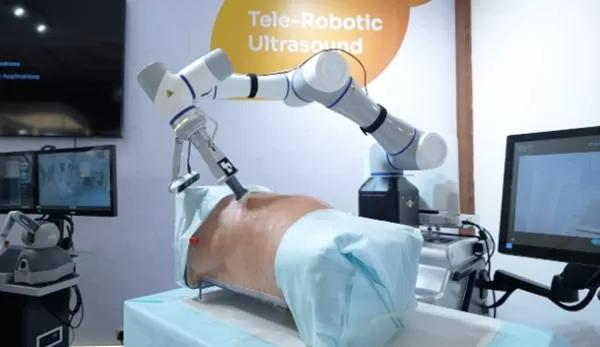
SS Innovations' single-arm robotic endoscopy cart is undergoing clinical validation in India. | Source: SS Innovations International
The company's new single-arm robotic carts for endoscopy and ultrasound assistance are currently in early-stage clinical validation in India. They are designed to provide stable, precise, and repeatable positioning of endoscopic and ultrasound instruments, introducing robotic consistency into clinical workflows.
Operating under direct clinician supervision, these robotic arms incorporate controlled speed, force limits, and predictable motion to ensure safe interaction with patients and operators. SS Innovations notes that compatibility with standard hospital infrastructure and existing clinical processes should facilitate smoother integration into established healthcare settings.
Related article
 HIVE Secures $15M to Develop Physical AI for Industrial Machines
HIVE upgrades existing customer machinery with sensors and a silicon-based control system. | Source: HIVEHIVE announced today the closing of a $15 million pre-Series A funding round. The London-headquartered physical AI startup stated its mission is
Generalist Unveils GEN-1 General-Purpose AI Model for Physical Systems
To develop GEN-1, Generalist enhanced training stability, created custom kernels, devised novel paged attention methods for real-time inference, refined post-training techniques, and improved controls for smoother, more precise operation. | Source: G
MoveIt Pro 9.0 Upgrades with Enhanced Perception and Teleoperation
According to PickNik, MoveIt Pro 9.0 allows robots to work efficiently in settings with shifting geometry and diverse surfaces. | Source: PickNik RoboticsPickNik Inc. has launched MoveIt Pro 9.0, the newest iteration of its platform for building robo
Related Special Topic Recommendations
Design & Art
HIVE Secures $15M to Develop Physical AI for Industrial Machines
HIVE upgrades existing customer machinery with sensors and a silicon-based control system. | Source: HIVEHIVE announced today the closing of a $15 million pre-Series A funding round. The London-headquartered physical AI startup stated its mission is
Generalist Unveils GEN-1 General-Purpose AI Model for Physical Systems
To develop GEN-1, Generalist enhanced training stability, created custom kernels, devised novel paged attention methods for real-time inference, refined post-training techniques, and improved controls for smoother, more precise operation. | Source: G
MoveIt Pro 9.0 Upgrades with Enhanced Perception and Teleoperation
According to PickNik, MoveIt Pro 9.0 allows robots to work efficiently in settings with shifting geometry and diverse surfaces. | Source: PickNik RoboticsPickNik Inc. has launched MoveIt Pro 9.0, the newest iteration of its platform for building robo
Related Special Topic Recommendations
Design & Art
 AI Visual Style Reference Tools for Character Sheets, Moodboards, and Pitch Decks
2026 Latest Best AI Visual Style Reference Tools for Character Sheets, Moodboards, and Pitch Decks are here on XIX.AI! This curated top-rated list features powerful game-changing tools that go through rigorous real-world tests. You’ll find a free vs paid comparison, detailed rankings, and must-try options to help you boost creativity and streamline your workflow. Explore now to discover your perfect tool for boosting productivity!
 11 tools
 xix.ai
SEO
Best AI SERP Analysis Tools for Search Strategy
xix.ai
SEO
Best AI SERP Analysis Tools for Search Strategy
2026 Latest Best Top-rated AI SERP Analysis Tools for Search Strategy are curated by XIX.AI through rigorous real-world tests and weekly updated rankings. These powerful tools help you unlock hidden optimization opportunities, boost content performance, and gain a competitive edge in search. Discover your perfect tool to elevate your search strategy today. Explore now!
13 tools
xix.ai
Data Analysis
Best AI Anomaly Detection Tools for KPI Monitoring across SaaS and Ecommerce Teams
2026 Latest Best Top-rated AI Anomaly Detection Tools for KPI Monitoring in SaaS and Ecommerce teams! XIX.AI has curated a powerful, game-changing collection based on rigorous real-world tests and weekly updated rankings. You’ll find detailed free vs paid comparison insights to help you identify the must-try solution that boosts productivity and unlocks your AI edge. Explore now!
10 tools
xix.ai
writing
Best AI Outline Generators for Long-Form SEO Articles
2026 Latest Best Top-Rated AI Outline Generators for Long-Form SEO Articles, meticulously curated by XIX.AI. These powerful tools offer game-changing assistance in creating high-quality content quickly, boosting writing efficiency significantly. Get a free vs paid comparison along with real-world tests and detailed rankings to help you find the must-try option that suits your needs. Explore now to unlock your AI edge.
8 tools
xix.ai
Education and Learning
AI Study Tools for Homework and Exam Prep
2026 Latest Best AI Study Tools for Homework and Exam Prep! XIX.AI curates a top-rated list of powerful, game-changing tools that help students boost productivity, streamline homework completion, and ace exams through real-world tests. Get a free vs paid comparison, detailed rankings, and must-try options to unlock your AI edge. Explore now!
10 tools
xix.ai
Music composition
AI Vocal Demo Tools for Songwriters, Hooks, Toplines, and Multilingual Draft Sessions
2026 Latest Best AI Vocal Demo Tools for Songwriters, Hook Creators, and Multi-Language Content Teams! XIX.AI has curated a top-rated list of powerful game-changing tools that go through rigorous real-world tests. You’ll find detailed free vs paid comparison data, comprehensive rankings, and must-try options to help you boost writing efficiency and unlock your creative potential. Explore now to discover your perfect tool for all your content needs!
9 tools
xix.ai

 Comments (0)
0/500
Comments (0)
0/500
The SSi Vimana Aero Drone System aims to deliver critical medical care directly to soldiers wounded on the battlefield. | Source: SS Innovations International
SS Innovations International Inc. recently showcased four surgical robotic systems currently in development at its Global Multi-Specialty Robotic Surgery Conference in New Delhi, India. The new platforms include the SSi Vimana Aero Drone System, the SSi Avtara Humanoid Surgical Platform, the SSi Operion Mobile Operating Room, and new single-arm robotic carts for endoscopic and ultrasound assistance.
“Innovation defines our core mission. While we continuously enhance our advanced, cost-effective SSi Mantra surgical robotic system and its telesurgery features, we are also committed to pioneering new robotic technologies that can significantly improve healthcare access for a broader range of patients,” said Dr. Sudhir Srivastava, Chairman and CEO of SS Innovations. “Our largest conference to date, SMRSC 2026, powerfully highlighted this crucial objective.”
Based in Fort Lauderdale, Florida, SS Innovations develops systems to make robotic surgery more affordable and widely available. The company’s portfolio includes its proprietary SSi Mantra multi-arm surgical system and the accompanying suite of SSi Mudra instruments.
SSi Vimana Aero delivers surgical care directly to the battlefield
The SSi Vimana Aero is a robotic system in development, engineered to provide expert surgical intervention directly to injured soldiers in active combat zones. This approach is designed to bridge the critical time gap between the initial injury and eventual medical evacuation from the front lines.
Deployed via a heavy-lift autonomous drone, the SSi Vimana Aero can land near a casualty. Once on site, it utilizes two miniature robotic arms with seven degrees of freedom and 5-mm surgical instruments to administer care. A trauma surgeon then operates the system remotely from an SSi Mantra surgeon command console.
The platform is intended to address procedures such as controlling hemorrhage, wound repair, chest decompression, shrapnel removal, and field suturing. Its primary goal is to stabilize patients until evacuation teams can reach them.
SS Innovations begins developing humanoids for surgical care
The SSi Avtara, another concept in development, seeks to leverage the advanced mobility, dexterity, and perception of humanoid systems for high-impact surgical applications across healthcare, defense, logistics, disaster response, and industrial sectors.
Integrated with artificial intelligence, teleoperation frameworks, and real-time sensing, SS Innovations states the SSi Avtara will be designed for trainability, continuous learning, adaptability, and precision in field operations.
The company anticipates that the platform's human-compatible design will allow seamless interaction with existing infrastructure and tools, from assisting clinical workflows to operating in hazardous or hard-to-reach environments.
SSi Operion is a mobile, platform-agnostic operating room
The SSi Operion, also under development, is a fully mobile, platform-agnostic operating room ecosystem designed for deployment in hospitals, remote areas, combat zones, and disaster sites.
Built on a wheeled chassis, it features an overhead-integrated robotic system with a zero-footprint architecture. This design suspends all surgical components from an integrated overhead system, aiming to eliminate traditional spatial constraints and allow 360-degree clinician access with real-time reconfiguration capability.
With integrated telesurgery features and low-latency connectivity, the SSi Operion could enable specialist surgeons to perform procedures remotely, expanding access to advanced surgical care across diverse geographical locations.
SS Innovations claims the SSi Operion could transform the operating room into a deployable, mission-ready asset suitable for defense operations, humanitarian missions, and rural healthcare delivery.
SS Innovations aims to integrate robotics into hospital workflows
SS Innovations' single-arm robotic endoscopy cart is undergoing clinical validation in India. | Source: SS Innovations International
The company's new single-arm robotic carts for endoscopy and ultrasound assistance are currently in early-stage clinical validation in India. They are designed to provide stable, precise, and repeatable positioning of endoscopic and ultrasound instruments, introducing robotic consistency into clinical workflows.
Operating under direct clinician supervision, these robotic arms incorporate controlled speed, force limits, and predictable motion to ensure safe interaction with patients and operators. SS Innovations notes that compatibility with standard hospital infrastructure and existing clinical processes should facilitate smoother integration into established healthcare settings.







 HIVE Secures $15M to Develop Physical AI for Industrial Machines
HIVE upgrades existing customer machinery with sensors and a silicon-based control system. | Source: HIVEHIVE announced today the closing of a $15 million pre-Series A funding round. The London-headquartered physical AI startup stated its mission is
HIVE Secures $15M to Develop Physical AI for Industrial Machines
HIVE upgrades existing customer machinery with sensors and a silicon-based control system. | Source: HIVEHIVE announced today the closing of a $15 million pre-Series A funding round. The London-headquartered physical AI startup stated its mission is
 Generalist Unveils GEN-1 General-Purpose AI Model for Physical Systems
To develop GEN-1, Generalist enhanced training stability, created custom kernels, devised novel paged attention methods for real-time inference, refined post-training techniques, and improved controls for smoother, more precise operation. | Source: G
MoveIt Pro 9.0 Upgrades with Enhanced Perception and Teleoperation
According to PickNik, MoveIt Pro 9.0 allows robots to work efficiently in settings with shifting geometry and diverse surfaces. | Source: PickNik RoboticsPickNik Inc. has launched MoveIt Pro 9.0, the newest iteration of its platform for building robo
Generalist Unveils GEN-1 General-Purpose AI Model for Physical Systems
To develop GEN-1, Generalist enhanced training stability, created custom kernels, devised novel paged attention methods for real-time inference, refined post-training techniques, and improved controls for smoother, more precise operation. | Source: G
MoveIt Pro 9.0 Upgrades with Enhanced Perception and Teleoperation
According to PickNik, MoveIt Pro 9.0 allows robots to work efficiently in settings with shifting geometry and diverse surfaces. | Source: PickNik RoboticsPickNik Inc. has launched MoveIt Pro 9.0, the newest iteration of its platform for building robo

2026 Latest Best AI Visual Style Reference Tools for Character Sheets, Moodboards, and Pitch Decks are here on XIX.AI! This curated top-rated list features powerful game-changing tools that go through rigorous real-world tests. You’ll find a free vs paid comparison, detailed rankings, and must-try options to help you boost creativity and streamline your workflow. Explore now to discover your perfect tool for boosting productivity!
11 tools
xix.ai

2026 Latest Best Top-rated AI SERP Analysis Tools for Search Strategy are curated by XIX.AI through rigorous real-world tests and weekly updated rankings. These powerful tools help you unlock hidden optimization opportunities, boost content performance, and gain a competitive edge in search. Discover your perfect tool to elevate your search strategy today. Explore now!
13 tools
xix.ai

2026 Latest Best Top-rated AI Anomaly Detection Tools for KPI Monitoring in SaaS and Ecommerce teams! XIX.AI has curated a powerful, game-changing collection based on rigorous real-world tests and weekly updated rankings. You’ll find detailed free vs paid comparison insights to help you identify the must-try solution that boosts productivity and unlocks your AI edge. Explore now!
10 tools
xix.ai

2026 Latest Best Top-Rated AI Outline Generators for Long-Form SEO Articles, meticulously curated by XIX.AI. These powerful tools offer game-changing assistance in creating high-quality content quickly, boosting writing efficiency significantly. Get a free vs paid comparison along with real-world tests and detailed rankings to help you find the must-try option that suits your needs. Explore now to unlock your AI edge.
8 tools
xix.ai

2026 Latest Best AI Study Tools for Homework and Exam Prep! XIX.AI curates a top-rated list of powerful, game-changing tools that help students boost productivity, streamline homework completion, and ace exams through real-world tests. Get a free vs paid comparison, detailed rankings, and must-try options to unlock your AI edge. Explore now!
10 tools
xix.ai

2026 Latest Best AI Vocal Demo Tools for Songwriters, Hook Creators, and Multi-Language Content Teams! XIX.AI has curated a top-rated list of powerful game-changing tools that go through rigorous real-world tests. You’ll find detailed free vs paid comparison data, comprehensive rankings, and must-try options to help you boost writing efficiency and unlock your creative potential. Explore now to discover your perfect tool for all your content needs!
9 tools
xix.ai












