


 Home
HomeSimulation Startup Aims to Become the Cursor for Physical AI
The vision of physical AI is to enable engineers to program physical agents with the same ease as their digital counterparts.
We haven't reached that point yet. Robotics continues to be constrained by a severe lack of data from the physical world. To train their machines, companies must construct mock warehouses for testing, while an entire industry has emerged to monitor factory lines and gig workers, gathering data to train deep learning models for robotic operations.
Simulation offers another path. Detailed virtual replicas of real-world environments could provide the scalable data and testing grounds roboticists need.
Antioch, a startup developing simulation tools for robot developers, aims to bridge the industry's "sim-to-real gap"—the challenge of creating virtual environments so realistic that robots trained within them can operate reliably in the physical world.
"How can we best minimize that gap, making simulation feel indistinguishable from reality from your autonomous system's perspective?" said Antioch CEO and co-founder Harry Mellsop.
To advance this goal, the company announced an $8.5 million seed funding round, valuing it at $60 million. The round was led by venture firms A* and Category Ventures, with participation from MaC Venture Capital, Abstract, Box Group, and Icehouse Ventures.
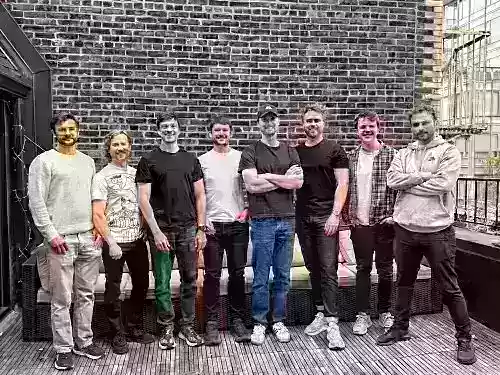
Mellsop founded the New York-based company with four co-founders in May last year. Two of them, Alex Langshur and Michael Calvey, previously co-founded the security and intelligence startup Transpose with him, which was later acquired by Chainalysis. The other two founders, Collin Schlager and Colton Swingle, have backgrounds at Google DeepMind and Meta Reality Labs, respectively.
The demand for advanced simulation is central to the work of many major autonomy companies. In autonomous driving, for instance, Waymo utilizes Google DeepMind's world models to test and evaluate its driving algorithms. This approach could theoretically reduce the extensive data collection required to deploy vehicles in new areas, a significant cost in scaling the technology.
Building and utilizing these models for robot testing requires a different skillset than developing a self-driving car. Antioch aims to create a platform that solves this problem for newer companies lacking the capital to build everything in-house. These smaller players also cannot afford to construct physical testing facilities or log millions of miles with sensor-equipped vehicles.
"The vast majority of the industry doesn't use simulation at all, and it's becoming increasingly clear that we need to accelerate progress," Mellsop stated.
Antioch executives liken their product to Cursor, the popular AI-powered software development tool. Their platform allows robot builders to launch multiple digital instances of their hardware, connected to simulated sensors that replicate real-world data feeds. These environments enable developers to test edge cases, conduct reinforcement learning, and generate new training data.
This is contingent, however, on the simulation achieving high fidelity. The core challenge is ensuring the virtual physics match reality so that models controlling actual machines perform flawlessly. Antioch builds upon models from Nvidia, World Labs, and others, creating domain-specific libraries for ease of use. By collaborating with multiple customers, the company gains a breadth of context for refining its simulations that a single physical AI firm could not achieve alone.
"What we saw with software engineering and LLMs is now beginning in physical AI," Çağla Kaymaz, a partner at Category Ventures, told TechCrunch. "We focus heavily on developer tools and love that vertical, but the challenges differ. With software, subpar coding tools pose risks largely confined to the digital realm. In the physical world, the stakes are far higher."
Antioch's current focus is primarily on sensor and perception systems, which represent a major need for automated vehicles, agricultural and construction machinery, and aerial drones. The broader aspiration for general-purpose robots replicating human tasks remains more distant. While targeting startups, some of Antioch's earliest clients are large multinationals with substantial existing investments in robotics.
Adrian Macneil has deep expertise in this field. As an executive at the self-driving startup Cruise, he built the company's data infrastructure before founding Foxglove in 2021, which provides similar data pipeline tools for physical AI startups. Macneil is also an angel investor in Antioch.
"Simulation is crucial for building safety cases or handling high-accuracy tasks," he said at the Ride.AI conference in San Francisco. "It's simply not feasible to drive enough real-world miles."
Macneil hopes to see the emergence of foundational tools for physical AI, similar to platforms like GitHub, Stripe, and Twilio that fueled the SaaS revolution. "We need much more of the entire toolchain to be available off the shelf," he added.
"We genuinely believe that within two to three years, anyone building a real-world autonomous system will do so primarily in software," Mellsop said. "For the first time, autonomous agents can iterate on a physical system and truly close the feedback loop."
Experiments are already underway. David Mayo, a researcher at MIT's Computer Science and Artificial Intelligence Laboratory, is using Antioch's platform to evaluate LLMs. In one test, AI models design robots, which are then evaluated in Antioch's simulator. The models can even compete in simulated contests, such as pushing a rival bot off a platform. Providing LLMs with a realistic sandbox could establish a new paradigm for benchmarking their capabilities.
Before a world of AI engineers emerges, significant work remains to close the gap between digital models and reality. If successful, developers could create a powerful data flywheel. Macneil believes this flywheel is key to the success of leaders like Waymo, where engineers grow increasingly confident that each new model iteration will outperform the last.
For other companies aiming to replicate that success, the choice will be to build these tools themselves—or purchase them.
Related article
 Former Infosys Chief’s AI Startup Secures Another $53M
Hang Ten Systems, an AI startup established by former Infosys CEO Vishal Sikka just four months ago, has secured an additional $53 million in seed funding. This latest investment round was finalized merely five weeks after the initial $32 million see
Crypto exchange OKX aims to empower AI agents to hire and pay each other
As AI agents start serving individuals and collaborating with each other, they require mechanisms to locate tasks, compensate for services, and establish credibility. Crypto exchange OKX anticipates this future is arriving sooner than anticipated, in
Thiel-backed startup claims AI can judge journalism, despite risks to whistleblowers
Following his role in the lawsuit that led to Gawker’s bankruptcy, Aron D’Souza identified a critical flaw in the American media landscape: individuals harmed by coverage lacked effective means to respond.His answer is technology. D’Souza’s new ventu
Related Special Topic Recommendations
writing
Former Infosys Chief’s AI Startup Secures Another $53M
Hang Ten Systems, an AI startup established by former Infosys CEO Vishal Sikka just four months ago, has secured an additional $53 million in seed funding. This latest investment round was finalized merely five weeks after the initial $32 million see
Crypto exchange OKX aims to empower AI agents to hire and pay each other
As AI agents start serving individuals and collaborating with each other, they require mechanisms to locate tasks, compensate for services, and establish credibility. Crypto exchange OKX anticipates this future is arriving sooner than anticipated, in
Thiel-backed startup claims AI can judge journalism, despite risks to whistleblowers
Following his role in the lawsuit that led to Gawker’s bankruptcy, Aron D’Souza identified a critical flaw in the American media landscape: individuals harmed by coverage lacked effective means to respond.His answer is technology. D’Souza’s new ventu
Related Special Topic Recommendations
writing
 Best AI Outline Generators for Long-Form SEO Articles
2026 Latest Best Top-Rated AI Outline Generators for Long-Form SEO Articles, meticulously curated by XIX.AI. These powerful tools offer game-changing assistance in creating high-quality content quickly, boosting writing efficiency significantly. Get a free vs paid comparison along with real-world tests and detailed rankings to help you find the must-try option that suits your needs. Explore now to unlock your AI edge.
 8 tools
 xix.ai
Education and Learning
AI Study Tools for Homework and Exam Prep
xix.ai
Education and Learning
AI Study Tools for Homework and Exam Prep
2026 Latest Best AI Study Tools for Homework and Exam Prep! XIX.AI curates a top-rated list of powerful, game-changing tools that help students boost productivity, streamline homework completion, and ace exams through real-world tests. Get a free vs paid comparison, detailed rankings, and must-try options to unlock your AI edge. Explore now!
10 tools
xix.ai
Music composition
AI Vocal Demo Tools for Songwriters, Hooks, Toplines, and Multilingual Draft Sessions
2026 Latest Best AI Vocal Demo Tools for Songwriters, Hook Creators, and Multi-Language Content Teams! XIX.AI has curated a top-rated list of powerful game-changing tools that go through rigorous real-world tests. You’ll find detailed free vs paid comparison data, comprehensive rankings, and must-try options to help you boost writing efficiency and unlock your creative potential. Explore now to discover your perfect tool for all your content needs!
9 tools
xix.ai
Business
Best AI Competitive Research Tools for Small Businesses
2026 Latest Best Top-rated AI Competitive Research Tools for Small Businesses! XIX.AI has curated a highly powerful game-changing collection, updated weekly with rigorous real-world tests and detailed rankings. You can find a comprehensive free vs paid comparison to help you identify the must-try tools that boost your productivity and give you a competitive edge. Explore now to discover your perfect tool!
9 tools
xix.ai
Image editing
Photoshop AI Retouch Tools for Ecommerce Apparel, Skin Cleanup, and Color Consistency
2026 Latest Best Photoshop AI retouch tools for ecommerce apparel, skin cleanup, and color consistency! This top-rated curated list features powerful game-changing solutions that help you boost writing efficiency, streamline content creation, and achieve perfect visual results effortlessly. Each tool has undergone real-world tests through weekly updated rankings, complete with free vs paid comparison details. Backed by XIX.AI, it’s the must-try guide for anyone aiming to unlock your AI edge. Explore now!
10 tools
xix.ai
Prompt
Best AI Prompt Libraries for ChatGPT Workflows
2026 Latest Best Top-Rated AI Prompt Libraries for optimizing all types of ChatGPT workflows. XIX.AI has curated a powerful, game-changing collection that goes through rigorous real-world tests to ensure top performance. You can find detailed free vs paid comparisons and expert rankings to help you choose the must-try tools that boost your productivity and unlock your AI edge. Explore now!
11 tools
xix.ai

 Comments (0)
0/500
Comments (0)
0/500
The vision of physical AI is to enable engineers to program physical agents with the same ease as their digital counterparts.
We haven't reached that point yet. Robotics continues to be constrained by a severe lack of data from the physical world. To train their machines, companies must construct mock warehouses for testing, while an entire industry has emerged to monitor factory lines and gig workers, gathering data to train deep learning models for robotic operations.
Simulation offers another path. Detailed virtual replicas of real-world environments could provide the scalable data and testing grounds roboticists need.
Antioch, a startup developing simulation tools for robot developers, aims to bridge the industry's "sim-to-real gap"—the challenge of creating virtual environments so realistic that robots trained within them can operate reliably in the physical world.
"How can we best minimize that gap, making simulation feel indistinguishable from reality from your autonomous system's perspective?" said Antioch CEO and co-founder Harry Mellsop.
To advance this goal, the company announced an $8.5 million seed funding round, valuing it at $60 million. The round was led by venture firms A* and Category Ventures, with participation from MaC Venture Capital, Abstract, Box Group, and Icehouse Ventures.
Mellsop founded the New York-based company with four co-founders in May last year. Two of them, Alex Langshur and Michael Calvey, previously co-founded the security and intelligence startup Transpose with him, which was later acquired by Chainalysis. The other two founders, Collin Schlager and Colton Swingle, have backgrounds at Google DeepMind and Meta Reality Labs, respectively.
The demand for advanced simulation is central to the work of many major autonomy companies. In autonomous driving, for instance, Waymo utilizes Google DeepMind's world models to test and evaluate its driving algorithms. This approach could theoretically reduce the extensive data collection required to deploy vehicles in new areas, a significant cost in scaling the technology.
Building and utilizing these models for robot testing requires a different skillset than developing a self-driving car. Antioch aims to create a platform that solves this problem for newer companies lacking the capital to build everything in-house. These smaller players also cannot afford to construct physical testing facilities or log millions of miles with sensor-equipped vehicles.
"The vast majority of the industry doesn't use simulation at all, and it's becoming increasingly clear that we need to accelerate progress," Mellsop stated.
Antioch executives liken their product to Cursor, the popular AI-powered software development tool. Their platform allows robot builders to launch multiple digital instances of their hardware, connected to simulated sensors that replicate real-world data feeds. These environments enable developers to test edge cases, conduct reinforcement learning, and generate new training data.
This is contingent, however, on the simulation achieving high fidelity. The core challenge is ensuring the virtual physics match reality so that models controlling actual machines perform flawlessly. Antioch builds upon models from Nvidia, World Labs, and others, creating domain-specific libraries for ease of use. By collaborating with multiple customers, the company gains a breadth of context for refining its simulations that a single physical AI firm could not achieve alone.
"What we saw with software engineering and LLMs is now beginning in physical AI," Çağla Kaymaz, a partner at Category Ventures, told TechCrunch. "We focus heavily on developer tools and love that vertical, but the challenges differ. With software, subpar coding tools pose risks largely confined to the digital realm. In the physical world, the stakes are far higher."
Antioch's current focus is primarily on sensor and perception systems, which represent a major need for automated vehicles, agricultural and construction machinery, and aerial drones. The broader aspiration for general-purpose robots replicating human tasks remains more distant. While targeting startups, some of Antioch's earliest clients are large multinationals with substantial existing investments in robotics.
Adrian Macneil has deep expertise in this field. As an executive at the self-driving startup Cruise, he built the company's data infrastructure before founding Foxglove in 2021, which provides similar data pipeline tools for physical AI startups. Macneil is also an angel investor in Antioch.
"Simulation is crucial for building safety cases or handling high-accuracy tasks," he said at the Ride.AI conference in San Francisco. "It's simply not feasible to drive enough real-world miles."
Macneil hopes to see the emergence of foundational tools for physical AI, similar to platforms like GitHub, Stripe, and Twilio that fueled the SaaS revolution. "We need much more of the entire toolchain to be available off the shelf," he added.
"We genuinely believe that within two to three years, anyone building a real-world autonomous system will do so primarily in software," Mellsop said. "For the first time, autonomous agents can iterate on a physical system and truly close the feedback loop."
Experiments are already underway. David Mayo, a researcher at MIT's Computer Science and Artificial Intelligence Laboratory, is using Antioch's platform to evaluate LLMs. In one test, AI models design robots, which are then evaluated in Antioch's simulator. The models can even compete in simulated contests, such as pushing a rival bot off a platform. Providing LLMs with a realistic sandbox could establish a new paradigm for benchmarking their capabilities.
Before a world of AI engineers emerges, significant work remains to close the gap between digital models and reality. If successful, developers could create a powerful data flywheel. Macneil believes this flywheel is key to the success of leaders like Waymo, where engineers grow increasingly confident that each new model iteration will outperform the last.
For other companies aiming to replicate that success, the choice will be to build these tools themselves—or purchase them.








 Former Infosys Chief’s AI Startup Secures Another $53M
Hang Ten Systems, an AI startup established by former Infosys CEO Vishal Sikka just four months ago, has secured an additional $53 million in seed funding. This latest investment round was finalized merely five weeks after the initial $32 million see
Former Infosys Chief’s AI Startup Secures Another $53M
Hang Ten Systems, an AI startup established by former Infosys CEO Vishal Sikka just four months ago, has secured an additional $53 million in seed funding. This latest investment round was finalized merely five weeks after the initial $32 million see
 Crypto exchange OKX aims to empower AI agents to hire and pay each other
As AI agents start serving individuals and collaborating with each other, they require mechanisms to locate tasks, compensate for services, and establish credibility. Crypto exchange OKX anticipates this future is arriving sooner than anticipated, in
Crypto exchange OKX aims to empower AI agents to hire and pay each other
As AI agents start serving individuals and collaborating with each other, they require mechanisms to locate tasks, compensate for services, and establish credibility. Crypto exchange OKX anticipates this future is arriving sooner than anticipated, in
 Thiel-backed startup claims AI can judge journalism, despite risks to whistleblowers
Following his role in the lawsuit that led to Gawker’s bankruptcy, Aron D’Souza identified a critical flaw in the American media landscape: individuals harmed by coverage lacked effective means to respond.His answer is technology. D’Souza’s new ventu
Thiel-backed startup claims AI can judge journalism, despite risks to whistleblowers
Following his role in the lawsuit that led to Gawker’s bankruptcy, Aron D’Souza identified a critical flaw in the American media landscape: individuals harmed by coverage lacked effective means to respond.His answer is technology. D’Souza’s new ventu

2026 Latest Best Top-Rated AI Outline Generators for Long-Form SEO Articles, meticulously curated by XIX.AI. These powerful tools offer game-changing assistance in creating high-quality content quickly, boosting writing efficiency significantly. Get a free vs paid comparison along with real-world tests and detailed rankings to help you find the must-try option that suits your needs. Explore now to unlock your AI edge.
8 tools
xix.ai

2026 Latest Best AI Study Tools for Homework and Exam Prep! XIX.AI curates a top-rated list of powerful, game-changing tools that help students boost productivity, streamline homework completion, and ace exams through real-world tests. Get a free vs paid comparison, detailed rankings, and must-try options to unlock your AI edge. Explore now!
10 tools
xix.ai

2026 Latest Best AI Vocal Demo Tools for Songwriters, Hook Creators, and Multi-Language Content Teams! XIX.AI has curated a top-rated list of powerful game-changing tools that go through rigorous real-world tests. You’ll find detailed free vs paid comparison data, comprehensive rankings, and must-try options to help you boost writing efficiency and unlock your creative potential. Explore now to discover your perfect tool for all your content needs!
9 tools
xix.ai

2026 Latest Best Top-rated AI Competitive Research Tools for Small Businesses! XIX.AI has curated a highly powerful game-changing collection, updated weekly with rigorous real-world tests and detailed rankings. You can find a comprehensive free vs paid comparison to help you identify the must-try tools that boost your productivity and give you a competitive edge. Explore now to discover your perfect tool!
9 tools
xix.ai

2026 Latest Best Photoshop AI retouch tools for ecommerce apparel, skin cleanup, and color consistency! This top-rated curated list features powerful game-changing solutions that help you boost writing efficiency, streamline content creation, and achieve perfect visual results effortlessly. Each tool has undergone real-world tests through weekly updated rankings, complete with free vs paid comparison details. Backed by XIX.AI, it’s the must-try guide for anyone aiming to unlock your AI edge. Explore now!
10 tools
xix.ai

2026 Latest Best Top-Rated AI Prompt Libraries for optimizing all types of ChatGPT workflows. XIX.AI has curated a powerful, game-changing collection that goes through rigorous real-world tests to ensure top performance. You can find detailed free vs paid comparisons and expert rankings to help you choose the must-try tools that boost your productivity and unlock your AI edge. Explore now!
11 tools
xix.ai












