


 Home
Home
How to implement the Shifting Sort algorithm? Complete 2025 guide with Codeforces example.
In competitive programming and algorithm design, efficient sorting techniques are crucial. The shifting sort algorithm offers a distinctive method for sorting arrays, providing an alternative when standard approaches are limited. This article explores the mechanics of shifting sort, demonstrates its application with a Codeforces example, and breaks down the underlying logic, step-by-step implementation, and its pros and cons.
Key Points
The shifting sort algorithm arranges an array by cyclically shifting specific segments.
Each cyclic shift involves choosing a segment and rotating it by a chosen offset.
The objective is to fully sort the array using at most 'n' cyclic shifts of its segments.
A solid grasp of the cyclic shift operation is essential for proper algorithm implementation.
The algorithm uses a loop to scan the array and locate the next maximum value to position.
Understanding the Shifting Sort Algorithm
What is Shifting Sort?
The shifting sort algorithm works on an array by allowing you to select any contiguous segment, perform a cyclic shift (rotation) on it by any offset, and then place it back in its original position
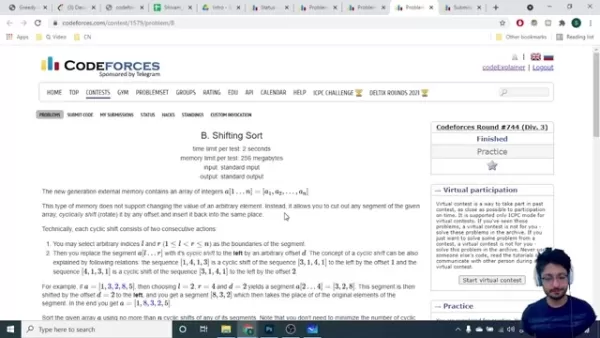
. Unlike conventional sorting algorithms that swap individual elements, this method manipulates entire array segments simultaneously.
Technically, each cyclic shift is a two-step process:
- Select arbitrary indices
l and r ( 1 ) to define the segment boundaries. - Replace the segment
a[l...r] with its cyclic shift to the left by a chosen offset d.
The challenge is to sort array 'a' using no more than 'n' cyclic shifts of any segments. The core of this algorithm is the cyclic shift operation. It selects a sub-array segment and rotates its elements left by a specified offset, causing elements to wrap from the segment's start to its end. The problem requires you to sort the array within a limited number of shifts. For example, the sequence [1, 4, 1, 3] is a cyclic shift of [3, 1, 4, 1] left by offset 1, and [4, 1, 3, 1] is a shift of the same sequence left by offset 2.
Problem Statement Explained
You are given an integer array to sort. The unique constraint is you cannot perform direct element swaps. Your only allowed operation is a cyclic shift.
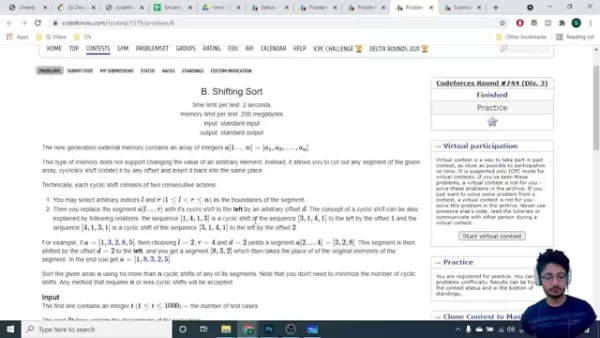
This operation selects an array segment and rotates the elements inside it by a chosen offset. The goal is to sort the entire array using at most 'n' such shifts, where 'n' is the array's element count.
Deconstructing the Rules:
- Array manipulation restriction: Direct swapping of individual element values is prohibited, pushing you to devise a strategy that avoids simple swaps.
- Cyclic shifts defined: You must rotate elements within a chosen segment. The main difficulty lies in selecting the right segments and offsets to efficiently achieve the sorted order.
- Efficiency constraint: The total number of cyclic shifts must not exceed the array's element count, enforcing an optimal approach that minimizes rotations.
How to Implement Shifting Sort: A Step-by-Step Guide
Step 1: Understand Cyclic Shifts
Before coding, ensure you thoroughly understand cyclic shifts.
Cons
ider the sequence [2, 3, 1, 4]. Shifting it left by one position yields [3, 1, 4, 2]. This operation is foundational to the entire sorting process.Step 2: Identify the Correct Position for Each Element
For every element, determine its target position in the sorted array. This means finding the smallest remaining number and placing it in the next available spot.
Step 3: Implement the Algorithm
Implementation involves iterating through the array and checking if the current position holds the correct value
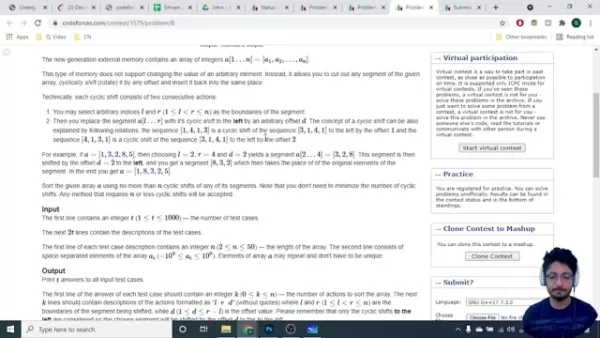
. If not, perform a cyclic shift to move the required element into place.
- Loop through each position in the array.
- Find the next required (minimum) number for the current position.
- Check if the iterator's target number is already correctly placed.
- If it is not, execute a cyclic shift to correct it.
Step 4: Choose a suitable code editor and programing language.
After planning, use a code editor like VS Code and a programming language such as C++ or Java to write the implementation. Remember to debug your code thoroughly.
Pricing and Availability
Accessing Codeforces Problems
Codeforces is a competitive programming platform with a vast problem library, including the shifting sort challenge. Access to the platform and its core problem set is free, making it widely accessible. Some advanced features or learning resources may be part of a premium subscription.
Advantages and Disadvantages of Shifting Sort
Pros
Minimizes direct element swaps, which can be beneficial in memory-constrained environments.
Offers a unique problem-solving perspective that encourages creative thinking about sorting.
The algorithm's implementation is relatively straightforward and not overly complex.
Cons
It is not generally efficient; algorithms like quicksort or mergesort are superior for most use cases.
Selecting the optimal segments for shifting can be complex and non-intuitive.
It is less practical for standard sorting tasks, serving more as an educational exercise than a production-ready method.
Core Features Used in Shifting Sort Implementation
Key Elements of the C++ Code
The C++ implementation utilizes several key features:
- Vectors: Provide dynamic array handling capabilities.
- Iterators: Facilitate traversal of the array and element identification.
- Algorithms: The
max_element function is used for searching within specific segments.
These components offer the necessary flexibility and control to execute cyclic shifts and sort the array efficiently.
Use Cases for Shifting Sort and Related Problems
When to Apply Shifting Sort
Shifting sort is most applicable in niche scenarios where direct element swaps are infeasible or prohibitively costly. Examples include certain specialized hardware environments or systems with specific memory access restrictions.
- Limited Resources: Suitable for environments with tight constraints on memory or processing power.
- Specialized Hardware: Potentially useful in systems where rotating a memory block is more efficient than individual element swaps.
- Educational Tool: Excellent for teaching algorithmic constraints and creative problem-solving approaches.
Frequently Asked Questions
Is shifting sort an efficient sorting algorithm in general?
Its efficiency is highly context-dependent, tied to specific problem constraints and the initial array state. While it can be advantageous when minimizing swaps is key, general-purpose sorting is better handled by algorithms like quicksort or mergesort, which offer superior performance.
Does the problem require the minimum shifts for sorting?
No, the problem does not demand the absolute minimum number of shifts. Any valid sorting process that uses no more than n shifts will be accepted.
Where to find the shifting sort problem?
You can find it on the Codeforces website, which is where this specific problem is hosted and solved by participants.
Related Questions
What are other creative sorting algorithms?
Beyond shifting sort, algorithms like pancake sort and gnome sort offer unique takes on traditional sorting. Each imposes specific constraints or uses unusual operations, challenging programmers to rethink how to achieve order. While rarely the most efficient for general use, they provide valuable insights into algorithmic creativity and constraint-driven design. Studying these algorithms broadens your understanding of sorting and enhances your ability to adapt solutions to novel problem requirements. Furthermore, it fosters a deeper appreciation for algorithmic trade-offs and the importance of matching the solution to the specific characteristics of the task.
Related article
 Anthropic Opens Doors to EU Cybersecurity Agency as Mythos5 Model Faces Compliance Exam
Artificial intelligence compliance regulations are advancing significantly. Leading AI firm Anthropic has officially granted the European Union's cybersecurity authority access to its Mythos AI model, a pivotal move for this advanced large language m
Lenovo Unveils AI Cutie at MWC 2026: Desktop Robotic Arm Becomes Your New Workplace Assistant
If AI in 2025 is still confined to screen-based chats, 2026 marks the shift toward tangible, desk-integrated intelligence. At MWC 2026 in Barcelona, Lenovo unveiled two groundbreaking AI hardware concepts: AI Workmate (an AI Office Partner) and AI Wo
TikTok Launches Voice Copyright Report Channel as AI Clone Voice Complaints Double
TikTok has introduced a dedicated reporting channel for voice-related intellectual property infringement, alongside enhanced rights protection mechanisms. The platform notes that as AI voice synthesis and imitation technologies become more accessible
Related Special Topic Recommendations
code
Anthropic Opens Doors to EU Cybersecurity Agency as Mythos5 Model Faces Compliance Exam
Artificial intelligence compliance regulations are advancing significantly. Leading AI firm Anthropic has officially granted the European Union's cybersecurity authority access to its Mythos AI model, a pivotal move for this advanced large language m
Lenovo Unveils AI Cutie at MWC 2026: Desktop Robotic Arm Becomes Your New Workplace Assistant
If AI in 2025 is still confined to screen-based chats, 2026 marks the shift toward tangible, desk-integrated intelligence. At MWC 2026 in Barcelona, Lenovo unveiled two groundbreaking AI hardware concepts: AI Workmate (an AI Office Partner) and AI Wo
TikTok Launches Voice Copyright Report Channel as AI Clone Voice Complaints Double
TikTok has introduced a dedicated reporting channel for voice-related intellectual property infringement, alongside enhanced rights protection mechanisms. The platform notes that as AI voice synthesis and imitation technologies become more accessible
Related Special Topic Recommendations
code
 AI Pull Request Review Tools for GitHub Teams Handling Refactors, Bugs, and Security Gaps
2026 Latest Best AI Pull Request Review Tools for GitHub Teams are here on XIX.AI! This top-rated curated list showcases powerful game-changing solutions that streamline refactoring, bug fixing, and security gap detection across all team workflows. Enjoy a free vs paid comparison along with real-world tests and detailed rankings to help you find the perfect tool that boosts productivity significantly. Explore now to unlock your AI edge!
 12 tools
 xix.ai
Text-to-speech
Best AI Text to Speech Tools for Natural Voiceovers
xix.ai
Text-to-speech
Best AI Text to Speech Tools for Natural Voiceovers
2026 Latest Best Top-rated AI Text to Speech Tools for Natural Voiceovers are here on XIX.AI! This curated list features powerful, game-changing options that deliver crystal-clear voices for every use case, backed by real-world tests and weekly updated rankings. Get a free vs paid comparison to find the must-try solution that boosts your productivity instantly. Explore now to Unlock your AI edge!
11 tools
xix.ai
Comic Creation
Manga AI Background Generators for Serialized Chapters, Covers, and Promo Art
2026 Latest Best Manga AI Background Generators Ranked Top-Rated! This curated collection showcases powerful game-changing tools perfect for creating high-quality chapter backgrounds, book covers, and promotional art. Every option has undergone rigorous real-world tests to ensure reliability. Get a free vs paid comparison along with detailed insights. Explore now to discover your perfect tool and unlock your AI edge in manga creation.
6 tools
xix.ai
Image editing
AI Object Removal Editors: Clean Up Portraits, Travel, and Product Shots
2026 Latest Best Top-rated AI Object Removal Editors for portraits travel product shots! XIX.AI curates a powerful game-changing collection regularly updated with weekly rankings. These tools offer real-world tests to help you quickly remove unwanted elements, boost content quality, and save tons of time without compromising results. Must-try for anyone aiming to unlock their AI creation edge. Explore now!
10 tools
xix.ai
Text-to-speech
Best AI Text to Speech Tools for Online Courses
2026 Latest Best Top-rated AI Text to Speech Tools for Online Courses are curated by XIX.AI based on rigorous real-world tests and weekly updated rankings. These powerful tools help creators deliver crystal-clear audio content effortlessly, boosting writing efficiency and streamlining course production. Check out the free vs paid comparison to find your perfect fit. Explore now to unlock your AI edge in online education.
10 tools
xix.ai
writing
AI Blog Title Tools for Higher Click Through Rates
2026 Latest Best Top-Rated AI Blog Title Tools for Higher Click Through Rates! XIX.AI has carefully curated a powerful, game-changing collection of top tools that go through rigorous real-world tests. You’ll find a free vs paid comparison, weekly updated rankings, and detailed insights to help you boost your blog’s traffic efficiently. Must-try options are highlighted to help you unlock your AI edge. Explore now!
10 tools
xix.ai

 Comments (2)
0/500
Comments (2)
0/500
![HarryRoberts]()
Hold up, shifting sort? Never heard of it. Is this just a fancy name for insertion sort with extra steps? 🤨 Would love to see how it handles worst-case scenarios on Codeforces, but the name alone makes me skeptical. Got any real performance benchmarks?
![KennethJohnson]()
Interesting read! I've always wondered about alternative sorting methods beyond the classics like quicksort or mergesort. The shifting sort approach seems clever for specific constraints in competitive programming. Might try implementing it myself on the next Codeforces round. 😄
In competitive programming and algorithm design, efficient sorting techniques are crucial. The shifting sort algorithm offers a distinctive method for sorting arrays, providing an alternative when standard approaches are limited. This article explores the mechanics of shifting sort, demonstrates its application with a Codeforces example, and breaks down the underlying logic, step-by-step implementation, and its pros and cons.
Key Points
The shifting sort algorithm arranges an array by cyclically shifting specific segments.
Each cyclic shift involves choosing a segment and rotating it by a chosen offset.
The objective is to fully sort the array using at most 'n' cyclic shifts of its segments.
A solid grasp of the cyclic shift operation is essential for proper algorithm implementation.
The algorithm uses a loop to scan the array and locate the next maximum value to position.
Understanding the Shifting Sort Algorithm
What is Shifting Sort?
The shifting sort algorithm works on an array by allowing you to select any contiguous segment, perform a cyclic shift (rotation) on it by any offset, and then place it back in its original position
. Unlike conventional sorting algorithms that swap individual elements, this method manipulates entire array segments simultaneously.
Technically, each cyclic shift is a two-step process:
- Select arbitrary indices
landr(1 ) to define the segment boundaries. - Replace the segment
a[l...r]with its cyclic shift to the left by a chosen offsetd.
The challenge is to sort array 'a' using no more than 'n' cyclic shifts of any segments. The core of this algorithm is the cyclic shift operation. It selects a sub-array segment and rotates its elements left by a specified offset, causing elements to wrap from the segment's start to its end. The problem requires you to sort the array within a limited number of shifts. For example, the sequence [1, 4, 1, 3] is a cyclic shift of [3, 1, 4, 1] left by offset 1, and [4, 1, 3, 1] is a shift of the same sequence left by offset 2.
Problem Statement Explained
You are given an integer array to sort. The unique constraint is you cannot perform direct element swaps. Your only allowed operation is a cyclic shift.
This operation selects an array segment and rotates the elements inside it by a chosen offset. The goal is to sort the entire array using at most 'n' such shifts, where 'n' is the array's element count.
Deconstructing the Rules:
- Array manipulation restriction: Direct swapping of individual element values is prohibited, pushing you to devise a strategy that avoids simple swaps.
- Cyclic shifts defined: You must rotate elements within a chosen segment. The main difficulty lies in selecting the right segments and offsets to efficiently achieve the sorted order.
- Efficiency constraint: The total number of cyclic shifts must not exceed the array's element count, enforcing an optimal approach that minimizes rotations.
How to Implement Shifting Sort: A Step-by-Step Guide
Step 1: Understand Cyclic Shifts
Before coding, ensure you thoroughly understand cyclic shifts.
Cons
ider the sequence [2, 3, 1, 4]. Shifting it left by one position yields [3, 1, 4, 2]. This operation is foundational to the entire sorting process.Step 2: Identify the Correct Position for Each Element
For every element, determine its target position in the sorted array. This means finding the smallest remaining number and placing it in the next available spot.
Step 3: Implement the Algorithm
Implementation involves iterating through the array and checking if the current position holds the correct value
. If not, perform a cyclic shift to move the required element into place.
- Loop through each position in the array.
- Find the next required (minimum) number for the current position.
- Check if the iterator's target number is already correctly placed.
- If it is not, execute a cyclic shift to correct it.
Step 4: Choose a suitable code editor and programing language.
After planning, use a code editor like VS Code and a programming language such as C++ or Java to write the implementation. Remember to debug your code thoroughly.
Pricing and Availability
Accessing Codeforces Problems
Codeforces is a competitive programming platform with a vast problem library, including the shifting sort challenge. Access to the platform and its core problem set is free, making it widely accessible. Some advanced features or learning resources may be part of a premium subscription.
Advantages and Disadvantages of Shifting Sort
Pros
Minimizes direct element swaps, which can be beneficial in memory-constrained environments.
Offers a unique problem-solving perspective that encourages creative thinking about sorting.
The algorithm's implementation is relatively straightforward and not overly complex.
Cons
It is not generally efficient; algorithms like quicksort or mergesort are superior for most use cases.
Selecting the optimal segments for shifting can be complex and non-intuitive.
It is less practical for standard sorting tasks, serving more as an educational exercise than a production-ready method.
Core Features Used in Shifting Sort Implementation
Key Elements of the C++ Code
The C++ implementation utilizes several key features:
- Vectors: Provide dynamic array handling capabilities.
- Iterators: Facilitate traversal of the array and element identification.
- Algorithms: The
max_elementfunction is used for searching within specific segments.
These components offer the necessary flexibility and control to execute cyclic shifts and sort the array efficiently.
Use Cases for Shifting Sort and Related Problems
When to Apply Shifting Sort
Shifting sort is most applicable in niche scenarios where direct element swaps are infeasible or prohibitively costly. Examples include certain specialized hardware environments or systems with specific memory access restrictions.
- Limited Resources: Suitable for environments with tight constraints on memory or processing power.
- Specialized Hardware: Potentially useful in systems where rotating a memory block is more efficient than individual element swaps.
- Educational Tool: Excellent for teaching algorithmic constraints and creative problem-solving approaches.
Frequently Asked Questions
Is shifting sort an efficient sorting algorithm in general?
Its efficiency is highly context-dependent, tied to specific problem constraints and the initial array state. While it can be advantageous when minimizing swaps is key, general-purpose sorting is better handled by algorithms like quicksort or mergesort, which offer superior performance.
Does the problem require the minimum shifts for sorting?
No, the problem does not demand the absolute minimum number of shifts. Any valid sorting process that uses no more than n shifts will be accepted.
Where to find the shifting sort problem?
You can find it on the Codeforces website, which is where this specific problem is hosted and solved by participants.
Related Questions
What are other creative sorting algorithms?
Beyond shifting sort, algorithms like pancake sort and gnome sort offer unique takes on traditional sorting. Each imposes specific constraints or uses unusual operations, challenging programmers to rethink how to achieve order. While rarely the most efficient for general use, they provide valuable insights into algorithmic creativity and constraint-driven design. Studying these algorithms broadens your understanding of sorting and enhances your ability to adapt solutions to novel problem requirements. Furthermore, it fosters a deeper appreciation for algorithmic trade-offs and the importance of matching the solution to the specific characteristics of the task.








 Anthropic Opens Doors to EU Cybersecurity Agency as Mythos5 Model Faces Compliance Exam
Artificial intelligence compliance regulations are advancing significantly. Leading AI firm Anthropic has officially granted the European Union's cybersecurity authority access to its Mythos AI model, a pivotal move for this advanced large language m
Anthropic Opens Doors to EU Cybersecurity Agency as Mythos5 Model Faces Compliance Exam
Artificial intelligence compliance regulations are advancing significantly. Leading AI firm Anthropic has officially granted the European Union's cybersecurity authority access to its Mythos AI model, a pivotal move for this advanced large language m
 Lenovo Unveils AI Cutie at MWC 2026: Desktop Robotic Arm Becomes Your New Workplace Assistant
If AI in 2025 is still confined to screen-based chats, 2026 marks the shift toward tangible, desk-integrated intelligence. At MWC 2026 in Barcelona, Lenovo unveiled two groundbreaking AI hardware concepts: AI Workmate (an AI Office Partner) and AI Wo
Lenovo Unveils AI Cutie at MWC 2026: Desktop Robotic Arm Becomes Your New Workplace Assistant
If AI in 2025 is still confined to screen-based chats, 2026 marks the shift toward tangible, desk-integrated intelligence. At MWC 2026 in Barcelona, Lenovo unveiled two groundbreaking AI hardware concepts: AI Workmate (an AI Office Partner) and AI Wo
 TikTok Launches Voice Copyright Report Channel as AI Clone Voice Complaints Double
TikTok has introduced a dedicated reporting channel for voice-related intellectual property infringement, alongside enhanced rights protection mechanisms. The platform notes that as AI voice synthesis and imitation technologies become more accessible
TikTok Launches Voice Copyright Report Channel as AI Clone Voice Complaints Double
TikTok has introduced a dedicated reporting channel for voice-related intellectual property infringement, alongside enhanced rights protection mechanisms. The platform notes that as AI voice synthesis and imitation technologies become more accessible

2026 Latest Best AI Pull Request Review Tools for GitHub Teams are here on XIX.AI! This top-rated curated list showcases powerful game-changing solutions that streamline refactoring, bug fixing, and security gap detection across all team workflows. Enjoy a free vs paid comparison along with real-world tests and detailed rankings to help you find the perfect tool that boosts productivity significantly. Explore now to unlock your AI edge!
12 tools
xix.ai

2026 Latest Best Top-rated AI Text to Speech Tools for Natural Voiceovers are here on XIX.AI! This curated list features powerful, game-changing options that deliver crystal-clear voices for every use case, backed by real-world tests and weekly updated rankings. Get a free vs paid comparison to find the must-try solution that boosts your productivity instantly. Explore now to Unlock your AI edge!
11 tools
xix.ai

2026 Latest Best Manga AI Background Generators Ranked Top-Rated! This curated collection showcases powerful game-changing tools perfect for creating high-quality chapter backgrounds, book covers, and promotional art. Every option has undergone rigorous real-world tests to ensure reliability. Get a free vs paid comparison along with detailed insights. Explore now to discover your perfect tool and unlock your AI edge in manga creation.
6 tools
xix.ai

2026 Latest Best Top-rated AI Object Removal Editors for portraits travel product shots! XIX.AI curates a powerful game-changing collection regularly updated with weekly rankings. These tools offer real-world tests to help you quickly remove unwanted elements, boost content quality, and save tons of time without compromising results. Must-try for anyone aiming to unlock their AI creation edge. Explore now!
10 tools
xix.ai

2026 Latest Best Top-rated AI Text to Speech Tools for Online Courses are curated by XIX.AI based on rigorous real-world tests and weekly updated rankings. These powerful tools help creators deliver crystal-clear audio content effortlessly, boosting writing efficiency and streamlining course production. Check out the free vs paid comparison to find your perfect fit. Explore now to unlock your AI edge in online education.
10 tools
xix.ai

2026 Latest Best Top-Rated AI Blog Title Tools for Higher Click Through Rates! XIX.AI has carefully curated a powerful, game-changing collection of top tools that go through rigorous real-world tests. You’ll find a free vs paid comparison, weekly updated rankings, and detailed insights to help you boost your blog’s traffic efficiently. Must-try options are highlighted to help you unlock your AI edge. Explore now!
10 tools
xix.ai

Hold up, shifting sort? Never heard of it. Is this just a fancy name for insertion sort with extra steps? 🤨 Would love to see how it handles worst-case scenarios on Codeforces, but the name alone makes me skeptical. Got any real performance benchmarks?
Interesting read! I've always wondered about alternative sorting methods beyond the classics like quicksort or mergesort. The shifting sort approach seems clever for specific constraints in competitive programming. Might try implementing it myself on the next Codeforces round. 😄












