


 Home
HomeOuster Unveils Stereolabs ZED X Nano Wrist-Mounted Camera
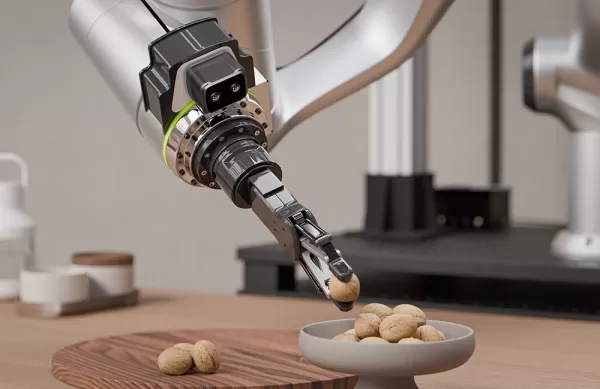
Ouster provides digital lidar, cameras, AI computing, sensor fusion and perception software, and AI models. | Source: Ouster
Ouster, Inc. announced the release of the Stereolabs ZED X Nano yesterday, a compact wrist-mounted stereo camera designed for robotic manipulation, imitation learning, and high-volume data collection.
“Building on Stereolabs' leadership in AI vision and perception solutions, the ZED X Nano allows us to penetrate deeper into the industrial and robotics markets, securing new applications that require more compact form factors,” said Ouster CEO Angus Pacala. “The future of Physical AI relies on vast amounts of high-quality, low-latency image data gathered at the edge. With the ZED X Nano, we are providing roboticists with a significant upgrade to their vision systems, enabling machines to perceive, reason, act, and learn with exceptional precision.”
As robotics teams scale up imitation learning and reinforcement learning for manipulation tasks, RGB image quality and end-to-end capture latency have become major bottlenecks. Conventional cameras often depend on USB connectivity, capture lower-resolution 720p RGB and depth data, and require CPU-mediated pipelines that limit throughput and increase latency.
Ouster engineered the Stereolabs ZED X Nano to address these challenges. It is 40% shorter in height than comparable solutions and mounts directly onto robotic wrists and end-of-arm tooling. It utilizes the same reliable 1920×1200 global shutter sensor found across the flagship ZED X camera line. The camera can capture high-resolution RGB and depth images at up to 120 frames per second for training data and manipulation tasks.
The ZED X Nano is available for pre-order starting today, with shipments commencing in May 2026.
ZED X Nano is engineered for physical AI, delivering sub-millimeter accuracy
The core of the ZED X Nano features an ultra-low-latency capture pipeline with a fully zero-copy data path from sensor to GPU. This allows frames to stream directly into NVIDIA hardware encoders and AI inference pipelines simultaneously.
For data collection teams, this enables higher-throughput dataset capture at full resolution. For deployment teams, it allows perception, segmentation, and policy networks to run in parallel on the same video feeds, freeing up more GPU resources.
Depth sensing is powered by Stereolabs' Neural Depth Engine, an AI-driven stereo depth system that achieves sub-millimeter accuracy along the Z-axis. Ouster states this depth engine provides significantly better lateral (XY) positioning than traditional structured-light or time-of-flight cameras. It offers critical advantages for grasp pose estimation, precise placement, and assembly tasks where lateral error can lead to manipulation failure. With a minimum depth-sensing range of 3 centimeters, the camera can also detect objects closer than many competing solutions on the market.
Ouster designed the ZED X Nano for durability. It features an onboard vibration-resistant IMU and is powered by a ruggedized GMSL2 connection with next-generation cabling built to withstand the repeated motion and cable stress of robotic arms. This replaces a fragile USB-C port with an industrial-grade link that can transmit video up to 15 meters while offering EMI resistance and secure locking connectors.
The ZED X Nano is the latest Stereolabs product to offer seamless native integration with NVIDIA Isaac Sim and Isaac Lab for sim-to-real transfer, alongside full support for ROS and ROS 2. Teams developing imitation learning or reinforcement learning pipelines can capture high-fidelity demonstrations, train in simulation using accurately matched camera models, and deploy to physical hardware—all utilizing the same sensor and software stack.
Related article
 U.S. Stocks Hit Historic Milestone as AI and Aerospace Giants Prepare for Trillion-Dollar Debut
Elon Musk, Sam Altman, and Dario Amodei, three titans of the technology sector, are advancing toward initial public offerings for their respective ventures. With SpaceX, OpenAI, and Anthropic—three industry behemoths nearing trillion-dollar valuation
Swedish AI Startup Lovable Eyes $13.2 Billion Valuation After Major Funding Round
As AI-driven coding tools gain traction, Swedish startup Lovable has secured a major funding round. The company aims to raise $3 billion, potentially boosting its valuation to $13.2 billion—double the $6.6 billion recorded last December. Menlo Ventur
Google Tests Remy AI Agent for Gemini as Focus Shifts to User Control
According to Business Insider, Google is testing Remy, a new AI personal agent for Gemini. This tool aims to execute tasks on behalf of users, streamlining both professional workflows and daily routines.Currently, Remy is undergoing testing in an int
Related Special Topic Recommendations
Data Analysis
U.S. Stocks Hit Historic Milestone as AI and Aerospace Giants Prepare for Trillion-Dollar Debut
Elon Musk, Sam Altman, and Dario Amodei, three titans of the technology sector, are advancing toward initial public offerings for their respective ventures. With SpaceX, OpenAI, and Anthropic—three industry behemoths nearing trillion-dollar valuation
Swedish AI Startup Lovable Eyes $13.2 Billion Valuation After Major Funding Round
As AI-driven coding tools gain traction, Swedish startup Lovable has secured a major funding round. The company aims to raise $3 billion, potentially boosting its valuation to $13.2 billion—double the $6.6 billion recorded last December. Menlo Ventur
Google Tests Remy AI Agent for Gemini as Focus Shifts to User Control
According to Business Insider, Google is testing Remy, a new AI personal agent for Gemini. This tool aims to execute tasks on behalf of users, streamlining both professional workflows and daily routines.Currently, Remy is undergoing testing in an int
Related Special Topic Recommendations
Data Analysis
 Best AI Anomaly Detection Tools for KPI Monitoring across SaaS and Ecommerce Teams
2026 Latest Best Top-rated AI Anomaly Detection Tools for KPI Monitoring in SaaS and Ecommerce teams! XIX.AI has curated a powerful, game-changing collection based on rigorous real-world tests and weekly updated rankings. You’ll find detailed free vs paid comparison insights to help you identify the must-try solution that boosts productivity and unlocks your AI edge. Explore now!
 10 tools
 xix.ai
writing
Best AI Outline Generators for Long-Form SEO Articles
xix.ai
writing
Best AI Outline Generators for Long-Form SEO Articles
2026 Latest Best Top-Rated AI Outline Generators for Long-Form SEO Articles, meticulously curated by XIX.AI. These powerful tools offer game-changing assistance in creating high-quality content quickly, boosting writing efficiency significantly. Get a free vs paid comparison along with real-world tests and detailed rankings to help you find the must-try option that suits your needs. Explore now to unlock your AI edge.
8 tools
xix.ai
Education and Learning
AI Study Tools for Homework and Exam Prep
2026 Latest Best AI Study Tools for Homework and Exam Prep! XIX.AI curates a top-rated list of powerful, game-changing tools that help students boost productivity, streamline homework completion, and ace exams through real-world tests. Get a free vs paid comparison, detailed rankings, and must-try options to unlock your AI edge. Explore now!
10 tools
xix.ai
Music composition
AI Vocal Demo Tools for Songwriters, Hooks, Toplines, and Multilingual Draft Sessions
2026 Latest Best AI Vocal Demo Tools for Songwriters, Hook Creators, and Multi-Language Content Teams! XIX.AI has curated a top-rated list of powerful game-changing tools that go through rigorous real-world tests. You’ll find detailed free vs paid comparison data, comprehensive rankings, and must-try options to help you boost writing efficiency and unlock your creative potential. Explore now to discover your perfect tool for all your content needs!
9 tools
xix.ai
Business
Best AI Competitive Research Tools for Small Businesses
2026 Latest Best Top-rated AI Competitive Research Tools for Small Businesses! XIX.AI has curated a highly powerful game-changing collection, updated weekly with rigorous real-world tests and detailed rankings. You can find a comprehensive free vs paid comparison to help you identify the must-try tools that boost your productivity and give you a competitive edge. Explore now to discover your perfect tool!
9 tools
xix.ai
Image editing
Photoshop AI Retouch Tools for Ecommerce Apparel, Skin Cleanup, and Color Consistency
2026 Latest Best Photoshop AI retouch tools for ecommerce apparel, skin cleanup, and color consistency! This top-rated curated list features powerful game-changing solutions that help you boost writing efficiency, streamline content creation, and achieve perfect visual results effortlessly. Each tool has undergone real-world tests through weekly updated rankings, complete with free vs paid comparison details. Backed by XIX.AI, it’s the must-try guide for anyone aiming to unlock your AI edge. Explore now!
10 tools
xix.ai

 Comments (0)
0/500
Comments (0)
0/500
Ouster provides digital lidar, cameras, AI computing, sensor fusion and perception software, and AI models. | Source: Ouster
Ouster, Inc. announced the release of the Stereolabs ZED X Nano yesterday, a compact wrist-mounted stereo camera designed for robotic manipulation, imitation learning, and high-volume data collection.
“Building on Stereolabs' leadership in AI vision and perception solutions, the ZED X Nano allows us to penetrate deeper into the industrial and robotics markets, securing new applications that require more compact form factors,” said Ouster CEO Angus Pacala. “The future of Physical AI relies on vast amounts of high-quality, low-latency image data gathered at the edge. With the ZED X Nano, we are providing roboticists with a significant upgrade to their vision systems, enabling machines to perceive, reason, act, and learn with exceptional precision.”
As robotics teams scale up imitation learning and reinforcement learning for manipulation tasks, RGB image quality and end-to-end capture latency have become major bottlenecks. Conventional cameras often depend on USB connectivity, capture lower-resolution 720p RGB and depth data, and require CPU-mediated pipelines that limit throughput and increase latency.
Ouster engineered the Stereolabs ZED X Nano to address these challenges. It is 40% shorter in height than comparable solutions and mounts directly onto robotic wrists and end-of-arm tooling. It utilizes the same reliable 1920×1200 global shutter sensor found across the flagship ZED X camera line. The camera can capture high-resolution RGB and depth images at up to 120 frames per second for training data and manipulation tasks.
The ZED X Nano is available for pre-order starting today, with shipments commencing in May 2026.
ZED X Nano is engineered for physical AI, delivering sub-millimeter accuracy
The core of the ZED X Nano features an ultra-low-latency capture pipeline with a fully zero-copy data path from sensor to GPU. This allows frames to stream directly into NVIDIA hardware encoders and AI inference pipelines simultaneously.
For data collection teams, this enables higher-throughput dataset capture at full resolution. For deployment teams, it allows perception, segmentation, and policy networks to run in parallel on the same video feeds, freeing up more GPU resources.
Depth sensing is powered by Stereolabs' Neural Depth Engine, an AI-driven stereo depth system that achieves sub-millimeter accuracy along the Z-axis. Ouster states this depth engine provides significantly better lateral (XY) positioning than traditional structured-light or time-of-flight cameras. It offers critical advantages for grasp pose estimation, precise placement, and assembly tasks where lateral error can lead to manipulation failure. With a minimum depth-sensing range of 3 centimeters, the camera can also detect objects closer than many competing solutions on the market.
Ouster designed the ZED X Nano for durability. It features an onboard vibration-resistant IMU and is powered by a ruggedized GMSL2 connection with next-generation cabling built to withstand the repeated motion and cable stress of robotic arms. This replaces a fragile USB-C port with an industrial-grade link that can transmit video up to 15 meters while offering EMI resistance and secure locking connectors.
The ZED X Nano is the latest Stereolabs product to offer seamless native integration with NVIDIA Isaac Sim and Isaac Lab for sim-to-real transfer, alongside full support for ROS and ROS 2. Teams developing imitation learning or reinforcement learning pipelines can capture high-fidelity demonstrations, train in simulation using accurately matched camera models, and deploy to physical hardware—all utilizing the same sensor and software stack.








 U.S. Stocks Hit Historic Milestone as AI and Aerospace Giants Prepare for Trillion-Dollar Debut
Elon Musk, Sam Altman, and Dario Amodei, three titans of the technology sector, are advancing toward initial public offerings for their respective ventures. With SpaceX, OpenAI, and Anthropic—three industry behemoths nearing trillion-dollar valuation
U.S. Stocks Hit Historic Milestone as AI and Aerospace Giants Prepare for Trillion-Dollar Debut
Elon Musk, Sam Altman, and Dario Amodei, three titans of the technology sector, are advancing toward initial public offerings for their respective ventures. With SpaceX, OpenAI, and Anthropic—three industry behemoths nearing trillion-dollar valuation
 Swedish AI Startup Lovable Eyes $13.2 Billion Valuation After Major Funding Round
As AI-driven coding tools gain traction, Swedish startup Lovable has secured a major funding round. The company aims to raise $3 billion, potentially boosting its valuation to $13.2 billion—double the $6.6 billion recorded last December. Menlo Ventur
Google Tests Remy AI Agent for Gemini as Focus Shifts to User Control
According to Business Insider, Google is testing Remy, a new AI personal agent for Gemini. This tool aims to execute tasks on behalf of users, streamlining both professional workflows and daily routines.Currently, Remy is undergoing testing in an int
Swedish AI Startup Lovable Eyes $13.2 Billion Valuation After Major Funding Round
As AI-driven coding tools gain traction, Swedish startup Lovable has secured a major funding round. The company aims to raise $3 billion, potentially boosting its valuation to $13.2 billion—double the $6.6 billion recorded last December. Menlo Ventur
Google Tests Remy AI Agent for Gemini as Focus Shifts to User Control
According to Business Insider, Google is testing Remy, a new AI personal agent for Gemini. This tool aims to execute tasks on behalf of users, streamlining both professional workflows and daily routines.Currently, Remy is undergoing testing in an int

2026 Latest Best Top-rated AI Anomaly Detection Tools for KPI Monitoring in SaaS and Ecommerce teams! XIX.AI has curated a powerful, game-changing collection based on rigorous real-world tests and weekly updated rankings. You’ll find detailed free vs paid comparison insights to help you identify the must-try solution that boosts productivity and unlocks your AI edge. Explore now!
10 tools
xix.ai

2026 Latest Best Top-Rated AI Outline Generators for Long-Form SEO Articles, meticulously curated by XIX.AI. These powerful tools offer game-changing assistance in creating high-quality content quickly, boosting writing efficiency significantly. Get a free vs paid comparison along with real-world tests and detailed rankings to help you find the must-try option that suits your needs. Explore now to unlock your AI edge.
8 tools
xix.ai

2026 Latest Best AI Study Tools for Homework and Exam Prep! XIX.AI curates a top-rated list of powerful, game-changing tools that help students boost productivity, streamline homework completion, and ace exams through real-world tests. Get a free vs paid comparison, detailed rankings, and must-try options to unlock your AI edge. Explore now!
10 tools
xix.ai

2026 Latest Best AI Vocal Demo Tools for Songwriters, Hook Creators, and Multi-Language Content Teams! XIX.AI has curated a top-rated list of powerful game-changing tools that go through rigorous real-world tests. You’ll find detailed free vs paid comparison data, comprehensive rankings, and must-try options to help you boost writing efficiency and unlock your creative potential. Explore now to discover your perfect tool for all your content needs!
9 tools
xix.ai

2026 Latest Best Top-rated AI Competitive Research Tools for Small Businesses! XIX.AI has curated a highly powerful game-changing collection, updated weekly with rigorous real-world tests and detailed rankings. You can find a comprehensive free vs paid comparison to help you identify the must-try tools that boost your productivity and give you a competitive edge. Explore now to discover your perfect tool!
9 tools
xix.ai

2026 Latest Best Photoshop AI retouch tools for ecommerce apparel, skin cleanup, and color consistency! This top-rated curated list features powerful game-changing solutions that help you boost writing efficiency, streamline content creation, and achieve perfect visual results effortlessly. Each tool has undergone real-world tests through weekly updated rankings, complete with free vs paid comparison details. Backed by XIX.AI, it’s the must-try guide for anyone aiming to unlock your AI edge. Explore now!
10 tools
xix.ai












