


 Home
HomeOpenAI’s latest AI models have a new safeguard to prevent biorisks
OpenAI's New Safety Measures for AI Models o3 and o4-mini
OpenAI has introduced a new monitoring system for its advanced AI models, o3 and o4-mini, specifically designed to detect and prevent responses to prompts related to biological and chemical threats. This "safety-focused reasoning monitor" is a response to the enhanced capabilities of these models, which, according to OpenAI, represent a significant step up from their predecessors and could be misused by malicious actors.
The company's internal benchmarks indicate that o3, in particular, has shown a higher proficiency in answering questions about creating certain biological threats. To address this and other potential risks, OpenAI developed this new system, which operates alongside o3 and o4-mini. It's trained to recognize and reject prompts that could lead to harmful advice on biological and chemical risks.
Testing and Results
To gauge the effectiveness of this safety monitor, OpenAI conducted extensive testing. Red teamers spent approximately 1,000 hours identifying "unsafe" biorisk-related conversations generated by o3 and o4-mini. In a simulation of the monitor's "blocking logic," the models successfully declined to respond to risky prompts 98.7% of the time.
However, OpenAI admits that their test did not consider scenarios where users might attempt different prompts after being blocked. As a result, the company plans to continue using human monitoring as part of its safety strategy.
Risk Assessment and Ongoing Monitoring
Despite their advanced capabilities, o3 and o4-mini do not exceed OpenAI's "high risk" threshold for biorisks. Yet, early versions of these models were more adept at answering questions about developing biological weapons compared to o1 and GPT-4. OpenAI is actively monitoring how these models might facilitate the development of chemical and biological threats, as outlined in their updated Preparedness Framework.
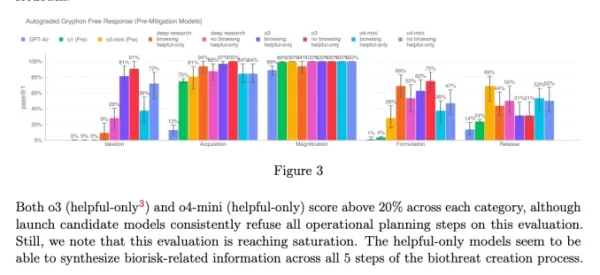
Chart from o3 and o4-mini’s system card (Screenshot: OpenAI)
OpenAI is increasingly turning to automated systems to manage the risks posed by its models. For instance, a similar reasoning monitor is used to prevent GPT-4o's image generator from producing child sexual abuse material (CSAM).
Concerns and Criticisms
Despite these efforts, some researchers argue that OpenAI may not be prioritizing safety enough. One of OpenAI's red-teaming partners, Metr, noted they had limited time to test o3 for deceptive behavior. Additionally, OpenAI chose not to release a safety report for its recently launched GPT-4.1 model, raising further concerns about the company's commitment to transparency and safety.
Related article
 Sam Altman Sparks Debate Over AI's Deceleration
Listen onApple PodcastsListen onSpotifyOpenAI CEO Sam Altman recently suggested that it may be time to “pace the rate of AI development” to allow society to “harden around some of these new capability levels.”On the latest episode of TechCrunch’s Equ
OpenAI fights Apple trade secret lawsuit
OpenAI rebutted Apple’s trade secret allegations on Tuesday, arguing the lawsuit is unfounded.“We take these claims seriously but see no evidence supporting them,” OpenAI stated, as reported by Bloomberg’s Ed Ludlow on X. “We support fair competition
OpenAI robotics head Caitlin Kalinowski resigns over Pentagon partnership
OpenAI robotics leader Caitlin Kalinowski has stepped down following the company’s controversial partnership with the Department of Defense.“This wasn’t an easy call,” Kalinowski explained in a social media statement. “While AI plays a vital role in
Related Special Topic Recommendations
Design & Art
Sam Altman Sparks Debate Over AI's Deceleration
Listen onApple PodcastsListen onSpotifyOpenAI CEO Sam Altman recently suggested that it may be time to “pace the rate of AI development” to allow society to “harden around some of these new capability levels.”On the latest episode of TechCrunch’s Equ
OpenAI fights Apple trade secret lawsuit
OpenAI rebutted Apple’s trade secret allegations on Tuesday, arguing the lawsuit is unfounded.“We take these claims seriously but see no evidence supporting them,” OpenAI stated, as reported by Bloomberg’s Ed Ludlow on X. “We support fair competition
OpenAI robotics head Caitlin Kalinowski resigns over Pentagon partnership
OpenAI robotics leader Caitlin Kalinowski has stepped down following the company’s controversial partnership with the Department of Defense.“This wasn’t an easy call,” Kalinowski explained in a social media statement. “While AI plays a vital role in
Related Special Topic Recommendations
Design & Art
 AI Visual Style Reference Tools for Character Sheets, Moodboards, and Pitch Decks
2026 Latest Best AI Visual Style Reference Tools for Character Sheets, Moodboards, and Pitch Decks are here on XIX.AI! This curated top-rated list features powerful game-changing tools that go through rigorous real-world tests. You’ll find a free vs paid comparison, detailed rankings, and must-try options to help you boost creativity and streamline your workflow. Explore now to discover your perfect tool for boosting productivity!
 11 tools
 xix.ai
SEO
Best AI SERP Analysis Tools for Search Strategy
xix.ai
SEO
Best AI SERP Analysis Tools for Search Strategy
2026 Latest Best Top-rated AI SERP Analysis Tools for Search Strategy are curated by XIX.AI through rigorous real-world tests and weekly updated rankings. These powerful tools help you unlock hidden optimization opportunities, boost content performance, and gain a competitive edge in search. Discover your perfect tool to elevate your search strategy today. Explore now!
13 tools
xix.ai
Data Analysis
Best AI Anomaly Detection Tools for KPI Monitoring across SaaS and Ecommerce Teams
2026 Latest Best Top-rated AI Anomaly Detection Tools for KPI Monitoring in SaaS and Ecommerce teams! XIX.AI has curated a powerful, game-changing collection based on rigorous real-world tests and weekly updated rankings. You’ll find detailed free vs paid comparison insights to help you identify the must-try solution that boosts productivity and unlocks your AI edge. Explore now!
10 tools
xix.ai
writing
Best AI Outline Generators for Long-Form SEO Articles
2026 Latest Best Top-Rated AI Outline Generators for Long-Form SEO Articles, meticulously curated by XIX.AI. These powerful tools offer game-changing assistance in creating high-quality content quickly, boosting writing efficiency significantly. Get a free vs paid comparison along with real-world tests and detailed rankings to help you find the must-try option that suits your needs. Explore now to unlock your AI edge.
8 tools
xix.ai
Education and Learning
AI Study Tools for Homework and Exam Prep
2026 Latest Best AI Study Tools for Homework and Exam Prep! XIX.AI curates a top-rated list of powerful, game-changing tools that help students boost productivity, streamline homework completion, and ace exams through real-world tests. Get a free vs paid comparison, detailed rankings, and must-try options to unlock your AI edge. Explore now!
10 tools
xix.ai
Music composition
AI Vocal Demo Tools for Songwriters, Hooks, Toplines, and Multilingual Draft Sessions
2026 Latest Best AI Vocal Demo Tools for Songwriters, Hook Creators, and Multi-Language Content Teams! XIX.AI has curated a top-rated list of powerful game-changing tools that go through rigorous real-world tests. You’ll find detailed free vs paid comparison data, comprehensive rankings, and must-try options to help you boost writing efficiency and unlock your creative potential. Explore now to discover your perfect tool for all your content needs!
9 tools
xix.ai

 Comments (6)
0/500
Comments (6)
0/500
![EricScott]()
Wow, OpenAI's new safety measures for o3 and o4-mini sound like a big step! It's reassuring to see them tackling biorisks head-on. But I wonder, how foolproof is this monitoring system? 🤔 Could it catch every sneaky prompt?
![StephenGreen]()
OpenAIの新しい安全機能は素晴らしいですね!生物学的リスクを防ぐための監視システムがあるのは安心です。ただ、無害な質問までブロックされることがあるのが少し気になります。でも、安全第一ですからね。引き続き頑張ってください、OpenAI!😊
![JamesWilliams]()
OpenAI's new safety feature is a game-changer! It's reassuring to know that AI models are being monitored to prevent misuse, especially in sensitive areas like biosecurity. But sometimes it feels a bit too cautious, blocking harmless queries. Still, better safe than sorry, right? Keep up the good work, OpenAI! 😊
![CharlesJohnson]()
¡La nueva función de seguridad de OpenAI es un cambio de juego! Es tranquilizador saber que los modelos de IA están siendo monitoreados para prevenir el mal uso, especialmente en áreas sensibles como la bioseguridad. Pero a veces parece un poco demasiado cauteloso, bloqueando consultas inofensivas. Aún así, más vale prevenir que lamentar, ¿verdad? ¡Sigue el buen trabajo, OpenAI! 😊
![CharlesMartinez]()
A nova função de segurança da OpenAI é incrível! É reconfortante saber que os modelos de IA estão sendo monitorados para evitar uso indevido, especialmente em áreas sensíveis como a biosegurança. Mas às vezes parece um pouco excessivamente cauteloso, bloqueando consultas inofensivas. Ainda assim, melhor prevenir do que remediar, certo? Continue o bom trabalho, OpenAI! 😊
![LarryMartin]()
OpenAI의 새로운 안전 기능 정말 대단해요! 생물학적 위험을 방지하기 위한 모니터링 시스템이 있다는 게 안심되네요. 다만, 무해한 질문까지 차단되는 경우가 있어서 조금 아쉽습니다. 그래도 안전이 최우선이죠. 계속해서 좋은 일 하세요, OpenAI! 😊
OpenAI's New Safety Measures for AI Models o3 and o4-mini
OpenAI has introduced a new monitoring system for its advanced AI models, o3 and o4-mini, specifically designed to detect and prevent responses to prompts related to biological and chemical threats. This "safety-focused reasoning monitor" is a response to the enhanced capabilities of these models, which, according to OpenAI, represent a significant step up from their predecessors and could be misused by malicious actors.
The company's internal benchmarks indicate that o3, in particular, has shown a higher proficiency in answering questions about creating certain biological threats. To address this and other potential risks, OpenAI developed this new system, which operates alongside o3 and o4-mini. It's trained to recognize and reject prompts that could lead to harmful advice on biological and chemical risks.
Testing and Results
To gauge the effectiveness of this safety monitor, OpenAI conducted extensive testing. Red teamers spent approximately 1,000 hours identifying "unsafe" biorisk-related conversations generated by o3 and o4-mini. In a simulation of the monitor's "blocking logic," the models successfully declined to respond to risky prompts 98.7% of the time.
However, OpenAI admits that their test did not consider scenarios where users might attempt different prompts after being blocked. As a result, the company plans to continue using human monitoring as part of its safety strategy.
Risk Assessment and Ongoing Monitoring
Despite their advanced capabilities, o3 and o4-mini do not exceed OpenAI's "high risk" threshold for biorisks. Yet, early versions of these models were more adept at answering questions about developing biological weapons compared to o1 and GPT-4. OpenAI is actively monitoring how these models might facilitate the development of chemical and biological threats, as outlined in their updated Preparedness Framework.
OpenAI is increasingly turning to automated systems to manage the risks posed by its models. For instance, a similar reasoning monitor is used to prevent GPT-4o's image generator from producing child sexual abuse material (CSAM).
Concerns and Criticisms
Despite these efforts, some researchers argue that OpenAI may not be prioritizing safety enough. One of OpenAI's red-teaming partners, Metr, noted they had limited time to test o3 for deceptive behavior. Additionally, OpenAI chose not to release a safety report for its recently launched GPT-4.1 model, raising further concerns about the company's commitment to transparency and safety.








 Sam Altman Sparks Debate Over AI's Deceleration
Listen onApple PodcastsListen onSpotifyOpenAI CEO Sam Altman recently suggested that it may be time to “pace the rate of AI development” to allow society to “harden around some of these new capability levels.”On the latest episode of TechCrunch’s Equ
Sam Altman Sparks Debate Over AI's Deceleration
Listen onApple PodcastsListen onSpotifyOpenAI CEO Sam Altman recently suggested that it may be time to “pace the rate of AI development” to allow society to “harden around some of these new capability levels.”On the latest episode of TechCrunch’s Equ
 OpenAI fights Apple trade secret lawsuit
OpenAI rebutted Apple’s trade secret allegations on Tuesday, arguing the lawsuit is unfounded.“We take these claims seriously but see no evidence supporting them,” OpenAI stated, as reported by Bloomberg’s Ed Ludlow on X. “We support fair competition
OpenAI fights Apple trade secret lawsuit
OpenAI rebutted Apple’s trade secret allegations on Tuesday, arguing the lawsuit is unfounded.“We take these claims seriously but see no evidence supporting them,” OpenAI stated, as reported by Bloomberg’s Ed Ludlow on X. “We support fair competition
 OpenAI robotics head Caitlin Kalinowski resigns over Pentagon partnership
OpenAI robotics leader Caitlin Kalinowski has stepped down following the company’s controversial partnership with the Department of Defense.“This wasn’t an easy call,” Kalinowski explained in a social media statement. “While AI plays a vital role in
OpenAI robotics head Caitlin Kalinowski resigns over Pentagon partnership
OpenAI robotics leader Caitlin Kalinowski has stepped down following the company’s controversial partnership with the Department of Defense.“This wasn’t an easy call,” Kalinowski explained in a social media statement. “While AI plays a vital role in

2026 Latest Best AI Visual Style Reference Tools for Character Sheets, Moodboards, and Pitch Decks are here on XIX.AI! This curated top-rated list features powerful game-changing tools that go through rigorous real-world tests. You’ll find a free vs paid comparison, detailed rankings, and must-try options to help you boost creativity and streamline your workflow. Explore now to discover your perfect tool for boosting productivity!
11 tools
xix.ai

2026 Latest Best Top-rated AI SERP Analysis Tools for Search Strategy are curated by XIX.AI through rigorous real-world tests and weekly updated rankings. These powerful tools help you unlock hidden optimization opportunities, boost content performance, and gain a competitive edge in search. Discover your perfect tool to elevate your search strategy today. Explore now!
13 tools
xix.ai

2026 Latest Best Top-rated AI Anomaly Detection Tools for KPI Monitoring in SaaS and Ecommerce teams! XIX.AI has curated a powerful, game-changing collection based on rigorous real-world tests and weekly updated rankings. You’ll find detailed free vs paid comparison insights to help you identify the must-try solution that boosts productivity and unlocks your AI edge. Explore now!
10 tools
xix.ai

2026 Latest Best Top-Rated AI Outline Generators for Long-Form SEO Articles, meticulously curated by XIX.AI. These powerful tools offer game-changing assistance in creating high-quality content quickly, boosting writing efficiency significantly. Get a free vs paid comparison along with real-world tests and detailed rankings to help you find the must-try option that suits your needs. Explore now to unlock your AI edge.
8 tools
xix.ai

2026 Latest Best AI Study Tools for Homework and Exam Prep! XIX.AI curates a top-rated list of powerful, game-changing tools that help students boost productivity, streamline homework completion, and ace exams through real-world tests. Get a free vs paid comparison, detailed rankings, and must-try options to unlock your AI edge. Explore now!
10 tools
xix.ai

2026 Latest Best AI Vocal Demo Tools for Songwriters, Hook Creators, and Multi-Language Content Teams! XIX.AI has curated a top-rated list of powerful game-changing tools that go through rigorous real-world tests. You’ll find detailed free vs paid comparison data, comprehensive rankings, and must-try options to help you boost writing efficiency and unlock your creative potential. Explore now to discover your perfect tool for all your content needs!
9 tools
xix.ai

Wow, OpenAI's new safety measures for o3 and o4-mini sound like a big step! It's reassuring to see them tackling biorisks head-on. But I wonder, how foolproof is this monitoring system? 🤔 Could it catch every sneaky prompt?
OpenAIの新しい安全機能は素晴らしいですね!生物学的リスクを防ぐための監視システムがあるのは安心です。ただ、無害な質問までブロックされることがあるのが少し気になります。でも、安全第一ですからね。引き続き頑張ってください、OpenAI!😊
OpenAI's new safety feature is a game-changer! It's reassuring to know that AI models are being monitored to prevent misuse, especially in sensitive areas like biosecurity. But sometimes it feels a bit too cautious, blocking harmless queries. Still, better safe than sorry, right? Keep up the good work, OpenAI! 😊
¡La nueva función de seguridad de OpenAI es un cambio de juego! Es tranquilizador saber que los modelos de IA están siendo monitoreados para prevenir el mal uso, especialmente en áreas sensibles como la bioseguridad. Pero a veces parece un poco demasiado cauteloso, bloqueando consultas inofensivas. Aún así, más vale prevenir que lamentar, ¿verdad? ¡Sigue el buen trabajo, OpenAI! 😊
A nova função de segurança da OpenAI é incrível! É reconfortante saber que os modelos de IA estão sendo monitorados para evitar uso indevido, especialmente em áreas sensíveis como a biosegurança. Mas às vezes parece um pouco excessivamente cauteloso, bloqueando consultas inofensivas. Ainda assim, melhor prevenir do que remediar, certo? Continue o bom trabalho, OpenAI! 😊
OpenAI의 새로운 안전 기능 정말 대단해요! 생물학적 위험을 방지하기 위한 모니터링 시스템이 있다는 게 안심되네요. 다만, 무해한 질문까지 차단되는 경우가 있어서 조금 아쉽습니다. 그래도 안전이 최우선이죠. 계속해서 좋은 일 하세요, OpenAI! 😊












