


 Home
HomeMiniMax M2.5 Goes Open Source, Ushering in Era of Affordable AI Agents
MiniMax has launched the M2.5 model, the third iteration in its M2 series, released within just 108 days. The open-source model weights are now accessible on ModelScope, marking significant progress in performance, efficiency, and affordability. It excels in programming, search, and workplace applications. Additionally, it offers a seamless access path—from no-code usage to private deployment—along with a comprehensive guide for tool calling and inference parameter tuning, ushering in an era of low-cost AI agents.
Core Capabilities Deliver Multidimensional Breakthroughs
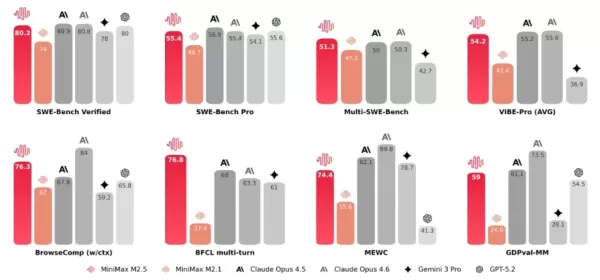
M2.5 has achieved outstanding results across multiple authoritative benchmarks. It reached 80.2% on SWE-Bench Verified, surpassing GPT-5.2 and nearing Claude Opus4.5. On Multi-SWE-Bench, it scored 51.3%, ranking first in multilingual programming performance. BrowseComp performance hit 76.3%, reflecting strong advantages in search and tool-calling tasks. In programming, the model demonstrates architectural-level planning, covering the full software development lifecycle and enabling cross-platform, full-stack development with better framework generalization than Claude Opus4.6. In search, it reduces the number of interaction rounds by 20%, excelling in expert-level search tasks. For office scenarios, it integrates domain knowledge from finance and law, delivering advanced productivity capabilities and achieving a 59.0% win rate against mainstream models in internal evaluations. At the same time, M2.5 is 37% faster than M2.1, matching Claude Opus4.6 in response time while costing only one-tenth as much.
Rapid Iteration Enabled by Technological Innovation
The swift evolution of M2.5 is driven by three core technological advances: first, the Forge native Agent RL framework, which delivers roughly 40x training acceleration; second, the CISPO algorithm, which ensures stability in large-scale training and resolves the long-context credit assignment problem; and third, an innovative Reward design that balances model performance and response speed. Thanks to these technologies, M2.5 now handles 30% of daily tasks and 80% of new code submissions within MiniMax. Over 108 days, the M2 series’ SWE-Bench Verified score rose from 69.4% to 80.2%, with an iteration pace that leads mainstream industry models.
Multiple Deployment Options to Suit Various Scenarios
M2.5 provides three access methods: no-code, API calls, and local deployment, catering to diverse user needs. Non-technical users can get started immediately using the MiniMax Agent web interface, where over 10,000 reusable “Expert” agents have been created by the community. Developers can utilize the free API on ModelScope or the official API. Two official API versions are available—Lightning and Standard—with costs ranging from 1/10 to 1/20 of comparable models. For local deployment, four solutions are supported: SGLang, vLLM, Transformers, and MLX, each tailored for high-concurrency production, small-to-medium scale deployment, quick validation, or Mac-based local development, complete with hardware requirements and operational instructions.
Dedicated Support for Tool Calls and Parameter Optimization
M2.5 natively supports structured tool calls, enabling parallel invocation of multiple tools. When deployed with vLLM or SGLang, you can directly use the OpenAI SDK format; other frameworks require manual parsing of XML-formatted outputs. A complete workflow and best practices are provided for feeding tool results back into the model. For inference, the recommended parameter settings are temperature=1.0, top_p=0.95, and top_k=40, with flexibility to optimize for specific use cases. Programming prompts can leverage the model’s architectural reasoning, and the model adapts well to over 10 programming languages and various scaffolding tools.
Related article
 ByteDance Boosts Core AI Incentives as Doubao Surges 14.6%
ByteDance recently convened a DouBao equity briefing to unveil fresh incentive policies for staff involved in the DouBao division. The strike price for DouBao shares has been lifted from $14.85 in June 2026 to $17.02, marking an approximate 14.6% inc
MiniMax Unveils 10x Team Program to Incentivize Global AI Experts
MiniMax (Xiyu Technology), the General Artificial Intelligence Lab, has officially launched "10x Team," a global talent collaboration initiative. This program aims to recruit top experts across industries to explore the deep application of large mode
South Korea Breaks Ground on National AI Computing Center, Investing 2.5 Trillion Won with 2028 Target
South Korean outlet EtNews reports that groundbreaking for the Korea AI Computing Center (KOACC) took place on August 3 at the Solar City data center park in Sunan, Jeollanam-do. Backed by a total investment of 2.5 trillion KRW (roughly 11.838 billio
Related Special Topic Recommendations
Education and Learning
ByteDance Boosts Core AI Incentives as Doubao Surges 14.6%
ByteDance recently convened a DouBao equity briefing to unveil fresh incentive policies for staff involved in the DouBao division. The strike price for DouBao shares has been lifted from $14.85 in June 2026 to $17.02, marking an approximate 14.6% inc
MiniMax Unveils 10x Team Program to Incentivize Global AI Experts
MiniMax (Xiyu Technology), the General Artificial Intelligence Lab, has officially launched "10x Team," a global talent collaboration initiative. This program aims to recruit top experts across industries to explore the deep application of large mode
South Korea Breaks Ground on National AI Computing Center, Investing 2.5 Trillion Won with 2028 Target
South Korean outlet EtNews reports that groundbreaking for the Korea AI Computing Center (KOACC) took place on August 3 at the Solar City data center park in Sunan, Jeollanam-do. Backed by a total investment of 2.5 trillion KRW (roughly 11.838 billio
Related Special Topic Recommendations
Education and Learning
 AI Study Tools for Homework and Exam Prep
2026 Latest Best AI Study Tools for Homework and Exam Prep! XIX.AI curates a top-rated list of powerful, game-changing tools that help students boost productivity, streamline homework completion, and ace exams through real-world tests. Get a free vs paid comparison, detailed rankings, and must-try options to unlock your AI edge. Explore now!
 10 tools
 xix.ai
Music composition
AI Vocal Demo Tools for Songwriters, Hooks, Toplines, and Multilingual Draft Sessions
xix.ai
Music composition
AI Vocal Demo Tools for Songwriters, Hooks, Toplines, and Multilingual Draft Sessions
2026 Latest Best AI Vocal Demo Tools for Songwriters, Hook Creators, and Multi-Language Content Teams! XIX.AI has curated a top-rated list of powerful game-changing tools that go through rigorous real-world tests. You’ll find detailed free vs paid comparison data, comprehensive rankings, and must-try options to help you boost writing efficiency and unlock your creative potential. Explore now to discover your perfect tool for all your content needs!
9 tools
xix.ai
Business
Best AI Competitive Research Tools for Small Businesses
2026 Latest Best Top-rated AI Competitive Research Tools for Small Businesses! XIX.AI has curated a highly powerful game-changing collection, updated weekly with rigorous real-world tests and detailed rankings. You can find a comprehensive free vs paid comparison to help you identify the must-try tools that boost your productivity and give you a competitive edge. Explore now to discover your perfect tool!
9 tools
xix.ai
Image editing
Photoshop AI Retouch Tools for Ecommerce Apparel, Skin Cleanup, and Color Consistency
2026 Latest Best Photoshop AI retouch tools for ecommerce apparel, skin cleanup, and color consistency! This top-rated curated list features powerful game-changing solutions that help you boost writing efficiency, streamline content creation, and achieve perfect visual results effortlessly. Each tool has undergone real-world tests through weekly updated rankings, complete with free vs paid comparison details. Backed by XIX.AI, it’s the must-try guide for anyone aiming to unlock your AI edge. Explore now!
10 tools
xix.ai
Prompt
Best AI Prompt Libraries for ChatGPT Workflows
2026 Latest Best Top-Rated AI Prompt Libraries for optimizing all types of ChatGPT workflows. XIX.AI has curated a powerful, game-changing collection that goes through rigorous real-world tests to ensure top performance. You can find detailed free vs paid comparisons and expert rankings to help you choose the must-try tools that boost your productivity and unlock your AI edge. Explore now!
11 tools
xix.ai
Education and Learning
AI Quiz Builder Platforms for Teachers, Tutors, and Cohort-Based Learning Programs
2026 Latest Best AI Quiz Builder Platforms for Teachers, Tutors, and Cohort-Based Learning Programs! XIX.AI has curated a top-rated list of powerful game-changing tools that go through real-world tests to deliver accurate rankings. These must-try platforms help boost writing efficiency, streamline content creation, and simplify quiz design across all learning scenarios. Explore now to discover your perfect tool for unlocking your AI edge in teaching!
13 tools
xix.ai

 Comments (2)
0/500
Comments (2)
0/500
![FrankLewis]()
Finally, MiniMax decided to open-source M2.5? About time! Though I'm a bit skeptical about the whole "affordable AI agents" hype – reminds me of those "free" trials that end up costing an arm and a leg. Let's see if the weights actually run on my laptop without melting it 🔥🤷
![AnthonyPerez]()
¡Esto es enorme! Que MiniMax abra su modelo M2.5 como código abierto en un tiempo récord realmente puede cambiar el juego 🚀. Hace que los agentes de IA avanzados sean mucho más accesibles para desarrolladores individuales y pequeñas empresas. Solo espero que esto presione a otros grandes actores y acelere el ritmo de la innovación en IA. Sin embargo, siempre me preocupa un poco la seguridad y los sesgos con los modelos open-source tan rápidamente disponibles. ¿Cómo se manejará eso?
MiniMax has launched the M2.5 model, the third iteration in its M2 series, released within just 108 days. The open-source model weights are now accessible on ModelScope, marking significant progress in performance, efficiency, and affordability. It excels in programming, search, and workplace applications. Additionally, it offers a seamless access path—from no-code usage to private deployment—along with a comprehensive guide for tool calling and inference parameter tuning, ushering in an era of low-cost AI agents.
Core Capabilities Deliver Multidimensional Breakthroughs
M2.5 has achieved outstanding results across multiple authoritative benchmarks. It reached 80.2% on SWE-Bench Verified, surpassing GPT-5.2 and nearing Claude Opus4.5. On Multi-SWE-Bench, it scored 51.3%, ranking first in multilingual programming performance. BrowseComp performance hit 76.3%, reflecting strong advantages in search and tool-calling tasks. In programming, the model demonstrates architectural-level planning, covering the full software development lifecycle and enabling cross-platform, full-stack development with better framework generalization than Claude Opus4.6. In search, it reduces the number of interaction rounds by 20%, excelling in expert-level search tasks. For office scenarios, it integrates domain knowledge from finance and law, delivering advanced productivity capabilities and achieving a 59.0% win rate against mainstream models in internal evaluations. At the same time, M2.5 is 37% faster than M2.1, matching Claude Opus4.6 in response time while costing only one-tenth as much.
Rapid Iteration Enabled by Technological Innovation
The swift evolution of M2.5 is driven by three core technological advances: first, the Forge native Agent RL framework, which delivers roughly 40x training acceleration; second, the CISPO algorithm, which ensures stability in large-scale training and resolves the long-context credit assignment problem; and third, an innovative Reward design that balances model performance and response speed. Thanks to these technologies, M2.5 now handles 30% of daily tasks and 80% of new code submissions within MiniMax. Over 108 days, the M2 series’ SWE-Bench Verified score rose from 69.4% to 80.2%, with an iteration pace that leads mainstream industry models.
Multiple Deployment Options to Suit Various Scenarios
M2.5 provides three access methods: no-code, API calls, and local deployment, catering to diverse user needs. Non-technical users can get started immediately using the MiniMax Agent web interface, where over 10,000 reusable “Expert” agents have been created by the community. Developers can utilize the free API on ModelScope or the official API. Two official API versions are available—Lightning and Standard—with costs ranging from 1/10 to 1/20 of comparable models. For local deployment, four solutions are supported: SGLang, vLLM, Transformers, and MLX, each tailored for high-concurrency production, small-to-medium scale deployment, quick validation, or Mac-based local development, complete with hardware requirements and operational instructions.
Dedicated Support for Tool Calls and Parameter Optimization
M2.5 natively supports structured tool calls, enabling parallel invocation of multiple tools. When deployed with vLLM or SGLang, you can directly use the OpenAI SDK format; other frameworks require manual parsing of XML-formatted outputs. A complete workflow and best practices are provided for feeding tool results back into the model. For inference, the recommended parameter settings are temperature=1.0, top_p=0.95, and top_k=40, with flexibility to optimize for specific use cases. Programming prompts can leverage the model’s architectural reasoning, and the model adapts well to over 10 programming languages and various scaffolding tools.








 ByteDance Boosts Core AI Incentives as Doubao Surges 14.6%
ByteDance recently convened a DouBao equity briefing to unveil fresh incentive policies for staff involved in the DouBao division. The strike price for DouBao shares has been lifted from $14.85 in June 2026 to $17.02, marking an approximate 14.6% inc
ByteDance Boosts Core AI Incentives as Doubao Surges 14.6%
ByteDance recently convened a DouBao equity briefing to unveil fresh incentive policies for staff involved in the DouBao division. The strike price for DouBao shares has been lifted from $14.85 in June 2026 to $17.02, marking an approximate 14.6% inc
 MiniMax Unveils 10x Team Program to Incentivize Global AI Experts
MiniMax (Xiyu Technology), the General Artificial Intelligence Lab, has officially launched "10x Team," a global talent collaboration initiative. This program aims to recruit top experts across industries to explore the deep application of large mode
MiniMax Unveils 10x Team Program to Incentivize Global AI Experts
MiniMax (Xiyu Technology), the General Artificial Intelligence Lab, has officially launched "10x Team," a global talent collaboration initiative. This program aims to recruit top experts across industries to explore the deep application of large mode
 South Korea Breaks Ground on National AI Computing Center, Investing 2.5 Trillion Won with 2028 Target
South Korean outlet EtNews reports that groundbreaking for the Korea AI Computing Center (KOACC) took place on August 3 at the Solar City data center park in Sunan, Jeollanam-do. Backed by a total investment of 2.5 trillion KRW (roughly 11.838 billio
South Korea Breaks Ground on National AI Computing Center, Investing 2.5 Trillion Won with 2028 Target
South Korean outlet EtNews reports that groundbreaking for the Korea AI Computing Center (KOACC) took place on August 3 at the Solar City data center park in Sunan, Jeollanam-do. Backed by a total investment of 2.5 trillion KRW (roughly 11.838 billio

2026 Latest Best AI Study Tools for Homework and Exam Prep! XIX.AI curates a top-rated list of powerful, game-changing tools that help students boost productivity, streamline homework completion, and ace exams through real-world tests. Get a free vs paid comparison, detailed rankings, and must-try options to unlock your AI edge. Explore now!
10 tools
xix.ai

2026 Latest Best AI Vocal Demo Tools for Songwriters, Hook Creators, and Multi-Language Content Teams! XIX.AI has curated a top-rated list of powerful game-changing tools that go through rigorous real-world tests. You’ll find detailed free vs paid comparison data, comprehensive rankings, and must-try options to help you boost writing efficiency and unlock your creative potential. Explore now to discover your perfect tool for all your content needs!
9 tools
xix.ai

2026 Latest Best Top-rated AI Competitive Research Tools for Small Businesses! XIX.AI has curated a highly powerful game-changing collection, updated weekly with rigorous real-world tests and detailed rankings. You can find a comprehensive free vs paid comparison to help you identify the must-try tools that boost your productivity and give you a competitive edge. Explore now to discover your perfect tool!
9 tools
xix.ai

2026 Latest Best Photoshop AI retouch tools for ecommerce apparel, skin cleanup, and color consistency! This top-rated curated list features powerful game-changing solutions that help you boost writing efficiency, streamline content creation, and achieve perfect visual results effortlessly. Each tool has undergone real-world tests through weekly updated rankings, complete with free vs paid comparison details. Backed by XIX.AI, it’s the must-try guide for anyone aiming to unlock your AI edge. Explore now!
10 tools
xix.ai
2026 Latest Best Top-Rated AI Prompt Libraries for optimizing all types of ChatGPT workflows. XIX.AI has curated a powerful, game-changing collection that goes through rigorous real-world tests to ensure top performance. You can find detailed free vs paid comparisons and expert rankings to help you choose the must-try tools that boost your productivity and unlock your AI edge. Explore now!
11 tools
xix.ai

2026 Latest Best AI Quiz Builder Platforms for Teachers, Tutors, and Cohort-Based Learning Programs! XIX.AI has curated a top-rated list of powerful game-changing tools that go through real-world tests to deliver accurate rankings. These must-try platforms help boost writing efficiency, streamline content creation, and simplify quiz design across all learning scenarios. Explore now to discover your perfect tool for unlocking your AI edge in teaching!
13 tools
xix.ai

Finally, MiniMax decided to open-source M2.5? About time! Though I'm a bit skeptical about the whole "affordable AI agents" hype – reminds me of those "free" trials that end up costing an arm and a leg. Let's see if the weights actually run on my laptop without melting it 🔥🤷
¡Esto es enorme! Que MiniMax abra su modelo M2.5 como código abierto en un tiempo récord realmente puede cambiar el juego 🚀. Hace que los agentes de IA avanzados sean mucho más accesibles para desarrolladores individuales y pequeñas empresas. Solo espero que esto presione a otros grandes actores y acelere el ritmo de la innovación en IA. Sin embargo, siempre me preocupa un poco la seguridad y los sesgos con los modelos open-source tan rápidamente disponibles. ¿Cómo se manejará eso?












