


 Home
Home
MiniCPM-V 4.6's 1.3B Model Dimension Reduction Attack Redefines Edge Multimodal Technology
On May 11, Mingshi Intelligence teamed up with Tsinghua University and the OpenBMB open-source community to unveil the new edge-side multimodal large model MiniCPM-V4.6. Despite its compact size—just 1.3 billion parameters—this lightweight model pushes the boundaries of larger models through exceptional intelligent density and cross-platform adaptability, speeding up the real-world deployment of edge-side AI.
1. Peak Performance: 1.3B Parameters Deliver Exceptional Results
MiniCPM-V4.6 comes in two versions—Instruct and Thinking—both demonstrating impressive reasoning and understanding across various benchmarks when compared to similarly sized models.
Global Leadership: On the Artificial Analysis (AA) leaderboard, MiniCPM-V4.6 scored an impressive 13 points, far surpassing similarly sized rivals (e.g., Alibaba's Qwen3.5-0.8B and Google's Gemma4-E2B-it) while nearly matching the performance of larger models like Qwen3.5-2B. This sets a new benchmark for 1B-parameter models.
Advanced Capabilities: From general image-text comprehension and complex STEM math reasoning to demanding document OCR and video temporal understanding, the model exhibits strong intelligence. The Thinking version, in particular, excels in multi-image reasoning and hallucination suppression.
2. Efficiency Breakthrough: Extreme Intelligent Density at the Edge
To tackle memory constraints in edge deployment, MiniCPM-V4.6 has been deeply optimized for inference speed and resource efficiency.
Low Memory Footprint: Memory requirements drop to just 6GB, enabling smooth operation on mainstream smartphones, PCs, and smart home devices.
Inference Efficiency: Powered by vLLM, inference throughput is 1.5× that of competitors. When processing a 3136² ultra-high-definition image at the edge, the first response latency is just 75.7ms—2.2× faster than competing models.
Throughput: A single GPU delivers text generation at 7,013 tokens per second and can process 1,344² images at 54.79 images per second, demonstrating remarkable efficiency.
3. Core Technology: LLaVA-UHD v4 Minimizes Overhead
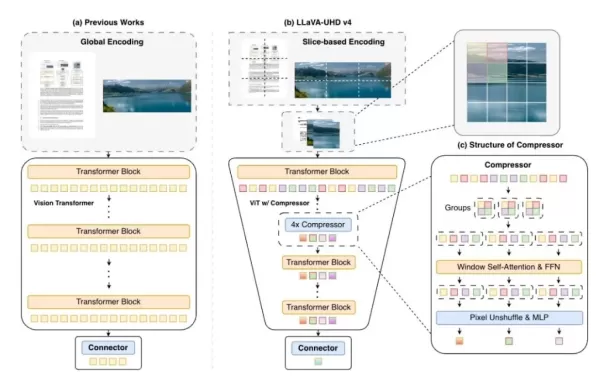
The model's lightweight design is made possible by LLaVA-UHD v4, jointly developed by Mingshi Intelligence and Tsinghua University.
Encoding Redesign: Through a revamped ViT image encoding and shallow compression module, image encoding overhead is cut by 50% and high-resolution floating-point operations by 55.8%.
Hybrid Compression: It introduces a 4×/16× hybrid token compression that enables flexible switching between performance-first and speed-first modes. This technology has been validated in Kuaishou's recommendation model OneRec, handling massive traffic.
4. Ecosystem Deployment: From Lab to Industry
The open-source release of MiniCPM-V4.6 marks both a technical and ecosystem milestone.
Easy Development: It integrates seamlessly with fine-tuning frameworks like ms-swift and LLaMA-Factory, enabling full-scale fine-tuning on a single RTX 4090 GPU.
Cross-Platform Support: Compatible with vLLM, Ollama, and other major frameworks, it offers test versions for iOS, Android, and HarmonyOS, bringing AI to a wider range of hardware.
Real-World Impact: The model series is already deployed in automotive, PC, smart home, and industrial inspection sectors, with partners including Lenovo, Geely, SAIC Volkswagen, Xiaomi, and OPPO.
Related article
 U.S. Stocks Hit Historic Milestone as AI and Aerospace Giants Prepare for Trillion-Dollar Debut
Elon Musk, Sam Altman, and Dario Amodei, three titans of the technology sector, are advancing toward initial public offerings for their respective ventures. With SpaceX, OpenAI, and Anthropic—three industry behemoths nearing trillion-dollar valuation
Swedish AI Startup Lovable Eyes $13.2 Billion Valuation After Major Funding Round
As AI-driven coding tools gain traction, Swedish startup Lovable has secured a major funding round. The company aims to raise $3 billion, potentially boosting its valuation to $13.2 billion—double the $6.6 billion recorded last December. Menlo Ventur
Google Tests Remy AI Agent for Gemini as Focus Shifts to User Control
According to Business Insider, Google is testing Remy, a new AI personal agent for Gemini. This tool aims to execute tasks on behalf of users, streamlining both professional workflows and daily routines.Currently, Remy is undergoing testing in an int
Related Special Topic Recommendations
Data Analysis
U.S. Stocks Hit Historic Milestone as AI and Aerospace Giants Prepare for Trillion-Dollar Debut
Elon Musk, Sam Altman, and Dario Amodei, three titans of the technology sector, are advancing toward initial public offerings for their respective ventures. With SpaceX, OpenAI, and Anthropic—three industry behemoths nearing trillion-dollar valuation
Swedish AI Startup Lovable Eyes $13.2 Billion Valuation After Major Funding Round
As AI-driven coding tools gain traction, Swedish startup Lovable has secured a major funding round. The company aims to raise $3 billion, potentially boosting its valuation to $13.2 billion—double the $6.6 billion recorded last December. Menlo Ventur
Google Tests Remy AI Agent for Gemini as Focus Shifts to User Control
According to Business Insider, Google is testing Remy, a new AI personal agent for Gemini. This tool aims to execute tasks on behalf of users, streamlining both professional workflows and daily routines.Currently, Remy is undergoing testing in an int
Related Special Topic Recommendations
Data Analysis
 Best AI Anomaly Detection Tools for KPI Monitoring across SaaS and Ecommerce Teams
2026 Latest Best Top-rated AI Anomaly Detection Tools for KPI Monitoring in SaaS and Ecommerce teams! XIX.AI has curated a powerful, game-changing collection based on rigorous real-world tests and weekly updated rankings. You’ll find detailed free vs paid comparison insights to help you identify the must-try solution that boosts productivity and unlocks your AI edge. Explore now!
 10 tools
 xix.ai
writing
Best AI Outline Generators for Long-Form SEO Articles
xix.ai
writing
Best AI Outline Generators for Long-Form SEO Articles
2026 Latest Best Top-Rated AI Outline Generators for Long-Form SEO Articles, meticulously curated by XIX.AI. These powerful tools offer game-changing assistance in creating high-quality content quickly, boosting writing efficiency significantly. Get a free vs paid comparison along with real-world tests and detailed rankings to help you find the must-try option that suits your needs. Explore now to unlock your AI edge.
8 tools
xix.ai
Education and Learning
AI Study Tools for Homework and Exam Prep
2026 Latest Best AI Study Tools for Homework and Exam Prep! XIX.AI curates a top-rated list of powerful, game-changing tools that help students boost productivity, streamline homework completion, and ace exams through real-world tests. Get a free vs paid comparison, detailed rankings, and must-try options to unlock your AI edge. Explore now!
10 tools
xix.ai
Music composition
AI Vocal Demo Tools for Songwriters, Hooks, Toplines, and Multilingual Draft Sessions
2026 Latest Best AI Vocal Demo Tools for Songwriters, Hook Creators, and Multi-Language Content Teams! XIX.AI has curated a top-rated list of powerful game-changing tools that go through rigorous real-world tests. You’ll find detailed free vs paid comparison data, comprehensive rankings, and must-try options to help you boost writing efficiency and unlock your creative potential. Explore now to discover your perfect tool for all your content needs!
9 tools
xix.ai
Business
Best AI Competitive Research Tools for Small Businesses
2026 Latest Best Top-rated AI Competitive Research Tools for Small Businesses! XIX.AI has curated a highly powerful game-changing collection, updated weekly with rigorous real-world tests and detailed rankings. You can find a comprehensive free vs paid comparison to help you identify the must-try tools that boost your productivity and give you a competitive edge. Explore now to discover your perfect tool!
9 tools
xix.ai
Image editing
Photoshop AI Retouch Tools for Ecommerce Apparel, Skin Cleanup, and Color Consistency
2026 Latest Best Photoshop AI retouch tools for ecommerce apparel, skin cleanup, and color consistency! This top-rated curated list features powerful game-changing solutions that help you boost writing efficiency, streamline content creation, and achieve perfect visual results effortlessly. Each tool has undergone real-world tests through weekly updated rankings, complete with free vs paid comparison details. Backed by XIX.AI, it’s the must-try guide for anyone aiming to unlock your AI edge. Explore now!
10 tools
xix.ai

 Comments (0)
0/500
Comments (0)
0/500
On May 11, Mingshi Intelligence teamed up with Tsinghua University and the OpenBMB open-source community to unveil the new edge-side multimodal large model MiniCPM-V4.6. Despite its compact size—just 1.3 billion parameters—this lightweight model pushes the boundaries of larger models through exceptional intelligent density and cross-platform adaptability, speeding up the real-world deployment of edge-side AI.
1. Peak Performance: 1.3B Parameters Deliver Exceptional Results
MiniCPM-V4.6 comes in two versions—Instruct and Thinking—both demonstrating impressive reasoning and understanding across various benchmarks when compared to similarly sized models.
Global Leadership: On the Artificial Analysis (AA) leaderboard, MiniCPM-V4.6 scored an impressive 13 points, far surpassing similarly sized rivals (e.g., Alibaba's Qwen3.5-0.8B and Google's Gemma4-E2B-it) while nearly matching the performance of larger models like Qwen3.5-2B. This sets a new benchmark for 1B-parameter models.
Advanced Capabilities: From general image-text comprehension and complex STEM math reasoning to demanding document OCR and video temporal understanding, the model exhibits strong intelligence. The Thinking version, in particular, excels in multi-image reasoning and hallucination suppression.
2. Efficiency Breakthrough: Extreme Intelligent Density at the Edge
To tackle memory constraints in edge deployment, MiniCPM-V4.6 has been deeply optimized for inference speed and resource efficiency.
Low Memory Footprint: Memory requirements drop to just 6GB, enabling smooth operation on mainstream smartphones, PCs, and smart home devices.
Inference Efficiency: Powered by vLLM, inference throughput is 1.5× that of competitors. When processing a 3136² ultra-high-definition image at the edge, the first response latency is just 75.7ms—2.2× faster than competing models.
Throughput: A single GPU delivers text generation at 7,013 tokens per second and can process 1,344² images at 54.79 images per second, demonstrating remarkable efficiency.
3. Core Technology: LLaVA-UHD v4 Minimizes Overhead
The model's lightweight design is made possible by LLaVA-UHD v4, jointly developed by Mingshi Intelligence and Tsinghua University.
Encoding Redesign: Through a revamped ViT image encoding and shallow compression module, image encoding overhead is cut by 50% and high-resolution floating-point operations by 55.8%.
Hybrid Compression: It introduces a 4×/16× hybrid token compression that enables flexible switching between performance-first and speed-first modes. This technology has been validated in Kuaishou's recommendation model OneRec, handling massive traffic.
4. Ecosystem Deployment: From Lab to Industry
The open-source release of MiniCPM-V4.6 marks both a technical and ecosystem milestone.
Easy Development: It integrates seamlessly with fine-tuning frameworks like ms-swift and LLaMA-Factory, enabling full-scale fine-tuning on a single RTX 4090 GPU.
Cross-Platform Support: Compatible with vLLM, Ollama, and other major frameworks, it offers test versions for iOS, Android, and HarmonyOS, bringing AI to a wider range of hardware.
Real-World Impact: The model series is already deployed in automotive, PC, smart home, and industrial inspection sectors, with partners including Lenovo, Geely, SAIC Volkswagen, Xiaomi, and OPPO.








 U.S. Stocks Hit Historic Milestone as AI and Aerospace Giants Prepare for Trillion-Dollar Debut
Elon Musk, Sam Altman, and Dario Amodei, three titans of the technology sector, are advancing toward initial public offerings for their respective ventures. With SpaceX, OpenAI, and Anthropic—three industry behemoths nearing trillion-dollar valuation
U.S. Stocks Hit Historic Milestone as AI and Aerospace Giants Prepare for Trillion-Dollar Debut
Elon Musk, Sam Altman, and Dario Amodei, three titans of the technology sector, are advancing toward initial public offerings for their respective ventures. With SpaceX, OpenAI, and Anthropic—three industry behemoths nearing trillion-dollar valuation
 Swedish AI Startup Lovable Eyes $13.2 Billion Valuation After Major Funding Round
As AI-driven coding tools gain traction, Swedish startup Lovable has secured a major funding round. The company aims to raise $3 billion, potentially boosting its valuation to $13.2 billion—double the $6.6 billion recorded last December. Menlo Ventur
Google Tests Remy AI Agent for Gemini as Focus Shifts to User Control
According to Business Insider, Google is testing Remy, a new AI personal agent for Gemini. This tool aims to execute tasks on behalf of users, streamlining both professional workflows and daily routines.Currently, Remy is undergoing testing in an int
Swedish AI Startup Lovable Eyes $13.2 Billion Valuation After Major Funding Round
As AI-driven coding tools gain traction, Swedish startup Lovable has secured a major funding round. The company aims to raise $3 billion, potentially boosting its valuation to $13.2 billion—double the $6.6 billion recorded last December. Menlo Ventur
Google Tests Remy AI Agent for Gemini as Focus Shifts to User Control
According to Business Insider, Google is testing Remy, a new AI personal agent for Gemini. This tool aims to execute tasks on behalf of users, streamlining both professional workflows and daily routines.Currently, Remy is undergoing testing in an int

2026 Latest Best Top-rated AI Anomaly Detection Tools for KPI Monitoring in SaaS and Ecommerce teams! XIX.AI has curated a powerful, game-changing collection based on rigorous real-world tests and weekly updated rankings. You’ll find detailed free vs paid comparison insights to help you identify the must-try solution that boosts productivity and unlocks your AI edge. Explore now!
10 tools
xix.ai

2026 Latest Best Top-Rated AI Outline Generators for Long-Form SEO Articles, meticulously curated by XIX.AI. These powerful tools offer game-changing assistance in creating high-quality content quickly, boosting writing efficiency significantly. Get a free vs paid comparison along with real-world tests and detailed rankings to help you find the must-try option that suits your needs. Explore now to unlock your AI edge.
8 tools
xix.ai

2026 Latest Best AI Study Tools for Homework and Exam Prep! XIX.AI curates a top-rated list of powerful, game-changing tools that help students boost productivity, streamline homework completion, and ace exams through real-world tests. Get a free vs paid comparison, detailed rankings, and must-try options to unlock your AI edge. Explore now!
10 tools
xix.ai

2026 Latest Best AI Vocal Demo Tools for Songwriters, Hook Creators, and Multi-Language Content Teams! XIX.AI has curated a top-rated list of powerful game-changing tools that go through rigorous real-world tests. You’ll find detailed free vs paid comparison data, comprehensive rankings, and must-try options to help you boost writing efficiency and unlock your creative potential. Explore now to discover your perfect tool for all your content needs!
9 tools
xix.ai

2026 Latest Best Top-rated AI Competitive Research Tools for Small Businesses! XIX.AI has curated a highly powerful game-changing collection, updated weekly with rigorous real-world tests and detailed rankings. You can find a comprehensive free vs paid comparison to help you identify the must-try tools that boost your productivity and give you a competitive edge. Explore now to discover your perfect tool!
9 tools
xix.ai

2026 Latest Best Photoshop AI retouch tools for ecommerce apparel, skin cleanup, and color consistency! This top-rated curated list features powerful game-changing solutions that help you boost writing efficiency, streamline content creation, and achieve perfect visual results effortlessly. Each tool has undergone real-world tests through weekly updated rankings, complete with free vs paid comparison details. Backed by XIX.AI, it’s the must-try guide for anyone aiming to unlock your AI edge. Explore now!
10 tools
xix.ai












