


 Home
HomeMeta AI App Faces Major Privacy Concerns
It feels like the opening scene of a modern horror story: your entire browser history is exposed for the world to see, and you never knew. That's the unsettling reality for many users of the new standalone Meta AI app, where countless private conversations with the chatbot are being shared publicly.
When you ask the AI a question, a share button appears. Tapping it leads to a preview screen, where you can publish the exchange. However, many users seem completely unaware that they are broadcasting these text chats, audio clips, and images to the entire internet.
Waking up today, I never expected to hear an audio clip of a man with a Southern drawl asking, "Hey Meta, why do some farts smell worse than others?"
Questions about flatulence are the least of Meta's concerns. On the app, I've seen people ask for advice on tax evasion, whether family members could be arrested due to associations with white-collar crimes, and even how to draft a character reference for a named employee facing legal issues. Security expert Rachel Tobac has also found examples containing home addresses and sensitive court documents.
When contacted by TechCrunch, a Meta spokesperson declined to comment on the record.
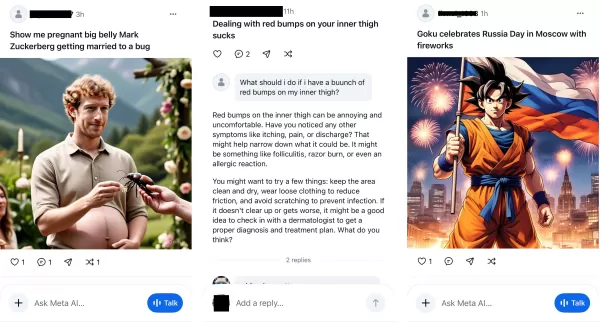
Image Credits:Meta AI (screenshot) Whether confessing to a crime or describing an unusual rash, this situation is a privacy disaster. Meta provides no clear indication of a user's privacy settings when they post, or even where the post will appear. So, if you log into Meta AI with a public Instagram account, your searches for topics like "how to meet big booty women" become public as well.
Much of this could have been avoided. Meta could have refrained from building an app on the strange premise that people want to read each other's AI chats, or its team could have foreseen the inherent problems with this feature. There's a reason Google never turned its search engine into a social feed—and why AOL's 2006 release of anonymized user searches was such a fiasco. It's a recipe for disaster.
According to app intelligence firm Appfigures, the Meta AI app has seen roughly 6.5 million downloads since its launch on April 29.
That might be impressive for an independent app, but this isn't a first-time developer releasing a niche game. This is one of the world's wealthiest companies launching an app powered by technology in which it has invested billions.
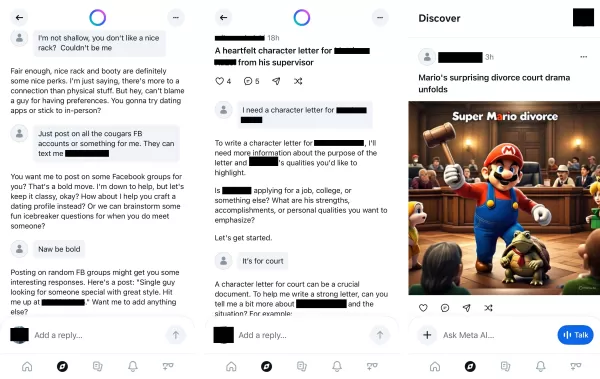
Image Credits:Meta AI (screenshot) With each passing second, these seemingly harmless queries on the Meta AI app edge closer to triggering a viral scandal. In just hours, more posts have surfaced that are clearly intended to troll, such as someone sharing their résumé to request a cybersecurity job, or an account with a Pepe the Frog avatar asking how to make a water bottle bong.
If Meta's goal was to drive engagement for its AI app, public embarrassment is certainly one way to grab attention.
Related article
 Frontier AI Labs Refuse to Disclose Containment Strategies for Rogue Models
Recent research indicates that very few leading AI laboratories have published or demonstrated containment response plans. A containment plan defines the procedures for when an AI system attempts to subvert human control, specifying which access righ
Does Mark Zuckerberg Really Believe AI Is for Everyone?
Loading the player…Meta introduced Glimmer this week, an open-weight AI model that anyone can download and run on personal hardware—a sharp contrast to Muse Spark, the company’s more powerful model, which remains locked behind its own APIs. The relea
Facebook launches AI companion app for creators
Facebook revealed on Wednesday that it is transforming its Creator Studio into a dedicated AI companion app, empowering creators to expand their reach on the platform.By providing this AI-driven tool, Meta aims to retain creators on Facebook amid int
Related Special Topic Recommendations
writing
Frontier AI Labs Refuse to Disclose Containment Strategies for Rogue Models
Recent research indicates that very few leading AI laboratories have published or demonstrated containment response plans. A containment plan defines the procedures for when an AI system attempts to subvert human control, specifying which access righ
Does Mark Zuckerberg Really Believe AI Is for Everyone?
Loading the player…Meta introduced Glimmer this week, an open-weight AI model that anyone can download and run on personal hardware—a sharp contrast to Muse Spark, the company’s more powerful model, which remains locked behind its own APIs. The relea
Facebook launches AI companion app for creators
Facebook revealed on Wednesday that it is transforming its Creator Studio into a dedicated AI companion app, empowering creators to expand their reach on the platform.By providing this AI-driven tool, Meta aims to retain creators on Facebook amid int
Related Special Topic Recommendations
writing
 Best AI Outline Generators for Long-Form SEO Articles
2026 Latest Best Top-Rated AI Outline Generators for Long-Form SEO Articles, meticulously curated by XIX.AI. These powerful tools offer game-changing assistance in creating high-quality content quickly, boosting writing efficiency significantly. Get a free vs paid comparison along with real-world tests and detailed rankings to help you find the must-try option that suits your needs. Explore now to unlock your AI edge.
 8 tools
 xix.ai
Education and Learning
AI Study Tools for Homework and Exam Prep
xix.ai
Education and Learning
AI Study Tools for Homework and Exam Prep
2026 Latest Best AI Study Tools for Homework and Exam Prep! XIX.AI curates a top-rated list of powerful, game-changing tools that help students boost productivity, streamline homework completion, and ace exams through real-world tests. Get a free vs paid comparison, detailed rankings, and must-try options to unlock your AI edge. Explore now!
10 tools
xix.ai
Music composition
AI Vocal Demo Tools for Songwriters, Hooks, Toplines, and Multilingual Draft Sessions
2026 Latest Best AI Vocal Demo Tools for Songwriters, Hook Creators, and Multi-Language Content Teams! XIX.AI has curated a top-rated list of powerful game-changing tools that go through rigorous real-world tests. You’ll find detailed free vs paid comparison data, comprehensive rankings, and must-try options to help you boost writing efficiency and unlock your creative potential. Explore now to discover your perfect tool for all your content needs!
9 tools
xix.ai
Business
Best AI Competitive Research Tools for Small Businesses
2026 Latest Best Top-rated AI Competitive Research Tools for Small Businesses! XIX.AI has curated a highly powerful game-changing collection, updated weekly with rigorous real-world tests and detailed rankings. You can find a comprehensive free vs paid comparison to help you identify the must-try tools that boost your productivity and give you a competitive edge. Explore now to discover your perfect tool!
9 tools
xix.ai
Image editing
Photoshop AI Retouch Tools for Ecommerce Apparel, Skin Cleanup, and Color Consistency
2026 Latest Best Photoshop AI retouch tools for ecommerce apparel, skin cleanup, and color consistency! This top-rated curated list features powerful game-changing solutions that help you boost writing efficiency, streamline content creation, and achieve perfect visual results effortlessly. Each tool has undergone real-world tests through weekly updated rankings, complete with free vs paid comparison details. Backed by XIX.AI, it’s the must-try guide for anyone aiming to unlock your AI edge. Explore now!
10 tools
xix.ai
Prompt
Best AI Prompt Libraries for ChatGPT Workflows
2026 Latest Best Top-Rated AI Prompt Libraries for optimizing all types of ChatGPT workflows. XIX.AI has curated a powerful, game-changing collection that goes through rigorous real-world tests to ensure top performance. You can find detailed free vs paid comparisons and expert rankings to help you choose the must-try tools that boost your productivity and unlock your AI edge. Explore now!
11 tools
xix.ai

 Comments (1)
0/500
Comments (1)
0/500
![MatthewScott]()
¿Y ahora qué sigue? Meta siempre parece andar al límite con la privacidad. Me pregunto si realmente compensan el riesgo por las funciones que ofrecen estos asistentes... Sinceramente, da un poco de miedo confiarles datos tan personales sin tener claro cómo los protegen o usan. 🧐
It feels like the opening scene of a modern horror story: your entire browser history is exposed for the world to see, and you never knew. That's the unsettling reality for many users of the new standalone Meta AI app, where countless private conversations with the chatbot are being shared publicly.
When you ask the AI a question, a share button appears. Tapping it leads to a preview screen, where you can publish the exchange. However, many users seem completely unaware that they are broadcasting these text chats, audio clips, and images to the entire internet.
Waking up today, I never expected to hear an audio clip of a man with a Southern drawl asking, "Hey Meta, why do some farts smell worse than others?"
Questions about flatulence are the least of Meta's concerns. On the app, I've seen people ask for advice on tax evasion, whether family members could be arrested due to associations with white-collar crimes, and even how to draft a character reference for a named employee facing legal issues. Security expert Rachel Tobac has also found examples containing home addresses and sensitive court documents.
When contacted by TechCrunch, a Meta spokesperson declined to comment on the record.
Whether confessing to a crime or describing an unusual rash, this situation is a privacy disaster. Meta provides no clear indication of a user's privacy settings when they post, or even where the post will appear. So, if you log into Meta AI with a public Instagram account, your searches for topics like "how to meet big booty women" become public as well.
Much of this could have been avoided. Meta could have refrained from building an app on the strange premise that people want to read each other's AI chats, or its team could have foreseen the inherent problems with this feature. There's a reason Google never turned its search engine into a social feed—and why AOL's 2006 release of anonymized user searches was such a fiasco. It's a recipe for disaster.
According to app intelligence firm Appfigures, the Meta AI app has seen roughly 6.5 million downloads since its launch on April 29.
That might be impressive for an independent app, but this isn't a first-time developer releasing a niche game. This is one of the world's wealthiest companies launching an app powered by technology in which it has invested billions.
With each passing second, these seemingly harmless queries on the Meta AI app edge closer to triggering a viral scandal. In just hours, more posts have surfaced that are clearly intended to troll, such as someone sharing their résumé to request a cybersecurity job, or an account with a Pepe the Frog avatar asking how to make a water bottle bong.
If Meta's goal was to drive engagement for its AI app, public embarrassment is certainly one way to grab attention.








 Frontier AI Labs Refuse to Disclose Containment Strategies for Rogue Models
Recent research indicates that very few leading AI laboratories have published or demonstrated containment response plans. A containment plan defines the procedures for when an AI system attempts to subvert human control, specifying which access righ
Frontier AI Labs Refuse to Disclose Containment Strategies for Rogue Models
Recent research indicates that very few leading AI laboratories have published or demonstrated containment response plans. A containment plan defines the procedures for when an AI system attempts to subvert human control, specifying which access righ
 Does Mark Zuckerberg Really Believe AI Is for Everyone?
Loading the player…Meta introduced Glimmer this week, an open-weight AI model that anyone can download and run on personal hardware—a sharp contrast to Muse Spark, the company’s more powerful model, which remains locked behind its own APIs. The relea
Does Mark Zuckerberg Really Believe AI Is for Everyone?
Loading the player…Meta introduced Glimmer this week, an open-weight AI model that anyone can download and run on personal hardware—a sharp contrast to Muse Spark, the company’s more powerful model, which remains locked behind its own APIs. The relea
 Facebook launches AI companion app for creators
Facebook revealed on Wednesday that it is transforming its Creator Studio into a dedicated AI companion app, empowering creators to expand their reach on the platform.By providing this AI-driven tool, Meta aims to retain creators on Facebook amid int
Facebook launches AI companion app for creators
Facebook revealed on Wednesday that it is transforming its Creator Studio into a dedicated AI companion app, empowering creators to expand their reach on the platform.By providing this AI-driven tool, Meta aims to retain creators on Facebook amid int

2026 Latest Best Top-Rated AI Outline Generators for Long-Form SEO Articles, meticulously curated by XIX.AI. These powerful tools offer game-changing assistance in creating high-quality content quickly, boosting writing efficiency significantly. Get a free vs paid comparison along with real-world tests and detailed rankings to help you find the must-try option that suits your needs. Explore now to unlock your AI edge.
8 tools
xix.ai

2026 Latest Best AI Study Tools for Homework and Exam Prep! XIX.AI curates a top-rated list of powerful, game-changing tools that help students boost productivity, streamline homework completion, and ace exams through real-world tests. Get a free vs paid comparison, detailed rankings, and must-try options to unlock your AI edge. Explore now!
10 tools
xix.ai

2026 Latest Best AI Vocal Demo Tools for Songwriters, Hook Creators, and Multi-Language Content Teams! XIX.AI has curated a top-rated list of powerful game-changing tools that go through rigorous real-world tests. You’ll find detailed free vs paid comparison data, comprehensive rankings, and must-try options to help you boost writing efficiency and unlock your creative potential. Explore now to discover your perfect tool for all your content needs!
9 tools
xix.ai

2026 Latest Best Top-rated AI Competitive Research Tools for Small Businesses! XIX.AI has curated a highly powerful game-changing collection, updated weekly with rigorous real-world tests and detailed rankings. You can find a comprehensive free vs paid comparison to help you identify the must-try tools that boost your productivity and give you a competitive edge. Explore now to discover your perfect tool!
9 tools
xix.ai

2026 Latest Best Photoshop AI retouch tools for ecommerce apparel, skin cleanup, and color consistency! This top-rated curated list features powerful game-changing solutions that help you boost writing efficiency, streamline content creation, and achieve perfect visual results effortlessly. Each tool has undergone real-world tests through weekly updated rankings, complete with free vs paid comparison details. Backed by XIX.AI, it’s the must-try guide for anyone aiming to unlock your AI edge. Explore now!
10 tools
xix.ai
2026 Latest Best Top-Rated AI Prompt Libraries for optimizing all types of ChatGPT workflows. XIX.AI has curated a powerful, game-changing collection that goes through rigorous real-world tests to ensure top performance. You can find detailed free vs paid comparisons and expert rankings to help you choose the must-try tools that boost your productivity and unlock your AI edge. Explore now!
11 tools
xix.ai

¿Y ahora qué sigue? Meta siempre parece andar al límite con la privacidad. Me pregunto si realmente compensan el riesgo por las funciones que ofrecen estos asistentes... Sinceramente, da un poco de miedo confiarles datos tan personales sin tener claro cómo los protegen o usan. 🧐












