


 Home
HomeHow to master array operations for Codeforces Problem D in 2025?
Navigating the competitive programming landscape requires a blend of algorithmic knowledge and strategic problem-solving. The 'Array and Operations' problem from Codeforces Round #760 presents an interesting challenge centered on array manipulation and minimizing a score. This guide breaks down the problem's core concepts and presents an efficient greedy strategy for solving it. Whether you're an experienced coder or a beginner, this walkthrough will help you master these types of array operations for competitive coding.
Key Points
Understanding the Problem: Clarify the rules for array manipulation and how the final score is calculated.
The Greedy Method: Develop a strategy to minimize the final score through careful pair selection and element division.
Sorting Strategy: Sort array elements in descending order to optimize the outcomes of division operations.
Algorithm Implementation: Translate the logical approach into efficient, correct code.
Optimization Techniques: Refine the algorithm to improve its time and space complexity.
Decoding the 'Array and Operations' Challenge
Understanding the Problem Statement: Array Manipulation and Score Minimization
The 'Array and Operations' problem presents you with an array of 'n' integers and an integer 'k', where 2k 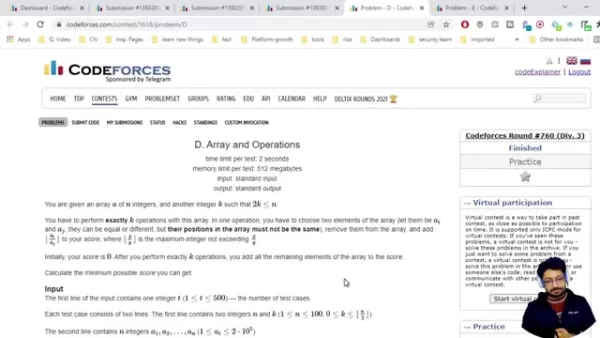
.
Key Problem Constraints:
- You must perform exactly 'k' operations.
- The chosen elements, ai and aj, must be from different positions in the array.
- 2k
Breaking down the components:
- The Array: You start with an array 'A' of 'n' integers. The initial state is crucial for planning your operations.
- The Integer k: This number dictates how many pair-removal operations you must perform. The constraint 2k
- The Operation:
- Select two distinct elements, ai and aj, from the array.
- Calculate the floor of ai divided by aj (⌊ai/aj⌋).
- Add this result to your running score.
- Remove both ai and aj from the array.
- Final Score Calculation: After completing 'k' operations, add the values of all remaining array elements to your score. This total, combined with the scores from your division operations, is your final result.
The core challenge is identifying which elements to pair and remove at each step to minimize the final score. This requires strategic thinking to balance the division scores against the sum of the leftover elements. By carefully choosing pairs, you can control both sources of points to achieve the lowest possible total. A clear understanding of these mechanics is the first step toward an effective solution.
Strategic Approach: Greedy Algorithm for Score Minimization
A greedy algorithm provides an effective strategy for minimizing the score in the 'Array and Operations' problem. This approach makes the locally optimal choice at each step to work towards a globally optimal solution.

For this specific problem, the goal is to minimize points from the division operations while managing the values of the elements that will remain. Here’s how to implement the greedy approach:
1. Sorting the Array:
Initial Sort: The first step is to sort the array 'A' in non-increasing (descending) order. This allows you to pair elements where dividing a larger number by a smaller one yields a smaller (or zero) quotient. In C++, you can use sort(a.rbegin(), a.rend());
Reasoning: Sorting in descending order ensures that when you divide ai by aj (where i
2. Pair Selection and Score Reduction:
Choosing Pairs: After sorting, select the first 'k' pairs for division operations. This selection is key to minimizing the score added from each division.
Selection Strategy: A highly effective tactic is to perform division operations using pairs of elements that yield a quotient of 1 or 0, as this adds little to the score. It's clear that the quotient (ai/aj) directly adds to your score.
3. Handling Remaining Elements
Sum of Remaining Elements: After 'k' operations, the leftover elements are added directly to the score. To minimize this, you should aim to remove the largest numbers via division, leaving the smaller numbers behind.
Final Score Calculation: Add the scores from the division operations to the sum of the remaining elements. Since each division ideally yields a small quotient, the remaining sum will also be relatively small. The goal is to end with the smallest possible numbers in the array.
Justification for the Greedy Approach:This method works by reducing division scores and ensuring the leftover array consists of small values. The sorting step enables you to make informed, locally optimal decisions that contribute to a globally minimized final score. A careful implementation of this strategy leads to an efficient and optimal solution for the problem.
Coding the Solution: Implementing the Greedy Algorithm in C++
Let's translate the greedy strategy into a C++ solution. The code focuses on sorting the array, selecting pairs strategically, and calculating the final score.
#include #include #include using namespace std;int main() {int t;cin >> t;while (t--) {int n, k;cin >> n >> k;vector a(n);for (int i = 0; i > a[i];}sort(a.rbegin(), a.rend()); // Sort in decreasing orderlong long ans = 0;for (int i = 0; i Code Explanation:
- Include Headers: The necessary headers are included for input/output, vector manipulation, and sorting.
- Input Processing: For each test case, the code reads 'n' and 'k', then inputs the 'n' elements into vector 'a'.
- Sorting: The vector is sorted in descending order using reverse iterators with
sort(a.rbegin(), a.rend());. - Pair Selection and Score Calculation:
- A variable
ans is initialized to store the final result. - The code loops 'k' times. For each operation, it adds the floor division result of
a[i + k] / a[i] to ans.
- Adding Remaining Elements: After the 'k' operations, all elements from index
2 * k to the end are added to ans. - Output: The computed minimum score, stored in
ans, is printed.
This implementation is efficient, readable, and should correctly handle all problem test cases.
Guide on How to Use to Solve the Problem
Understand the Problem Constraints
Before writing code, ensure you fully understand the problem's constraints:
- Understanding how many operations are required.
- Determining the maximum number of valid pairs you can form.
- Knowing how the division result contributes to the final score versus the sum of the remaining elements.
Implement the base solution
Start by implementing a base solution, perhaps inspired by existing Codeforces submissions, and test it with provided examples.
Coding With Optimization and Analysis
Finally, write the program efficiently, utilizing sorting or other search techniques as needed for optimal performance.
Greedy Approach: Unveiling the Pros and Cons
Pros
Simplicity: The logic is easy to understand and implement.
Efficiency: It often leads to fast, straightforward solutions.
Optimality: For problems with the right structure, it can guarantee an optimal result.
Cons
Not Always Optimal: It may fail to produce the best solution for all problem types.
Subtleties: Careful analysis is required to prove its correctness for a given problem.
Local Optima: The algorithm can become trapped in a suboptimal solution path.
Frequently Asked Questions
Why is sorting the array crucial in this problem?
Sorting is fundamental to the greedy approach. Arranging the array in descending order allows you to strategically pair a larger element with a smaller one, which typically results in a smaller (or zero) division quotient, thereby minimizing the score from those operations.
What happens if I don't perform exactly 'k' operations?
The problem mandates that you perform exactly 'k' operations. Doing fewer will leave more elements to be added to your score, while doing more is impossible by the rules, both leading to an incorrect answer.
Can I choose the same element twice in different operations?
No. The problem rules state you must select two distinct elements from the array for each operation. Once an element is removed, it cannot be used again.
Related Questions
Are there other algorithmic approaches to solve the 'Array and Operations' problem?
While the greedy method is often the most intuitive and efficient solution, exploring other algorithmic strategies can provide deeper insight. Dynamic programming and branch-and-bound techniques are possible alternatives, though they are generally more complex.
1. Dynamic Programming (DP):
Basic Idea: DP solves complex problems by breaking them into overlapping subproblems, solving each once, and storing the results to avoid recomputation.
Application to 'Array and Operations':
For this problem, DP could be used to explore different pairing combinations to find the minimum score. However, the state space can become large.
2. Branch and Bound:
Basic Idea: This technique solves optimization problems by systematically exploring all candidate solutions, pruning branches that cannot improve upon the best solution found so far.
For this problem, you could explore subsets of 2-3 numbers to check if they lower the score.
While typically more complicated, studying these alternative methods can enhance your problem-solving toolkit and provide different perspectives for tackling similar optimization challenges in competitive programming.
Related article
 TikTok Launches Voice Copyright Report Channel as AI Clone Voice Complaints Double
TikTok has introduced a dedicated reporting channel for voice-related intellectual property infringement, alongside enhanced rights protection mechanisms. The platform notes that as AI voice synthesis and imitation technologies become more accessible
Is Google AI Overviews safe for SEO? How to use it in 2024
Survivor.io Evo Skills Tier List: The Best and Worst Ranked!Table of Contents:IntroductionWhat is an Evo Skill?Tier List ExplanationC Tier SkillsForce BarrierB Tier SkillsShark Mod GunMagnetic RebounderCaltropsThunderbolt BombInferno BombInquisitor D
OpenAI fights Apple trade secret lawsuit
OpenAI rebutted Apple’s trade secret allegations on Tuesday, arguing the lawsuit is unfounded.“We take these claims seriously but see no evidence supporting them,” OpenAI stated, as reported by Bloomberg’s Ed Ludlow on X. “We support fair competition
Related Special Topic Recommendations
Comic Creation
TikTok Launches Voice Copyright Report Channel as AI Clone Voice Complaints Double
TikTok has introduced a dedicated reporting channel for voice-related intellectual property infringement, alongside enhanced rights protection mechanisms. The platform notes that as AI voice synthesis and imitation technologies become more accessible
Is Google AI Overviews safe for SEO? How to use it in 2024
Survivor.io Evo Skills Tier List: The Best and Worst Ranked!Table of Contents:IntroductionWhat is an Evo Skill?Tier List ExplanationC Tier SkillsForce BarrierB Tier SkillsShark Mod GunMagnetic RebounderCaltropsThunderbolt BombInferno BombInquisitor D
OpenAI fights Apple trade secret lawsuit
OpenAI rebutted Apple’s trade secret allegations on Tuesday, arguing the lawsuit is unfounded.“We take these claims seriously but see no evidence supporting them,” OpenAI stated, as reported by Bloomberg’s Ed Ludlow on X. “We support fair competition
Related Special Topic Recommendations
Comic Creation
 Manga AI Background Generators for Serialized Chapters, Covers, and Promo Art
2026 Latest Best Manga AI Background Generators Ranked Top-Rated! This curated collection showcases powerful game-changing tools perfect for creating high-quality chapter backgrounds, book covers, and promotional art. Every option has undergone rigorous real-world tests to ensure reliability. Get a free vs paid comparison along with detailed insights. Explore now to discover your perfect tool and unlock your AI edge in manga creation.
 6 tools
 xix.ai
Image editing
AI Object Removal Editors: Clean Up Portraits, Travel, and Product Shots
xix.ai
Image editing
AI Object Removal Editors: Clean Up Portraits, Travel, and Product Shots
2026 Latest Best Top-rated AI Object Removal Editors for portraits travel product shots! XIX.AI curates a powerful game-changing collection regularly updated with weekly rankings. These tools offer real-world tests to help you quickly remove unwanted elements, boost content quality, and save tons of time without compromising results. Must-try for anyone aiming to unlock their AI creation edge. Explore now!
10 tools
xix.ai
Text-to-speech
Best AI Text to Speech Tools for Online Courses
2026 Latest Best Top-rated AI Text to Speech Tools for Online Courses are curated by XIX.AI based on rigorous real-world tests and weekly updated rankings. These powerful tools help creators deliver crystal-clear audio content effortlessly, boosting writing efficiency and streamlining course production. Check out the free vs paid comparison to find your perfect fit. Explore now to unlock your AI edge in online education.
10 tools
xix.ai
writing
AI Blog Title Tools for Higher Click Through Rates
2026 Latest Best Top-Rated AI Blog Title Tools for Higher Click Through Rates! XIX.AI has carefully curated a powerful, game-changing collection of top tools that go through rigorous real-world tests. You’ll find a free vs paid comparison, weekly updated rankings, and detailed insights to help you boost your blog’s traffic efficiently. Must-try options are highlighted to help you unlock your AI edge. Explore now!
10 tools
xix.ai
automation
Best AI Task Routing Tools for Support Workflows
2026 Latest Best Top-rated AI Task Routing Tools for Support Workflows! XIX.AI has curated a highly powerful game-changing collection of must-try solutions, all undergoing rigorous real-world tests and updated weekly. These tools streamline workflows, boost productivity, and help teams deliver faster, more efficient support. Explore now to discover your perfect tool and unlock your AI edge!
17 tools
xix.ai
Academic Research
AI Citation and Paper Summary Tools
2026 Latest Best Top-Rated AI Citation and Paper Summary Tools Curated by XIX.AI. Get powerful game-changing solutions for quick content creation, improved writing efficiency, and boosting productivity. We offer a free vs paid comparison along with real-world tests and weekly updated rankings to help you find the must-try tool that fits your needs perfectly. Explore now to Unlock your AI edge.
10 tools
xix.ai

 Comments (2)
0/500
Comments (2)
0/500
![GregoryCarter]()
Не ожидал, что работа с массивами может быть такой сложной! В этой задаче особенно интересно, как можно оптимизировать операции. Кто-нибудь пробовал применять подобные алгоритмы в реальных проектах? 🤔
![RoyPerez]()
这篇讲Codeforces题目的文章真不错!看完让我回想起自己刷题时总被‘区间操作’卡住的经历😂 作者把数组操作的核心拎得很清楚,但对新手来说是不是缺少点‘先排序还是先处理边界’的具体步骤建议?我在想,要是结合动态规划的思路来拆解这类题目,会不会更容易想明白?下次竞赛准备试试文里提到的那种预处理奇偶性的技巧!
Navigating the competitive programming landscape requires a blend of algorithmic knowledge and strategic problem-solving. The 'Array and Operations' problem from Codeforces Round #760 presents an interesting challenge centered on array manipulation and minimizing a score. This guide breaks down the problem's core concepts and presents an efficient greedy strategy for solving it. Whether you're an experienced coder or a beginner, this walkthrough will help you master these types of array operations for competitive coding.
Key Points
Understanding the Problem: Clarify the rules for array manipulation and how the final score is calculated.
The Greedy Method: Develop a strategy to minimize the final score through careful pair selection and element division.
Sorting Strategy: Sort array elements in descending order to optimize the outcomes of division operations.
Algorithm Implementation: Translate the logical approach into efficient, correct code.
Optimization Techniques: Refine the algorithm to improve its time and space complexity.
Decoding the 'Array and Operations' Challenge
Understanding the Problem Statement: Array Manipulation and Score Minimization
The 'Array and Operations' problem presents you with an array of 'n' integers and an integer 'k', where 2k
.
Key Problem Constraints:
- You must perform exactly 'k' operations.
- The chosen elements, ai and aj, must be from different positions in the array.
- 2k
Breaking down the components:
- The Array: You start with an array 'A' of 'n' integers. The initial state is crucial for planning your operations.
- The Integer k: This number dictates how many pair-removal operations you must perform. The constraint 2k
- The Operation:
- Select two distinct elements, ai and aj, from the array.
- Calculate the floor of ai divided by aj (⌊ai/aj⌋).
- Add this result to your running score.
- Remove both ai and aj from the array.
- Final Score Calculation: After completing 'k' operations, add the values of all remaining array elements to your score. This total, combined with the scores from your division operations, is your final result.
The core challenge is identifying which elements to pair and remove at each step to minimize the final score. This requires strategic thinking to balance the division scores against the sum of the leftover elements. By carefully choosing pairs, you can control both sources of points to achieve the lowest possible total. A clear understanding of these mechanics is the first step toward an effective solution.
Strategic Approach: Greedy Algorithm for Score Minimization
A greedy algorithm provides an effective strategy for minimizing the score in the 'Array and Operations' problem. This approach makes the locally optimal choice at each step to work towards a globally optimal solution.
For this specific problem, the goal is to minimize points from the division operations while managing the values of the elements that will remain. Here’s how to implement the greedy approach:
1. Sorting the Array:
Initial Sort: The first step is to sort the array 'A' in non-increasing (descending) order. This allows you to pair elements where dividing a larger number by a smaller one yields a smaller (or zero) quotient. In C++, you can use
sort(a.rbegin(), a.rend());Reasoning: Sorting in descending order ensures that when you divide ai by aj (where i
2. Pair Selection and Score Reduction:
Choosing Pairs: After sorting, select the first 'k' pairs for division operations. This selection is key to minimizing the score added from each division.
Selection Strategy: A highly effective tactic is to perform division operations using pairs of elements that yield a quotient of 1 or 0, as this adds little to the score. It's clear that the quotient (ai/aj) directly adds to your score.
3. Handling Remaining Elements
Sum of Remaining Elements: After 'k' operations, the leftover elements are added directly to the score. To minimize this, you should aim to remove the largest numbers via division, leaving the smaller numbers behind.
Final Score Calculation: Add the scores from the division operations to the sum of the remaining elements. Since each division ideally yields a small quotient, the remaining sum will also be relatively small. The goal is to end with the smallest possible numbers in the array.
Justification for the Greedy Approach:This method works by reducing division scores and ensuring the leftover array consists of small values. The sorting step enables you to make informed, locally optimal decisions that contribute to a globally minimized final score. A careful implementation of this strategy leads to an efficient and optimal solution for the problem.
Coding the Solution: Implementing the Greedy Algorithm in C++
Let's translate the greedy strategy into a C++ solution. The code focuses on sorting the array, selecting pairs strategically, and calculating the final score.
Code Explanation: This implementation is efficient, readable, and should correctly handle all problem test cases. Before writing code, ensure you fully understand the problem's constraints: Start by implementing a base solution, perhaps inspired by existing Codeforces submissions, and test it with provided examples. Finally, write the program efficiently, utilizing sorting or other search techniques as needed for optimal performance. Simplicity: The logic is easy to understand and implement. Efficiency: It often leads to fast, straightforward solutions. Optimality: For problems with the right structure, it can guarantee an optimal result. Not Always Optimal: It may fail to produce the best solution for all problem types. Subtleties: Careful analysis is required to prove its correctness for a given problem. Local Optima: The algorithm can become trapped in a suboptimal solution path. Sorting is fundamental to the greedy approach. Arranging the array in descending order allows you to strategically pair a larger element with a smaller one, which typically results in a smaller (or zero) division quotient, thereby minimizing the score from those operations. The problem mandates that you perform exactly 'k' operations. Doing fewer will leave more elements to be added to your score, while doing more is impossible by the rules, both leading to an incorrect answer. No. The problem rules state you must select two distinct elements from the array for each operation. Once an element is removed, it cannot be used again. While the greedy method is often the most intuitive and efficient solution, exploring other algorithmic strategies can provide deeper insight. Dynamic programming and branch-and-bound techniques are possible alternatives, though they are generally more complex.#include sort(a.rbegin(), a.rend());.ans is initialized to store the final result.a[i + k] / a[i] to ans.2 * k to the end are added to ans.ans, is printed.Guide on How to Use to Solve the Problem
Understand the Problem Constraints
Implement the base solution
Coding With Optimization and Analysis
Greedy Approach: Unveiling the Pros and Cons
Pros
Cons
Frequently Asked Questions
Why is sorting the array crucial in this problem?
What happens if I don't perform exactly 'k' operations?
Can I choose the same element twice in different operations?
Related Questions
Are there other algorithmic approaches to solve the 'Array and Operations' problem?
1. Dynamic Programming (DP):
Basic Idea: DP solves complex problems by breaking them into overlapping subproblems, solving each once, and storing the results to avoid recomputation.
Application to 'Array and Operations':
For this problem, DP could be used to explore different pairing combinations to find the minimum score. However, the state space can become large.
2. Branch and Bound:
Basic Idea: This technique solves optimization problems by systematically exploring all candidate solutions, pruning branches that cannot improve upon the best solution found so far.
For this problem, you could explore subsets of 2-3 numbers to check if they lower the score.
While typically more complicated, studying these alternative methods can enhance your problem-solving toolkit and provide different perspectives for tackling similar optimization challenges in competitive programming.








 TikTok Launches Voice Copyright Report Channel as AI Clone Voice Complaints Double
TikTok has introduced a dedicated reporting channel for voice-related intellectual property infringement, alongside enhanced rights protection mechanisms. The platform notes that as AI voice synthesis and imitation technologies become more accessible
TikTok Launches Voice Copyright Report Channel as AI Clone Voice Complaints Double
TikTok has introduced a dedicated reporting channel for voice-related intellectual property infringement, alongside enhanced rights protection mechanisms. The platform notes that as AI voice synthesis and imitation technologies become more accessible
 Is Google AI Overviews safe for SEO? How to use it in 2024
Survivor.io Evo Skills Tier List: The Best and Worst Ranked!Table of Contents:IntroductionWhat is an Evo Skill?Tier List ExplanationC Tier SkillsForce BarrierB Tier SkillsShark Mod GunMagnetic RebounderCaltropsThunderbolt BombInferno BombInquisitor D
Is Google AI Overviews safe for SEO? How to use it in 2024
Survivor.io Evo Skills Tier List: The Best and Worst Ranked!Table of Contents:IntroductionWhat is an Evo Skill?Tier List ExplanationC Tier SkillsForce BarrierB Tier SkillsShark Mod GunMagnetic RebounderCaltropsThunderbolt BombInferno BombInquisitor D
 OpenAI fights Apple trade secret lawsuit
OpenAI rebutted Apple’s trade secret allegations on Tuesday, arguing the lawsuit is unfounded.“We take these claims seriously but see no evidence supporting them,” OpenAI stated, as reported by Bloomberg’s Ed Ludlow on X. “We support fair competition
OpenAI fights Apple trade secret lawsuit
OpenAI rebutted Apple’s trade secret allegations on Tuesday, arguing the lawsuit is unfounded.“We take these claims seriously but see no evidence supporting them,” OpenAI stated, as reported by Bloomberg’s Ed Ludlow on X. “We support fair competition

2026 Latest Best Manga AI Background Generators Ranked Top-Rated! This curated collection showcases powerful game-changing tools perfect for creating high-quality chapter backgrounds, book covers, and promotional art. Every option has undergone rigorous real-world tests to ensure reliability. Get a free vs paid comparison along with detailed insights. Explore now to discover your perfect tool and unlock your AI edge in manga creation.
6 tools
xix.ai

2026 Latest Best Top-rated AI Object Removal Editors for portraits travel product shots! XIX.AI curates a powerful game-changing collection regularly updated with weekly rankings. These tools offer real-world tests to help you quickly remove unwanted elements, boost content quality, and save tons of time without compromising results. Must-try for anyone aiming to unlock their AI creation edge. Explore now!
10 tools
xix.ai

2026 Latest Best Top-rated AI Text to Speech Tools for Online Courses are curated by XIX.AI based on rigorous real-world tests and weekly updated rankings. These powerful tools help creators deliver crystal-clear audio content effortlessly, boosting writing efficiency and streamlining course production. Check out the free vs paid comparison to find your perfect fit. Explore now to unlock your AI edge in online education.
10 tools
xix.ai

2026 Latest Best Top-Rated AI Blog Title Tools for Higher Click Through Rates! XIX.AI has carefully curated a powerful, game-changing collection of top tools that go through rigorous real-world tests. You’ll find a free vs paid comparison, weekly updated rankings, and detailed insights to help you boost your blog’s traffic efficiently. Must-try options are highlighted to help you unlock your AI edge. Explore now!
10 tools
xix.ai

2026 Latest Best Top-rated AI Task Routing Tools for Support Workflows! XIX.AI has curated a highly powerful game-changing collection of must-try solutions, all undergoing rigorous real-world tests and updated weekly. These tools streamline workflows, boost productivity, and help teams deliver faster, more efficient support. Explore now to discover your perfect tool and unlock your AI edge!
17 tools
xix.ai

2026 Latest Best Top-Rated AI Citation and Paper Summary Tools Curated by XIX.AI. Get powerful game-changing solutions for quick content creation, improved writing efficiency, and boosting productivity. We offer a free vs paid comparison along with real-world tests and weekly updated rankings to help you find the must-try tool that fits your needs perfectly. Explore now to Unlock your AI edge.
10 tools
xix.ai

Не ожидал, что работа с массивами может быть такой сложной! В этой задаче особенно интересно, как можно оптимизировать операции. Кто-нибудь пробовал применять подобные алгоритмы в реальных проектах? 🤔
这篇讲Codeforces题目的文章真不错!看完让我回想起自己刷题时总被‘区间操作’卡住的经历😂 作者把数组操作的核心拎得很清楚,但对新手来说是不是缺少点‘先排序还是先处理边界’的具体步骤建议?我在想,要是结合动态规划的思路来拆解这类题目,会不会更容易想明白?下次竞赛准备试试文里提到的那种预处理奇偶性的技巧!












