


 Home
HomeHow to solve right side greater element problems in Amazon coding interviews?
Preparing for a coding interview at Amazon can be a significant challenge. One frequent category of question focuses on arrays and logical reasoning. This article provides a detailed breakdown of how to tackle a common Amazon coding interview problem: identifying the next greatest element to the right for each item in an array. We will examine the problem definition, work through illustrative examples, explain the underlying logic, and explore code implementation. By the end of this guide, you'll gain valuable skills to help you succeed in your Amazon technical interview. Mastering this problem is a key component of an effective preparation strategy for landing a role at Amazon.
Key Points
Grasp the core objective: For each element in an array, find the largest element to its right.
Assign a value of -1 to the last element, as it has no elements to its right.
The optimal solution traverses the array from its end to its beginning.
Maintain a single variable to track the maximum value seen so far, minimizing space requirements.
At each step, compare the current element with the stored maximum and update values appropriately.
Code implementation prioritizes runtime efficiency and minimal memory usage.
The zero-space approach involves updating the array directly without extra data structures.
The fundamental technique is to perform iteration and updates within the given array itself.
Understanding the Problem: Greater Element on Right Side
Problem Statement
The objective is to process a given array and, for every element, determine the largest element that appears after it (to its right). If no larger element exists to the right, you must assign a value of -1 to that position. This task evaluates your skills in array traversal, comparison logic, and in-place updates—all crucial abilities in technical interviews.
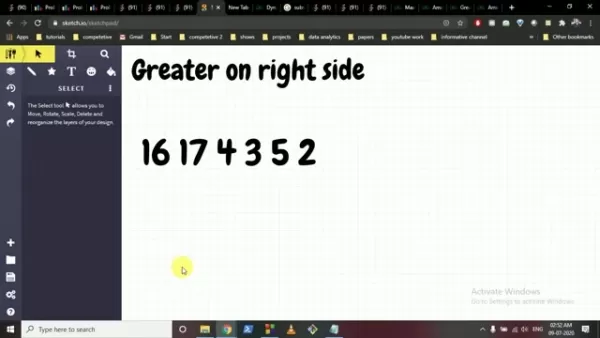
Consider this array as an example: [16, 17, 4, 3, 5, 2]
Here's how we would process it:
- For
16, the greatest element on its right is 17. So, 16 becomes 17.
- For
17, there's no greater element on its right. So, 17 becomes -1.
- For
4, the greatest element on its right is 5. So, 4 becomes 5.
- For
3, the greatest element on its right is 5. So, 3 becomes 5.
- For
5, the greatest element on its right is 2. So, 5 becomes 2.
- For
2, there is no right element. So, 2 becomes -1.
The resulting array would be: [17, -1, 5, 5, 2, -1]
This exercise effectively tests your ability to traverse data structures, apply conditional logic, and modify arrays in place, making it a practical assessment of coding proficiency. The greater element on right problem is a fundamental concept to understand for technical screening.
Why is this Problem Important for Coding Interviews?
This problem is a popular choice in coding interviews because it assesses more than just syntax. Companies like Amazon evaluate your analytical and problem-solving process. They look for evidence of your capacity to:
- Analyze a problem: Can you deconstruct the problem into logical, manageable steps?
- Develop an algorithm: Can you formulate a clear, step-by-step plan for an efficient solution?
- Write clean code: Can you translate your algorithm into readable, well-structured code?
- Optimize for performance: Can you analyze and improve the time and space complexity of your solution? The focus on optimization and algorithmic efficiency highlights the core competencies companies seek. These skills are essential for tackling complex interview problems.
Mastering such questions demonstrates your ability to think critically and solve practical problems, not just write code. Showcasing these core competencies is vital during an Amazon technical interview. Strategic preparation is fundamental for success in coding interviews.
Solving the Greater Element Problem: A Step-by-Step Guide
The Naive Approach (and Why to Avoid It)
A simple but inefficient method uses nested loops. For every element, you scan all subsequent elements to find the maximum. This leads to a time complexity of O(n^2), where n is the array's size.
Here’s why this approach is suboptimal:
- Inefficiency: Nested loops perform poorly with large input arrays.
- Poor Scalability: Performance degrades significantly as array size grows.
- Limited Impact: Interviewers expect candidates to propose and implement more optimized solutions.
While it can serve as a conceptual starting point, you should quickly advance to a more efficient strategy.
An Optimized Approach: Right-to-Left Traversal
A far more efficient solution processes the array from right to left. As you move, you keep track of the largest element encountered so far. This method achieves O(n) time complexity and O(1) auxiliary space complexity.
Here's the algorithm:
- Initialize a variable,
max_so_far, with the value of the last array element.
- Begin iterating from the second-to-last element towards the start of the array.
- For each element, compare it with
max_so_far:
- If the current element is greater than
max_so_far, update max_so_far with this new value.
- Otherwise, replace the current element's value with
max_so_far.
- After processing all elements, set the last element's value to -1 (as it has no right neighbor).
This approach significantly reduces comparisons, resulting in a faster and highly scalable solution. Adhering to this logic allows the code to be efficiently optimized.
Detailed Steps with Example
Let's walk through the example array: [16, 17, 4, 3, 5, 2]
- Start from the last element,
2. With no elements to the right, it becomes -1.
- Move to
5. The current max_so_far is 2. Since 5 > 2, the element's new value becomes 2, and max_so_far is updated to 5.
- Move to
3. max_so_far is 5. Since 3 < 5, replace 3 with 5.
- Move to
4. max_so_far remains 5. Since 4 < 5, replace 4 with 5.
- Move to
17. max_so_far is 5. Since 17 > 5, the element becomes 5, and max_so_far is updated to 17.
- Move to
16. max_so_far is 17. Since 16 < 17, replace 16 with 17.
- The first element is updated with the latest greatest value encountered during traversal. A clear understanding of this algorithm is necessary for implementation.
The final transformed array is [17, -1, 5, 5, 2, -1], which correctly satisfies the problem's requirements.
Right-to-Left Traversal: Pros
and Cons
Advantages
Excellent time complexity: O(n)
Minimal space overhead: O(1)
Straightforward to implement
Scales well with large datasets
Disadvantages
The right-to-left logic can be less intuitive initially
It modifies the original input array directly
Not suitable if you must preserve the original array data
Frequently Asked Questions
What if the array is empty?
If the input array is empty, there are no elements to process. You should return an empty array or handle this edge case as specified by the problem. Anticipating and managing such scenarios is essential for writing robust code.
Can I use a stack to solve this problem?
Using a stack is possible and yields a correct solution, but it is not the most space-optimal method for this specific problem. The right-to-left traversal is generally more efficient. Concentrating on space optimization can lead to an ideal solution.
What is the time complexity of the optimized solution?
The optimized solution, which employs a single right-to-left pass, has a linear time complexity of O(n). This ensures it handles large arrays efficiently.
How does this problem relate to real-world applications?
While seemingly academic, the skills this problem tests—efficient data traversal and conditional updates—are directly applicable in domains like data analysis, time-series processing, and algorithmic trading. Proficiency in array manipulation is a cornerstone of software development.
Related Questions
How do I deal with the constraints in an interview question?
Constraints are vital guidelines for your solution design. Pay close attention to any limits on input size, time, or space. Tailor your algorithm to work within these boundaries. Discussing constraints with your interviewer confirms your understanding and ensures you are solving the intended problem. Asking clarifying questions is a key part of a successful interview.
What are some common mistakes to avoid when solving array problems?
Typical errors include off-by-one mistakes in loop indices, incorrect handling of boundary conditions, and neglecting edge cases (like empty or single-element arrays). Always test your code with diverse inputs, including edge cases, to catch these issues early. Comprehensive testing is crucial for delivering high-quality code.
Related article
 Lenovo Unveils AI Cutie at MWC 2026: Desktop Robotic Arm Becomes Your New Workplace Assistant
If AI in 2025 is still confined to screen-based chats, 2026 marks the shift toward tangible, desk-integrated intelligence. At MWC 2026 in Barcelona, Lenovo unveiled two groundbreaking AI hardware concepts: AI Workmate (an AI Office Partner) and AI Wo
TikTok Launches Voice Copyright Report Channel as AI Clone Voice Complaints Double
TikTok has introduced a dedicated reporting channel for voice-related intellectual property infringement, alongside enhanced rights protection mechanisms. The platform notes that as AI voice synthesis and imitation technologies become more accessible
Is Google AI Overviews safe for SEO? How to use it in 2024
Survivor.io Evo Skills Tier List: The Best and Worst Ranked!Table of Contents:IntroductionWhat is an Evo Skill?Tier List ExplanationC Tier SkillsForce BarrierB Tier SkillsShark Mod GunMagnetic RebounderCaltropsThunderbolt BombInferno BombInquisitor D
Related Special Topic Recommendations
Comic Creation
Lenovo Unveils AI Cutie at MWC 2026: Desktop Robotic Arm Becomes Your New Workplace Assistant
If AI in 2025 is still confined to screen-based chats, 2026 marks the shift toward tangible, desk-integrated intelligence. At MWC 2026 in Barcelona, Lenovo unveiled two groundbreaking AI hardware concepts: AI Workmate (an AI Office Partner) and AI Wo
TikTok Launches Voice Copyright Report Channel as AI Clone Voice Complaints Double
TikTok has introduced a dedicated reporting channel for voice-related intellectual property infringement, alongside enhanced rights protection mechanisms. The platform notes that as AI voice synthesis and imitation technologies become more accessible
Is Google AI Overviews safe for SEO? How to use it in 2024
Survivor.io Evo Skills Tier List: The Best and Worst Ranked!Table of Contents:IntroductionWhat is an Evo Skill?Tier List ExplanationC Tier SkillsForce BarrierB Tier SkillsShark Mod GunMagnetic RebounderCaltropsThunderbolt BombInferno BombInquisitor D
Related Special Topic Recommendations
Comic Creation
 Manga AI Background Generators for Serialized Chapters, Covers, and Promo Art
2026 Latest Best Manga AI Background Generators Ranked Top-Rated! This curated collection showcases powerful game-changing tools perfect for creating high-quality chapter backgrounds, book covers, and promotional art. Every option has undergone rigorous real-world tests to ensure reliability. Get a free vs paid comparison along with detailed insights. Explore now to discover your perfect tool and unlock your AI edge in manga creation.
 6 tools
 xix.ai
Image editing
AI Object Removal Editors: Clean Up Portraits, Travel, and Product Shots
xix.ai
Image editing
AI Object Removal Editors: Clean Up Portraits, Travel, and Product Shots
2026 Latest Best Top-rated AI Object Removal Editors for portraits travel product shots! XIX.AI curates a powerful game-changing collection regularly updated with weekly rankings. These tools offer real-world tests to help you quickly remove unwanted elements, boost content quality, and save tons of time without compromising results. Must-try for anyone aiming to unlock their AI creation edge. Explore now!
10 tools
xix.ai
Text-to-speech
Best AI Text to Speech Tools for Online Courses
2026 Latest Best Top-rated AI Text to Speech Tools for Online Courses are curated by XIX.AI based on rigorous real-world tests and weekly updated rankings. These powerful tools help creators deliver crystal-clear audio content effortlessly, boosting writing efficiency and streamlining course production. Check out the free vs paid comparison to find your perfect fit. Explore now to unlock your AI edge in online education.
10 tools
xix.ai
writing
AI Blog Title Tools for Higher Click Through Rates
2026 Latest Best Top-Rated AI Blog Title Tools for Higher Click Through Rates! XIX.AI has carefully curated a powerful, game-changing collection of top tools that go through rigorous real-world tests. You’ll find a free vs paid comparison, weekly updated rankings, and detailed insights to help you boost your blog’s traffic efficiently. Must-try options are highlighted to help you unlock your AI edge. Explore now!
10 tools
xix.ai
automation
Best AI Task Routing Tools for Support Workflows
2026 Latest Best Top-rated AI Task Routing Tools for Support Workflows! XIX.AI has curated a highly powerful game-changing collection of must-try solutions, all undergoing rigorous real-world tests and updated weekly. These tools streamline workflows, boost productivity, and help teams deliver faster, more efficient support. Explore now to discover your perfect tool and unlock your AI edge!
17 tools
xix.ai
Academic Research
AI Citation and Paper Summary Tools
2026 Latest Best Top-Rated AI Citation and Paper Summary Tools Curated by XIX.AI. Get powerful game-changing solutions for quick content creation, improved writing efficiency, and boosting productivity. We offer a free vs paid comparison along with real-world tests and weekly updated rankings to help you find the must-try tool that fits your needs perfectly. Explore now to Unlock your AI edge.
10 tools
xix.ai

 Comments (3)
0/500
Comments (3)
0/500
![MarkWilson]()
Amazon's array questions are no joke! This breakdown actually makes the 'right side greater element' logic click, which usually trips me up in mock interviews. Thanks for the clear steps, really saved my prep time before the next round!
![AlbertEvans]()
Ich finde es gut, dass solche Artikel existieren. Als jemand, der sich auch auf Tech-Interviews vorbereitet, ist es hilfreich, spezifische Problemkategorien wie diese zu sehen. Manchmal frage ich mich aber, ob dieser ganze Fokus auf Algorithmen-Puzzles wirklich die besten Entwickler findet. 🤔 Die Realität der Softwareentwicklung ist doch oft anders.
![ScottRoberts]()
Решил почитать про подготовку к собеседованию в Amazon. Задачи с массивами всегда были моей слабой стороной 😅 Интересно, насколько такие алгоритмы реально используются в работе, или это просто способ отсеять кандидатов?
Preparing for a coding interview at Amazon can be a significant challenge. One frequent category of question focuses on arrays and logical reasoning. This article provides a detailed breakdown of how to tackle a common Amazon coding interview problem: identifying the next greatest element to the right for each item in an array. We will examine the problem definition, work through illustrative examples, explain the underlying logic, and explore code implementation. By the end of this guide, you'll gain valuable skills to help you succeed in your Amazon technical interview. Mastering this problem is a key component of an effective preparation strategy for landing a role at Amazon.
Key Points
Grasp the core objective: For each element in an array, find the largest element to its right.
Assign a value of -1 to the last element, as it has no elements to its right.
The optimal solution traverses the array from its end to its beginning.
Maintain a single variable to track the maximum value seen so far, minimizing space requirements.
At each step, compare the current element with the stored maximum and update values appropriately.
Code implementation prioritizes runtime efficiency and minimal memory usage.
The zero-space approach involves updating the array directly without extra data structures.
The fundamental technique is to perform iteration and updates within the given array itself.
Understanding the Problem: Greater Element on Right Side
Problem Statement
The objective is to process a given array and, for every element, determine the largest element that appears after it (to its right). If no larger element exists to the right, you must assign a value of -1 to that position. This task evaluates your skills in array traversal, comparison logic, and in-place updates—all crucial abilities in technical interviews.
Consider this array as an example: [16, 17, 4, 3, 5, 2]
Here's how we would process it:
- For
16, the greatest element on its right is17. So,16becomes17. - For
17, there's no greater element on its right. So,17becomes-1. - For
4, the greatest element on its right is5. So,4becomes5. - For
3, the greatest element on its right is5. So,3becomes5. - For
5, the greatest element on its right is2. So,5becomes2. - For
2, there is no right element. So,2becomes-1.
The resulting array would be: [17, -1, 5, 5, 2, -1]
This exercise effectively tests your ability to traverse data structures, apply conditional logic, and modify arrays in place, making it a practical assessment of coding proficiency. The greater element on right problem is a fundamental concept to understand for technical screening.
Why is this Problem Important for Coding Interviews?
This problem is a popular choice in coding interviews because it assesses more than just syntax. Companies like Amazon evaluate your analytical and problem-solving process. They look for evidence of your capacity to:
- Analyze a problem: Can you deconstruct the problem into logical, manageable steps?
- Develop an algorithm: Can you formulate a clear, step-by-step plan for an efficient solution?
- Write clean code: Can you translate your algorithm into readable, well-structured code?
- Optimize for performance: Can you analyze and improve the time and space complexity of your solution? The focus on optimization and algorithmic efficiency highlights the core competencies companies seek. These skills are essential for tackling complex interview problems.
Mastering such questions demonstrates your ability to think critically and solve practical problems, not just write code. Showcasing these core competencies is vital during an Amazon technical interview. Strategic preparation is fundamental for success in coding interviews.
Solving the Greater Element Problem: A Step-by-Step Guide
The Naive Approach (and Why to Avoid It)
A simple but inefficient method uses nested loops. For every element, you scan all subsequent elements to find the maximum. This leads to a time complexity of O(n^2), where n is the array's size.
Here’s why this approach is suboptimal:
- Inefficiency: Nested loops perform poorly with large input arrays.
- Poor Scalability: Performance degrades significantly as array size grows.
- Limited Impact: Interviewers expect candidates to propose and implement more optimized solutions.
While it can serve as a conceptual starting point, you should quickly advance to a more efficient strategy.
An Optimized Approach: Right-to-Left Traversal
A far more efficient solution processes the array from right to left. As you move, you keep track of the largest element encountered so far. This method achieves O(n) time complexity and O(1) auxiliary space complexity.
Here's the algorithm:
- Initialize a variable,
max_so_far, with the value of the last array element. - Begin iterating from the second-to-last element towards the start of the array.
- For each element, compare it with
max_so_far:- If the current element is greater than
max_so_far, updatemax_so_farwith this new value. - Otherwise, replace the current element's value with
max_so_far.
- If the current element is greater than
- After processing all elements, set the last element's value to -1 (as it has no right neighbor).
This approach significantly reduces comparisons, resulting in a faster and highly scalable solution. Adhering to this logic allows the code to be efficiently optimized.
Detailed Steps with Example
Let's walk through the example array: [16, 17, 4, 3, 5, 2]
- Start from the last element,
2. With no elements to the right, it becomes-1. - Move to
5. The currentmax_so_faris2. Since5 > 2, the element's new value becomes2, andmax_so_faris updated to5. - Move to
3.max_so_faris5. Since3 < 5, replace3with5. - Move to
4.max_so_farremains5. Since4 < 5, replace4with5. - Move to
17.max_so_faris5. Since17 > 5, the element becomes5, andmax_so_faris updated to17. - Move to
16.max_so_faris17. Since16 < 17, replace16with17. - The first element is updated with the latest greatest value encountered during traversal. A clear understanding of this algorithm is necessary for implementation.
The final transformed array is [17, -1, 5, 5, 2, -1], which correctly satisfies the problem's requirements.
Right-to-Left Traversal: Pros
and Cons
Advantages
Excellent time complexity: O(n)
Minimal space overhead: O(1)
Straightforward to implement
Scales well with large datasets
Disadvantages
The right-to-left logic can be less intuitive initially
It modifies the original input array directly
Not suitable if you must preserve the original array data
Frequently Asked Questions
What if the array is empty?
If the input array is empty, there are no elements to process. You should return an empty array or handle this edge case as specified by the problem. Anticipating and managing such scenarios is essential for writing robust code.
Can I use a stack to solve this problem?
Using a stack is possible and yields a correct solution, but it is not the most space-optimal method for this specific problem. The right-to-left traversal is generally more efficient. Concentrating on space optimization can lead to an ideal solution.
What is the time complexity of the optimized solution?
The optimized solution, which employs a single right-to-left pass, has a linear time complexity of O(n). This ensures it handles large arrays efficiently.
How does this problem relate to real-world applications?
While seemingly academic, the skills this problem tests—efficient data traversal and conditional updates—are directly applicable in domains like data analysis, time-series processing, and algorithmic trading. Proficiency in array manipulation is a cornerstone of software development.
Related Questions
How do I deal with the constraints in an interview question?
Constraints are vital guidelines for your solution design. Pay close attention to any limits on input size, time, or space. Tailor your algorithm to work within these boundaries. Discussing constraints with your interviewer confirms your understanding and ensures you are solving the intended problem. Asking clarifying questions is a key part of a successful interview.
What are some common mistakes to avoid when solving array problems?
Typical errors include off-by-one mistakes in loop indices, incorrect handling of boundary conditions, and neglecting edge cases (like empty or single-element arrays). Always test your code with diverse inputs, including edge cases, to catch these issues early. Comprehensive testing is crucial for delivering high-quality code.








 Lenovo Unveils AI Cutie at MWC 2026: Desktop Robotic Arm Becomes Your New Workplace Assistant
If AI in 2025 is still confined to screen-based chats, 2026 marks the shift toward tangible, desk-integrated intelligence. At MWC 2026 in Barcelona, Lenovo unveiled two groundbreaking AI hardware concepts: AI Workmate (an AI Office Partner) and AI Wo
Lenovo Unveils AI Cutie at MWC 2026: Desktop Robotic Arm Becomes Your New Workplace Assistant
If AI in 2025 is still confined to screen-based chats, 2026 marks the shift toward tangible, desk-integrated intelligence. At MWC 2026 in Barcelona, Lenovo unveiled two groundbreaking AI hardware concepts: AI Workmate (an AI Office Partner) and AI Wo
 TikTok Launches Voice Copyright Report Channel as AI Clone Voice Complaints Double
TikTok has introduced a dedicated reporting channel for voice-related intellectual property infringement, alongside enhanced rights protection mechanisms. The platform notes that as AI voice synthesis and imitation technologies become more accessible
TikTok Launches Voice Copyright Report Channel as AI Clone Voice Complaints Double
TikTok has introduced a dedicated reporting channel for voice-related intellectual property infringement, alongside enhanced rights protection mechanisms. The platform notes that as AI voice synthesis and imitation technologies become more accessible
 Is Google AI Overviews safe for SEO? How to use it in 2024
Survivor.io Evo Skills Tier List: The Best and Worst Ranked!Table of Contents:IntroductionWhat is an Evo Skill?Tier List ExplanationC Tier SkillsForce BarrierB Tier SkillsShark Mod GunMagnetic RebounderCaltropsThunderbolt BombInferno BombInquisitor D
Is Google AI Overviews safe for SEO? How to use it in 2024
Survivor.io Evo Skills Tier List: The Best and Worst Ranked!Table of Contents:IntroductionWhat is an Evo Skill?Tier List ExplanationC Tier SkillsForce BarrierB Tier SkillsShark Mod GunMagnetic RebounderCaltropsThunderbolt BombInferno BombInquisitor D

2026 Latest Best Manga AI Background Generators Ranked Top-Rated! This curated collection showcases powerful game-changing tools perfect for creating high-quality chapter backgrounds, book covers, and promotional art. Every option has undergone rigorous real-world tests to ensure reliability. Get a free vs paid comparison along with detailed insights. Explore now to discover your perfect tool and unlock your AI edge in manga creation.
6 tools
xix.ai

2026 Latest Best Top-rated AI Object Removal Editors for portraits travel product shots! XIX.AI curates a powerful game-changing collection regularly updated with weekly rankings. These tools offer real-world tests to help you quickly remove unwanted elements, boost content quality, and save tons of time without compromising results. Must-try for anyone aiming to unlock their AI creation edge. Explore now!
10 tools
xix.ai

2026 Latest Best Top-rated AI Text to Speech Tools for Online Courses are curated by XIX.AI based on rigorous real-world tests and weekly updated rankings. These powerful tools help creators deliver crystal-clear audio content effortlessly, boosting writing efficiency and streamlining course production. Check out the free vs paid comparison to find your perfect fit. Explore now to unlock your AI edge in online education.
10 tools
xix.ai

2026 Latest Best Top-Rated AI Blog Title Tools for Higher Click Through Rates! XIX.AI has carefully curated a powerful, game-changing collection of top tools that go through rigorous real-world tests. You’ll find a free vs paid comparison, weekly updated rankings, and detailed insights to help you boost your blog’s traffic efficiently. Must-try options are highlighted to help you unlock your AI edge. Explore now!
10 tools
xix.ai

2026 Latest Best Top-rated AI Task Routing Tools for Support Workflows! XIX.AI has curated a highly powerful game-changing collection of must-try solutions, all undergoing rigorous real-world tests and updated weekly. These tools streamline workflows, boost productivity, and help teams deliver faster, more efficient support. Explore now to discover your perfect tool and unlock your AI edge!
17 tools
xix.ai

2026 Latest Best Top-Rated AI Citation and Paper Summary Tools Curated by XIX.AI. Get powerful game-changing solutions for quick content creation, improved writing efficiency, and boosting productivity. We offer a free vs paid comparison along with real-world tests and weekly updated rankings to help you find the must-try tool that fits your needs perfectly. Explore now to Unlock your AI edge.
10 tools
xix.ai

Amazon's array questions are no joke! This breakdown actually makes the 'right side greater element' logic click, which usually trips me up in mock interviews. Thanks for the clear steps, really saved my prep time before the next round!
Ich finde es gut, dass solche Artikel existieren. Als jemand, der sich auch auf Tech-Interviews vorbereitet, ist es hilfreich, spezifische Problemkategorien wie diese zu sehen. Manchmal frage ich mich aber, ob dieser ganze Fokus auf Algorithmen-Puzzles wirklich die besten Entwickler findet. 🤔 Die Realität der Softwareentwicklung ist doch oft anders.
Решил почитать про подготовку к собеседованию в Amazon. Задачи с массивами всегда были моей слабой стороной 😅 Интересно, насколько такие алгоритмы реально используются в работе, или это просто способ отсеять кандидатов?












