


 Home
HomeLuma AI unveils Uni-1 autoregressive model that generates text and pixels simultaneously
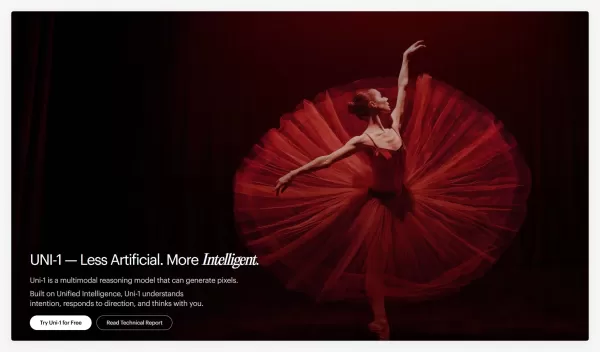
Luma Labs launched its image generation model Uni-1 on March 23, marking the company's first publicly available model built on the Unified Intelligence architecture. Free trial access is now open on the official website, with API pricing announced and enterprise access channels rolling out gradually.
Architecture Shift: From Diffusion Models to Autoregressive
Uni-1 moves away from the prevailing diffusion model approach, opting instead for a decoder-only autoregressive Transformer. It arranges text and image tokens in an alternating sequence within a single sequence, completing inference and pixel generation in one forward pass.
Luma CEO Amit Jain explained that traditional solutions typically first use a language model for planning, then hand off to a diffusion model for generation, causing information loss between the two stages. Uni-1’s design aims to eliminate this gap.
Jain previously worked at Apple and contributed to Vision Pro engineering.
Capabilities: Reference Image Control and Cross-Style Generation
Uni-1 supports image generation guided by one or more reference images, preserving the subject's identity, posture, and composition. Official tests show stable performance in handling character consistency and portrait control in multi-reference image mode.
The model claims support for 76 visual styles, covering categories such as realistic photography, comics, and ukiyo-e.
In a demonstration, inputting "Draw an infographic of the Golden Gate Bridge" led the model to automatically plan the layout, generate a bridge structure diagram, and annotate data such as "1711 Meters," with the internal reasoning process visible in real time.
Benchmarks: Leading in Spatial Reasoning and Reference Generation
Data published by Luma shows that Uni-1 scored 0.51 on the RISEBench reasoning benchmark, higher than Google Nano Banana 2's 0.50 and OpenAI GPT Image 1.5's 0.46. Its spatial reasoning score reached 0.58, and logical reasoning 0.32, roughly double that of GPT Image.
On the ODinW-13 object detection benchmark, Uni-1 achieved 46.2 mAP, close to Google Gemini 3 Pro's 46.3.
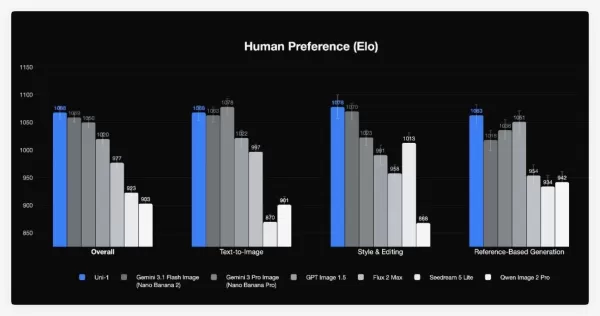
In human preference Elo rankings, Uni-1 placed first in overall preference, style and editing, and reference generation, and second in text-to-image generation.
Pricing
API charges are token-based: $0.50 per million tokens for input text, $1.20 per million tokens for input images, $3.00 per million tokens for output text and thought chain, and $45.45 per million tokens for output images.
Converted to a per-image basis: text-to-image (2048px) costs approximately $0.0909, editing with a single reference image around $0.0933, and eight reference images about $0.1101.
VentureBeat reported that in enterprise scenarios with 2K resolution, Uni-1 costs 10% to 30% less than Google Nano Banana 2.
Background
Luma Labs previously focused on video generation products like Dream Machine (Ray3 series). On March 5, the company released the Luma Agents creative agent platform, also based on the Unified Intelligence architecture. Uni-1 is the first application of this architecture in a static image product.
Within hours of the release, related posts on the X platform garnered over 2.3 million views. Luma stated that video and audio versions will follow, though specific timelines have not been disclosed.
Try it at: lumalabs.ai/uni-1
Related article
 Suno to Watermark Songs Amid Legal Battles
Suno, the platform enabling users to generate AI-created music, has unveiled new features to label platform-produced tracks, restrict downloads, and update community standards to curb unauthorized replicas. These updates arrive as Suno confronts mult
Musk Admits Grok Build Leaked User Code, Promises to Erase All Historical Data
Elon Musk directly addressed the privacy controversy surrounding Grok Build, beginning with a simple "True" to confirm the incident's validity. He pledged that all user data previously uploaded to SpaceXAI would be permanently erased, stating, "not a
U.S. Stocks Hit Historic Milestone as AI and Aerospace Giants Prepare for Trillion-Dollar Debut
Elon Musk, Sam Altman, and Dario Amodei, three titans of the technology sector, are advancing toward initial public offerings for their respective ventures. With SpaceX, OpenAI, and Anthropic—three industry behemoths nearing trillion-dollar valuation
Related Special Topic Recommendations
SEO
Suno to Watermark Songs Amid Legal Battles
Suno, the platform enabling users to generate AI-created music, has unveiled new features to label platform-produced tracks, restrict downloads, and update community standards to curb unauthorized replicas. These updates arrive as Suno confronts mult
Musk Admits Grok Build Leaked User Code, Promises to Erase All Historical Data
Elon Musk directly addressed the privacy controversy surrounding Grok Build, beginning with a simple "True" to confirm the incident's validity. He pledged that all user data previously uploaded to SpaceXAI would be permanently erased, stating, "not a
U.S. Stocks Hit Historic Milestone as AI and Aerospace Giants Prepare for Trillion-Dollar Debut
Elon Musk, Sam Altman, and Dario Amodei, three titans of the technology sector, are advancing toward initial public offerings for their respective ventures. With SpaceX, OpenAI, and Anthropic—three industry behemoths nearing trillion-dollar valuation
Related Special Topic Recommendations
SEO
 Best AI SERP Analysis Tools for Search Strategy
2026 Latest Best Top-rated AI SERP Analysis Tools for Search Strategy are curated by XIX.AI through rigorous real-world tests and weekly updated rankings. These powerful tools help you unlock hidden optimization opportunities, boost content performance, and gain a competitive edge in search. Discover your perfect tool to elevate your search strategy today. Explore now!
 13 tools
 xix.ai
Data Analysis
Best AI Anomaly Detection Tools for KPI Monitoring across SaaS and Ecommerce Teams
xix.ai
Data Analysis
Best AI Anomaly Detection Tools for KPI Monitoring across SaaS and Ecommerce Teams
2026 Latest Best Top-rated AI Anomaly Detection Tools for KPI Monitoring in SaaS and Ecommerce teams! XIX.AI has curated a powerful, game-changing collection based on rigorous real-world tests and weekly updated rankings. You’ll find detailed free vs paid comparison insights to help you identify the must-try solution that boosts productivity and unlocks your AI edge. Explore now!
10 tools
xix.ai
writing
Best AI Outline Generators for Long-Form SEO Articles
2026 Latest Best Top-Rated AI Outline Generators for Long-Form SEO Articles, meticulously curated by XIX.AI. These powerful tools offer game-changing assistance in creating high-quality content quickly, boosting writing efficiency significantly. Get a free vs paid comparison along with real-world tests and detailed rankings to help you find the must-try option that suits your needs. Explore now to unlock your AI edge.
8 tools
xix.ai
Education and Learning
AI Study Tools for Homework and Exam Prep
2026 Latest Best AI Study Tools for Homework and Exam Prep! XIX.AI curates a top-rated list of powerful, game-changing tools that help students boost productivity, streamline homework completion, and ace exams through real-world tests. Get a free vs paid comparison, detailed rankings, and must-try options to unlock your AI edge. Explore now!
10 tools
xix.ai
Music composition
AI Vocal Demo Tools for Songwriters, Hooks, Toplines, and Multilingual Draft Sessions
2026 Latest Best AI Vocal Demo Tools for Songwriters, Hook Creators, and Multi-Language Content Teams! XIX.AI has curated a top-rated list of powerful game-changing tools that go through rigorous real-world tests. You’ll find detailed free vs paid comparison data, comprehensive rankings, and must-try options to help you boost writing efficiency and unlock your creative potential. Explore now to discover your perfect tool for all your content needs!
9 tools
xix.ai
Business
Best AI Competitive Research Tools for Small Businesses
2026 Latest Best Top-rated AI Competitive Research Tools for Small Businesses! XIX.AI has curated a highly powerful game-changing collection, updated weekly with rigorous real-world tests and detailed rankings. You can find a comprehensive free vs paid comparison to help you identify the must-try tools that boost your productivity and give you a competitive edge. Explore now to discover your perfect tool!
9 tools
xix.ai

 Comments (0)
0/500
Comments (0)
0/500
Luma Labs launched its image generation model Uni-1 on March 23, marking the company's first publicly available model built on the Unified Intelligence architecture. Free trial access is now open on the official website, with API pricing announced and enterprise access channels rolling out gradually.
Architecture Shift: From Diffusion Models to Autoregressive
Uni-1 moves away from the prevailing diffusion model approach, opting instead for a decoder-only autoregressive Transformer. It arranges text and image tokens in an alternating sequence within a single sequence, completing inference and pixel generation in one forward pass.
Luma CEO Amit Jain explained that traditional solutions typically first use a language model for planning, then hand off to a diffusion model for generation, causing information loss between the two stages. Uni-1’s design aims to eliminate this gap.
Jain previously worked at Apple and contributed to Vision Pro engineering.
Capabilities: Reference Image Control and Cross-Style Generation
Uni-1 supports image generation guided by one or more reference images, preserving the subject's identity, posture, and composition. Official tests show stable performance in handling character consistency and portrait control in multi-reference image mode.
The model claims support for 76 visual styles, covering categories such as realistic photography, comics, and ukiyo-e.
In a demonstration, inputting "Draw an infographic of the Golden Gate Bridge" led the model to automatically plan the layout, generate a bridge structure diagram, and annotate data such as "1711 Meters," with the internal reasoning process visible in real time.
Benchmarks: Leading in Spatial Reasoning and Reference Generation
Data published by Luma shows that Uni-1 scored 0.51 on the RISEBench reasoning benchmark, higher than Google Nano Banana 2's 0.50 and OpenAI GPT Image 1.5's 0.46. Its spatial reasoning score reached 0.58, and logical reasoning 0.32, roughly double that of GPT Image.
On the ODinW-13 object detection benchmark, Uni-1 achieved 46.2 mAP, close to Google Gemini 3 Pro's 46.3.
In human preference Elo rankings, Uni-1 placed first in overall preference, style and editing, and reference generation, and second in text-to-image generation.
Pricing
API charges are token-based: $0.50 per million tokens for input text, $1.20 per million tokens for input images, $3.00 per million tokens for output text and thought chain, and $45.45 per million tokens for output images.
Converted to a per-image basis: text-to-image (2048px) costs approximately $0.0909, editing with a single reference image around $0.0933, and eight reference images about $0.1101.
VentureBeat reported that in enterprise scenarios with 2K resolution, Uni-1 costs 10% to 30% less than Google Nano Banana 2.
Background
Luma Labs previously focused on video generation products like Dream Machine (Ray3 series). On March 5, the company released the Luma Agents creative agent platform, also based on the Unified Intelligence architecture. Uni-1 is the first application of this architecture in a static image product.
Within hours of the release, related posts on the X platform garnered over 2.3 million views. Luma stated that video and audio versions will follow, though specific timelines have not been disclosed.
Try it at: lumalabs.ai/uni-1








 Suno to Watermark Songs Amid Legal Battles
Suno, the platform enabling users to generate AI-created music, has unveiled new features to label platform-produced tracks, restrict downloads, and update community standards to curb unauthorized replicas. These updates arrive as Suno confronts mult
Suno to Watermark Songs Amid Legal Battles
Suno, the platform enabling users to generate AI-created music, has unveiled new features to label platform-produced tracks, restrict downloads, and update community standards to curb unauthorized replicas. These updates arrive as Suno confronts mult
 Musk Admits Grok Build Leaked User Code, Promises to Erase All Historical Data
Elon Musk directly addressed the privacy controversy surrounding Grok Build, beginning with a simple "True" to confirm the incident's validity. He pledged that all user data previously uploaded to SpaceXAI would be permanently erased, stating, "not a
Musk Admits Grok Build Leaked User Code, Promises to Erase All Historical Data
Elon Musk directly addressed the privacy controversy surrounding Grok Build, beginning with a simple "True" to confirm the incident's validity. He pledged that all user data previously uploaded to SpaceXAI would be permanently erased, stating, "not a
 U.S. Stocks Hit Historic Milestone as AI and Aerospace Giants Prepare for Trillion-Dollar Debut
Elon Musk, Sam Altman, and Dario Amodei, three titans of the technology sector, are advancing toward initial public offerings for their respective ventures. With SpaceX, OpenAI, and Anthropic—three industry behemoths nearing trillion-dollar valuation
U.S. Stocks Hit Historic Milestone as AI and Aerospace Giants Prepare for Trillion-Dollar Debut
Elon Musk, Sam Altman, and Dario Amodei, three titans of the technology sector, are advancing toward initial public offerings for their respective ventures. With SpaceX, OpenAI, and Anthropic—three industry behemoths nearing trillion-dollar valuation

2026 Latest Best Top-rated AI SERP Analysis Tools for Search Strategy are curated by XIX.AI through rigorous real-world tests and weekly updated rankings. These powerful tools help you unlock hidden optimization opportunities, boost content performance, and gain a competitive edge in search. Discover your perfect tool to elevate your search strategy today. Explore now!
13 tools
xix.ai

2026 Latest Best Top-rated AI Anomaly Detection Tools for KPI Monitoring in SaaS and Ecommerce teams! XIX.AI has curated a powerful, game-changing collection based on rigorous real-world tests and weekly updated rankings. You’ll find detailed free vs paid comparison insights to help you identify the must-try solution that boosts productivity and unlocks your AI edge. Explore now!
10 tools
xix.ai

2026 Latest Best Top-Rated AI Outline Generators for Long-Form SEO Articles, meticulously curated by XIX.AI. These powerful tools offer game-changing assistance in creating high-quality content quickly, boosting writing efficiency significantly. Get a free vs paid comparison along with real-world tests and detailed rankings to help you find the must-try option that suits your needs. Explore now to unlock your AI edge.
8 tools
xix.ai

2026 Latest Best AI Study Tools for Homework and Exam Prep! XIX.AI curates a top-rated list of powerful, game-changing tools that help students boost productivity, streamline homework completion, and ace exams through real-world tests. Get a free vs paid comparison, detailed rankings, and must-try options to unlock your AI edge. Explore now!
10 tools
xix.ai

2026 Latest Best AI Vocal Demo Tools for Songwriters, Hook Creators, and Multi-Language Content Teams! XIX.AI has curated a top-rated list of powerful game-changing tools that go through rigorous real-world tests. You’ll find detailed free vs paid comparison data, comprehensive rankings, and must-try options to help you boost writing efficiency and unlock your creative potential. Explore now to discover your perfect tool for all your content needs!
9 tools
xix.ai

2026 Latest Best Top-rated AI Competitive Research Tools for Small Businesses! XIX.AI has curated a highly powerful game-changing collection, updated weekly with rigorous real-world tests and detailed rankings. You can find a comprehensive free vs paid comparison to help you identify the must-try tools that boost your productivity and give you a competitive edge. Explore now to discover your perfect tool!
9 tools
xix.ai












