


 Home
HomeAI Startup Lovable Nears 8 Million Users, Targets Corporate Expansion

The AI coding platform Lovable, based in Stockholm, is approaching 8 million users, CEO Anton Osika revealed in a Monday interview. This marks a significant jump from the 2.3 million active users the company reported back in July. Osika also noted that the year-old company now sees "100,000 new products built on Lovable every single day."
These metrics point to the startup's rapid expansion. To date, Lovable has raised a total of $228 million, including a $200 million round this past summer that valued the company at $1.8 billion. Rumors have circulated recently—potentially fueled by its own investors—that new backers are interested in investing at a $5 billion valuation. However, Osika stated the company is not currently capital-constrained and declined to comment on any future fundraising plans.
While speaking onstage at the Web Summit in Lisbon, Osika notably did not disclose Lovable's current annual recurring revenue. The company, which operates on a freemium model, had publicly celebrated reaching $100 million in ARR this June. However, questions are now arising about the long-term sustainability of the vibe coding trend.
Research from Barclays this summer, combined with Google Trends data, indicated that traffic to some of the most hyped services, including Lovable and Vercel's v0, had declined after peaking earlier in the year. According to the Barclays analysts, traffic to Lovable was down 40% as of September. They reportedly wrote in an investor note that this drop "raises the question of whether app/site vibe coding has already peaked or is simply in a lull before interest picks up again."
Despite this, Osika emphasized that user retention remains strong, citing a net dollar retention rate of over 100%, meaning existing users are spending more over time. He also mentioned the company has "just passed" the 100-employee milestone and is now recruiting leadership talent from San Francisco to strengthen its Stockholm headquarters.
Lovable originated from GPT Engineer, an open-source tool Osika built that went viral among developers. He soon realized the larger opportunity was with the 99% of people who don't know how to code. "A few days after building GPT Engineer, I woke up and realized we were going to reimagine how software is built," Osika recalled. "I biked to my co-founder's place, woke him up, and told him I had a great idea."
The platform has attracted a diverse user base. Osika stated that over half of the Fortune 500 companies are using Lovable to "supercharge creativity." Simultaneously, he shared that an 11-year-old in Lisbon built a Facebook clone for his school, and a Swedish duo is making $700,000 annually from a startup they launched on the platform just seven months ago.
Join the Disrupt 2026 Waitlist
Add yourself to the Disrupt 2026 waitlist to get priority access when Early Bird tickets are released. Past Disrupt events have featured industry leaders from Google Cloud, Netflix, Microsoft, Box, Phia, a16z, ElevenLabs, Wayve, Hugging Face, Elad Gil, and Vinod Khosla—just a fraction of the 250+ experts leading 200+ sessions designed to fuel your growth and sharpen your competitive edge. You'll also have the chance to connect with hundreds of startups driving innovation across all sectors.
Join the Disrupt 2026 Waitlist
Add yourself to the Disrupt 2026 waitlist to get priority access when Early Bird tickets are released. Past Disrupt events have featured industry leaders from Google Cloud, Netflix, Microsoft, Box, Phia, a16z, ElevenLabs, Wayve, Hugging Face, Elad Gil, and Vinod Khosla—just a fraction of the 250+ experts leading 200+ sessions designed to fuel your growth and sharpen your competitive edge. You'll also have the chance to connect with hundreds of startups driving innovation across all sectors.
"The feedback I consistently hear from people trying Lovable is, 'It just works,'" Osika said, attributing this to what he described as a distinct Swedish design sensibility.
Security, however, remains a more complex challenge for the vibe coding sector. When asked about a recent incident where an app built with vibe coding tools leaked 72,000 images, along with GPS data and user IDs, Osika acknowledged the seriousness of the issue.
"The area of our engineering organization where we're hiring most aggressively is security engineering," he stated. His goal is to make building with Lovable "more secure than using only human-written code." He explained that before users can deploy an application, Lovable now runs multiple automated security checks. However, the platform still advises users building sensitive applications, such as banking apps, to engage dedicated security experts, much like they would in a traditional development process.
Osika was similarly pragmatic when discussing competition from AI giants like OpenAI and Anthropic, whose models power Lovable but who also release their own coding agents. He believes the market is expansive enough for multiple successful players. "If we can unlock more human creativity and agency... and drive a change where anyone with a good idea can create and build businesses, that achievement should be celebrated, no matter who accomplishes it."
This is a notably collegial stance in an industry not known for such camaraderie (Osika himself has engaged in some light-hearted social media banter with Amjad Masad of rival Replit). He said his current focus is on creating "the most intuitive human experience" rather than fixating on competitors.
Osika described Lovable's ultimate mission as building "the last piece of software"—a comprehensive platform where a product team can handle everything from user research to deploying mission-critical features, all through a simple interface.
He said the popular product leadership mantra, "Demo, don't memo," captures how companies are now using Lovable. Employees can quickly prototype ideas instead of writing lengthy presentations, allowing them to test concepts with early users before making significant resource commitments.
Despite the hyper-growth and intense investor interest, Osika—dressed in a simple beige T-shirt and button-down, with floppy hair framing his face—appeared completely at ease. The 30-something former particle physicist, who was the first employee at Sauna Labs before founding Lovable, has rapidly transitioned from open-source developer to venture-backed founder to a sought-after conference speaker. Yet, he seemed more interested in discussing European work culture than his company's trajectory or the sudden spotlight on him.
"What matters to me is that everyone at the company is mission-driven, genuinely cares about their work, and is focused on how we succeed as a team," he said, pushing back against Silicon Valley's intensifying hustle culture. "The top performers on my team today, most of them have children and are deeply passionate about our mission. They aren't working 12-hour days, six days a week."
Though he added with a note of realism: "Of course, it's a startup, so they're probably working more than in most other jobs."
Related article
 TechCrunch Disrupt 2026 to showcase leaders from Amazon, Replit and Tether
TechCrunch Disrupt has long been the epicenter of technology’s most critical dialogues, with a legacy spanning over a decade. The speakers who have graced this stage are icons of both the startup era and the current AI revolution, including Zuckerber
Visa invests in Replit to enable agentic payments for developers
Visa has announced an undisclosed investment in the AI coding platform Replit. The two companies are also exploring how to integrate Visa's payment products into Replit, enabling developers—and the AI agents they build—to accept payments directly fro
Lovable strikes multi-year Google Cloud deal to boost usage 5x, source says
On Wednesday, Lovable and Google announced an expanded multi-year partnership. Lovable, the fast-growing Stockholm-based vibe-coding startup, has been a Google Cloud customer for some time. Under the new agreement, its usage will increase significant
Related Special Topic Recommendations
Data Analysis
TechCrunch Disrupt 2026 to showcase leaders from Amazon, Replit and Tether
TechCrunch Disrupt has long been the epicenter of technology’s most critical dialogues, with a legacy spanning over a decade. The speakers who have graced this stage are icons of both the startup era and the current AI revolution, including Zuckerber
Visa invests in Replit to enable agentic payments for developers
Visa has announced an undisclosed investment in the AI coding platform Replit. The two companies are also exploring how to integrate Visa's payment products into Replit, enabling developers—and the AI agents they build—to accept payments directly fro
Lovable strikes multi-year Google Cloud deal to boost usage 5x, source says
On Wednesday, Lovable and Google announced an expanded multi-year partnership. Lovable, the fast-growing Stockholm-based vibe-coding startup, has been a Google Cloud customer for some time. Under the new agreement, its usage will increase significant
Related Special Topic Recommendations
Data Analysis
 Best AI Anomaly Detection Tools for KPI Monitoring across SaaS and Ecommerce Teams
2026 Latest Best Top-rated AI Anomaly Detection Tools for KPI Monitoring in SaaS and Ecommerce teams! XIX.AI has curated a powerful, game-changing collection based on rigorous real-world tests and weekly updated rankings. You’ll find detailed free vs paid comparison insights to help you identify the must-try solution that boosts productivity and unlocks your AI edge. Explore now!
 10 tools
 xix.ai
writing
Best AI Outline Generators for Long-Form SEO Articles
xix.ai
writing
Best AI Outline Generators for Long-Form SEO Articles
2026 Latest Best Top-Rated AI Outline Generators for Long-Form SEO Articles, meticulously curated by XIX.AI. These powerful tools offer game-changing assistance in creating high-quality content quickly, boosting writing efficiency significantly. Get a free vs paid comparison along with real-world tests and detailed rankings to help you find the must-try option that suits your needs. Explore now to unlock your AI edge.
8 tools
xix.ai
Education and Learning
AI Study Tools for Homework and Exam Prep
2026 Latest Best AI Study Tools for Homework and Exam Prep! XIX.AI curates a top-rated list of powerful, game-changing tools that help students boost productivity, streamline homework completion, and ace exams through real-world tests. Get a free vs paid comparison, detailed rankings, and must-try options to unlock your AI edge. Explore now!
10 tools
xix.ai
Music composition
AI Vocal Demo Tools for Songwriters, Hooks, Toplines, and Multilingual Draft Sessions
2026 Latest Best AI Vocal Demo Tools for Songwriters, Hook Creators, and Multi-Language Content Teams! XIX.AI has curated a top-rated list of powerful game-changing tools that go through rigorous real-world tests. You’ll find detailed free vs paid comparison data, comprehensive rankings, and must-try options to help you boost writing efficiency and unlock your creative potential. Explore now to discover your perfect tool for all your content needs!
9 tools
xix.ai
Business
Best AI Competitive Research Tools for Small Businesses
2026 Latest Best Top-rated AI Competitive Research Tools for Small Businesses! XIX.AI has curated a highly powerful game-changing collection, updated weekly with rigorous real-world tests and detailed rankings. You can find a comprehensive free vs paid comparison to help you identify the must-try tools that boost your productivity and give you a competitive edge. Explore now to discover your perfect tool!
9 tools
xix.ai
Image editing
Photoshop AI Retouch Tools for Ecommerce Apparel, Skin Cleanup, and Color Consistency
2026 Latest Best Photoshop AI retouch tools for ecommerce apparel, skin cleanup, and color consistency! This top-rated curated list features powerful game-changing solutions that help you boost writing efficiency, streamline content creation, and achieve perfect visual results effortlessly. Each tool has undergone real-world tests through weekly updated rankings, complete with free vs paid comparison details. Backed by XIX.AI, it’s the must-try guide for anyone aiming to unlock your AI edge. Explore now!
10 tools
xix.ai

 Comments (0)
0/500
Comments (0)
0/500
The AI coding platform Lovable, based in Stockholm, is approaching 8 million users, CEO Anton Osika revealed in a Monday interview. This marks a significant jump from the 2.3 million active users the company reported back in July. Osika also noted that the year-old company now sees "100,000 new products built on Lovable every single day."
These metrics point to the startup's rapid expansion. To date, Lovable has raised a total of $228 million, including a $200 million round this past summer that valued the company at $1.8 billion. Rumors have circulated recently—potentially fueled by its own investors—that new backers are interested in investing at a $5 billion valuation. However, Osika stated the company is not currently capital-constrained and declined to comment on any future fundraising plans.
While speaking onstage at the Web Summit in Lisbon, Osika notably did not disclose Lovable's current annual recurring revenue. The company, which operates on a freemium model, had publicly celebrated reaching $100 million in ARR this June. However, questions are now arising about the long-term sustainability of the vibe coding trend.
Research from Barclays this summer, combined with Google Trends data, indicated that traffic to some of the most hyped services, including Lovable and Vercel's v0, had declined after peaking earlier in the year. According to the Barclays analysts, traffic to Lovable was down 40% as of September. They reportedly wrote in an investor note that this drop "raises the question of whether app/site vibe coding has already peaked or is simply in a lull before interest picks up again."
Despite this, Osika emphasized that user retention remains strong, citing a net dollar retention rate of over 100%, meaning existing users are spending more over time. He also mentioned the company has "just passed" the 100-employee milestone and is now recruiting leadership talent from San Francisco to strengthen its Stockholm headquarters.
Lovable originated from GPT Engineer, an open-source tool Osika built that went viral among developers. He soon realized the larger opportunity was with the 99% of people who don't know how to code. "A few days after building GPT Engineer, I woke up and realized we were going to reimagine how software is built," Osika recalled. "I biked to my co-founder's place, woke him up, and told him I had a great idea."
The platform has attracted a diverse user base. Osika stated that over half of the Fortune 500 companies are using Lovable to "supercharge creativity." Simultaneously, he shared that an 11-year-old in Lisbon built a Facebook clone for his school, and a Swedish duo is making $700,000 annually from a startup they launched on the platform just seven months ago.
Join the Disrupt 2026 Waitlist
Add yourself to the Disrupt 2026 waitlist to get priority access when Early Bird tickets are released. Past Disrupt events have featured industry leaders from Google Cloud, Netflix, Microsoft, Box, Phia, a16z, ElevenLabs, Wayve, Hugging Face, Elad Gil, and Vinod Khosla—just a fraction of the 250+ experts leading 200+ sessions designed to fuel your growth and sharpen your competitive edge. You'll also have the chance to connect with hundreds of startups driving innovation across all sectors.
Join the Disrupt 2026 Waitlist
Add yourself to the Disrupt 2026 waitlist to get priority access when Early Bird tickets are released. Past Disrupt events have featured industry leaders from Google Cloud, Netflix, Microsoft, Box, Phia, a16z, ElevenLabs, Wayve, Hugging Face, Elad Gil, and Vinod Khosla—just a fraction of the 250+ experts leading 200+ sessions designed to fuel your growth and sharpen your competitive edge. You'll also have the chance to connect with hundreds of startups driving innovation across all sectors.
"The feedback I consistently hear from people trying Lovable is, 'It just works,'" Osika said, attributing this to what he described as a distinct Swedish design sensibility.
Security, however, remains a more complex challenge for the vibe coding sector. When asked about a recent incident where an app built with vibe coding tools leaked 72,000 images, along with GPS data and user IDs, Osika acknowledged the seriousness of the issue.
"The area of our engineering organization where we're hiring most aggressively is security engineering," he stated. His goal is to make building with Lovable "more secure than using only human-written code." He explained that before users can deploy an application, Lovable now runs multiple automated security checks. However, the platform still advises users building sensitive applications, such as banking apps, to engage dedicated security experts, much like they would in a traditional development process.
Osika was similarly pragmatic when discussing competition from AI giants like OpenAI and Anthropic, whose models power Lovable but who also release their own coding agents. He believes the market is expansive enough for multiple successful players. "If we can unlock more human creativity and agency... and drive a change where anyone with a good idea can create and build businesses, that achievement should be celebrated, no matter who accomplishes it."
This is a notably collegial stance in an industry not known for such camaraderie (Osika himself has engaged in some light-hearted social media banter with Amjad Masad of rival Replit). He said his current focus is on creating "the most intuitive human experience" rather than fixating on competitors.
Osika described Lovable's ultimate mission as building "the last piece of software"—a comprehensive platform where a product team can handle everything from user research to deploying mission-critical features, all through a simple interface.
He said the popular product leadership mantra, "Demo, don't memo," captures how companies are now using Lovable. Employees can quickly prototype ideas instead of writing lengthy presentations, allowing them to test concepts with early users before making significant resource commitments.
Despite the hyper-growth and intense investor interest, Osika—dressed in a simple beige T-shirt and button-down, with floppy hair framing his face—appeared completely at ease. The 30-something former particle physicist, who was the first employee at Sauna Labs before founding Lovable, has rapidly transitioned from open-source developer to venture-backed founder to a sought-after conference speaker. Yet, he seemed more interested in discussing European work culture than his company's trajectory or the sudden spotlight on him.
"What matters to me is that everyone at the company is mission-driven, genuinely cares about their work, and is focused on how we succeed as a team," he said, pushing back against Silicon Valley's intensifying hustle culture. "The top performers on my team today, most of them have children and are deeply passionate about our mission. They aren't working 12-hour days, six days a week."
Though he added with a note of realism: "Of course, it's a startup, so they're probably working more than in most other jobs."








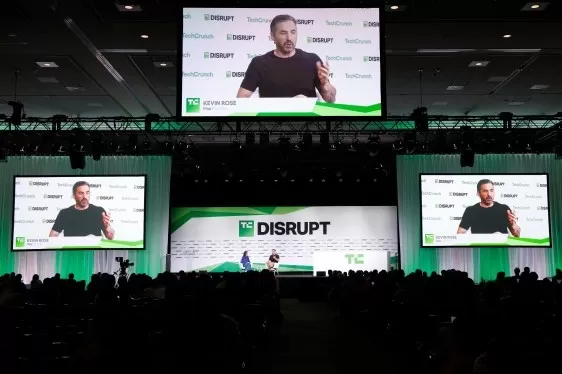 TechCrunch Disrupt 2026 to showcase leaders from Amazon, Replit and Tether
TechCrunch Disrupt has long been the epicenter of technology’s most critical dialogues, with a legacy spanning over a decade. The speakers who have graced this stage are icons of both the startup era and the current AI revolution, including Zuckerber
TechCrunch Disrupt 2026 to showcase leaders from Amazon, Replit and Tether
TechCrunch Disrupt has long been the epicenter of technology’s most critical dialogues, with a legacy spanning over a decade. The speakers who have graced this stage are icons of both the startup era and the current AI revolution, including Zuckerber
 Visa invests in Replit to enable agentic payments for developers
Visa has announced an undisclosed investment in the AI coding platform Replit. The two companies are also exploring how to integrate Visa's payment products into Replit, enabling developers—and the AI agents they build—to accept payments directly fro
Visa invests in Replit to enable agentic payments for developers
Visa has announced an undisclosed investment in the AI coding platform Replit. The two companies are also exploring how to integrate Visa's payment products into Replit, enabling developers—and the AI agents they build—to accept payments directly fro
 Lovable strikes multi-year Google Cloud deal to boost usage 5x, source says
On Wednesday, Lovable and Google announced an expanded multi-year partnership. Lovable, the fast-growing Stockholm-based vibe-coding startup, has been a Google Cloud customer for some time. Under the new agreement, its usage will increase significant
Lovable strikes multi-year Google Cloud deal to boost usage 5x, source says
On Wednesday, Lovable and Google announced an expanded multi-year partnership. Lovable, the fast-growing Stockholm-based vibe-coding startup, has been a Google Cloud customer for some time. Under the new agreement, its usage will increase significant

2026 Latest Best Top-rated AI Anomaly Detection Tools for KPI Monitoring in SaaS and Ecommerce teams! XIX.AI has curated a powerful, game-changing collection based on rigorous real-world tests and weekly updated rankings. You’ll find detailed free vs paid comparison insights to help you identify the must-try solution that boosts productivity and unlocks your AI edge. Explore now!
10 tools
xix.ai

2026 Latest Best Top-Rated AI Outline Generators for Long-Form SEO Articles, meticulously curated by XIX.AI. These powerful tools offer game-changing assistance in creating high-quality content quickly, boosting writing efficiency significantly. Get a free vs paid comparison along with real-world tests and detailed rankings to help you find the must-try option that suits your needs. Explore now to unlock your AI edge.
8 tools
xix.ai

2026 Latest Best AI Study Tools for Homework and Exam Prep! XIX.AI curates a top-rated list of powerful, game-changing tools that help students boost productivity, streamline homework completion, and ace exams through real-world tests. Get a free vs paid comparison, detailed rankings, and must-try options to unlock your AI edge. Explore now!
10 tools
xix.ai

2026 Latest Best AI Vocal Demo Tools for Songwriters, Hook Creators, and Multi-Language Content Teams! XIX.AI has curated a top-rated list of powerful game-changing tools that go through rigorous real-world tests. You’ll find detailed free vs paid comparison data, comprehensive rankings, and must-try options to help you boost writing efficiency and unlock your creative potential. Explore now to discover your perfect tool for all your content needs!
9 tools
xix.ai

2026 Latest Best Top-rated AI Competitive Research Tools for Small Businesses! XIX.AI has curated a highly powerful game-changing collection, updated weekly with rigorous real-world tests and detailed rankings. You can find a comprehensive free vs paid comparison to help you identify the must-try tools that boost your productivity and give you a competitive edge. Explore now to discover your perfect tool!
9 tools
xix.ai

2026 Latest Best Photoshop AI retouch tools for ecommerce apparel, skin cleanup, and color consistency! This top-rated curated list features powerful game-changing solutions that help you boost writing efficiency, streamline content creation, and achieve perfect visual results effortlessly. Each tool has undergone real-world tests through weekly updated rankings, complete with free vs paid comparison details. Backed by XIX.AI, it’s the must-try guide for anyone aiming to unlock your AI edge. Explore now!
10 tools
xix.ai












