


 Home
HomeWhat is Julius AI and how does it unleash data analysis in 2025?
In today's data-centric environment, efficient data analysis is vital. Julius AI offers an innovative solution, merging the power of Python, Excel, and ChatGPT to simplify analytical workflows. This article explores the transformative potential of Julius AI, demonstrating how it revolutionizes research and data tasks by cutting through complexity and making sophisticated analysis straightforward.
Key Points
Julius AI is an AI-powered data analyst tool that combines Python, Excel, and ChatGPT.
It significantly cuts down the time required for tasks typically done in Excel.
Key features are creating charts and graphs, answering questions with insights, performing advanced modeling, and solving problems.
Julius AI streamlines data cleaning, significance testing, and time series analysis.
Users can easily generate professional reports and summaries.
The tool supports coding in Python, R, and a simplified Python environment.
Julius AI enables effective data analysis regardless of dataset size or complexity.
Revolutionizing Data Analysis with Julius AI
What is Julius AI?
Julius AI ushers in a new era for data analytics, serving as an AI data analyst that blends Python's computational strength with Excel's familiarity and ChatGPT's natural language understanding. This integration benefits researchers, analysts, and academics by making data analysis more efficient. It demystifies complex datasets, saves countless hours, and improves the accuracy and depth of insights. Within its intuitive platform, Julius AI facilitates research paper writing, literature searches, plagiarism checks, and reference management. Its core strength is transforming tedious Excel work into swift, optimized processes, dramatically reducing analytical overhead.

Key Benefits of Julius AI
- Converts hours of Excel work into minutes.
- Simplifies intricate data analysis.
- Improves the precision and depth of data insights.
- Streamlines research tasks and report creation.
Core Capabilities of Julius AI: Charting, Insights, and Advanced Analytics
Julius AI provides a comprehensive suite of features designed to turn raw data into actionable intelligence, making analysis accessible and efficient for users of all technical levels.

- Charts and Graphs: Create compelling visual data representations for easier interpretation.
- Insights: Ask your data direct questions and receive clear, concise answers.
- Advanced Analysis: Execute complex modeling and predictive forecasting with ease.
- Problem Solving:
Tackle mathematical, chemical, and physical problems using data-driven methods.
- Reports: Generate polished, professional reports and summaries to communicate findings effectively.
These tools establish Julius AI as a powerful assistant for enhancing data analysis capabilities on projects of any complexity.
Julius AI for Research: Accelerating the Discovery Process
For researchers, time is a critical resource. Julius AI accelerates the discovery process by supporting essential research functions. Rapid data analysis, advanced statistical testing, and comprehensive report generation conserve valuable time.

The platform fosters collaboration and knowledge sharing, allowing researchers to disseminate findings easily and translate research into actionable insights more quickly. By automating routine tasks and providing deep analytical support, Julius AI frees researchers to focus on the creative and strategic aspects of their work, speeding up breakthroughs and innovation.
It also streamlines literature reviews and reference management, alleviating common research bottlenecks. Ultimately, it enables academics to concentrate on advancing knowledge by tackling the most challenging problems.
Discount Coupon
Discount Coupon
The creator of this content offers a discount coupon for those interested in trying Julius AI.
How to Get Started with Julius AI
Step-by-Step Guide to Data Analysis with Julius AI
Researchers and analysts can perform data-driven tasks with Julius AI by following these straightforward steps:
Upload Your Data: Start by uploading your data file in supported formats like Excel or CSV.
Initiate a New Thread: After upload, Julius AI reads the data and displays the first 15 rows for you to verify.
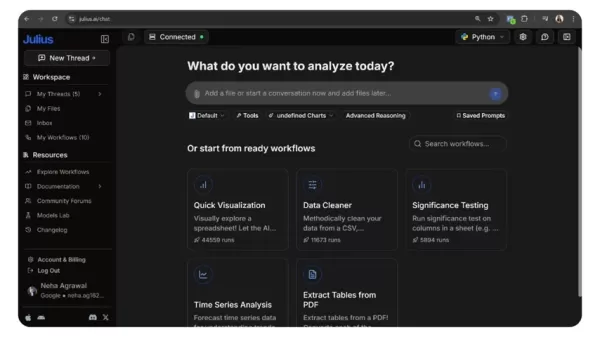
Choose Coding Language: Select your preferred analysis language: Python, R, or a simplified Python environment.
Ask Specific Questions: Pose targeted questions to your dataset to extract insights relevant to your research goals.
Data Cleaner Tool: Use the data cleaner feature to prepare your datasets, reducing errors and improving analysis efficiency.
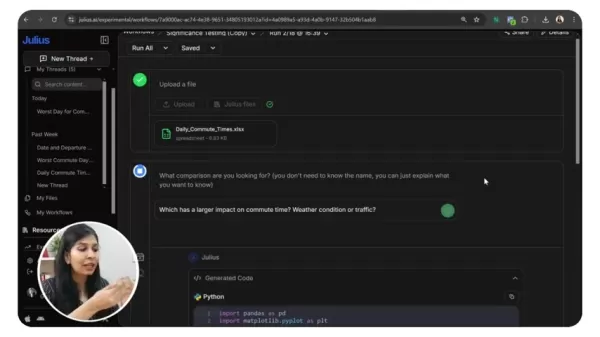
Significance Testing Tool: Apply the tool to perform statistical significance tests on your data.
Generate Reports: Once your analysis is complete, use Julius AI to compile polished reports summarizing the results.
This workflow saves time, enhances precision, and ensures conclusions are well-supported and clearly presented.
Understanding Julius AI Pricing Plans
Julius AI Subscription and Usage
Julius AI offers flexible pricing plans to accommodate different needs, starting with a free option and scaling to more comprehensive subscriptions. The free plan allows new users to send up to 15 messages per month to explore core features.
Paid subscriptions unlock enhanced capabilities, including more monthly messages, access to advanced AI models, improved data retention, and longer memory containers. Detailed pricing and features are available on the Julius AI website, which also provides custom solutions for teams and organizations seeking optimal AI-powered data analysis.
Here is a brief comparison of the available plan types:
Plan Description Features Price (Billed Annually) Free Introductory Access Up to 15 Messages per Month, Basic AI Model Access Free Lite Enhanced Individual Use 250 Messages per Month, Custom AI Settings, Longer Input Lengths $20.83/month (approx.) Standard Professional Data Analysis Unlimited Messages, Enhanced Data Retention, Memory Boost $29.99/month (approx.)
Each plan is designed to scale analytical capabilities, emphasizing the value of AI for both simple and complex data tasks.
Advantages and Disadvantages of Julius AI
Pros
Simplifies complex data analysis.
Reduces analysis time from hours to minutes.
Integrates powerful tools like Python, Excel, and ChatGPT.
Enhances the accuracy and depth of data insights.
Produces professional-quality reports.
Cons
Limited free usage may necessitate a subscription for larger projects.
Over-reliance on AI might hinder the development of hands-on analytical skills.
Mastering advanced features requires an initial learning investment.
Unlock Key Features and AI Customization with Julius AI
Comprehensive Feature Overview
Julius AI is built with a core set of features designed to make data analysis more accessible and productive for all users.
- Charts & Graphs: Enables creation of impactful data visualizations for clear presentation.
- Insights: Delivers immediate answers to data questions, simplifying interpretation.
- Advanced Analysis: Facilitates deep modeling and predictive forecasting for strategic insights.
- Problem-Solving: Assists in solving complex mathematical, physical, and chemical problems.
- Reporting: Automates the creation of refined reports and concise summaries.
These tools boost productivity and support informed decision-making with manageable, actionable insights.
Users can also customize the AI model used for analysis, tailoring how the system interacts with and interprets data.
.
Diverse Use Cases for Julius AI Across Industries
Versatile Applications of AI Data Analysis
Julius AI's adaptability makes it a valuable asset across numerous sectors, helping professionals convert complex data into clear, actionable steps. Key applications include:
- Marketing: Optimize campaigns by analyzing consumer data for personalized outreach.
- Healthcare: Enhance medical research and management through improved data insights.
- Ecology: Analyze complex datasets, such as with Kruskal-Wallis tests, to advance ecological research.
- Academia: Improve spatial analysis by studying animal movement data.
- Bioinformatics: Streamline gene expression analysis for faster results.
These examples showcase Julius AI's capacity to transform data management and decision-making processes, highlighting its broad adaptability.
Frequently Asked Questions About Julius AI
What types of data sources are supported by Julius AI?
Julius AI supports a variety of data sources, including CSV files, Excel spreadsheets, and other common formats, allowing users to consolidate data from multiple origins for unified analysis.
Is Julius AI free to use?
Yes, Julius AI provides a free tier offering up to 15 messages per month with access to an advanced AI model, ideal for initial exploration of the platform.
Can Julius AI create custom reports?
Absolutely. Julius AI can generate detailed, customizable reports that incorporate charts, graphs, and narrative summaries to effectively present findings.
Related Questions
How does Julius AI compare to traditional data analysis tools?
Unlike traditional tools like Excel or SPSS, Julius AI integrates AI directly to accelerate workflows, simplify data handling, and automate reporting. It is ideal for users seeking AI-enhanced productivity, whereas Excel and SPSS lack native AI integration and require more manual effort.
Feature Julius AI Excel/SPSS AI Integration Yes, integrates Python, Excel, and ChatGPT No direct AI integration Automation High automation for data tasks Requires manual setup and scripting Ease of Use Simplifies analysis via natural language Requires software proficiency Report Generation Automated, polished reports Manual compilation of data and visuals
Related article
 How Fintech Companies Achieve Strong Return on Investment by Leveraging Data
A solid foundation of integrated data is essential for boosting return on investment in fintech marketing efforts. Credit: Getty ImagesStephen Williams, CEO of Marketing Evolution, explains why unified data represents a crucial missing element for fi
Bain forecasts US$100 billion SaaS market in agentic AI automation
Bain & Company has estimated a $100 billion market in the U.S. for SaaS companies leveraging agentic AI. The firm said this market stems from automating coordination tasks within enterprise systems.This estimate comes from the second installment in B
Kakao Mobility outlines Level 4 autonomous driving roadmap for physical AI
Kakao Mobility is planning to develop Level 4 autonomous driving technologies internally as part of its physical AI strategy.
At the 2026 World IT Show conference in Seoul's COEX, Kim Jin-kyu — vice president and head of Kakao Mobility's Physical AI
Related Special Topic Recommendations
writing
How Fintech Companies Achieve Strong Return on Investment by Leveraging Data
A solid foundation of integrated data is essential for boosting return on investment in fintech marketing efforts. Credit: Getty ImagesStephen Williams, CEO of Marketing Evolution, explains why unified data represents a crucial missing element for fi
Bain forecasts US$100 billion SaaS market in agentic AI automation
Bain & Company has estimated a $100 billion market in the U.S. for SaaS companies leveraging agentic AI. The firm said this market stems from automating coordination tasks within enterprise systems.This estimate comes from the second installment in B
Kakao Mobility outlines Level 4 autonomous driving roadmap for physical AI
Kakao Mobility is planning to develop Level 4 autonomous driving technologies internally as part of its physical AI strategy.
At the 2026 World IT Show conference in Seoul's COEX, Kim Jin-kyu — vice president and head of Kakao Mobility's Physical AI
Related Special Topic Recommendations
writing
 Best AI Outline Generators for Long-Form SEO Articles
2026 Latest Best Top-Rated AI Outline Generators for Long-Form SEO Articles, meticulously curated by XIX.AI. These powerful tools offer game-changing assistance in creating high-quality content quickly, boosting writing efficiency significantly. Get a free vs paid comparison along with real-world tests and detailed rankings to help you find the must-try option that suits your needs. Explore now to unlock your AI edge.
 8 tools
 xix.ai
Education and Learning
AI Study Tools for Homework and Exam Prep
xix.ai
Education and Learning
AI Study Tools for Homework and Exam Prep
2026 Latest Best AI Study Tools for Homework and Exam Prep! XIX.AI curates a top-rated list of powerful, game-changing tools that help students boost productivity, streamline homework completion, and ace exams through real-world tests. Get a free vs paid comparison, detailed rankings, and must-try options to unlock your AI edge. Explore now!
10 tools
xix.ai
Music composition
AI Vocal Demo Tools for Songwriters, Hooks, Toplines, and Multilingual Draft Sessions
2026 Latest Best AI Vocal Demo Tools for Songwriters, Hook Creators, and Multi-Language Content Teams! XIX.AI has curated a top-rated list of powerful game-changing tools that go through rigorous real-world tests. You’ll find detailed free vs paid comparison data, comprehensive rankings, and must-try options to help you boost writing efficiency and unlock your creative potential. Explore now to discover your perfect tool for all your content needs!
9 tools
xix.ai
Business
Best AI Competitive Research Tools for Small Businesses
2026 Latest Best Top-rated AI Competitive Research Tools for Small Businesses! XIX.AI has curated a highly powerful game-changing collection, updated weekly with rigorous real-world tests and detailed rankings. You can find a comprehensive free vs paid comparison to help you identify the must-try tools that boost your productivity and give you a competitive edge. Explore now to discover your perfect tool!
9 tools
xix.ai
Image editing
Photoshop AI Retouch Tools for Ecommerce Apparel, Skin Cleanup, and Color Consistency
2026 Latest Best Photoshop AI retouch tools for ecommerce apparel, skin cleanup, and color consistency! This top-rated curated list features powerful game-changing solutions that help you boost writing efficiency, streamline content creation, and achieve perfect visual results effortlessly. Each tool has undergone real-world tests through weekly updated rankings, complete with free vs paid comparison details. Backed by XIX.AI, it’s the must-try guide for anyone aiming to unlock your AI edge. Explore now!
10 tools
xix.ai
Prompt
Best AI Prompt Libraries for ChatGPT Workflows
2026 Latest Best Top-Rated AI Prompt Libraries for optimizing all types of ChatGPT workflows. XIX.AI has curated a powerful, game-changing collection that goes through rigorous real-world tests to ensure top performance. You can find detailed free vs paid comparisons and expert rankings to help you choose the must-try tools that boost your productivity and unlock your AI edge. Explore now!
11 tools
xix.ai

 Comments (0)
0/500
Comments (0)
0/500
In today's data-centric environment, efficient data analysis is vital. Julius AI offers an innovative solution, merging the power of Python, Excel, and ChatGPT to simplify analytical workflows. This article explores the transformative potential of Julius AI, demonstrating how it revolutionizes research and data tasks by cutting through complexity and making sophisticated analysis straightforward.
Key Points
Julius AI is an AI-powered data analyst tool that combines Python, Excel, and ChatGPT.
It significantly cuts down the time required for tasks typically done in Excel.
Key features are creating charts and graphs, answering questions with insights, performing advanced modeling, and solving problems.
Julius AI streamlines data cleaning, significance testing, and time series analysis.
Users can easily generate professional reports and summaries.
The tool supports coding in Python, R, and a simplified Python environment.
Julius AI enables effective data analysis regardless of dataset size or complexity.
Revolutionizing Data Analysis with Julius AI
What is Julius AI?
Julius AI ushers in a new era for data analytics, serving as an AI data analyst that blends Python's computational strength with Excel's familiarity and ChatGPT's natural language understanding. This integration benefits researchers, analysts, and academics by making data analysis more efficient. It demystifies complex datasets, saves countless hours, and improves the accuracy and depth of insights. Within its intuitive platform, Julius AI facilitates research paper writing, literature searches, plagiarism checks, and reference management. Its core strength is transforming tedious Excel work into swift, optimized processes, dramatically reducing analytical overhead.
Key Benefits of Julius AI
- Converts hours of Excel work into minutes.
- Simplifies intricate data analysis.
- Improves the precision and depth of data insights.
- Streamlines research tasks and report creation.
Core Capabilities of Julius AI: Charting, Insights, and Advanced Analytics
Julius AI provides a comprehensive suite of features designed to turn raw data into actionable intelligence, making analysis accessible and efficient for users of all technical levels.
- Charts and Graphs: Create compelling visual data representations for easier interpretation.
- Insights: Ask your data direct questions and receive clear, concise answers.
- Advanced Analysis: Execute complex modeling and predictive forecasting with ease.
- Problem Solving: Tackle mathematical, chemical, and physical problems using data-driven methods.
- Reports: Generate polished, professional reports and summaries to communicate findings effectively.
These tools establish Julius AI as a powerful assistant for enhancing data analysis capabilities on projects of any complexity.
Julius AI for Research: Accelerating the Discovery Process
For researchers, time is a critical resource. Julius AI accelerates the discovery process by supporting essential research functions. Rapid data analysis, advanced statistical testing, and comprehensive report generation conserve valuable time.
The platform fosters collaboration and knowledge sharing, allowing researchers to disseminate findings easily and translate research into actionable insights more quickly. By automating routine tasks and providing deep analytical support, Julius AI frees researchers to focus on the creative and strategic aspects of their work, speeding up breakthroughs and innovation.
It also streamlines literature reviews and reference management, alleviating common research bottlenecks. Ultimately, it enables academics to concentrate on advancing knowledge by tackling the most challenging problems.
Discount Coupon
Discount Coupon
The creator of this content offers a discount coupon for those interested in trying Julius AI.
How to Get Started with Julius AI
Step-by-Step Guide to Data Analysis with Julius AI
Researchers and analysts can perform data-driven tasks with Julius AI by following these straightforward steps:
Upload Your Data: Start by uploading your data file in supported formats like Excel or CSV.
Initiate a New Thread: After upload, Julius AI reads the data and displays the first 15 rows for you to verify.
Choose Coding Language: Select your preferred analysis language: Python, R, or a simplified Python environment.
Ask Specific Questions: Pose targeted questions to your dataset to extract insights relevant to your research goals.
Data Cleaner Tool: Use the data cleaner feature to prepare your datasets, reducing errors and improving analysis efficiency.
Significance Testing Tool: Apply the tool to perform statistical significance tests on your data.
Generate Reports: Once your analysis is complete, use Julius AI to compile polished reports summarizing the results.
This workflow saves time, enhances precision, and ensures conclusions are well-supported and clearly presented.
Understanding Julius AI Pricing Plans
Julius AI Subscription and Usage
Julius AI offers flexible pricing plans to accommodate different needs, starting with a free option and scaling to more comprehensive subscriptions. The free plan allows new users to send up to 15 messages per month to explore core features.
Paid subscriptions unlock enhanced capabilities, including more monthly messages, access to advanced AI models, improved data retention, and longer memory containers. Detailed pricing and features are available on the Julius AI website, which also provides custom solutions for teams and organizations seeking optimal AI-powered data analysis.
Here is a brief comparison of the available plan types:
| Plan | Description | Features | Price (Billed Annually) |
|---|---|---|---|
| Free | Introductory Access | Up to 15 Messages per Month, Basic AI Model Access | Free |
| Lite | Enhanced Individual Use | 250 Messages per Month, Custom AI Settings, Longer Input Lengths | $20.83/month (approx.) |
| Standard | Professional Data Analysis | Unlimited Messages, Enhanced Data Retention, Memory Boost | $29.99/month (approx.) |
Each plan is designed to scale analytical capabilities, emphasizing the value of AI for both simple and complex data tasks.
Advantages and Disadvantages of Julius AI
Pros
Simplifies complex data analysis.
Reduces analysis time from hours to minutes.
Integrates powerful tools like Python, Excel, and ChatGPT.
Enhances the accuracy and depth of data insights.
Produces professional-quality reports.
Cons
Limited free usage may necessitate a subscription for larger projects.
Over-reliance on AI might hinder the development of hands-on analytical skills.
Mastering advanced features requires an initial learning investment.
Unlock Key Features and AI Customization with Julius AI
Comprehensive Feature Overview
Julius AI is built with a core set of features designed to make data analysis more accessible and productive for all users.
- Charts & Graphs: Enables creation of impactful data visualizations for clear presentation.
- Insights: Delivers immediate answers to data questions, simplifying interpretation.
- Advanced Analysis: Facilitates deep modeling and predictive forecasting for strategic insights.
- Problem-Solving: Assists in solving complex mathematical, physical, and chemical problems.
- Reporting: Automates the creation of refined reports and concise summaries.
These tools boost productivity and support informed decision-making with manageable, actionable insights.
Users can also customize the AI model used for analysis, tailoring how the system interacts with and interprets data.
.
Diverse Use Cases for Julius AI Across Industries
Versatile Applications of AI Data Analysis
Julius AI's adaptability makes it a valuable asset across numerous sectors, helping professionals convert complex data into clear, actionable steps. Key applications include:
- Marketing: Optimize campaigns by analyzing consumer data for personalized outreach.
- Healthcare: Enhance medical research and management through improved data insights.
- Ecology: Analyze complex datasets, such as with Kruskal-Wallis tests, to advance ecological research.
- Academia: Improve spatial analysis by studying animal movement data.
- Bioinformatics: Streamline gene expression analysis for faster results.
These examples showcase Julius AI's capacity to transform data management and decision-making processes, highlighting its broad adaptability.
Frequently Asked Questions About Julius AI
What types of data sources are supported by Julius AI?
Julius AI supports a variety of data sources, including CSV files, Excel spreadsheets, and other common formats, allowing users to consolidate data from multiple origins for unified analysis.
Is Julius AI free to use?
Yes, Julius AI provides a free tier offering up to 15 messages per month with access to an advanced AI model, ideal for initial exploration of the platform.
Can Julius AI create custom reports?
Absolutely. Julius AI can generate detailed, customizable reports that incorporate charts, graphs, and narrative summaries to effectively present findings.
Related Questions
How does Julius AI compare to traditional data analysis tools?
Unlike traditional tools like Excel or SPSS, Julius AI integrates AI directly to accelerate workflows, simplify data handling, and automate reporting. It is ideal for users seeking AI-enhanced productivity, whereas Excel and SPSS lack native AI integration and require more manual effort.
| Feature | Julius AI | Excel/SPSS |
|---|---|---|
| AI Integration | Yes, integrates Python, Excel, and ChatGPT | No direct AI integration |
| Automation | High automation for data tasks | Requires manual setup and scripting |
| Ease of Use | Simplifies analysis via natural language | Requires software proficiency |
| Report Generation | Automated, polished reports | Manual compilation of data and visuals |








 How Fintech Companies Achieve Strong Return on Investment by Leveraging Data
A solid foundation of integrated data is essential for boosting return on investment in fintech marketing efforts. Credit: Getty ImagesStephen Williams, CEO of Marketing Evolution, explains why unified data represents a crucial missing element for fi
Bain forecasts US$100 billion SaaS market in agentic AI automation
Bain & Company has estimated a $100 billion market in the U.S. for SaaS companies leveraging agentic AI. The firm said this market stems from automating coordination tasks within enterprise systems.This estimate comes from the second installment in B
Kakao Mobility outlines Level 4 autonomous driving roadmap for physical AI
Kakao Mobility is planning to develop Level 4 autonomous driving technologies internally as part of its physical AI strategy.
At the 2026 World IT Show conference in Seoul's COEX, Kim Jin-kyu — vice president and head of Kakao Mobility's Physical AI
How Fintech Companies Achieve Strong Return on Investment by Leveraging Data
A solid foundation of integrated data is essential for boosting return on investment in fintech marketing efforts. Credit: Getty ImagesStephen Williams, CEO of Marketing Evolution, explains why unified data represents a crucial missing element for fi
Bain forecasts US$100 billion SaaS market in agentic AI automation
Bain & Company has estimated a $100 billion market in the U.S. for SaaS companies leveraging agentic AI. The firm said this market stems from automating coordination tasks within enterprise systems.This estimate comes from the second installment in B
Kakao Mobility outlines Level 4 autonomous driving roadmap for physical AI
Kakao Mobility is planning to develop Level 4 autonomous driving technologies internally as part of its physical AI strategy.
At the 2026 World IT Show conference in Seoul's COEX, Kim Jin-kyu — vice president and head of Kakao Mobility's Physical AI

2026 Latest Best Top-Rated AI Outline Generators for Long-Form SEO Articles, meticulously curated by XIX.AI. These powerful tools offer game-changing assistance in creating high-quality content quickly, boosting writing efficiency significantly. Get a free vs paid comparison along with real-world tests and detailed rankings to help you find the must-try option that suits your needs. Explore now to unlock your AI edge.
8 tools
xix.ai

2026 Latest Best AI Study Tools for Homework and Exam Prep! XIX.AI curates a top-rated list of powerful, game-changing tools that help students boost productivity, streamline homework completion, and ace exams through real-world tests. Get a free vs paid comparison, detailed rankings, and must-try options to unlock your AI edge. Explore now!
10 tools
xix.ai

2026 Latest Best AI Vocal Demo Tools for Songwriters, Hook Creators, and Multi-Language Content Teams! XIX.AI has curated a top-rated list of powerful game-changing tools that go through rigorous real-world tests. You’ll find detailed free vs paid comparison data, comprehensive rankings, and must-try options to help you boost writing efficiency and unlock your creative potential. Explore now to discover your perfect tool for all your content needs!
9 tools
xix.ai

2026 Latest Best Top-rated AI Competitive Research Tools for Small Businesses! XIX.AI has curated a highly powerful game-changing collection, updated weekly with rigorous real-world tests and detailed rankings. You can find a comprehensive free vs paid comparison to help you identify the must-try tools that boost your productivity and give you a competitive edge. Explore now to discover your perfect tool!
9 tools
xix.ai

2026 Latest Best Photoshop AI retouch tools for ecommerce apparel, skin cleanup, and color consistency! This top-rated curated list features powerful game-changing solutions that help you boost writing efficiency, streamline content creation, and achieve perfect visual results effortlessly. Each tool has undergone real-world tests through weekly updated rankings, complete with free vs paid comparison details. Backed by XIX.AI, it’s the must-try guide for anyone aiming to unlock your AI edge. Explore now!
10 tools
xix.ai

2026 Latest Best Top-Rated AI Prompt Libraries for optimizing all types of ChatGPT workflows. XIX.AI has curated a powerful, game-changing collection that goes through rigorous real-world tests to ensure top performance. You can find detailed free vs paid comparisons and expert rankings to help you choose the must-try tools that boost your productivity and unlock your AI edge. Explore now!
11 tools
xix.ai












