


 Home
HomeHowToRobot, Robotics Australia Group Partner to Boost Robot Adoption

Robotics Australia Group and HowToRobot leverage AI to assist businesses in implementing automation. Source: HowToRobot
According to the International Federation of Robotics (IFR), Australia’s robot density stands at 134 robots per 10,000 manufacturing employees, trailing the global average of 162 and lagging behind most other industrialized nations. To address this gap, HowToRobot and Robotics Australia Group have announced a collaboration aimed at accelerating automation adoption across Australian industry.
“Most businesses lack the internal structure, bandwidth, and expertise to advance automation projects with the necessary confidence and speed,” explained Søren Peters, founder and CEO of HowToRobot. “We launched a new platform version where AI assists companies in defining their projects. Rather than hiring an engineer for an 18-month engagement, businesses can use the tool to refine project descriptions, enabling them to present a clear case to management for funding, such as requesting $200,000 for automation.”
“We conducted market reports and maintained contact with various countries and their robot associations,” he told The Robot Report. “Like many other nations, Australia struggles to encourage manufacturers to adopt automation. After presenting the new HowToRobot version to its association, they asked for a copy. We then created a country-specific version.”
HowToRobot’s independent validation system helps companies determine what to automate, estimate costs, and identify capable providers. The platform serves both small operations and Fortune 500 companies, enabling users to discover automation opportunities, specify projects, and connect with vetted suppliers from a global network.
Australia’s manufacturing sector requires increased automation
According to the Australian Bureau of Statistics, Australian manufacturing is grappling with persistent skilled labor shortages, cost pressures, and the slowest productivity growth in six decades. The government’s National Robotics Strategy estimates that increasing automation usage could add between $170 billion and $600 billion annually to Australia’s GDP by 2030. (The U.S. has engaged in similar discussions regarding a national robotics strategy.)
“To realize the productivity benefits of automation, we must make it easier for more Australian businesses to adopt it,” said Paul Mason, CEO of Robotics Australia Group. “This involves helping companies make informed decisions before spending money—identifying the right opportunities, building a solid business case, and engaging the appropriate solution providers.”
Robotics Australia Group aims to foster a sustainable and internationally competitive Australian robotics industry. The organization connects developers, researchers, integrators, manufacturers, adopters, educators, investors, and government entities within the robotics and automation ecosystem. It has published three editions of the “Australian Robotics Roadmap” and supported the National Robotics Strategy.
Editor’s note: Reshoring production through automation will be a key topic at RoboBusiness 2026, taking place on Oct. 20 and 21 in Santa Clara, Calif. Register now to attend.
AutomationFinder.com.au serves as a national resource
The partners have launched AutomationFinder.com.au, a localized site operated by Robotics Australia Group and powered by HowToRobot’s AI. The platform is designed to help Australian businesses identify where automation can most benefit their operations.
According to HowToRobot, the subscription-based platform offers a structured system for local engineers to describe their needs and convert them into supplier-ready project briefs. Users can then receive real market feedback on costs, feasibility, and solution concepts from a global network of over 20,000 vetted suppliers, including 500 based in Australia.
AutomationFinder.com.au utilizes data from more than 600 existing automation projects worldwide. The partners also noted that a panel of independent automation experts is available for hands-on engagements across Australia.
“This partnership introduces a system proven to work in the most advanced markets,” said Mason. “We are excited to partner with HowToRobot to provide [manufacturers] with the system, expertise, and clarity they need to succeed.”
Australian companies can use the platform to compare suppliers, proceed with firm quotes, and make final selections. HowToRobot emphasizes that its system is vendor-neutral, drawing from a mix of suppliers ranging from divisions of global vendors like FANUC to local integrators and startups.
“What we observe across businesses using our platform is that providing a structured way to validate key decisions—what to automate, what it should cost, and who can deliver—accelerates adoption and makes outcomes more predictable,” said Peters. “We are excited to bring this to Australian manufacturers alongside Robotics Australia Group.”
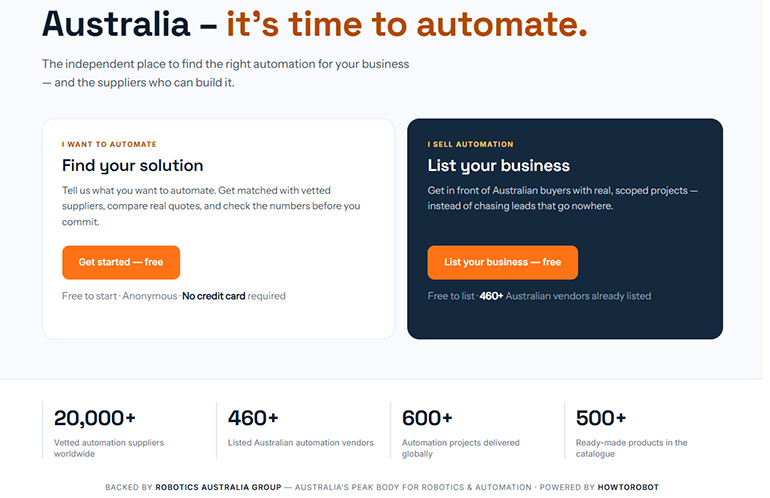
AutomationFinder.com.au represents the first national version of the AI robotics sourcing platform. Source: HowToRobot
First national platform for automation buyers and suppliers
AutomationFinder.com.au marks the first country-wide licensed deployment of HowToRobot’s platform, though Peters indicated it will not be the last.
“We are now receiving inquiries from other associations and countries. Every client seeks to shorten their supply chain,” he observed. “We have seen numerous government initiatives spend significant funds and identify promising solutions, yet few progress. Even if one project moves forward, what happens to the other 11?”
“With HowToRobot, the platform retains that context. Even if robotic palletizing is the initial project, you can return to a company four months later to discuss packaging,” said Peters. “It provides a sense of memory.”
“Imagine if 10,000 Australian companies had bookmarked their automation thoughts, and you provided that anonymized data to the public, stating, ‘This is what the nation is considering right now,’” he said. “If packaging emerges as Australia’s biggest challenge, it would significantly shift the focus on what a country aims to advance.”
Peters noted that other areas of interest in Europe, U.S. states, and elsewhere include agriculture and end-of-line packaging.
“It took time to understand our role—mom-and-pop shops are seeking an accessible way to automate,” he acknowledged. “We do not fly anyone to Ohio or California; instead, we look for local experts. This is crucial for building trust between buyers and sellers.”
“We are not attempting to take an advisory role—we provide the infrastructure,” said Peters. “People often mistake us for a simple marketplace, but we are building a pipeline for the discovery and purchasing aspects of robotics.”
![]() Related article
Related article
 California AV Compliance: A New Era of Tickets, Geofences, and 1M Miles
Guident operates an AuveTech shuttle in South Florida, managing a four-mile route in West Palm Beach and a one-mile route in Boca Raton using its remote monitoring technology. | Credit: GuidentCalifornia is redefining the regulatory landscape for dri
FCC Robot Ruling Highlights U.S. Policy; Next-Gen AI Boosts Warehousing
Derik Pridmore serves as the CEO of OSARO.Pridmore explains the evolution of warehouse robotics from basic perception systems to adaptable, AI-driven automation. He emphasizes that hardware-agnostic design, continuous learning, and real-world monitor
Agentic AI in government faces tough question: What should machines be allowed to decide?
The United Arab Emirates has been an early adopter of artificial intelligence for nine years. It launched a national AI strategy in October 2017 and, shortly thereafter, established a ministerial role to oversee it, appointing Omar Sultan Al Olama as
Related Special Topic Recommendations
SEO
California AV Compliance: A New Era of Tickets, Geofences, and 1M Miles
Guident operates an AuveTech shuttle in South Florida, managing a four-mile route in West Palm Beach and a one-mile route in Boca Raton using its remote monitoring technology. | Credit: GuidentCalifornia is redefining the regulatory landscape for dri
FCC Robot Ruling Highlights U.S. Policy; Next-Gen AI Boosts Warehousing
Derik Pridmore serves as the CEO of OSARO.Pridmore explains the evolution of warehouse robotics from basic perception systems to adaptable, AI-driven automation. He emphasizes that hardware-agnostic design, continuous learning, and real-world monitor
Agentic AI in government faces tough question: What should machines be allowed to decide?
The United Arab Emirates has been an early adopter of artificial intelligence for nine years. It launched a national AI strategy in October 2017 and, shortly thereafter, established a ministerial role to oversee it, appointing Omar Sultan Al Olama as
Related Special Topic Recommendations
SEO
 Best AI SERP Analysis Tools for Search Strategy
2026 Latest Best Top-rated AI SERP Analysis Tools for Search Strategy are curated by XIX.AI through rigorous real-world tests and weekly updated rankings. These powerful tools help you unlock hidden optimization opportunities, boost content performance, and gain a competitive edge in search. Discover your perfect tool to elevate your search strategy today. Explore now!
 13 tools
 xix.ai
Data Analysis
Best AI Anomaly Detection Tools for KPI Monitoring across SaaS and Ecommerce Teams
xix.ai
Data Analysis
Best AI Anomaly Detection Tools for KPI Monitoring across SaaS and Ecommerce Teams
2026 Latest Best Top-rated AI Anomaly Detection Tools for KPI Monitoring in SaaS and Ecommerce teams! XIX.AI has curated a powerful, game-changing collection based on rigorous real-world tests and weekly updated rankings. You’ll find detailed free vs paid comparison insights to help you identify the must-try solution that boosts productivity and unlocks your AI edge. Explore now!
10 tools
xix.ai
writing
Best AI Outline Generators for Long-Form SEO Articles
2026 Latest Best Top-Rated AI Outline Generators for Long-Form SEO Articles, meticulously curated by XIX.AI. These powerful tools offer game-changing assistance in creating high-quality content quickly, boosting writing efficiency significantly. Get a free vs paid comparison along with real-world tests and detailed rankings to help you find the must-try option that suits your needs. Explore now to unlock your AI edge.
8 tools
xix.ai
Education and Learning
AI Study Tools for Homework and Exam Prep
2026 Latest Best AI Study Tools for Homework and Exam Prep! XIX.AI curates a top-rated list of powerful, game-changing tools that help students boost productivity, streamline homework completion, and ace exams through real-world tests. Get a free vs paid comparison, detailed rankings, and must-try options to unlock your AI edge. Explore now!
10 tools
xix.ai
Music composition
AI Vocal Demo Tools for Songwriters, Hooks, Toplines, and Multilingual Draft Sessions
2026 Latest Best AI Vocal Demo Tools for Songwriters, Hook Creators, and Multi-Language Content Teams! XIX.AI has curated a top-rated list of powerful game-changing tools that go through rigorous real-world tests. You’ll find detailed free vs paid comparison data, comprehensive rankings, and must-try options to help you boost writing efficiency and unlock your creative potential. Explore now to discover your perfect tool for all your content needs!
9 tools
xix.ai
Business
Best AI Competitive Research Tools for Small Businesses
2026 Latest Best Top-rated AI Competitive Research Tools for Small Businesses! XIX.AI has curated a highly powerful game-changing collection, updated weekly with rigorous real-world tests and detailed rankings. You can find a comprehensive free vs paid comparison to help you identify the must-try tools that boost your productivity and give you a competitive edge. Explore now to discover your perfect tool!
9 tools
xix.ai

 Comments (0)
0/500
Comments (0)
0/500
Robotics Australia Group and HowToRobot leverage AI to assist businesses in implementing automation. Source: HowToRobot
According to the International Federation of Robotics (IFR), Australia’s robot density stands at 134 robots per 10,000 manufacturing employees, trailing the global average of 162 and lagging behind most other industrialized nations. To address this gap, HowToRobot and Robotics Australia Group have announced a collaboration aimed at accelerating automation adoption across Australian industry.
“Most businesses lack the internal structure, bandwidth, and expertise to advance automation projects with the necessary confidence and speed,” explained Søren Peters, founder and CEO of HowToRobot. “We launched a new platform version where AI assists companies in defining their projects. Rather than hiring an engineer for an 18-month engagement, businesses can use the tool to refine project descriptions, enabling them to present a clear case to management for funding, such as requesting $200,000 for automation.”
“We conducted market reports and maintained contact with various countries and their robot associations,” he told The Robot Report. “Like many other nations, Australia struggles to encourage manufacturers to adopt automation. After presenting the new HowToRobot version to its association, they asked for a copy. We then created a country-specific version.”
HowToRobot’s independent validation system helps companies determine what to automate, estimate costs, and identify capable providers. The platform serves both small operations and Fortune 500 companies, enabling users to discover automation opportunities, specify projects, and connect with vetted suppliers from a global network.
Australia’s manufacturing sector requires increased automation
According to the Australian Bureau of Statistics, Australian manufacturing is grappling with persistent skilled labor shortages, cost pressures, and the slowest productivity growth in six decades. The government’s National Robotics Strategy estimates that increasing automation usage could add between $170 billion and $600 billion annually to Australia’s GDP by 2030. (The U.S. has engaged in similar discussions regarding a national robotics strategy.)
“To realize the productivity benefits of automation, we must make it easier for more Australian businesses to adopt it,” said Paul Mason, CEO of Robotics Australia Group. “This involves helping companies make informed decisions before spending money—identifying the right opportunities, building a solid business case, and engaging the appropriate solution providers.”
Robotics Australia Group aims to foster a sustainable and internationally competitive Australian robotics industry. The organization connects developers, researchers, integrators, manufacturers, adopters, educators, investors, and government entities within the robotics and automation ecosystem. It has published three editions of the “Australian Robotics Roadmap” and supported the National Robotics Strategy.
Editor’s note: Reshoring production through automation will be a key topic at RoboBusiness 2026, taking place on Oct. 20 and 21 in Santa Clara, Calif. Register now to attend.
AutomationFinder.com.au serves as a national resource
The partners have launched AutomationFinder.com.au, a localized site operated by Robotics Australia Group and powered by HowToRobot’s AI. The platform is designed to help Australian businesses identify where automation can most benefit their operations.
According to HowToRobot, the subscription-based platform offers a structured system for local engineers to describe their needs and convert them into supplier-ready project briefs. Users can then receive real market feedback on costs, feasibility, and solution concepts from a global network of over 20,000 vetted suppliers, including 500 based in Australia.
AutomationFinder.com.au utilizes data from more than 600 existing automation projects worldwide. The partners also noted that a panel of independent automation experts is available for hands-on engagements across Australia.
“This partnership introduces a system proven to work in the most advanced markets,” said Mason. “We are excited to partner with HowToRobot to provide [manufacturers] with the system, expertise, and clarity they need to succeed.”
Australian companies can use the platform to compare suppliers, proceed with firm quotes, and make final selections. HowToRobot emphasizes that its system is vendor-neutral, drawing from a mix of suppliers ranging from divisions of global vendors like FANUC to local integrators and startups.
“What we observe across businesses using our platform is that providing a structured way to validate key decisions—what to automate, what it should cost, and who can deliver—accelerates adoption and makes outcomes more predictable,” said Peters. “We are excited to bring this to Australian manufacturers alongside Robotics Australia Group.”
AutomationFinder.com.au represents the first national version of the AI robotics sourcing platform. Source: HowToRobot
First national platform for automation buyers and suppliers
AutomationFinder.com.au marks the first country-wide licensed deployment of HowToRobot’s platform, though Peters indicated it will not be the last.
“We are now receiving inquiries from other associations and countries. Every client seeks to shorten their supply chain,” he observed. “We have seen numerous government initiatives spend significant funds and identify promising solutions, yet few progress. Even if one project moves forward, what happens to the other 11?”
“With HowToRobot, the platform retains that context. Even if robotic palletizing is the initial project, you can return to a company four months later to discuss packaging,” said Peters. “It provides a sense of memory.”
“Imagine if 10,000 Australian companies had bookmarked their automation thoughts, and you provided that anonymized data to the public, stating, ‘This is what the nation is considering right now,’” he said. “If packaging emerges as Australia’s biggest challenge, it would significantly shift the focus on what a country aims to advance.”
Peters noted that other areas of interest in Europe, U.S. states, and elsewhere include agriculture and end-of-line packaging.
“It took time to understand our role—mom-and-pop shops are seeking an accessible way to automate,” he acknowledged. “We do not fly anyone to Ohio or California; instead, we look for local experts. This is crucial for building trust between buyers and sellers.”
“We are not attempting to take an advisory role—we provide the infrastructure,” said Peters. “People often mistake us for a simple marketplace, but we are building a pipeline for the discovery and purchasing aspects of robotics.”







 California AV Compliance: A New Era of Tickets, Geofences, and 1M Miles
Guident operates an AuveTech shuttle in South Florida, managing a four-mile route in West Palm Beach and a one-mile route in Boca Raton using its remote monitoring technology. | Credit: GuidentCalifornia is redefining the regulatory landscape for dri
FCC Robot Ruling Highlights U.S. Policy; Next-Gen AI Boosts Warehousing
Derik Pridmore serves as the CEO of OSARO.Pridmore explains the evolution of warehouse robotics from basic perception systems to adaptable, AI-driven automation. He emphasizes that hardware-agnostic design, continuous learning, and real-world monitor
California AV Compliance: A New Era of Tickets, Geofences, and 1M Miles
Guident operates an AuveTech shuttle in South Florida, managing a four-mile route in West Palm Beach and a one-mile route in Boca Raton using its remote monitoring technology. | Credit: GuidentCalifornia is redefining the regulatory landscape for dri
FCC Robot Ruling Highlights U.S. Policy; Next-Gen AI Boosts Warehousing
Derik Pridmore serves as the CEO of OSARO.Pridmore explains the evolution of warehouse robotics from basic perception systems to adaptable, AI-driven automation. He emphasizes that hardware-agnostic design, continuous learning, and real-world monitor
 Agentic AI in government faces tough question: What should machines be allowed to decide?
The United Arab Emirates has been an early adopter of artificial intelligence for nine years. It launched a national AI strategy in October 2017 and, shortly thereafter, established a ministerial role to oversee it, appointing Omar Sultan Al Olama as
Agentic AI in government faces tough question: What should machines be allowed to decide?
The United Arab Emirates has been an early adopter of artificial intelligence for nine years. It launched a national AI strategy in October 2017 and, shortly thereafter, established a ministerial role to oversee it, appointing Omar Sultan Al Olama as

2026 Latest Best Top-rated AI SERP Analysis Tools for Search Strategy are curated by XIX.AI through rigorous real-world tests and weekly updated rankings. These powerful tools help you unlock hidden optimization opportunities, boost content performance, and gain a competitive edge in search. Discover your perfect tool to elevate your search strategy today. Explore now!
13 tools
xix.ai
2026 Latest Best Top-rated AI Anomaly Detection Tools for KPI Monitoring in SaaS and Ecommerce teams! XIX.AI has curated a powerful, game-changing collection based on rigorous real-world tests and weekly updated rankings. You’ll find detailed free vs paid comparison insights to help you identify the must-try solution that boosts productivity and unlocks your AI edge. Explore now!
10 tools
xix.ai

2026 Latest Best Top-Rated AI Outline Generators for Long-Form SEO Articles, meticulously curated by XIX.AI. These powerful tools offer game-changing assistance in creating high-quality content quickly, boosting writing efficiency significantly. Get a free vs paid comparison along with real-world tests and detailed rankings to help you find the must-try option that suits your needs. Explore now to unlock your AI edge.
8 tools
xix.ai

2026 Latest Best AI Study Tools for Homework and Exam Prep! XIX.AI curates a top-rated list of powerful, game-changing tools that help students boost productivity, streamline homework completion, and ace exams through real-world tests. Get a free vs paid comparison, detailed rankings, and must-try options to unlock your AI edge. Explore now!
10 tools
xix.ai

2026 Latest Best AI Vocal Demo Tools for Songwriters, Hook Creators, and Multi-Language Content Teams! XIX.AI has curated a top-rated list of powerful game-changing tools that go through rigorous real-world tests. You’ll find detailed free vs paid comparison data, comprehensive rankings, and must-try options to help you boost writing efficiency and unlock your creative potential. Explore now to discover your perfect tool for all your content needs!
9 tools
xix.ai

2026 Latest Best Top-rated AI Competitive Research Tools for Small Businesses! XIX.AI has curated a highly powerful game-changing collection, updated weekly with rigorous real-world tests and detailed rankings. You can find a comprehensive free vs paid comparison to help you identify the must-try tools that boost your productivity and give you a competitive edge. Explore now to discover your perfect tool!
9 tools
xix.ai












