


 Home
Home
GPT-5.5 released three weeks ago, GPT-5.6 in internal testing; OpenAI and Anthropic begin subsidy battle, developers benefit
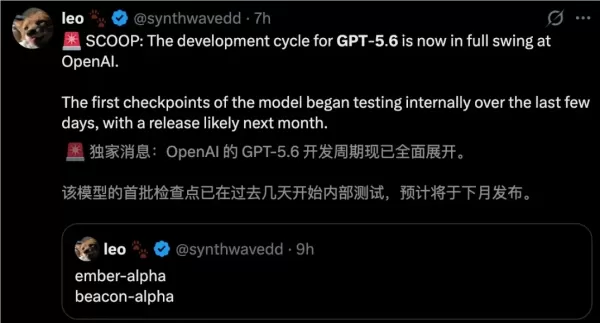
Just three weeks after GPT-5.5 launched, rumors about GPT-5.6 are already spreading.
Well-known leaker Leo revealed that GPT-5.6 development is now in full swing, with the first internal checkpoints being tested in recent days. An official unveiling is expected next month. Interestingly, traces of rollout mapping were found in OpenAI’s internal Codex logs — most calls still point to GPT-5.5, but one record clearly points to GPT-5.6. This suggests Codex may already be using it secretly for testing. Internal code names were also accidentally exposed: ember-alpha and beacon-alpha.
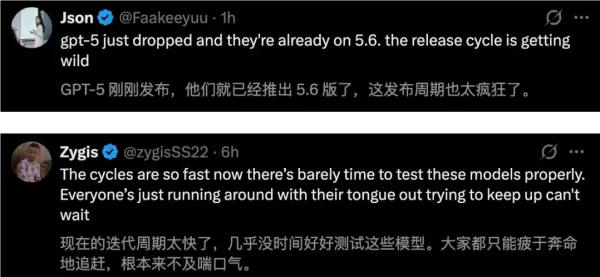
Netizens commented that this iteration speed is impossible to keep up with.
Speed pushed to the limit again — Codex to launch ultrafast mode
Even before GPT-5.6 arrives, OpenAI's product team can't wait any longer.
Leaker Chetaslua also revealed that this Thursday, OpenAI will introduce "ultrafast mode" on Codex, boosting response speed by 2 to 3 times, specifically for latency-sensitive tasks. At the same time, gpt-image-2, which leads the Image Arena rankings with +242 points, is undergoing A/B testing updates as well.
This is not the first time. When GPT-5.4 was released in March, the /fast mode already achieved a 1.5x speedup. GPT-5.3-Codex-Spark, powered by Cerebras chips, even increased reasoning speed to over 1000 tokens per second — 15 times faster than normal mode. This time, ultrafast mode directly accelerates the flagship main model — not a stripped-down version or a small model, but full-scale acceleration.
For developers, any area that involves "waiting" — such as Agent loops, long task pipelines, and browser automation — will feel entirely different.
By the way, last week the official ChatGPT account posted a sci-fi image, and the classic "Ask ChatGPT" on the interface was quietly replaced with "Message ChatGPT". Otto said "Call me maybe", which fueled speculation about ChatGPT integrating voice calls or launching hardware products.
Codex vs Claude Code: the subsidy war is officially underway
The most dramatic scene in Silicon Valley unfolded today.
Just before the launch of OpenAI's ultrafast mode, Anthropic made the first move — announcing that starting June 15, paid users will receive a 50% increase in monthly programming quotas, covering Claude Agent SDK, command-line tools, and Claude Code deeply integrated with GitHub workflows. They also released Opus4.7Fast mode, focused on faster advanced reasoning and a smoother long-context coding experience than Codex.
OpenAI did not keep people waiting. In response, they launched a powerful subsidy: any company that migrates to Codex from other platforms within the next 30 days will receive two months of free usage. Based on the $200/month Pro plan, that's equivalent to $400. Otto personally joined the campaign, stating that Codex is "the strongest AI programming product available on the market."
Just hours later, reports came in: 2,000 developers contacted OpenAI within 3 hours.
This face-to-face confrontation stunned the entire Silicon Valley. Developers, however, were happy — getting subsidies from two top companies like this is a rare opportunity.
The flywheel has already started spinning
Looking at these two events together, a trend more significant than any single piece of news is taking shape.
AI is accelerating its own evolution. GPT-5.3-Codex was OpenAI's first model that "participated in its own training." By GPT-5.5, 85% of OpenAI employees were using Codex to write code weekly. It's almost certain that GPT-5.6 was developed with deep involvement from GPT-5.5 — AI is helping OpenAI build stronger AI.
At the same time, the widespread adoption of programming tools is unleashing unprecedented engineering productivity. Codex already has 3 million weekly active users, and Claude Code's user base is also growing rapidly. Millions of developers now treat AI programming tools as a daily standard, and AI-generated code further feeds back into AI training and deployment. This cycle will only spin faster.
Otto said that OpenAI's goal is no longer just AGI, but directly aiming for ASI.
When model iteration speed is driven by AI itself, when AI programming tools become the infrastructure for AI development, and when two trillion-dollar companies use a "subsidy war" to accelerate this process —
The flywheel toward ASI has already begun to spin on its own.
Related article
 Suno to Watermark Songs Amid Legal Battles
Suno, the platform enabling users to generate AI-created music, has unveiled new features to label platform-produced tracks, restrict downloads, and update community standards to curb unauthorized replicas. These updates arrive as Suno confronts mult
Musk Admits Grok Build Leaked User Code, Promises to Erase All Historical Data
Elon Musk directly addressed the privacy controversy surrounding Grok Build, beginning with a simple "True" to confirm the incident's validity. He pledged that all user data previously uploaded to SpaceXAI would be permanently erased, stating, "not a
U.S. Stocks Hit Historic Milestone as AI and Aerospace Giants Prepare for Trillion-Dollar Debut
Elon Musk, Sam Altman, and Dario Amodei, three titans of the technology sector, are advancing toward initial public offerings for their respective ventures. With SpaceX, OpenAI, and Anthropic—three industry behemoths nearing trillion-dollar valuation
Related Special Topic Recommendations
SEO
Suno to Watermark Songs Amid Legal Battles
Suno, the platform enabling users to generate AI-created music, has unveiled new features to label platform-produced tracks, restrict downloads, and update community standards to curb unauthorized replicas. These updates arrive as Suno confronts mult
Musk Admits Grok Build Leaked User Code, Promises to Erase All Historical Data
Elon Musk directly addressed the privacy controversy surrounding Grok Build, beginning with a simple "True" to confirm the incident's validity. He pledged that all user data previously uploaded to SpaceXAI would be permanently erased, stating, "not a
U.S. Stocks Hit Historic Milestone as AI and Aerospace Giants Prepare for Trillion-Dollar Debut
Elon Musk, Sam Altman, and Dario Amodei, three titans of the technology sector, are advancing toward initial public offerings for their respective ventures. With SpaceX, OpenAI, and Anthropic—three industry behemoths nearing trillion-dollar valuation
Related Special Topic Recommendations
SEO
 Best AI SERP Analysis Tools for Search Strategy
2026 Latest Best Top-rated AI SERP Analysis Tools for Search Strategy are curated by XIX.AI through rigorous real-world tests and weekly updated rankings. These powerful tools help you unlock hidden optimization opportunities, boost content performance, and gain a competitive edge in search. Discover your perfect tool to elevate your search strategy today. Explore now!
 13 tools
 xix.ai
Data Analysis
Best AI Anomaly Detection Tools for KPI Monitoring across SaaS and Ecommerce Teams
xix.ai
Data Analysis
Best AI Anomaly Detection Tools for KPI Monitoring across SaaS and Ecommerce Teams
2026 Latest Best Top-rated AI Anomaly Detection Tools for KPI Monitoring in SaaS and Ecommerce teams! XIX.AI has curated a powerful, game-changing collection based on rigorous real-world tests and weekly updated rankings. You’ll find detailed free vs paid comparison insights to help you identify the must-try solution that boosts productivity and unlocks your AI edge. Explore now!
10 tools
xix.ai
writing
Best AI Outline Generators for Long-Form SEO Articles
2026 Latest Best Top-Rated AI Outline Generators for Long-Form SEO Articles, meticulously curated by XIX.AI. These powerful tools offer game-changing assistance in creating high-quality content quickly, boosting writing efficiency significantly. Get a free vs paid comparison along with real-world tests and detailed rankings to help you find the must-try option that suits your needs. Explore now to unlock your AI edge.
8 tools
xix.ai
Education and Learning
AI Study Tools for Homework and Exam Prep
2026 Latest Best AI Study Tools for Homework and Exam Prep! XIX.AI curates a top-rated list of powerful, game-changing tools that help students boost productivity, streamline homework completion, and ace exams through real-world tests. Get a free vs paid comparison, detailed rankings, and must-try options to unlock your AI edge. Explore now!
10 tools
xix.ai
Music composition
AI Vocal Demo Tools for Songwriters, Hooks, Toplines, and Multilingual Draft Sessions
2026 Latest Best AI Vocal Demo Tools for Songwriters, Hook Creators, and Multi-Language Content Teams! XIX.AI has curated a top-rated list of powerful game-changing tools that go through rigorous real-world tests. You’ll find detailed free vs paid comparison data, comprehensive rankings, and must-try options to help you boost writing efficiency and unlock your creative potential. Explore now to discover your perfect tool for all your content needs!
9 tools
xix.ai
Business
Best AI Competitive Research Tools for Small Businesses
2026 Latest Best Top-rated AI Competitive Research Tools for Small Businesses! XIX.AI has curated a highly powerful game-changing collection, updated weekly with rigorous real-world tests and detailed rankings. You can find a comprehensive free vs paid comparison to help you identify the must-try tools that boost your productivity and give you a competitive edge. Explore now to discover your perfect tool!
9 tools
xix.ai

 Comments (0)
0/500
Comments (0)
0/500
Just three weeks after GPT-5.5 launched, rumors about GPT-5.6 are already spreading.
Well-known leaker Leo revealed that GPT-5.6 development is now in full swing, with the first internal checkpoints being tested in recent days. An official unveiling is expected next month. Interestingly, traces of rollout mapping were found in OpenAI’s internal Codex logs — most calls still point to GPT-5.5, but one record clearly points to GPT-5.6. This suggests Codex may already be using it secretly for testing. Internal code names were also accidentally exposed: ember-alpha and beacon-alpha.
Netizens commented that this iteration speed is impossible to keep up with.
Speed pushed to the limit again — Codex to launch ultrafast mode
Even before GPT-5.6 arrives, OpenAI's product team can't wait any longer.
Leaker Chetaslua also revealed that this Thursday, OpenAI will introduce "ultrafast mode" on Codex, boosting response speed by 2 to 3 times, specifically for latency-sensitive tasks. At the same time, gpt-image-2, which leads the Image Arena rankings with +242 points, is undergoing A/B testing updates as well.
This is not the first time. When GPT-5.4 was released in March, the /fast mode already achieved a 1.5x speedup. GPT-5.3-Codex-Spark, powered by Cerebras chips, even increased reasoning speed to over 1000 tokens per second — 15 times faster than normal mode. This time, ultrafast mode directly accelerates the flagship main model — not a stripped-down version or a small model, but full-scale acceleration.
For developers, any area that involves "waiting" — such as Agent loops, long task pipelines, and browser automation — will feel entirely different.
By the way, last week the official ChatGPT account posted a sci-fi image, and the classic "Ask ChatGPT" on the interface was quietly replaced with "Message ChatGPT". Otto said "Call me maybe", which fueled speculation about ChatGPT integrating voice calls or launching hardware products.
Codex vs Claude Code: the subsidy war is officially underway
The most dramatic scene in Silicon Valley unfolded today.
Just before the launch of OpenAI's ultrafast mode, Anthropic made the first move — announcing that starting June 15, paid users will receive a 50% increase in monthly programming quotas, covering Claude Agent SDK, command-line tools, and Claude Code deeply integrated with GitHub workflows. They also released Opus4.7Fast mode, focused on faster advanced reasoning and a smoother long-context coding experience than Codex.
OpenAI did not keep people waiting. In response, they launched a powerful subsidy: any company that migrates to Codex from other platforms within the next 30 days will receive two months of free usage. Based on the $200/month Pro plan, that's equivalent to $400. Otto personally joined the campaign, stating that Codex is "the strongest AI programming product available on the market."
Just hours later, reports came in: 2,000 developers contacted OpenAI within 3 hours.
This face-to-face confrontation stunned the entire Silicon Valley. Developers, however, were happy — getting subsidies from two top companies like this is a rare opportunity.
The flywheel has already started spinning
Looking at these two events together, a trend more significant than any single piece of news is taking shape.
AI is accelerating its own evolution. GPT-5.3-Codex was OpenAI's first model that "participated in its own training." By GPT-5.5, 85% of OpenAI employees were using Codex to write code weekly. It's almost certain that GPT-5.6 was developed with deep involvement from GPT-5.5 — AI is helping OpenAI build stronger AI.
At the same time, the widespread adoption of programming tools is unleashing unprecedented engineering productivity. Codex already has 3 million weekly active users, and Claude Code's user base is also growing rapidly. Millions of developers now treat AI programming tools as a daily standard, and AI-generated code further feeds back into AI training and deployment. This cycle will only spin faster.
Otto said that OpenAI's goal is no longer just AGI, but directly aiming for ASI.
When model iteration speed is driven by AI itself, when AI programming tools become the infrastructure for AI development, and when two trillion-dollar companies use a "subsidy war" to accelerate this process —
The flywheel toward ASI has already begun to spin on its own.








 Suno to Watermark Songs Amid Legal Battles
Suno, the platform enabling users to generate AI-created music, has unveiled new features to label platform-produced tracks, restrict downloads, and update community standards to curb unauthorized replicas. These updates arrive as Suno confronts mult
Suno to Watermark Songs Amid Legal Battles
Suno, the platform enabling users to generate AI-created music, has unveiled new features to label platform-produced tracks, restrict downloads, and update community standards to curb unauthorized replicas. These updates arrive as Suno confronts mult
 Musk Admits Grok Build Leaked User Code, Promises to Erase All Historical Data
Elon Musk directly addressed the privacy controversy surrounding Grok Build, beginning with a simple "True" to confirm the incident's validity. He pledged that all user data previously uploaded to SpaceXAI would be permanently erased, stating, "not a
Musk Admits Grok Build Leaked User Code, Promises to Erase All Historical Data
Elon Musk directly addressed the privacy controversy surrounding Grok Build, beginning with a simple "True" to confirm the incident's validity. He pledged that all user data previously uploaded to SpaceXAI would be permanently erased, stating, "not a
 U.S. Stocks Hit Historic Milestone as AI and Aerospace Giants Prepare for Trillion-Dollar Debut
Elon Musk, Sam Altman, and Dario Amodei, three titans of the technology sector, are advancing toward initial public offerings for their respective ventures. With SpaceX, OpenAI, and Anthropic—three industry behemoths nearing trillion-dollar valuation
U.S. Stocks Hit Historic Milestone as AI and Aerospace Giants Prepare for Trillion-Dollar Debut
Elon Musk, Sam Altman, and Dario Amodei, three titans of the technology sector, are advancing toward initial public offerings for their respective ventures. With SpaceX, OpenAI, and Anthropic—three industry behemoths nearing trillion-dollar valuation

2026 Latest Best Top-rated AI SERP Analysis Tools for Search Strategy are curated by XIX.AI through rigorous real-world tests and weekly updated rankings. These powerful tools help you unlock hidden optimization opportunities, boost content performance, and gain a competitive edge in search. Discover your perfect tool to elevate your search strategy today. Explore now!
13 tools
xix.ai

2026 Latest Best Top-rated AI Anomaly Detection Tools for KPI Monitoring in SaaS and Ecommerce teams! XIX.AI has curated a powerful, game-changing collection based on rigorous real-world tests and weekly updated rankings. You’ll find detailed free vs paid comparison insights to help you identify the must-try solution that boosts productivity and unlocks your AI edge. Explore now!
10 tools
xix.ai

2026 Latest Best Top-Rated AI Outline Generators for Long-Form SEO Articles, meticulously curated by XIX.AI. These powerful tools offer game-changing assistance in creating high-quality content quickly, boosting writing efficiency significantly. Get a free vs paid comparison along with real-world tests and detailed rankings to help you find the must-try option that suits your needs. Explore now to unlock your AI edge.
8 tools
xix.ai

2026 Latest Best AI Study Tools for Homework and Exam Prep! XIX.AI curates a top-rated list of powerful, game-changing tools that help students boost productivity, streamline homework completion, and ace exams through real-world tests. Get a free vs paid comparison, detailed rankings, and must-try options to unlock your AI edge. Explore now!
10 tools
xix.ai

2026 Latest Best AI Vocal Demo Tools for Songwriters, Hook Creators, and Multi-Language Content Teams! XIX.AI has curated a top-rated list of powerful game-changing tools that go through rigorous real-world tests. You’ll find detailed free vs paid comparison data, comprehensive rankings, and must-try options to help you boost writing efficiency and unlock your creative potential. Explore now to discover your perfect tool for all your content needs!
9 tools
xix.ai

2026 Latest Best Top-rated AI Competitive Research Tools for Small Businesses! XIX.AI has curated a highly powerful game-changing collection, updated weekly with rigorous real-world tests and detailed rankings. You can find a comprehensive free vs paid comparison to help you identify the must-try tools that boost your productivity and give you a competitive edge. Explore now to discover your perfect tool!
9 tools
xix.ai












