


 Home
HomeGoogle Doppl App Emerges as a Surprise Breakout Success
I virtually tried on five different outfits in under 10 minutes — or rather, my AI-generated double did. This was all possible thanks to Doppl, a new app currently being tested by Google, which I used to create AI video clips of myself modeling clothing I discovered online. While the app functions reasonably well, it clearly struggles with accurately superimposing pants over photos where I'm wearing shorts. In one particularly amusing case, it even replaced my mismatched socks with artificially generated feet.
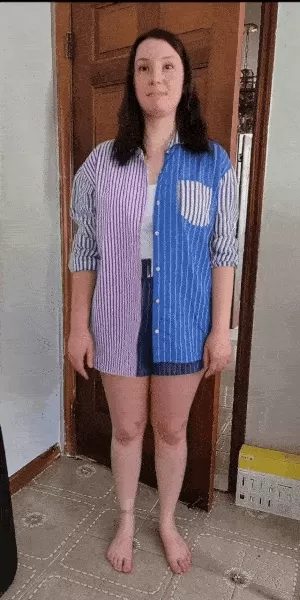
No, those are NOT my real feet. GIF: Emma Roth / The VergeUsing the app is incredibly straightforward. All you need is a screenshot of the outfit you'd like to try — whether from Pinterest, Instagram, or another site — along with a full-body photo of yourself taken in bright lighting, featuring a natural pose and no headwear. After uploading both, you can have Doppl generate a still image of you wearing the selected clothing. The generation process takes a moment, but once it's complete, you can tap the animation icon to add a random movement. This might show you flashing a peace sign, smiling and waving at the camera, or striking another casual pose.
For my test, I uploaded a straightforward photo of myself in a T-shirt, shorts, and socks. In my first try-on, I picked one of Google's sample outfits. The app reproduced the white and blue striped shirt fairly well, but it swapped the intended skinny jeans for red shorts and wrapped what should have been denim fabric around my calves, creating a strange leg warmer effect. Another outfit I tried, featuring distressed jeans, resulted in Doppl only generating the lower portion of the pants while elongating the shirt to end precisely where my shorts do in reality.
The results got even more unusual when I gave Doppl an outfit image showing a person from the knees up, wearing a striped button-down and long striped shorts. Rather than recreating a similar look, it made the shorts even shorter and gave me a pair of surprisingly believable, yet entirely fake, feet.
Interestingly, even when the outfits I uploaded didn't show the model’s shoes, Doppl still generated some form of footwear for each look. (Perhaps Google's AI simply decided the outfits looked better with bare feet?)
Throughout my testing, I noticed Doppl prevented me from uploading pictures of more revealing clothing found online, such as someone in a bikini. It also blocked my colleague, Marina Galperina, from uploading an image of former President Donald Trump. These safeguards likely help curb the creation of fake images of public figures or the generation of inappropriate content.

It just can’t seem to get pants right if you’re wearing shorts. GIF: Emma Roth / The VergeA curious pattern emerged, however, when Marina and I uploaded mirror selfies to virtually try on outfits. Instead of maintaining a close resemblance to our actual appearances, Doppl made both of our digital avatars noticeably thinner, to the point where we looked somewhat like bobblehead figures. This issue did not occur when I used other full-body photos taken by another person.
Google has offered a virtual try-on tool for a few years, but earlier this year it enhanced the feature, allowing users to upload their own photos and use AI to visualize themselves in tops, dresses, skirts, or pants found via Google Search. Doppl represents an even greater advancement, enabling you to try on a wider variety of clothing from different online sources and even generate a video of the result. If Google can iron out some of the tool's current oddities, I can see it becoming a genuinely useful way to picture yourself in any outfit you spot online.
Doppl is now available in the U.S. via its app on both Android and iOS.
Related article
 Ollie bets privacy focus to win AI assistant race
To be genuinely helpful, an AI assistant must understand its user deeply. Ollie, a personal assistant designed for daily life, operates on the premise that this doesn’t require surrendering your data or compromising your privacy.While certain enterpr
How AI LIVE: London Will Explore AI & Industrial Automation
The summit will convene C-suite executives from around the globe to address pressing challenges in global industries, ranging from AI-driven disruption to economic volatility.AI LIVE: The London Summit will gather over 2,000 international leaders und
Anthropic Enters AI Legal Tech Market as Competition Intensifies
Anthropic unveiled a suite of new chatbot capabilities on Tuesday, aimed at delivering automated support to legal practices. These enhancements expand upon Claude for Legal, the firm-specific platform introduced earlier this year, by adding specializ
Related Special Topic Recommendations
Education and Learning
Ollie bets privacy focus to win AI assistant race
To be genuinely helpful, an AI assistant must understand its user deeply. Ollie, a personal assistant designed for daily life, operates on the premise that this doesn’t require surrendering your data or compromising your privacy.While certain enterpr
How AI LIVE: London Will Explore AI & Industrial Automation
The summit will convene C-suite executives from around the globe to address pressing challenges in global industries, ranging from AI-driven disruption to economic volatility.AI LIVE: The London Summit will gather over 2,000 international leaders und
Anthropic Enters AI Legal Tech Market as Competition Intensifies
Anthropic unveiled a suite of new chatbot capabilities on Tuesday, aimed at delivering automated support to legal practices. These enhancements expand upon Claude for Legal, the firm-specific platform introduced earlier this year, by adding specializ
Related Special Topic Recommendations
Education and Learning
 AI Study Tools for Homework and Exam Prep
2026 Latest Best AI Study Tools for Homework and Exam Prep! XIX.AI curates a top-rated list of powerful, game-changing tools that help students boost productivity, streamline homework completion, and ace exams through real-world tests. Get a free vs paid comparison, detailed rankings, and must-try options to unlock your AI edge. Explore now!
 10 tools
 xix.ai
Music composition
AI Vocal Demo Tools for Songwriters, Hooks, Toplines, and Multilingual Draft Sessions
xix.ai
Music composition
AI Vocal Demo Tools for Songwriters, Hooks, Toplines, and Multilingual Draft Sessions
2026 Latest Best AI Vocal Demo Tools for Songwriters, Hook Creators, and Multi-Language Content Teams! XIX.AI has curated a top-rated list of powerful game-changing tools that go through rigorous real-world tests. You’ll find detailed free vs paid comparison data, comprehensive rankings, and must-try options to help you boost writing efficiency and unlock your creative potential. Explore now to discover your perfect tool for all your content needs!
9 tools
xix.ai
Business
Best AI Competitive Research Tools for Small Businesses
2026 Latest Best Top-rated AI Competitive Research Tools for Small Businesses! XIX.AI has curated a highly powerful game-changing collection, updated weekly with rigorous real-world tests and detailed rankings. You can find a comprehensive free vs paid comparison to help you identify the must-try tools that boost your productivity and give you a competitive edge. Explore now to discover your perfect tool!
9 tools
xix.ai
Image editing
Photoshop AI Retouch Tools for Ecommerce Apparel, Skin Cleanup, and Color Consistency
2026 Latest Best Photoshop AI retouch tools for ecommerce apparel, skin cleanup, and color consistency! This top-rated curated list features powerful game-changing solutions that help you boost writing efficiency, streamline content creation, and achieve perfect visual results effortlessly. Each tool has undergone real-world tests through weekly updated rankings, complete with free vs paid comparison details. Backed by XIX.AI, it’s the must-try guide for anyone aiming to unlock your AI edge. Explore now!
10 tools
xix.ai
Prompt
Best AI Prompt Libraries for ChatGPT Workflows
2026 Latest Best Top-Rated AI Prompt Libraries for optimizing all types of ChatGPT workflows. XIX.AI has curated a powerful, game-changing collection that goes through rigorous real-world tests to ensure top performance. You can find detailed free vs paid comparisons and expert rankings to help you choose the must-try tools that boost your productivity and unlock your AI edge. Explore now!
11 tools
xix.ai
Education and Learning
AI Quiz Builder Platforms for Teachers, Tutors, and Cohort-Based Learning Programs
2026 Latest Best AI Quiz Builder Platforms for Teachers, Tutors, and Cohort-Based Learning Programs! XIX.AI has curated a top-rated list of powerful game-changing tools that go through real-world tests to deliver accurate rankings. These must-try platforms help boost writing efficiency, streamline content creation, and simplify quiz design across all learning scenarios. Explore now to discover your perfect tool for unlocking your AI edge in teaching!
13 tools
xix.ai

 Comments (1)
0/500
Comments (1)
0/500
![AnthonyHill]()
Just tried this app and honestly it‘s a bit eerie seeing a digital version of myself try on outfits so smoothly. Saves a ton of time for sure! I do wonder about the privacy angle though—will our data just feed more targeted ads? Still, the convenience is undeniable. 🤔
I virtually tried on five different outfits in under 10 minutes — or rather, my AI-generated double did. This was all possible thanks to Doppl, a new app currently being tested by Google, which I used to create AI video clips of myself modeling clothing I discovered online. While the app functions reasonably well, it clearly struggles with accurately superimposing pants over photos where I'm wearing shorts. In one particularly amusing case, it even replaced my mismatched socks with artificially generated feet.
Using the app is incredibly straightforward. All you need is a screenshot of the outfit you'd like to try — whether from Pinterest, Instagram, or another site — along with a full-body photo of yourself taken in bright lighting, featuring a natural pose and no headwear. After uploading both, you can have Doppl generate a still image of you wearing the selected clothing. The generation process takes a moment, but once it's complete, you can tap the animation icon to add a random movement. This might show you flashing a peace sign, smiling and waving at the camera, or striking another casual pose.
For my test, I uploaded a straightforward photo of myself in a T-shirt, shorts, and socks. In my first try-on, I picked one of Google's sample outfits. The app reproduced the white and blue striped shirt fairly well, but it swapped the intended skinny jeans for red shorts and wrapped what should have been denim fabric around my calves, creating a strange leg warmer effect. Another outfit I tried, featuring distressed jeans, resulted in Doppl only generating the lower portion of the pants while elongating the shirt to end precisely where my shorts do in reality.
The results got even more unusual when I gave Doppl an outfit image showing a person from the knees up, wearing a striped button-down and long striped shorts. Rather than recreating a similar look, it made the shorts even shorter and gave me a pair of surprisingly believable, yet entirely fake, feet.
Interestingly, even when the outfits I uploaded didn't show the model’s shoes, Doppl still generated some form of footwear for each look. (Perhaps Google's AI simply decided the outfits looked better with bare feet?)
Throughout my testing, I noticed Doppl prevented me from uploading pictures of more revealing clothing found online, such as someone in a bikini. It also blocked my colleague, Marina Galperina, from uploading an image of former President Donald Trump. These safeguards likely help curb the creation of fake images of public figures or the generation of inappropriate content.
A curious pattern emerged, however, when Marina and I uploaded mirror selfies to virtually try on outfits. Instead of maintaining a close resemblance to our actual appearances, Doppl made both of our digital avatars noticeably thinner, to the point where we looked somewhat like bobblehead figures. This issue did not occur when I used other full-body photos taken by another person.
Google has offered a virtual try-on tool for a few years, but earlier this year it enhanced the feature, allowing users to upload their own photos and use AI to visualize themselves in tops, dresses, skirts, or pants found via Google Search. Doppl represents an even greater advancement, enabling you to try on a wider variety of clothing from different online sources and even generate a video of the result. If Google can iron out some of the tool's current oddities, I can see it becoming a genuinely useful way to picture yourself in any outfit you spot online.
Doppl is now available in the U.S. via its app on both Android and iOS.








 Ollie bets privacy focus to win AI assistant race
To be genuinely helpful, an AI assistant must understand its user deeply. Ollie, a personal assistant designed for daily life, operates on the premise that this doesn’t require surrendering your data or compromising your privacy.While certain enterpr
Ollie bets privacy focus to win AI assistant race
To be genuinely helpful, an AI assistant must understand its user deeply. Ollie, a personal assistant designed for daily life, operates on the premise that this doesn’t require surrendering your data or compromising your privacy.While certain enterpr
 How AI LIVE: London Will Explore AI & Industrial Automation
The summit will convene C-suite executives from around the globe to address pressing challenges in global industries, ranging from AI-driven disruption to economic volatility.AI LIVE: The London Summit will gather over 2,000 international leaders und
How AI LIVE: London Will Explore AI & Industrial Automation
The summit will convene C-suite executives from around the globe to address pressing challenges in global industries, ranging from AI-driven disruption to economic volatility.AI LIVE: The London Summit will gather over 2,000 international leaders und
 Anthropic Enters AI Legal Tech Market as Competition Intensifies
Anthropic unveiled a suite of new chatbot capabilities on Tuesday, aimed at delivering automated support to legal practices. These enhancements expand upon Claude for Legal, the firm-specific platform introduced earlier this year, by adding specializ
Anthropic Enters AI Legal Tech Market as Competition Intensifies
Anthropic unveiled a suite of new chatbot capabilities on Tuesday, aimed at delivering automated support to legal practices. These enhancements expand upon Claude for Legal, the firm-specific platform introduced earlier this year, by adding specializ

2026 Latest Best AI Study Tools for Homework and Exam Prep! XIX.AI curates a top-rated list of powerful, game-changing tools that help students boost productivity, streamline homework completion, and ace exams through real-world tests. Get a free vs paid comparison, detailed rankings, and must-try options to unlock your AI edge. Explore now!
10 tools
xix.ai

2026 Latest Best AI Vocal Demo Tools for Songwriters, Hook Creators, and Multi-Language Content Teams! XIX.AI has curated a top-rated list of powerful game-changing tools that go through rigorous real-world tests. You’ll find detailed free vs paid comparison data, comprehensive rankings, and must-try options to help you boost writing efficiency and unlock your creative potential. Explore now to discover your perfect tool for all your content needs!
9 tools
xix.ai

2026 Latest Best Top-rated AI Competitive Research Tools for Small Businesses! XIX.AI has curated a highly powerful game-changing collection, updated weekly with rigorous real-world tests and detailed rankings. You can find a comprehensive free vs paid comparison to help you identify the must-try tools that boost your productivity and give you a competitive edge. Explore now to discover your perfect tool!
9 tools
xix.ai

2026 Latest Best Photoshop AI retouch tools for ecommerce apparel, skin cleanup, and color consistency! This top-rated curated list features powerful game-changing solutions that help you boost writing efficiency, streamline content creation, and achieve perfect visual results effortlessly. Each tool has undergone real-world tests through weekly updated rankings, complete with free vs paid comparison details. Backed by XIX.AI, it’s the must-try guide for anyone aiming to unlock your AI edge. Explore now!
10 tools
xix.ai
2026 Latest Best Top-Rated AI Prompt Libraries for optimizing all types of ChatGPT workflows. XIX.AI has curated a powerful, game-changing collection that goes through rigorous real-world tests to ensure top performance. You can find detailed free vs paid comparisons and expert rankings to help you choose the must-try tools that boost your productivity and unlock your AI edge. Explore now!
11 tools
xix.ai

2026 Latest Best AI Quiz Builder Platforms for Teachers, Tutors, and Cohort-Based Learning Programs! XIX.AI has curated a top-rated list of powerful game-changing tools that go through real-world tests to deliver accurate rankings. These must-try platforms help boost writing efficiency, streamline content creation, and simplify quiz design across all learning scenarios. Explore now to discover your perfect tool for unlocking your AI edge in teaching!
13 tools
xix.ai

Just tried this app and honestly it‘s a bit eerie seeing a digital version of myself try on outfits so smoothly. Saves a ton of time for sure! I do wonder about the privacy angle though—will our data just feed more targeted ads? Still, the convenience is undeniable. 🤔












