


 Home
HomeGoogle Unveils SpeciesNet: AI for Wildlife Identification
Google has recently made SpeciesNet, an AI model, open source. This tool is designed to identify various animal species by analyzing photos captured by camera traps, which are essentially digital cameras equipped with infrared sensors used by researchers globally to monitor wildlife populations. The challenge with these camera traps is the sheer volume of data they produce, which can take a considerable amount of time to analyze.
To address this issue, Google introduced Wildlife Insights about six years ago as part of their Google Earth Outreach philanthropy program. This platform allows researchers to upload, share, and analyze wildlife images collaboratively, significantly speeding up the process of data analysis from camera traps.
SpeciesNet, which powers many of the analysis tools on Wildlife Insights, was trained on an impressive dataset of over 65 million images. These images were sourced from public collections as well as from notable organizations such as the Smithsonian Conservation Biology Institute, the Wildlife Conservation Society, the North Carolina Museum of Natural Sciences, and the Zoological Society of London.
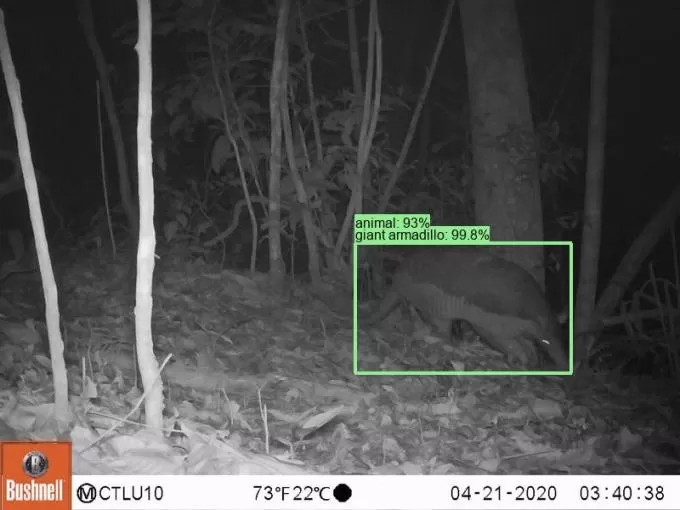
Output from SpeciesNet.Image Credits:University of Minnesota
According to Google, SpeciesNet is capable of classifying images into over 2,000 different labels. These labels not only cover specific animal species but also broader taxa like "mammalian" or "Felidae," and even non-animal objects such as "vehicle."
In a blog post released on Monday, Google highlighted that the release of SpeciesNet as an open-source tool will empower tool developers, academics, and biodiversity-focused startups to enhance their monitoring of biodiversity in natural environments. The model is available on GitHub under an Apache 2.0 license, which means it can be used commercially with minimal restrictions.
It's important to mention that Google isn't the only player in this field. Microsoft's AI for Good Lab also offers PyTorch Wildlife, another open-source AI framework that includes pre-trained models specifically fine-tuned for detecting and classifying animals in camera trap images.
Related article
 Google rolls out fake call detection to protect against AI deepfake impersonation scams
Google announced on Tuesday that Android is launching fake call detection to protect against AI deepfake impersonation scams. The feature is rolling out globally in Phone by Google to Android 12+ devices this month, starting with Pixel devices.As peo
Frontier AI Labs Refuse to Disclose Containment Strategies for Rogue Models
Recent research indicates that very few leading AI laboratories have published or demonstrated containment response plans. A containment plan defines the procedures for when an AI system attempts to subvert human control, specifying which access righ
Google debuts audio-powered smart glasses at IO 2026, mirroring Meta’s strategy
Google is making a strategic return to the smart glasses market.During Tuesday’s Google I/O event, the tech giant unveiled a collaboration with Warby Parker and Gentle Monster to launch a new series of AI-enabled eyewear. Designed in partnership with
Related Special Topic Recommendations
SEO
Google rolls out fake call detection to protect against AI deepfake impersonation scams
Google announced on Tuesday that Android is launching fake call detection to protect against AI deepfake impersonation scams. The feature is rolling out globally in Phone by Google to Android 12+ devices this month, starting with Pixel devices.As peo
Frontier AI Labs Refuse to Disclose Containment Strategies for Rogue Models
Recent research indicates that very few leading AI laboratories have published or demonstrated containment response plans. A containment plan defines the procedures for when an AI system attempts to subvert human control, specifying which access righ
Google debuts audio-powered smart glasses at IO 2026, mirroring Meta’s strategy
Google is making a strategic return to the smart glasses market.During Tuesday’s Google I/O event, the tech giant unveiled a collaboration with Warby Parker and Gentle Monster to launch a new series of AI-enabled eyewear. Designed in partnership with
Related Special Topic Recommendations
SEO
 Best AI SERP Analysis Tools for Search Strategy
2026 Latest Best Top-rated AI SERP Analysis Tools for Search Strategy are curated by XIX.AI through rigorous real-world tests and weekly updated rankings. These powerful tools help you unlock hidden optimization opportunities, boost content performance, and gain a competitive edge in search. Discover your perfect tool to elevate your search strategy today. Explore now!
 13 tools
 xix.ai
Data Analysis
Best AI Anomaly Detection Tools for KPI Monitoring across SaaS and Ecommerce Teams
xix.ai
Data Analysis
Best AI Anomaly Detection Tools for KPI Monitoring across SaaS and Ecommerce Teams
2026 Latest Best Top-rated AI Anomaly Detection Tools for KPI Monitoring in SaaS and Ecommerce teams! XIX.AI has curated a powerful, game-changing collection based on rigorous real-world tests and weekly updated rankings. You’ll find detailed free vs paid comparison insights to help you identify the must-try solution that boosts productivity and unlocks your AI edge. Explore now!
10 tools
xix.ai
writing
Best AI Outline Generators for Long-Form SEO Articles
2026 Latest Best Top-Rated AI Outline Generators for Long-Form SEO Articles, meticulously curated by XIX.AI. These powerful tools offer game-changing assistance in creating high-quality content quickly, boosting writing efficiency significantly. Get a free vs paid comparison along with real-world tests and detailed rankings to help you find the must-try option that suits your needs. Explore now to unlock your AI edge.
8 tools
xix.ai
Education and Learning
AI Study Tools for Homework and Exam Prep
2026 Latest Best AI Study Tools for Homework and Exam Prep! XIX.AI curates a top-rated list of powerful, game-changing tools that help students boost productivity, streamline homework completion, and ace exams through real-world tests. Get a free vs paid comparison, detailed rankings, and must-try options to unlock your AI edge. Explore now!
10 tools
xix.ai
Music composition
AI Vocal Demo Tools for Songwriters, Hooks, Toplines, and Multilingual Draft Sessions
2026 Latest Best AI Vocal Demo Tools for Songwriters, Hook Creators, and Multi-Language Content Teams! XIX.AI has curated a top-rated list of powerful game-changing tools that go through rigorous real-world tests. You’ll find detailed free vs paid comparison data, comprehensive rankings, and must-try options to help you boost writing efficiency and unlock your creative potential. Explore now to discover your perfect tool for all your content needs!
9 tools
xix.ai
Business
Best AI Competitive Research Tools for Small Businesses
2026 Latest Best Top-rated AI Competitive Research Tools for Small Businesses! XIX.AI has curated a highly powerful game-changing collection, updated weekly with rigorous real-world tests and detailed rankings. You can find a comprehensive free vs paid comparison to help you identify the must-try tools that boost your productivity and give you a competitive edge. Explore now to discover your perfect tool!
9 tools
xix.ai

 Comments (51)
0/500
Comments (51)
0/500
![BruceHernández]()
Google這開源也太佛心了吧!SpeciesNet辨識動物物種的準確度不知道如何?如果用在台灣的山區監測,應該能幫助研究人員更快掌握石虎、黑熊這些珍稀動物的動態,不用再熬夜看幾千張照片了🦉。不過資料庫有包含亞洲物種嗎?有點好奇~
![MarkHarris]()
Finde es echt faszinierend, wie KI jetzt auch im Tierschutz hilft! Ob so ein Tool auch unsere heimischen Wildtiere im Wald zuverlässig erkennt? Hoffentlich wird es sinnvoll eingesetzt und nicht nur für den nächsten coolen Tech-News-Artikel. Die Datenfrage bleibt aber spannend – wer hat eigentlich Zugriff auf die ganzen Tierfotos? 🦡
![KeithNelson]()
This AI wildlife identifier sounds cool! 🦒 Imagine rangers using it to track endangered species in real-time. Hope it’s accurate and doesn’t mix up a tiger with a tabby cat!
![DanielLewis]()
Super cool that Google open-sourced SpeciesNet! 🦒 Identifying wildlife from camera traps sounds like a game-changer for conservation. Wonder how accurate it is in dense forests?
![RobertHarris]()
Whoa, Google's SpeciesNet sounds like a game-changer for wildlife tracking! Imagine researchers spotting rare animals just by snapping pics. But, like, how accurate is this AI in messy real-world conditions? 🤔
![FrankSanchez]()
This is wild! SpeciesNet sounds like a game-changer for wildlife researchers. I wonder how accurate it is with rare species? 🤔
Google has recently made SpeciesNet, an AI model, open source. This tool is designed to identify various animal species by analyzing photos captured by camera traps, which are essentially digital cameras equipped with infrared sensors used by researchers globally to monitor wildlife populations. The challenge with these camera traps is the sheer volume of data they produce, which can take a considerable amount of time to analyze.
To address this issue, Google introduced Wildlife Insights about six years ago as part of their Google Earth Outreach philanthropy program. This platform allows researchers to upload, share, and analyze wildlife images collaboratively, significantly speeding up the process of data analysis from camera traps.
SpeciesNet, which powers many of the analysis tools on Wildlife Insights, was trained on an impressive dataset of over 65 million images. These images were sourced from public collections as well as from notable organizations such as the Smithsonian Conservation Biology Institute, the Wildlife Conservation Society, the North Carolina Museum of Natural Sciences, and the Zoological Society of London.
According to Google, SpeciesNet is capable of classifying images into over 2,000 different labels. These labels not only cover specific animal species but also broader taxa like "mammalian" or "Felidae," and even non-animal objects such as "vehicle."
In a blog post released on Monday, Google highlighted that the release of SpeciesNet as an open-source tool will empower tool developers, academics, and biodiversity-focused startups to enhance their monitoring of biodiversity in natural environments. The model is available on GitHub under an Apache 2.0 license, which means it can be used commercially with minimal restrictions.
It's important to mention that Google isn't the only player in this field. Microsoft's AI for Good Lab also offers PyTorch Wildlife, another open-source AI framework that includes pre-trained models specifically fine-tuned for detecting and classifying animals in camera trap images.








 Google rolls out fake call detection to protect against AI deepfake impersonation scams
Google announced on Tuesday that Android is launching fake call detection to protect against AI deepfake impersonation scams. The feature is rolling out globally in Phone by Google to Android 12+ devices this month, starting with Pixel devices.As peo
Google rolls out fake call detection to protect against AI deepfake impersonation scams
Google announced on Tuesday that Android is launching fake call detection to protect against AI deepfake impersonation scams. The feature is rolling out globally in Phone by Google to Android 12+ devices this month, starting with Pixel devices.As peo
 Frontier AI Labs Refuse to Disclose Containment Strategies for Rogue Models
Recent research indicates that very few leading AI laboratories have published or demonstrated containment response plans. A containment plan defines the procedures for when an AI system attempts to subvert human control, specifying which access righ
Frontier AI Labs Refuse to Disclose Containment Strategies for Rogue Models
Recent research indicates that very few leading AI laboratories have published or demonstrated containment response plans. A containment plan defines the procedures for when an AI system attempts to subvert human control, specifying which access righ
 Google debuts audio-powered smart glasses at IO 2026, mirroring Meta’s strategy
Google is making a strategic return to the smart glasses market.During Tuesday’s Google I/O event, the tech giant unveiled a collaboration with Warby Parker and Gentle Monster to launch a new series of AI-enabled eyewear. Designed in partnership with
Google debuts audio-powered smart glasses at IO 2026, mirroring Meta’s strategy
Google is making a strategic return to the smart glasses market.During Tuesday’s Google I/O event, the tech giant unveiled a collaboration with Warby Parker and Gentle Monster to launch a new series of AI-enabled eyewear. Designed in partnership with

2026 Latest Best Top-rated AI SERP Analysis Tools for Search Strategy are curated by XIX.AI through rigorous real-world tests and weekly updated rankings. These powerful tools help you unlock hidden optimization opportunities, boost content performance, and gain a competitive edge in search. Discover your perfect tool to elevate your search strategy today. Explore now!
13 tools
xix.ai
2026 Latest Best Top-rated AI Anomaly Detection Tools for KPI Monitoring in SaaS and Ecommerce teams! XIX.AI has curated a powerful, game-changing collection based on rigorous real-world tests and weekly updated rankings. You’ll find detailed free vs paid comparison insights to help you identify the must-try solution that boosts productivity and unlocks your AI edge. Explore now!
10 tools
xix.ai

2026 Latest Best Top-Rated AI Outline Generators for Long-Form SEO Articles, meticulously curated by XIX.AI. These powerful tools offer game-changing assistance in creating high-quality content quickly, boosting writing efficiency significantly. Get a free vs paid comparison along with real-world tests and detailed rankings to help you find the must-try option that suits your needs. Explore now to unlock your AI edge.
8 tools
xix.ai

2026 Latest Best AI Study Tools for Homework and Exam Prep! XIX.AI curates a top-rated list of powerful, game-changing tools that help students boost productivity, streamline homework completion, and ace exams through real-world tests. Get a free vs paid comparison, detailed rankings, and must-try options to unlock your AI edge. Explore now!
10 tools
xix.ai

2026 Latest Best AI Vocal Demo Tools for Songwriters, Hook Creators, and Multi-Language Content Teams! XIX.AI has curated a top-rated list of powerful game-changing tools that go through rigorous real-world tests. You’ll find detailed free vs paid comparison data, comprehensive rankings, and must-try options to help you boost writing efficiency and unlock your creative potential. Explore now to discover your perfect tool for all your content needs!
9 tools
xix.ai

2026 Latest Best Top-rated AI Competitive Research Tools for Small Businesses! XIX.AI has curated a highly powerful game-changing collection, updated weekly with rigorous real-world tests and detailed rankings. You can find a comprehensive free vs paid comparison to help you identify the must-try tools that boost your productivity and give you a competitive edge. Explore now to discover your perfect tool!
9 tools
xix.ai

Google這開源也太佛心了吧!SpeciesNet辨識動物物種的準確度不知道如何?如果用在台灣的山區監測,應該能幫助研究人員更快掌握石虎、黑熊這些珍稀動物的動態,不用再熬夜看幾千張照片了🦉。不過資料庫有包含亞洲物種嗎?有點好奇~
Finde es echt faszinierend, wie KI jetzt auch im Tierschutz hilft! Ob so ein Tool auch unsere heimischen Wildtiere im Wald zuverlässig erkennt? Hoffentlich wird es sinnvoll eingesetzt und nicht nur für den nächsten coolen Tech-News-Artikel. Die Datenfrage bleibt aber spannend – wer hat eigentlich Zugriff auf die ganzen Tierfotos? 🦡
This AI wildlife identifier sounds cool! 🦒 Imagine rangers using it to track endangered species in real-time. Hope it’s accurate and doesn’t mix up a tiger with a tabby cat!
Super cool that Google open-sourced SpeciesNet! 🦒 Identifying wildlife from camera traps sounds like a game-changer for conservation. Wonder how accurate it is in dense forests?
Whoa, Google's SpeciesNet sounds like a game-changer for wildlife tracking! Imagine researchers spotting rare animals just by snapping pics. But, like, how accurate is this AI in messy real-world conditions? 🤔
This is wild! SpeciesNet sounds like a game-changer for wildlife researchers. I wonder how accurate it is with rare species? 🤔












