


 Home
Home
Google DeepMind Launches Lyria 3 Pro, Transforming AI Music from 30-Second Previews to Full Songs
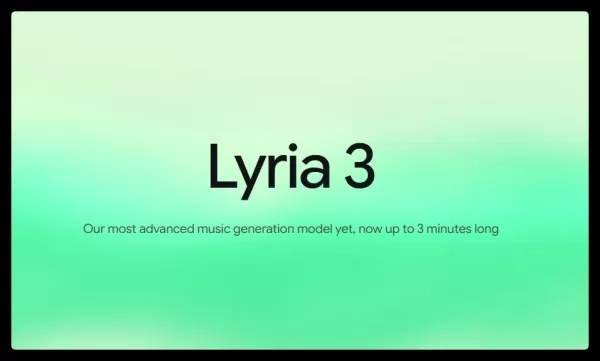
On March 25, Google DeepMind launched Lyria 3 Pro, an upgrade released just six weeks after the previous Lyria 3 version. The main improvement centers on extending generation time from 30 seconds to three minutes, while enabling the model to grasp the internal structure of a song.
This update is significant. Thirty seconds suffices for background sound effects but falls short of writing a complete song—no verses, no twists, no climax. The new structure-aware feature in Lyria 3 Pro lets users specify elements such as intro, verse, chorus, and bridge in their prompts. The model then arranges transitions and dynamic changes accordingly. This represents a key shift for AI music tools, moving from mere generators toward creative tools.
Suno and Udio have been around for over a year
In truth, this capability has been present in Suno and Udio since early 2025, offering longer generation times and more flexible structural control. Google's entry at this stage signals its serious commitment to competing in AI music. With the distribution power of the Gemini ecosystem, Lyria 3 Pro's user base is expected to far exceed that of any independent AI music tool.
The concurrent release of Vertex AI sends another signal: Google aims not only to build consumer-facing tools but also to integrate Lyria into enterprise workflows.
What can it do?
It accepts input in text, images, and videos, with the model automatically matching the music style to the content's emotion. Generated output includes vocals, lyrics, and instruments, supporting multiple languages. All outputs are automatically watermarked with SynthID to indicate AI origin—a consistent practice from DeepMind in content tracing.
Who can use it and how?
Gemini App paid subscribers can now access it. It is tiered by plan: AI Plus allows roughly 10 songs per day, Pro about 20, and Ultra about 50. Free users continue with the 30-second version of Lyria 3.
Supported languages include English, Japanese, Korean, Hindi, Spanish, Portuguese, German, and French. Usage is restricted to users aged 18 and older. The workflow is: Gemini App → Create Music → select "Thinking" or "Pro" mode.
Developers can access it via Google AI Studio and the Gemini API. Vertex AI is now in public preview, aimed at enterprise-level on-demand generation. Google Vids and its music production tool, ProducerAI, have also started integration. Enterprise Workspace support is expected within a few days.
Copyright issues remain unresolved
Google says its use of training data complies with agreements with artists, but it has not disclosed specific sources or licensing scope. This mirrors the copyright lawsuits faced by Suno and Udio—legal disputes over AI music training data remain unresolved in the industry, and Google's statement is more a position declaration than a complete answer.
Lyria 3 Pro is currently rolling out to users gradually, with potential delays in some regions.
Related article
 U.S. Stocks Hit Historic Milestone as AI and Aerospace Giants Prepare for Trillion-Dollar Debut
Elon Musk, Sam Altman, and Dario Amodei, three titans of the technology sector, are advancing toward initial public offerings for their respective ventures. With SpaceX, OpenAI, and Anthropic—three industry behemoths nearing trillion-dollar valuation
Swedish AI Startup Lovable Eyes $13.2 Billion Valuation After Major Funding Round
As AI-driven coding tools gain traction, Swedish startup Lovable has secured a major funding round. The company aims to raise $3 billion, potentially boosting its valuation to $13.2 billion—double the $6.6 billion recorded last December. Menlo Ventur
Google Tests Remy AI Agent for Gemini as Focus Shifts to User Control
According to Business Insider, Google is testing Remy, a new AI personal agent for Gemini. This tool aims to execute tasks on behalf of users, streamlining both professional workflows and daily routines.Currently, Remy is undergoing testing in an int
Related Special Topic Recommendations
Data Analysis
U.S. Stocks Hit Historic Milestone as AI and Aerospace Giants Prepare for Trillion-Dollar Debut
Elon Musk, Sam Altman, and Dario Amodei, three titans of the technology sector, are advancing toward initial public offerings for their respective ventures. With SpaceX, OpenAI, and Anthropic—three industry behemoths nearing trillion-dollar valuation
Swedish AI Startup Lovable Eyes $13.2 Billion Valuation After Major Funding Round
As AI-driven coding tools gain traction, Swedish startup Lovable has secured a major funding round. The company aims to raise $3 billion, potentially boosting its valuation to $13.2 billion—double the $6.6 billion recorded last December. Menlo Ventur
Google Tests Remy AI Agent for Gemini as Focus Shifts to User Control
According to Business Insider, Google is testing Remy, a new AI personal agent for Gemini. This tool aims to execute tasks on behalf of users, streamlining both professional workflows and daily routines.Currently, Remy is undergoing testing in an int
Related Special Topic Recommendations
Data Analysis
 Best AI Anomaly Detection Tools for KPI Monitoring across SaaS and Ecommerce Teams
2026 Latest Best Top-rated AI Anomaly Detection Tools for KPI Monitoring in SaaS and Ecommerce teams! XIX.AI has curated a powerful, game-changing collection based on rigorous real-world tests and weekly updated rankings. You’ll find detailed free vs paid comparison insights to help you identify the must-try solution that boosts productivity and unlocks your AI edge. Explore now!
 10 tools
 xix.ai
writing
Best AI Outline Generators for Long-Form SEO Articles
xix.ai
writing
Best AI Outline Generators for Long-Form SEO Articles
2026 Latest Best Top-Rated AI Outline Generators for Long-Form SEO Articles, meticulously curated by XIX.AI. These powerful tools offer game-changing assistance in creating high-quality content quickly, boosting writing efficiency significantly. Get a free vs paid comparison along with real-world tests and detailed rankings to help you find the must-try option that suits your needs. Explore now to unlock your AI edge.
8 tools
xix.ai
Education and Learning
AI Study Tools for Homework and Exam Prep
2026 Latest Best AI Study Tools for Homework and Exam Prep! XIX.AI curates a top-rated list of powerful, game-changing tools that help students boost productivity, streamline homework completion, and ace exams through real-world tests. Get a free vs paid comparison, detailed rankings, and must-try options to unlock your AI edge. Explore now!
10 tools
xix.ai
Music composition
AI Vocal Demo Tools for Songwriters, Hooks, Toplines, and Multilingual Draft Sessions
2026 Latest Best AI Vocal Demo Tools for Songwriters, Hook Creators, and Multi-Language Content Teams! XIX.AI has curated a top-rated list of powerful game-changing tools that go through rigorous real-world tests. You’ll find detailed free vs paid comparison data, comprehensive rankings, and must-try options to help you boost writing efficiency and unlock your creative potential. Explore now to discover your perfect tool for all your content needs!
9 tools
xix.ai
Business
Best AI Competitive Research Tools for Small Businesses
2026 Latest Best Top-rated AI Competitive Research Tools for Small Businesses! XIX.AI has curated a highly powerful game-changing collection, updated weekly with rigorous real-world tests and detailed rankings. You can find a comprehensive free vs paid comparison to help you identify the must-try tools that boost your productivity and give you a competitive edge. Explore now to discover your perfect tool!
9 tools
xix.ai
Image editing
Photoshop AI Retouch Tools for Ecommerce Apparel, Skin Cleanup, and Color Consistency
2026 Latest Best Photoshop AI retouch tools for ecommerce apparel, skin cleanup, and color consistency! This top-rated curated list features powerful game-changing solutions that help you boost writing efficiency, streamline content creation, and achieve perfect visual results effortlessly. Each tool has undergone real-world tests through weekly updated rankings, complete with free vs paid comparison details. Backed by XIX.AI, it’s the must-try guide for anyone aiming to unlock your AI edge. Explore now!
10 tools
xix.ai

 Comments (0)
0/500
Comments (0)
0/500
On March 25, Google DeepMind launched Lyria 3 Pro, an upgrade released just six weeks after the previous Lyria 3 version. The main improvement centers on extending generation time from 30 seconds to three minutes, while enabling the model to grasp the internal structure of a song.
This update is significant. Thirty seconds suffices for background sound effects but falls short of writing a complete song—no verses, no twists, no climax. The new structure-aware feature in Lyria 3 Pro lets users specify elements such as intro, verse, chorus, and bridge in their prompts. The model then arranges transitions and dynamic changes accordingly. This represents a key shift for AI music tools, moving from mere generators toward creative tools.
Suno and Udio have been around for over a year
In truth, this capability has been present in Suno and Udio since early 2025, offering longer generation times and more flexible structural control. Google's entry at this stage signals its serious commitment to competing in AI music. With the distribution power of the Gemini ecosystem, Lyria 3 Pro's user base is expected to far exceed that of any independent AI music tool.
The concurrent release of Vertex AI sends another signal: Google aims not only to build consumer-facing tools but also to integrate Lyria into enterprise workflows.
What can it do?
It accepts input in text, images, and videos, with the model automatically matching the music style to the content's emotion. Generated output includes vocals, lyrics, and instruments, supporting multiple languages. All outputs are automatically watermarked with SynthID to indicate AI origin—a consistent practice from DeepMind in content tracing.
Who can use it and how?
Gemini App paid subscribers can now access it. It is tiered by plan: AI Plus allows roughly 10 songs per day, Pro about 20, and Ultra about 50. Free users continue with the 30-second version of Lyria 3.
Supported languages include English, Japanese, Korean, Hindi, Spanish, Portuguese, German, and French. Usage is restricted to users aged 18 and older. The workflow is: Gemini App → Create Music → select "Thinking" or "Pro" mode.
Developers can access it via Google AI Studio and the Gemini API. Vertex AI is now in public preview, aimed at enterprise-level on-demand generation. Google Vids and its music production tool, ProducerAI, have also started integration. Enterprise Workspace support is expected within a few days.
Copyright issues remain unresolved
Google says its use of training data complies with agreements with artists, but it has not disclosed specific sources or licensing scope. This mirrors the copyright lawsuits faced by Suno and Udio—legal disputes over AI music training data remain unresolved in the industry, and Google's statement is more a position declaration than a complete answer.
Lyria 3 Pro is currently rolling out to users gradually, with potential delays in some regions.








 U.S. Stocks Hit Historic Milestone as AI and Aerospace Giants Prepare for Trillion-Dollar Debut
Elon Musk, Sam Altman, and Dario Amodei, three titans of the technology sector, are advancing toward initial public offerings for their respective ventures. With SpaceX, OpenAI, and Anthropic—three industry behemoths nearing trillion-dollar valuation
U.S. Stocks Hit Historic Milestone as AI and Aerospace Giants Prepare for Trillion-Dollar Debut
Elon Musk, Sam Altman, and Dario Amodei, three titans of the technology sector, are advancing toward initial public offerings for their respective ventures. With SpaceX, OpenAI, and Anthropic—three industry behemoths nearing trillion-dollar valuation
 Swedish AI Startup Lovable Eyes $13.2 Billion Valuation After Major Funding Round
As AI-driven coding tools gain traction, Swedish startup Lovable has secured a major funding round. The company aims to raise $3 billion, potentially boosting its valuation to $13.2 billion—double the $6.6 billion recorded last December. Menlo Ventur
Google Tests Remy AI Agent for Gemini as Focus Shifts to User Control
According to Business Insider, Google is testing Remy, a new AI personal agent for Gemini. This tool aims to execute tasks on behalf of users, streamlining both professional workflows and daily routines.Currently, Remy is undergoing testing in an int
Swedish AI Startup Lovable Eyes $13.2 Billion Valuation After Major Funding Round
As AI-driven coding tools gain traction, Swedish startup Lovable has secured a major funding round. The company aims to raise $3 billion, potentially boosting its valuation to $13.2 billion—double the $6.6 billion recorded last December. Menlo Ventur
Google Tests Remy AI Agent for Gemini as Focus Shifts to User Control
According to Business Insider, Google is testing Remy, a new AI personal agent for Gemini. This tool aims to execute tasks on behalf of users, streamlining both professional workflows and daily routines.Currently, Remy is undergoing testing in an int

2026 Latest Best Top-rated AI Anomaly Detection Tools for KPI Monitoring in SaaS and Ecommerce teams! XIX.AI has curated a powerful, game-changing collection based on rigorous real-world tests and weekly updated rankings. You’ll find detailed free vs paid comparison insights to help you identify the must-try solution that boosts productivity and unlocks your AI edge. Explore now!
10 tools
xix.ai

2026 Latest Best Top-Rated AI Outline Generators for Long-Form SEO Articles, meticulously curated by XIX.AI. These powerful tools offer game-changing assistance in creating high-quality content quickly, boosting writing efficiency significantly. Get a free vs paid comparison along with real-world tests and detailed rankings to help you find the must-try option that suits your needs. Explore now to unlock your AI edge.
8 tools
xix.ai

2026 Latest Best AI Study Tools for Homework and Exam Prep! XIX.AI curates a top-rated list of powerful, game-changing tools that help students boost productivity, streamline homework completion, and ace exams through real-world tests. Get a free vs paid comparison, detailed rankings, and must-try options to unlock your AI edge. Explore now!
10 tools
xix.ai

2026 Latest Best AI Vocal Demo Tools for Songwriters, Hook Creators, and Multi-Language Content Teams! XIX.AI has curated a top-rated list of powerful game-changing tools that go through rigorous real-world tests. You’ll find detailed free vs paid comparison data, comprehensive rankings, and must-try options to help you boost writing efficiency and unlock your creative potential. Explore now to discover your perfect tool for all your content needs!
9 tools
xix.ai

2026 Latest Best Top-rated AI Competitive Research Tools for Small Businesses! XIX.AI has curated a highly powerful game-changing collection, updated weekly with rigorous real-world tests and detailed rankings. You can find a comprehensive free vs paid comparison to help you identify the must-try tools that boost your productivity and give you a competitive edge. Explore now to discover your perfect tool!
9 tools
xix.ai

2026 Latest Best Photoshop AI retouch tools for ecommerce apparel, skin cleanup, and color consistency! This top-rated curated list features powerful game-changing solutions that help you boost writing efficiency, streamline content creation, and achieve perfect visual results effortlessly. Each tool has undergone real-world tests through weekly updated rankings, complete with free vs paid comparison details. Backed by XIX.AI, it’s the must-try guide for anyone aiming to unlock your AI edge. Explore now!
10 tools
xix.ai












