


 Home
HomeEnhancing AI's Ability to Render Realistic Mirror Reflections
Since generative AI captured widespread attention, computer vision researchers have intensified efforts to develop models that grasp and replicate physical laws, with a particular focus on challenges like simulating gravity and fluid dynamics over the past five years.
With latent diffusion models (LDMs) leading generative AI since 2022, attention has shifted to their struggles with accurately depicting physical phenomena. This issue has gained traction following OpenAI's Sora video model and the recent open-source releases of Hunyuan Video and Wan 2.1.
Struggles with Reflections
Research to improve LDMs’ grasp of physics has largely centered on areas like gait simulation and Newtonian motion, as inaccuracies here undermine the realism of AI-generated videos.
Yet, a growing body of work targets a key LDM weakness: its limited ability to generate accurate reflections.
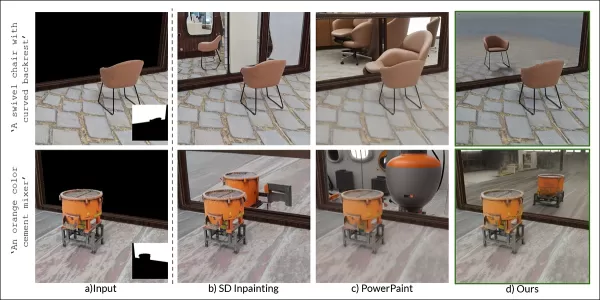
From the January 2025 paper ‘Reflecting Reality: Enabling Diffusion Models to Produce Faithful Mirror Reflections’, examples of ‘reflection failure’ versus the researchers’ approach. Source: https://arxiv.org/pdf/2409.14677
This challenge, also prevalent in CGI and video gaming, relies on ray-tracing algorithms to simulate light’s interaction with surfaces, producing realistic reflections, refractions, and shadows.
However, each additional light-ray bounce significantly increases computational demands, forcing real-time applications to balance latency and accuracy by capping bounce counts.
![A representation of a virtually-calculated light-beam in a traditional 3D-based (i.e., CGI) scenario, using technologies and principles first developed in the 1960s, and which came to fruition between 1982-93 (the span between Tron [1982] and Jurassic Park [1993]). Source: https://www.unrealengine.com/en-US/explainers/ray-tracing/what-is-real-time-ray-tracing](https://img.xix.ai/uploads/55/680fa78ce2769.webp)
A virtual light-beam in a 3D-based (CGI) scenario, using techniques from the 1960s, refined between ‘Tron’ (1982) and ‘Jurassic Park’ (1993). Source: https://www.unrealengine.com/en-US/explainers/ray-tracing/what-is-real-time-ray-tracing
For example, rendering a chrome teapot before a mirror involves light rays bouncing repeatedly, creating near-infinite loops with minimal visual benefit. Typically, two to three bounces suffice for perceptible reflections, as a single bounce yields a dark mirror.
Each extra bounce doubles rendering time, making efficient reflection handling critical for improving ray-traced visuals.
Reflections are vital for photorealism in subtler cases, like wet city streets, shop window reflections, or characters’ glasses, where objects and environments must appear accurately.
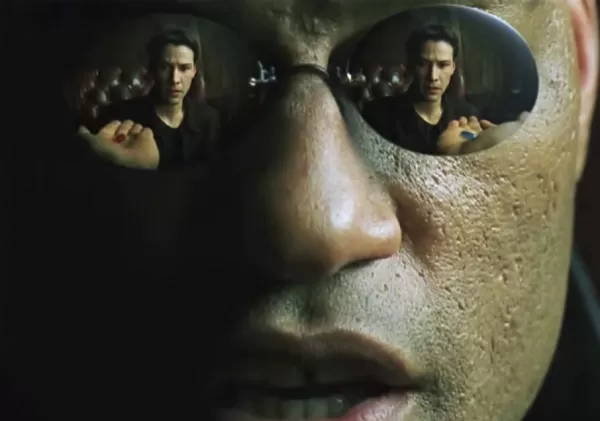
A twin-reflection created through traditional compositing for a scene in ‘The Matrix’ (1999).
Challenges in Visuals
Before diffusion models, frameworks like Neural Radiance Fields (NeRF) and newer approaches like Gaussian Splatting struggled to naturally depict reflections.
The REF2-NeRF project proposed a NeRF-based method for scenes with glass cases, modeling refraction and reflection based on viewer perspective. This allowed estimation of glass surfaces and separation of direct and reflected light.
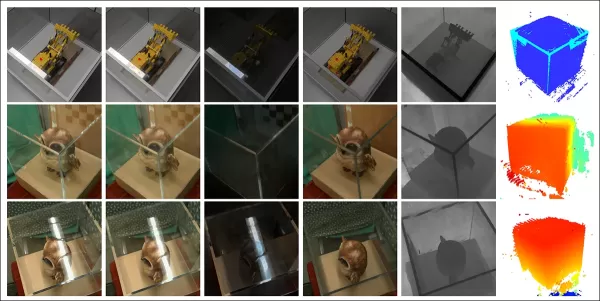
Examples from the Ref2Nerf paper. Source: https://arxiv.org/pdf/2311.17116
Other reflection-focused NeRF solutions include NeRFReN, Reflecting Reality, and Meta’s 2024 Planar Reflection-Aware Neural Radiance Fields project.
For Gaussian Splatting, efforts like Mirror-3DGS, Reflective Gaussian Splatting, and RefGaussian tackled reflection issues, while the 2023 Nero project introduced a unique method for neural representations.
MirrorVerse Breakthrough
Teaching diffusion models to handle reflection logic is tougher than with structural methods like Gaussian Splatting or NeRF. Reliable reflection in diffusion models hinges on diverse, high-quality training data across varied scenarios.
Traditionally, adding such behaviors involves LoRA or fine-tuning, but these skew outputs or create model-specific tools incompatible with the original model.
Improving diffusion models demands training data that emphasizes reflection physics. However, curating hyperscale datasets for every weakness is costly and impractical.
Still, solutions emerge, like India’s MirrorVerse project, which offers an enhanced dataset and training method to advance reflection accuracy in diffusion models.
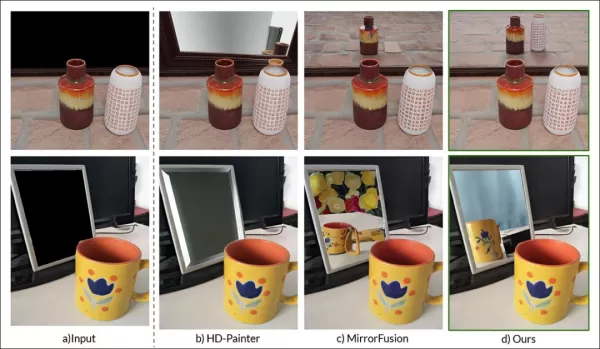
Rightmost, MirrorVerse results compared to two prior approaches (central columns). Source: https://arxiv.org/pdf/2504.15397
As shown above, MirrorVerse improves on recent efforts but isn’t flawless.
In the top right image, ceramic jars are slightly misaligned, and in the lower image, an erroneous cup reflection appears against natural reflective angles.
We’ll explore this method not as a definitive solution but to highlight the persistent challenges diffusion models face in static and video formats, where reflection data is often tied to specific scenarios.
Thus, LDMs may lag behind NeRF, Gaussian Splatting, and traditional CGI in reflection accuracy.
The paper, MirrorVerse: Pushing Diffusion Models to Realistically Reflect the World, comes from researchers at Vision and AI Lab, IISc Bangalore, and Samsung R&D Institute, Bangalore, with a project page, Hugging Face dataset, and GitHub code.
Methodology
The researchers highlight the difficulty models like Stable Diffusion and Flux face with reflection-based prompts, as shown below:
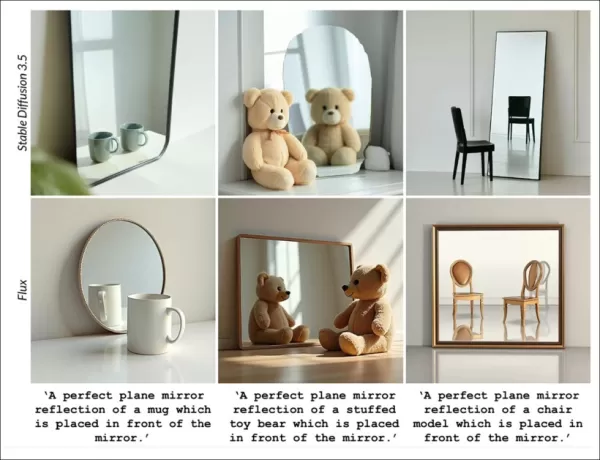
From the paper: Top text-to-image models, SD3.5 and Flux, struggle with consistent, geometrically accurate reflections.
The team developed MirrorFusion 2.0, a diffusion-based model to enhance photorealism and geometric accuracy of mirror reflections. It was trained on their MirrorGen2 dataset, designed to address generalization issues.
MirrorGen2 introduces random object positioning, randomized rotations, and explicit object grounding to ensure plausible reflections across diverse object placements.
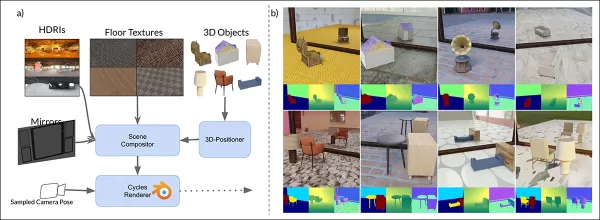
MirrorVerse’s synthetic data schema: random positioning, rotation, and grounding via 3D-Positioner, with paired objects for realistic spatial interactions.
MirrorGen2 includes paired object scenes to better handle occlusions and complex spatial arrangements in reflective settings.
The paper notes:
‘Categories are paired for semantic coherence, like a chair with a table. After positioning the primary object, a secondary one is added without overlap, ensuring distinct spatial regions.’
For object grounding, the authors ensured objects were anchored to the ground, avoiding unnatural ‘floating’ in synthetic data.
Since dataset innovation drives the paper’s novelty, we’ll cover this next.
Data and Tests
SynMirrorV2
The SynMirrorV2 dataset enhances reflection training data diversity, using 3D objects from Objaverse and Amazon Berkeley Objects (ABO), refined via OBJECT 3DIT and V1 MirrorFusion filtering, yielding 66,062 high-quality objects.
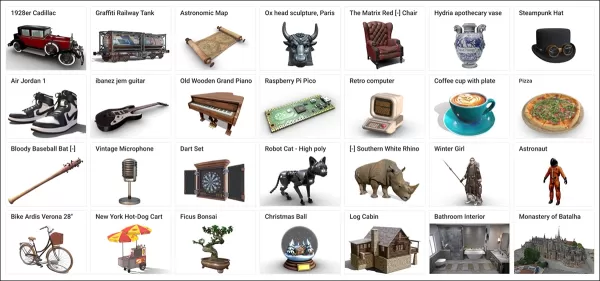
Objaverse dataset examples used for the curated dataset. Source: https://arxiv.org/pdf/2212.08051
Scenes were built with textured floors from CC-Textures and HDRI backgrounds from PolyHaven, using full-wall or rectangular mirrors. Lighting used an area-light at a 45-degree angle. Objects were scaled, positioned via mirror-camera frustum intersection, and randomly rotated on the y-axis, with grounding to avoid floating artifacts.
Multi-object scenes used 3,140 semantically coherent pairings from ABO, avoiding overlap to capture varied occlusions and depth.
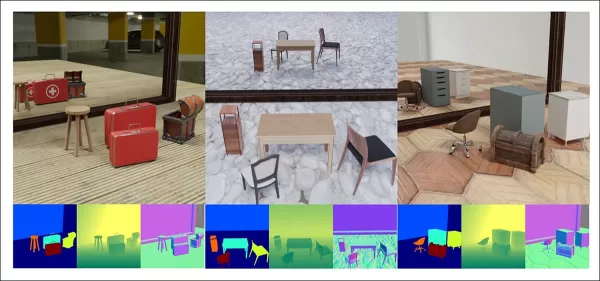
Rendered views from the dataset with multiple objects, showing segmentation and depth maps.
Training Process
A three-stage curriculum learning process trained MirrorFusion 2.0 for robust real-world generalization.
Stage 1 initialized weights from Stable Diffusion v1.5, fine-tuning on SynMirrorV2’s single-object split for 40,000 iterations, keeping both conditioning and generation branches active.
Stage 2 fine-tuned for 10,000 iterations on SynMirrorV2’s multi-object split to handle occlusions and complex scenes.
Stage 3 added 10,000 iterations with real-world MSD dataset data, using Matterport3D depth maps.
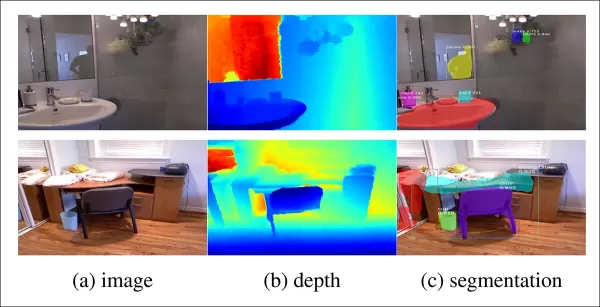
MSD dataset examples with depth and segmentation maps. Source: https://arxiv.org/pdf/1908.09101
Text prompts were omitted 20% of the time to prioritize depth information. Training used four NVIDIA A100 GPUs, a 1e-5 learning rate, batch size of 4 per GPU, and AdamW optimizer.
This progressive training moved from simple synthetic to complex real-world scenes for better transferability.
Testing
MirrorFusion 2.0 was tested against the baseline MirrorFusion on MirrorBenchV2, covering single and multi-object scenes, with qualitative tests on MSD and Google Scanned Objects (GSO) datasets.
Evaluation used 2,991 single-object and 300 two-object scenes, measuring PSNR, SSIM, and LPIPS for reflection quality, and CLIP for prompt alignment. Images were generated with four seeds, selecting the best SSIM score.

Left: Single-object reflection quality on MirrorBenchV2, with MirrorFusion 2.0 outperforming the baseline. Right: Multi-object reflection quality, with multi-object training improving results.
The authors note:
‘Our method outperforms the baseline, and multi-object fine-tuning enhances complex scene results.’
Qualitative tests emphasized MirrorFusion 2.0’s improvements:
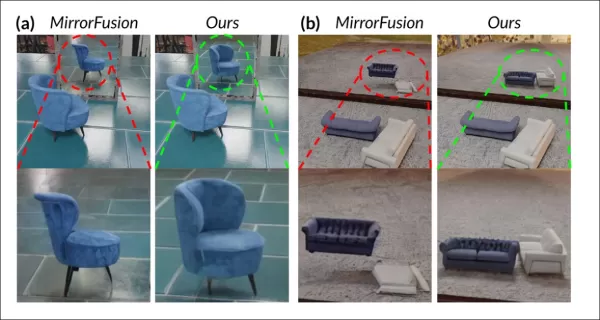
MirrorBenchV2 comparison: Baseline shows incorrect chair orientation and distorted reflections; MirrorFusion 2.0 renders accurately.
The baseline struggled with object orientation and spatial artifacts, while MirrorFusion 2.0, trained on SynMirrorV2, maintained accurate positioning and realistic reflections.
GSO dataset results:
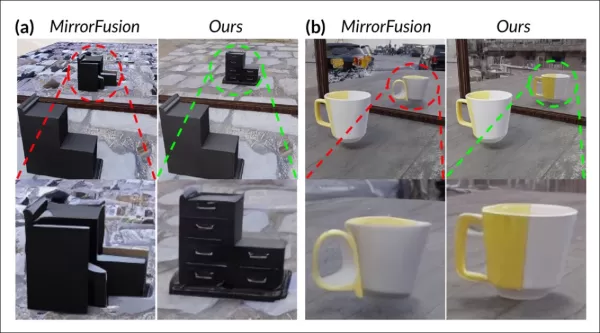
GSO comparison: Baseline distorts object structure; MirrorFusion 2.0 preserves geometry, color, and detail.
The authors comment:
‘MirrorFusion 2.0 accurately reflects details like drawer handles, while the baseline produces implausible results.’
Real-world MSD dataset results:
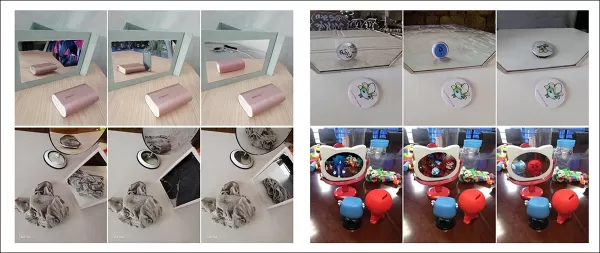
MSD results: MirrorFusion 2.0, fine-tuned on MSD, captures complex scenes with cluttered objects and multiple mirrors accurately.
Fine-tuning on MSD improved MirrorFusion 2.0’s handling of complex real-world scenes, enhancing reflection coherence.
A user study found 84% preferred MirrorFusion 2.0’s outputs.
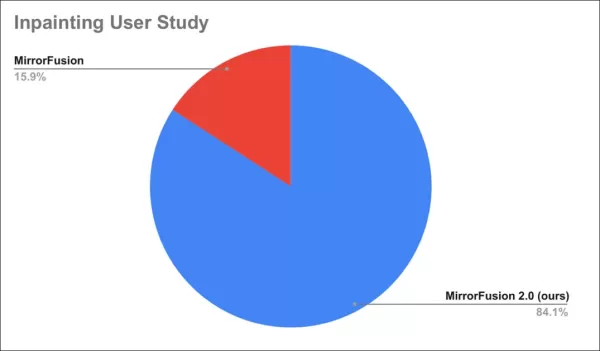
User study results.
Conclusion
While MirrorFusion 2.0 marks progress, the baseline for reflection accuracy in diffusion models remains low, making even modest improvements notable. Diffusion models’ architecture struggles with consistent physics, and adding data, as done here, is a standard but limited fix.
Future datasets with better reflection data distribution could improve results, but this applies to many LDM weaknesses. Prioritizing which issues to address remains a challenge.
First published Monday, April 28, 2025
Related article
 Musk Considered Leaving OpenAI to His Kids as Altman Testifies
This morning, OpenAI CEO Sam Altman took the stand to address former co-founder Elon Musk’s lawsuit challenging the company’s corporate structure.When asked about Musk’s claim that other founders “stole a charity” by launching a for-profit subsidiary
Sam Altman Sparks Debate Over AI's Deceleration
Listen onApple PodcastsListen onSpotifyOpenAI CEO Sam Altman recently suggested that it may be time to “pace the rate of AI development” to allow society to “harden around some of these new capability levels.”On the latest episode of TechCrunch’s Equ
Anthropic Opens Doors to EU Cybersecurity Agency as Mythos5 Model Faces Compliance Exam
Artificial intelligence compliance regulations are advancing significantly. Leading AI firm Anthropic has officially granted the European Union's cybersecurity authority access to its Mythos AI model, a pivotal move for this advanced large language m
Related Special Topic Recommendations
Image editing
Musk Considered Leaving OpenAI to His Kids as Altman Testifies
This morning, OpenAI CEO Sam Altman took the stand to address former co-founder Elon Musk’s lawsuit challenging the company’s corporate structure.When asked about Musk’s claim that other founders “stole a charity” by launching a for-profit subsidiary
Sam Altman Sparks Debate Over AI's Deceleration
Listen onApple PodcastsListen onSpotifyOpenAI CEO Sam Altman recently suggested that it may be time to “pace the rate of AI development” to allow society to “harden around some of these new capability levels.”On the latest episode of TechCrunch’s Equ
Anthropic Opens Doors to EU Cybersecurity Agency as Mythos5 Model Faces Compliance Exam
Artificial intelligence compliance regulations are advancing significantly. Leading AI firm Anthropic has officially granted the European Union's cybersecurity authority access to its Mythos AI model, a pivotal move for this advanced large language m
Related Special Topic Recommendations
Image editing
 Photoshop AI Retouch Tools for Ecommerce Apparel, Skin Cleanup, and Color Consistency
2026 Latest Best Photoshop AI retouch tools for ecommerce apparel, skin cleanup, and color consistency! This top-rated curated list features powerful game-changing solutions that help you boost writing efficiency, streamline content creation, and achieve perfect visual results effortlessly. Each tool has undergone real-world tests through weekly updated rankings, complete with free vs paid comparison details. Backed by XIX.AI, it’s the must-try guide for anyone aiming to unlock your AI edge. Explore now!
 10 tools
 xix.ai
Prompt
Best AI Prompt Libraries for ChatGPT Workflows
xix.ai
Prompt
Best AI Prompt Libraries for ChatGPT Workflows
2026 Latest Best Top-Rated AI Prompt Libraries for optimizing all types of ChatGPT workflows. XIX.AI has curated a powerful, game-changing collection that goes through rigorous real-world tests to ensure top performance. You can find detailed free vs paid comparisons and expert rankings to help you choose the must-try tools that boost your productivity and unlock your AI edge. Explore now!
11 tools
xix.ai
Education and Learning
AI Quiz Builder Platforms for Teachers, Tutors, and Cohort-Based Learning Programs
2026 Latest Best AI Quiz Builder Platforms for Teachers, Tutors, and Cohort-Based Learning Programs! XIX.AI has curated a top-rated list of powerful game-changing tools that go through real-world tests to deliver accurate rankings. These must-try platforms help boost writing efficiency, streamline content creation, and simplify quiz design across all learning scenarios. Explore now to discover your perfect tool for unlocking your AI edge in teaching!
13 tools
xix.ai
code
AI Pull Request Review Tools for GitHub Teams Handling Refactors, Bugs, and Security Gaps
2026 Latest Best AI Pull Request Review Tools for GitHub Teams are here on XIX.AI! This top-rated curated list showcases powerful game-changing solutions that streamline refactoring, bug fixing, and security gap detection across all team workflows. Enjoy a free vs paid comparison along with real-world tests and detailed rankings to help you find the perfect tool that boosts productivity significantly. Explore now to unlock your AI edge!
12 tools
xix.ai
Text-to-speech
Best AI Text to Speech Tools for Natural Voiceovers
2026 Latest Best Top-rated AI Text to Speech Tools for Natural Voiceovers are here on XIX.AI! This curated list features powerful, game-changing options that deliver crystal-clear voices for every use case, backed by real-world tests and weekly updated rankings. Get a free vs paid comparison to find the must-try solution that boosts your productivity instantly. Explore now to Unlock your AI edge!
11 tools
xix.ai
Comic Creation
Manga AI Background Generators for Serialized Chapters, Covers, and Promo Art
2026 Latest Best Manga AI Background Generators Ranked Top-Rated! This curated collection showcases powerful game-changing tools perfect for creating high-quality chapter backgrounds, book covers, and promotional art. Every option has undergone rigorous real-world tests to ensure reliability. Get a free vs paid comparison along with detailed insights. Explore now to discover your perfect tool and unlock your AI edge in manga creation.
6 tools
xix.ai

 Comments (4)
0/500
Comments (4)
0/500
![GaryWalker]()
鏡の反射をリアルに描画するAIの進歩ってすごいですね!でも、これが深フェイクに悪用されたらどうなるんだろう…ちょっと怖いかも😅 反射の物理法則を理解するって、AIが現実世界を「見る」能力が向上している証拠でしょうか?
![JimmyWilson]()
This article on AI mirror reflections is wild! It's like teaching a robot to see itself in a funhouse mirror and actually get it right. Can't wait to see this in video games! 😎
![FredGreen]()
This article on AI rendering mirror reflections is mind-blowing! It's crazy how far computer vision has come. 😮 Makes me wonder if we'll soon see AI designing entire virtual worlds with perfect physics!
![RogerNelson]()
This article on AI rendering realistic mirror reflections is fascinating! It’s wild to think how far computer vision has come, mimicking actual physics like that. Makes me wonder if we’ll soon see AI designing entire virtual worlds that feel totally real. 🤯
Since generative AI captured widespread attention, computer vision researchers have intensified efforts to develop models that grasp and replicate physical laws, with a particular focus on challenges like simulating gravity and fluid dynamics over the past five years.
With latent diffusion models (LDMs) leading generative AI since 2022, attention has shifted to their struggles with accurately depicting physical phenomena. This issue has gained traction following OpenAI's Sora video model and the recent open-source releases of Hunyuan Video and Wan 2.1.
Struggles with Reflections
Research to improve LDMs’ grasp of physics has largely centered on areas like gait simulation and Newtonian motion, as inaccuracies here undermine the realism of AI-generated videos.
Yet, a growing body of work targets a key LDM weakness: its limited ability to generate accurate reflections.
From the January 2025 paper ‘Reflecting Reality: Enabling Diffusion Models to Produce Faithful Mirror Reflections’, examples of ‘reflection failure’ versus the researchers’ approach. Source: https://arxiv.org/pdf/2409.14677
This challenge, also prevalent in CGI and video gaming, relies on ray-tracing algorithms to simulate light’s interaction with surfaces, producing realistic reflections, refractions, and shadows.
However, each additional light-ray bounce significantly increases computational demands, forcing real-time applications to balance latency and accuracy by capping bounce counts.
A virtual light-beam in a 3D-based (CGI) scenario, using techniques from the 1960s, refined between ‘Tron’ (1982) and ‘Jurassic Park’ (1993). Source: https://www.unrealengine.com/en-US/explainers/ray-tracing/what-is-real-time-ray-tracing
For example, rendering a chrome teapot before a mirror involves light rays bouncing repeatedly, creating near-infinite loops with minimal visual benefit. Typically, two to three bounces suffice for perceptible reflections, as a single bounce yields a dark mirror.
Each extra bounce doubles rendering time, making efficient reflection handling critical for improving ray-traced visuals.
Reflections are vital for photorealism in subtler cases, like wet city streets, shop window reflections, or characters’ glasses, where objects and environments must appear accurately.
A twin-reflection created through traditional compositing for a scene in ‘The Matrix’ (1999).
Challenges in Visuals
Before diffusion models, frameworks like Neural Radiance Fields (NeRF) and newer approaches like Gaussian Splatting struggled to naturally depict reflections.
The REF2-NeRF project proposed a NeRF-based method for scenes with glass cases, modeling refraction and reflection based on viewer perspective. This allowed estimation of glass surfaces and separation of direct and reflected light.
Examples from the Ref2Nerf paper. Source: https://arxiv.org/pdf/2311.17116
Other reflection-focused NeRF solutions include NeRFReN, Reflecting Reality, and Meta’s 2024 Planar Reflection-Aware Neural Radiance Fields project.
For Gaussian Splatting, efforts like Mirror-3DGS, Reflective Gaussian Splatting, and RefGaussian tackled reflection issues, while the 2023 Nero project introduced a unique method for neural representations.
MirrorVerse Breakthrough
Teaching diffusion models to handle reflection logic is tougher than with structural methods like Gaussian Splatting or NeRF. Reliable reflection in diffusion models hinges on diverse, high-quality training data across varied scenarios.
Traditionally, adding such behaviors involves LoRA or fine-tuning, but these skew outputs or create model-specific tools incompatible with the original model.
Improving diffusion models demands training data that emphasizes reflection physics. However, curating hyperscale datasets for every weakness is costly and impractical.
Still, solutions emerge, like India’s MirrorVerse project, which offers an enhanced dataset and training method to advance reflection accuracy in diffusion models.
Rightmost, MirrorVerse results compared to two prior approaches (central columns). Source: https://arxiv.org/pdf/2504.15397
As shown above, MirrorVerse improves on recent efforts but isn’t flawless.
In the top right image, ceramic jars are slightly misaligned, and in the lower image, an erroneous cup reflection appears against natural reflective angles.
We’ll explore this method not as a definitive solution but to highlight the persistent challenges diffusion models face in static and video formats, where reflection data is often tied to specific scenarios.
Thus, LDMs may lag behind NeRF, Gaussian Splatting, and traditional CGI in reflection accuracy.
The paper, MirrorVerse: Pushing Diffusion Models to Realistically Reflect the World, comes from researchers at Vision and AI Lab, IISc Bangalore, and Samsung R&D Institute, Bangalore, with a project page, Hugging Face dataset, and GitHub code.
Methodology
The researchers highlight the difficulty models like Stable Diffusion and Flux face with reflection-based prompts, as shown below:
From the paper: Top text-to-image models, SD3.5 and Flux, struggle with consistent, geometrically accurate reflections.
The team developed MirrorFusion 2.0, a diffusion-based model to enhance photorealism and geometric accuracy of mirror reflections. It was trained on their MirrorGen2 dataset, designed to address generalization issues.
MirrorGen2 introduces random object positioning, randomized rotations, and explicit object grounding to ensure plausible reflections across diverse object placements.
MirrorVerse’s synthetic data schema: random positioning, rotation, and grounding via 3D-Positioner, with paired objects for realistic spatial interactions.
MirrorGen2 includes paired object scenes to better handle occlusions and complex spatial arrangements in reflective settings.
The paper notes:
‘Categories are paired for semantic coherence, like a chair with a table. After positioning the primary object, a secondary one is added without overlap, ensuring distinct spatial regions.’
For object grounding, the authors ensured objects were anchored to the ground, avoiding unnatural ‘floating’ in synthetic data.
Since dataset innovation drives the paper’s novelty, we’ll cover this next.
Data and Tests
SynMirrorV2
The SynMirrorV2 dataset enhances reflection training data diversity, using 3D objects from Objaverse and Amazon Berkeley Objects (ABO), refined via OBJECT 3DIT and V1 MirrorFusion filtering, yielding 66,062 high-quality objects.
Objaverse dataset examples used for the curated dataset. Source: https://arxiv.org/pdf/2212.08051
Scenes were built with textured floors from CC-Textures and HDRI backgrounds from PolyHaven, using full-wall or rectangular mirrors. Lighting used an area-light at a 45-degree angle. Objects were scaled, positioned via mirror-camera frustum intersection, and randomly rotated on the y-axis, with grounding to avoid floating artifacts.
Multi-object scenes used 3,140 semantically coherent pairings from ABO, avoiding overlap to capture varied occlusions and depth.
Rendered views from the dataset with multiple objects, showing segmentation and depth maps.
Training Process
A three-stage curriculum learning process trained MirrorFusion 2.0 for robust real-world generalization.
Stage 1 initialized weights from Stable Diffusion v1.5, fine-tuning on SynMirrorV2’s single-object split for 40,000 iterations, keeping both conditioning and generation branches active.
Stage 2 fine-tuned for 10,000 iterations on SynMirrorV2’s multi-object split to handle occlusions and complex scenes.
Stage 3 added 10,000 iterations with real-world MSD dataset data, using Matterport3D depth maps.
MSD dataset examples with depth and segmentation maps. Source: https://arxiv.org/pdf/1908.09101
Text prompts were omitted 20% of the time to prioritize depth information. Training used four NVIDIA A100 GPUs, a 1e-5 learning rate, batch size of 4 per GPU, and AdamW optimizer.
This progressive training moved from simple synthetic to complex real-world scenes for better transferability.
Testing
MirrorFusion 2.0 was tested against the baseline MirrorFusion on MirrorBenchV2, covering single and multi-object scenes, with qualitative tests on MSD and Google Scanned Objects (GSO) datasets.
Evaluation used 2,991 single-object and 300 two-object scenes, measuring PSNR, SSIM, and LPIPS for reflection quality, and CLIP for prompt alignment. Images were generated with four seeds, selecting the best SSIM score.
Left: Single-object reflection quality on MirrorBenchV2, with MirrorFusion 2.0 outperforming the baseline. Right: Multi-object reflection quality, with multi-object training improving results.
The authors note:
‘Our method outperforms the baseline, and multi-object fine-tuning enhances complex scene results.’
Qualitative tests emphasized MirrorFusion 2.0’s improvements:
MirrorBenchV2 comparison: Baseline shows incorrect chair orientation and distorted reflections; MirrorFusion 2.0 renders accurately.
The baseline struggled with object orientation and spatial artifacts, while MirrorFusion 2.0, trained on SynMirrorV2, maintained accurate positioning and realistic reflections.
GSO dataset results:
GSO comparison: Baseline distorts object structure; MirrorFusion 2.0 preserves geometry, color, and detail.
The authors comment:
‘MirrorFusion 2.0 accurately reflects details like drawer handles, while the baseline produces implausible results.’
Real-world MSD dataset results:
MSD results: MirrorFusion 2.0, fine-tuned on MSD, captures complex scenes with cluttered objects and multiple mirrors accurately.
Fine-tuning on MSD improved MirrorFusion 2.0’s handling of complex real-world scenes, enhancing reflection coherence.
A user study found 84% preferred MirrorFusion 2.0’s outputs.
User study results.
Conclusion
While MirrorFusion 2.0 marks progress, the baseline for reflection accuracy in diffusion models remains low, making even modest improvements notable. Diffusion models’ architecture struggles with consistent physics, and adding data, as done here, is a standard but limited fix.
Future datasets with better reflection data distribution could improve results, but this applies to many LDM weaknesses. Prioritizing which issues to address remains a challenge.
First published Monday, April 28, 2025








 Musk Considered Leaving OpenAI to His Kids as Altman Testifies
This morning, OpenAI CEO Sam Altman took the stand to address former co-founder Elon Musk’s lawsuit challenging the company’s corporate structure.When asked about Musk’s claim that other founders “stole a charity” by launching a for-profit subsidiary
Musk Considered Leaving OpenAI to His Kids as Altman Testifies
This morning, OpenAI CEO Sam Altman took the stand to address former co-founder Elon Musk’s lawsuit challenging the company’s corporate structure.When asked about Musk’s claim that other founders “stole a charity” by launching a for-profit subsidiary
 Sam Altman Sparks Debate Over AI's Deceleration
Listen onApple PodcastsListen onSpotifyOpenAI CEO Sam Altman recently suggested that it may be time to “pace the rate of AI development” to allow society to “harden around some of these new capability levels.”On the latest episode of TechCrunch’s Equ
Sam Altman Sparks Debate Over AI's Deceleration
Listen onApple PodcastsListen onSpotifyOpenAI CEO Sam Altman recently suggested that it may be time to “pace the rate of AI development” to allow society to “harden around some of these new capability levels.”On the latest episode of TechCrunch’s Equ
 Anthropic Opens Doors to EU Cybersecurity Agency as Mythos5 Model Faces Compliance Exam
Artificial intelligence compliance regulations are advancing significantly. Leading AI firm Anthropic has officially granted the European Union's cybersecurity authority access to its Mythos AI model, a pivotal move for this advanced large language m
Anthropic Opens Doors to EU Cybersecurity Agency as Mythos5 Model Faces Compliance Exam
Artificial intelligence compliance regulations are advancing significantly. Leading AI firm Anthropic has officially granted the European Union's cybersecurity authority access to its Mythos AI model, a pivotal move for this advanced large language m

2026 Latest Best Photoshop AI retouch tools for ecommerce apparel, skin cleanup, and color consistency! This top-rated curated list features powerful game-changing solutions that help you boost writing efficiency, streamline content creation, and achieve perfect visual results effortlessly. Each tool has undergone real-world tests through weekly updated rankings, complete with free vs paid comparison details. Backed by XIX.AI, it’s the must-try guide for anyone aiming to unlock your AI edge. Explore now!
10 tools
xix.ai

2026 Latest Best Top-Rated AI Prompt Libraries for optimizing all types of ChatGPT workflows. XIX.AI has curated a powerful, game-changing collection that goes through rigorous real-world tests to ensure top performance. You can find detailed free vs paid comparisons and expert rankings to help you choose the must-try tools that boost your productivity and unlock your AI edge. Explore now!
11 tools
xix.ai

2026 Latest Best AI Quiz Builder Platforms for Teachers, Tutors, and Cohort-Based Learning Programs! XIX.AI has curated a top-rated list of powerful game-changing tools that go through real-world tests to deliver accurate rankings. These must-try platforms help boost writing efficiency, streamline content creation, and simplify quiz design across all learning scenarios. Explore now to discover your perfect tool for unlocking your AI edge in teaching!
13 tools
xix.ai

2026 Latest Best AI Pull Request Review Tools for GitHub Teams are here on XIX.AI! This top-rated curated list showcases powerful game-changing solutions that streamline refactoring, bug fixing, and security gap detection across all team workflows. Enjoy a free vs paid comparison along with real-world tests and detailed rankings to help you find the perfect tool that boosts productivity significantly. Explore now to unlock your AI edge!
12 tools
xix.ai

2026 Latest Best Top-rated AI Text to Speech Tools for Natural Voiceovers are here on XIX.AI! This curated list features powerful, game-changing options that deliver crystal-clear voices for every use case, backed by real-world tests and weekly updated rankings. Get a free vs paid comparison to find the must-try solution that boosts your productivity instantly. Explore now to Unlock your AI edge!
11 tools
xix.ai

2026 Latest Best Manga AI Background Generators Ranked Top-Rated! This curated collection showcases powerful game-changing tools perfect for creating high-quality chapter backgrounds, book covers, and promotional art. Every option has undergone rigorous real-world tests to ensure reliability. Get a free vs paid comparison along with detailed insights. Explore now to discover your perfect tool and unlock your AI edge in manga creation.
6 tools
xix.ai

鏡の反射をリアルに描画するAIの進歩ってすごいですね!でも、これが深フェイクに悪用されたらどうなるんだろう…ちょっと怖いかも😅 反射の物理法則を理解するって、AIが現実世界を「見る」能力が向上している証拠でしょうか?
This article on AI mirror reflections is wild! It's like teaching a robot to see itself in a funhouse mirror and actually get it right. Can't wait to see this in video games! 😎
This article on AI rendering mirror reflections is mind-blowing! It's crazy how far computer vision has come. 😮 Makes me wonder if we'll soon see AI designing entire virtual worlds with perfect physics!
This article on AI rendering realistic mirror reflections is fascinating! It’s wild to think how far computer vision has come, mimicking actual physics like that. Makes me wonder if we’ll soon see AI designing entire virtual worlds that feel totally real. 🤯












