


 Home
HomeHow to detect AI-edited text in 2025? EditLens guide for accuracy and safety.
In today's landscape of AI-assisted writing, accurately identifying human-authored, AI-edited, and fully AI-generated text is more important than ever. Conventional AI detectors typically offer a simple binary choice, failing to capture the complex reality of AI's role in content creation. EditLens presents a revolutionary alternative with its continuous scoring system, which quantifies the degree of AI editing. This article explores how EditLens is transforming AI detection, its underlying methodology, and its potential impact across different industries.
Key Points
EditLens provides a continuous score to measure the level of AI editing within a text.
Standard AI detectors frequently misclassify lightly edited text as entirely AI-generated.
EditLens employs efficient similarity metrics to improve the accuracy of AI text classification.
The model was developed using an extensive, purpose-built dataset of AI-edited text.
EditLens surpasses existing models in differentiating between human, AI-edited, and fully AI-generated text.
This tool has significant implications for establishing AI authorship and for educational applications.
EditLens can help develop more adaptable and equitable policies regarding AI use.
Understanding the AI Editing Dilemma
The Rise of AI-Edited Text
Writing assistants like Grammarly and ChatGPT are now commonly used to polish and improve written material.
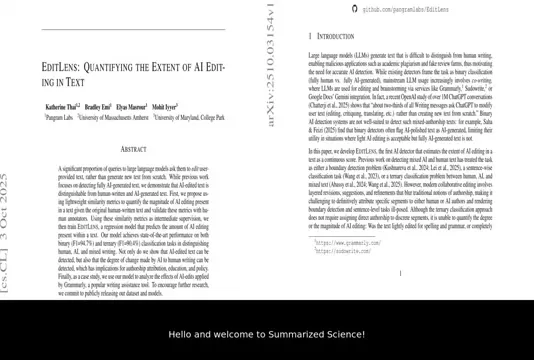
This practice produces what is known as 'AI-edited' text, which occupies a middle ground—not purely human nor entirely machine-generated. This presents a significant challenge for standard AI detectors that rely on a binary classification (human vs. AI), as they often struggle to correctly assess text that has been only lightly edited by AI. Determining whether the final output should be classified as human or AI-generated is not always straightforward.
Many individuals use AI tools to improve their writing, but this can lead to complications. These tools can correct spelling, rephrase sentences, and enhance overall clarity. The resulting text is a hybrid, neither fully human nor fully AI.
This ambiguity creates practical issues. For instance, AI detectors often mistakenly flag lightly polished text as completely AI-generated, potentially penalizing someone for simply using a grammar checker. What if we could precisely measure how much AI contributed?
This is the central question addressed by researchers in a new paper introducing a tool named 'EditLens'.
Limitations of Traditional AI Detectors
Most current AI detectors make a basic distinction: 'human' or 'AI.'
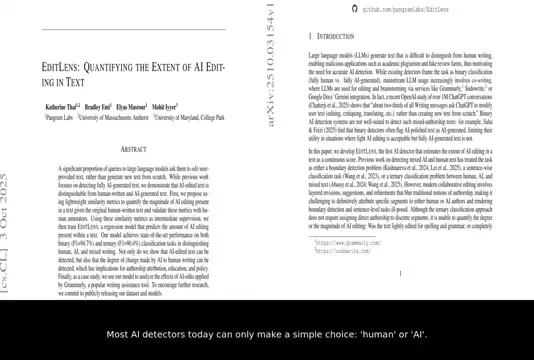
However, they often incorrectly label lightly edited text as completely AI-generated. This oversimplification can result in inaccurate and unfair conclusions, especially in academic and professional contexts where the appropriate use of AI tools is vital. A more sophisticated method is needed to evaluate whether AI has contributed excessively. The ultimate objective is to move beyond a black-and-white perspective and instead view text creation on a spectrum.
Introducing EditLens: A Nuanced Approach to AI Detection
EditLens: Quantifying AI Involvement
EditLens directly addresses this challenge by generating a continuous score that reflects the degree of AI involvement in a text.
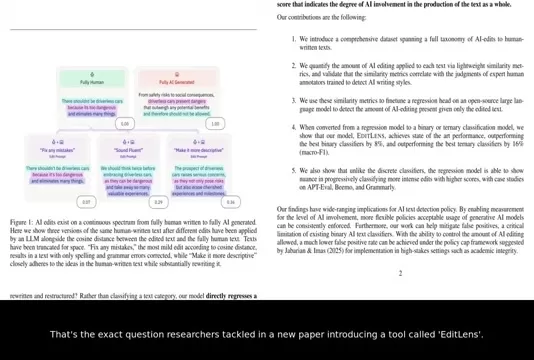
Rather than a simple human/AI label, EditLens assigns a score ranging from 0 (entirely human) to 1 (entirely AI-generated), illustrating a spectrum of AI influence. A document that has only had spelling corrections is fundamentally different from one completely rewritten by an AI, even if the original idea was human. EditLens was designed to analyze a text and assign it this continuous score, from 0 for purely human to 1 for purely AI-generated.
How EditLens Was Built: The Methodology
The creation of EditLens involved a meticulous process, beginning with the assembly of a massive dataset of AI-edited text.
This dataset, unprecedented in scale, was crucial because existing datasets did not properly represent the full range of AI-human collaboration in writing.
The researchers achieved this by applying AI with hundreds of distinct editing instructions, such as "make this more descriptive" or "improve fluency." They took thousands of human-written texts and processed them with AI using these varied prompts. For each edited version, they calculated a 'difference score' by measuring how much it deviated from the original human text. This score served as the 'ground truth' for training. They then trained the EditLens model to predict this difference score by analyzing only the final, edited text, without access to the original.
Performance and Validation of EditLens
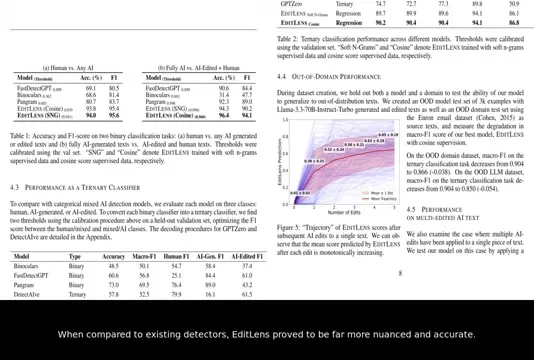
The performance results for EditLens are compelling. When tested against existing detectors, EditLens demonstrated far greater nuance and accuracy. It successfully identified the subtle distinctions between minor touch-ups and major rewrites. The model can differentiate between varying levels of AI assistance.
EditLens achieved top-tier performance, significantly outperforming the best available models in classifying text as human, AI-edited, or fully AI-generated.
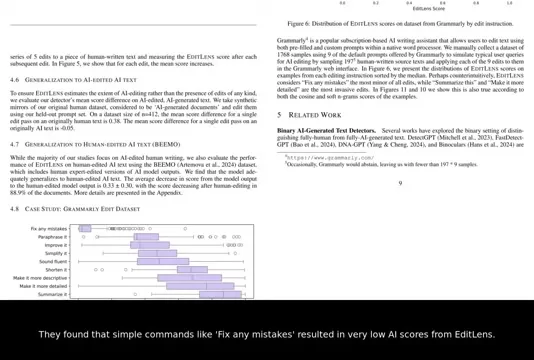
To validate real-world application, the researchers tested it on Grammarly, a popular AI writing assistant. They found that simple commands like 'Fix any mistakes' yielded very low AI scores from EditLens. Conversely, more transformative edits like 'Make it more detailed' or 'Summarize it' received much higher scores, demonstrating the model's ability to distinguish between different degrees of AI assistance.
Leveraging EditLens: Practical Applications
Utilizing EditLens for Authorship Attribution
In academic publishing, EditLens could help accurately attribute authorship by quantifying the AI's contribution to a submitted manuscript. This promotes transparency and research integrity, helps prevent unintended plagiarism, and allows for a fair evaluation of each author's input.
EditLens can facilitate better authorship assessment. If a human writes most of the content and AI merely reviews it for spelling and grammar, EditLens could help ensure the author receives proper credit. Conversely, if a human provides only a few simple sentences and AI generates the bulk of a paper, the tool could appropriately attribute a larger share of the contribution to the AI.
Enhancing Educational Integrity with EditLens
Educators can use EditLens to evaluate student work more fairly, establishing policies that permit AI for proofreading but discourage its use for generating entire paragraphs. EditLens offers a way to measure and manage AI usage in education, helping students cultivate original thinking and writing skills while using AI tools responsibly.
This could lead to more flexible and equitable AI use policies. For example, an instructor could allow students to use AI for proofreading (which would result in a low EditLens score) but prohibit its use for writing complete paragraphs (which would yield a high score).
Pricing
EditLens Pricing Details
As EditLens is currently a research tool, pricing information is not yet available, pending potential commercial release. It is distributed for research purposes. Please consult the official GitHub page for further details.
EditLens: Weighing the Benefits and Drawbacks
Pros
Provides a continuous score representing the level of AI involvement.
Delivers a more nuanced evaluation than binary AI detectors.
Trained on a custom dataset, improving its accuracy.
Has the potential to encourage more flexible and ethical AI usage policies.
Cons
Currently a research tool, so general availability may be limited.
Requires users to understand its scoring system for proper interpretation.
Its assessments depend on the accuracy of underlying similarity metrics.
Core Features of EditLens
Key Functionalities of EditLens
EditLens is a powerful resource for anyone interested in the intersection of AI and writing. The tool operates by learning the patterns associated with different levels of AI editing from a custom-built dataset, and it substantially outperforms earlier models.
Here are some of the model's core features:
- Continuous Scoring: Offers a nuanced spectrum of AI involvement, from purely human to fully AI-generated.
- Similarity Metrics: Uses efficient similarity metrics to accurately identify AI edits.
- Custom Dataset Training: Trained on a large, purpose-built dataset of AI-edited text.
- Superior Performance: Outperforms traditional AI detectors in text classification.
Use Cases: Who Can Benefit from EditLens?
Diverse Applications of EditLens
EditLens has a wide range of potential applications across multiple sectors:
- Academic Integrity: Educators can establish flexible AI usage policies.
- Content Creation: Content creators can measure the AI influence on their work.
- Publishing: Publishers can uphold ethical AI guidelines for their publications.
- AI Research: Researchers can use EditLens to study AI's impact on writing.
Frequently Asked Questions About EditLens
What exactly does EditLens do?
EditLens is a tool that evaluates the extent of AI editing in a piece of text and assigns a continuous score to represent the level of AI involvement. This enables users to more accurately differentiate between human-authored, AI-edited, and fully AI-generated content.
How is EditLens different from other AI detectors?
Unlike conventional AI detectors that provide a binary (human or AI) classification, EditLens delivers a continuous score. This provides a more detailed understanding of AI's role in the text creation process.
Where can I get EditLens?
EditLens is released for research purposes. Please check the official GitHub page for more information.
Related Questions
What implications does EditLens have for the future of AI-assisted writing?
EditLens could help establish more transparent and ethical AI usage policies in various fields. In education, it may enable fairer assessment of student work. In content creation, it could assist in maintaining originality while responsibly utilizing AI for support.
Related article
 U.S. Stocks Hit Historic Milestone as AI and Aerospace Giants Prepare for Trillion-Dollar Debut
Elon Musk, Sam Altman, and Dario Amodei, three titans of the technology sector, are advancing toward initial public offerings for their respective ventures. With SpaceX, OpenAI, and Anthropic—three industry behemoths nearing trillion-dollar valuation
Swedish AI Startup Lovable Eyes $13.2 Billion Valuation After Major Funding Round
As AI-driven coding tools gain traction, Swedish startup Lovable has secured a major funding round. The company aims to raise $3 billion, potentially boosting its valuation to $13.2 billion—double the $6.6 billion recorded last December. Menlo Ventur
Google Tests Remy AI Agent for Gemini as Focus Shifts to User Control
According to Business Insider, Google is testing Remy, a new AI personal agent for Gemini. This tool aims to execute tasks on behalf of users, streamlining both professional workflows and daily routines.Currently, Remy is undergoing testing in an int
Related Special Topic Recommendations
Data Analysis
U.S. Stocks Hit Historic Milestone as AI and Aerospace Giants Prepare for Trillion-Dollar Debut
Elon Musk, Sam Altman, and Dario Amodei, three titans of the technology sector, are advancing toward initial public offerings for their respective ventures. With SpaceX, OpenAI, and Anthropic—three industry behemoths nearing trillion-dollar valuation
Swedish AI Startup Lovable Eyes $13.2 Billion Valuation After Major Funding Round
As AI-driven coding tools gain traction, Swedish startup Lovable has secured a major funding round. The company aims to raise $3 billion, potentially boosting its valuation to $13.2 billion—double the $6.6 billion recorded last December. Menlo Ventur
Google Tests Remy AI Agent for Gemini as Focus Shifts to User Control
According to Business Insider, Google is testing Remy, a new AI personal agent for Gemini. This tool aims to execute tasks on behalf of users, streamlining both professional workflows and daily routines.Currently, Remy is undergoing testing in an int
Related Special Topic Recommendations
Data Analysis
 Best AI Anomaly Detection Tools for KPI Monitoring across SaaS and Ecommerce Teams
2026 Latest Best Top-rated AI Anomaly Detection Tools for KPI Monitoring in SaaS and Ecommerce teams! XIX.AI has curated a powerful, game-changing collection based on rigorous real-world tests and weekly updated rankings. You’ll find detailed free vs paid comparison insights to help you identify the must-try solution that boosts productivity and unlocks your AI edge. Explore now!
 10 tools
 xix.ai
writing
Best AI Outline Generators for Long-Form SEO Articles
xix.ai
writing
Best AI Outline Generators for Long-Form SEO Articles
2026 Latest Best Top-Rated AI Outline Generators for Long-Form SEO Articles, meticulously curated by XIX.AI. These powerful tools offer game-changing assistance in creating high-quality content quickly, boosting writing efficiency significantly. Get a free vs paid comparison along with real-world tests and detailed rankings to help you find the must-try option that suits your needs. Explore now to unlock your AI edge.
8 tools
xix.ai
Education and Learning
AI Study Tools for Homework and Exam Prep
2026 Latest Best AI Study Tools for Homework and Exam Prep! XIX.AI curates a top-rated list of powerful, game-changing tools that help students boost productivity, streamline homework completion, and ace exams through real-world tests. Get a free vs paid comparison, detailed rankings, and must-try options to unlock your AI edge. Explore now!
10 tools
xix.ai
Music composition
AI Vocal Demo Tools for Songwriters, Hooks, Toplines, and Multilingual Draft Sessions
2026 Latest Best AI Vocal Demo Tools for Songwriters, Hook Creators, and Multi-Language Content Teams! XIX.AI has curated a top-rated list of powerful game-changing tools that go through rigorous real-world tests. You’ll find detailed free vs paid comparison data, comprehensive rankings, and must-try options to help you boost writing efficiency and unlock your creative potential. Explore now to discover your perfect tool for all your content needs!
9 tools
xix.ai
Business
Best AI Competitive Research Tools for Small Businesses
2026 Latest Best Top-rated AI Competitive Research Tools for Small Businesses! XIX.AI has curated a highly powerful game-changing collection, updated weekly with rigorous real-world tests and detailed rankings. You can find a comprehensive free vs paid comparison to help you identify the must-try tools that boost your productivity and give you a competitive edge. Explore now to discover your perfect tool!
9 tools
xix.ai
Image editing
Photoshop AI Retouch Tools for Ecommerce Apparel, Skin Cleanup, and Color Consistency
2026 Latest Best Photoshop AI retouch tools for ecommerce apparel, skin cleanup, and color consistency! This top-rated curated list features powerful game-changing solutions that help you boost writing efficiency, streamline content creation, and achieve perfect visual results effortlessly. Each tool has undergone real-world tests through weekly updated rankings, complete with free vs paid comparison details. Backed by XIX.AI, it’s the must-try guide for anyone aiming to unlock your AI edge. Explore now!
10 tools
xix.ai

 Comments (0)
0/500
Comments (0)
0/500
In today's landscape of AI-assisted writing, accurately identifying human-authored, AI-edited, and fully AI-generated text is more important than ever. Conventional AI detectors typically offer a simple binary choice, failing to capture the complex reality of AI's role in content creation. EditLens presents a revolutionary alternative with its continuous scoring system, which quantifies the degree of AI editing. This article explores how EditLens is transforming AI detection, its underlying methodology, and its potential impact across different industries.
Key Points
EditLens provides a continuous score to measure the level of AI editing within a text.
Standard AI detectors frequently misclassify lightly edited text as entirely AI-generated.
EditLens employs efficient similarity metrics to improve the accuracy of AI text classification.
The model was developed using an extensive, purpose-built dataset of AI-edited text.
EditLens surpasses existing models in differentiating between human, AI-edited, and fully AI-generated text.
This tool has significant implications for establishing AI authorship and for educational applications.
EditLens can help develop more adaptable and equitable policies regarding AI use.
Understanding the AI Editing Dilemma
The Rise of AI-Edited Text
Writing assistants like Grammarly and ChatGPT are now commonly used to polish and improve written material.
This practice produces what is known as 'AI-edited' text, which occupies a middle ground—not purely human nor entirely machine-generated. This presents a significant challenge for standard AI detectors that rely on a binary classification (human vs. AI), as they often struggle to correctly assess text that has been only lightly edited by AI. Determining whether the final output should be classified as human or AI-generated is not always straightforward.
Many individuals use AI tools to improve their writing, but this can lead to complications. These tools can correct spelling, rephrase sentences, and enhance overall clarity. The resulting text is a hybrid, neither fully human nor fully AI.
This ambiguity creates practical issues. For instance, AI detectors often mistakenly flag lightly polished text as completely AI-generated, potentially penalizing someone for simply using a grammar checker. What if we could precisely measure how much AI contributed?
This is the central question addressed by researchers in a new paper introducing a tool named 'EditLens'.
Limitations of Traditional AI Detectors
Most current AI detectors make a basic distinction: 'human' or 'AI.'
However, they often incorrectly label lightly edited text as completely AI-generated. This oversimplification can result in inaccurate and unfair conclusions, especially in academic and professional contexts where the appropriate use of AI tools is vital. A more sophisticated method is needed to evaluate whether AI has contributed excessively. The ultimate objective is to move beyond a black-and-white perspective and instead view text creation on a spectrum.
Introducing EditLens: A Nuanced Approach to AI Detection
EditLens: Quantifying AI Involvement
EditLens directly addresses this challenge by generating a continuous score that reflects the degree of AI involvement in a text.
Rather than a simple human/AI label, EditLens assigns a score ranging from 0 (entirely human) to 1 (entirely AI-generated), illustrating a spectrum of AI influence. A document that has only had spelling corrections is fundamentally different from one completely rewritten by an AI, even if the original idea was human. EditLens was designed to analyze a text and assign it this continuous score, from 0 for purely human to 1 for purely AI-generated.
How EditLens Was Built: The Methodology
The creation of EditLens involved a meticulous process, beginning with the assembly of a massive dataset of AI-edited text.
This dataset, unprecedented in scale, was crucial because existing datasets did not properly represent the full range of AI-human collaboration in writing.
The researchers achieved this by applying AI with hundreds of distinct editing instructions, such as "make this more descriptive" or "improve fluency." They took thousands of human-written texts and processed them with AI using these varied prompts. For each edited version, they calculated a 'difference score' by measuring how much it deviated from the original human text. This score served as the 'ground truth' for training. They then trained the EditLens model to predict this difference score by analyzing only the final, edited text, without access to the original.
Performance and Validation of EditLens
The performance results for EditLens are compelling. When tested against existing detectors, EditLens demonstrated far greater nuance and accuracy. It successfully identified the subtle distinctions between minor touch-ups and major rewrites. The model can differentiate between varying levels of AI assistance.
EditLens achieved top-tier performance, significantly outperforming the best available models in classifying text as human, AI-edited, or fully AI-generated.
To validate real-world application, the researchers tested it on Grammarly, a popular AI writing assistant. They found that simple commands like 'Fix any mistakes' yielded very low AI scores from EditLens. Conversely, more transformative edits like 'Make it more detailed' or 'Summarize it' received much higher scores, demonstrating the model's ability to distinguish between different degrees of AI assistance.
Leveraging EditLens: Practical Applications
Utilizing EditLens for Authorship Attribution
In academic publishing, EditLens could help accurately attribute authorship by quantifying the AI's contribution to a submitted manuscript. This promotes transparency and research integrity, helps prevent unintended plagiarism, and allows for a fair evaluation of each author's input.
EditLens can facilitate better authorship assessment. If a human writes most of the content and AI merely reviews it for spelling and grammar, EditLens could help ensure the author receives proper credit. Conversely, if a human provides only a few simple sentences and AI generates the bulk of a paper, the tool could appropriately attribute a larger share of the contribution to the AI.
Enhancing Educational Integrity with EditLens
Educators can use EditLens to evaluate student work more fairly, establishing policies that permit AI for proofreading but discourage its use for generating entire paragraphs. EditLens offers a way to measure and manage AI usage in education, helping students cultivate original thinking and writing skills while using AI tools responsibly.
This could lead to more flexible and equitable AI use policies. For example, an instructor could allow students to use AI for proofreading (which would result in a low EditLens score) but prohibit its use for writing complete paragraphs (which would yield a high score).
Pricing
EditLens Pricing Details
As EditLens is currently a research tool, pricing information is not yet available, pending potential commercial release. It is distributed for research purposes. Please consult the official GitHub page for further details.
EditLens: Weighing the Benefits and Drawbacks
Pros
Provides a continuous score representing the level of AI involvement.
Delivers a more nuanced evaluation than binary AI detectors.
Trained on a custom dataset, improving its accuracy.
Has the potential to encourage more flexible and ethical AI usage policies.
Cons
Currently a research tool, so general availability may be limited.
Requires users to understand its scoring system for proper interpretation.
Its assessments depend on the accuracy of underlying similarity metrics.
Core Features of EditLens
Key Functionalities of EditLens
EditLens is a powerful resource for anyone interested in the intersection of AI and writing. The tool operates by learning the patterns associated with different levels of AI editing from a custom-built dataset, and it substantially outperforms earlier models.
Here are some of the model's core features:
- Continuous Scoring: Offers a nuanced spectrum of AI involvement, from purely human to fully AI-generated.
- Similarity Metrics: Uses efficient similarity metrics to accurately identify AI edits.
- Custom Dataset Training: Trained on a large, purpose-built dataset of AI-edited text.
- Superior Performance: Outperforms traditional AI detectors in text classification.
Use Cases: Who Can Benefit from EditLens?
Diverse Applications of EditLens
EditLens has a wide range of potential applications across multiple sectors:
- Academic Integrity: Educators can establish flexible AI usage policies.
- Content Creation: Content creators can measure the AI influence on their work.
- Publishing: Publishers can uphold ethical AI guidelines for their publications.
- AI Research: Researchers can use EditLens to study AI's impact on writing.
Frequently Asked Questions About EditLens
What exactly does EditLens do?
EditLens is a tool that evaluates the extent of AI editing in a piece of text and assigns a continuous score to represent the level of AI involvement. This enables users to more accurately differentiate between human-authored, AI-edited, and fully AI-generated content.
How is EditLens different from other AI detectors?
Unlike conventional AI detectors that provide a binary (human or AI) classification, EditLens delivers a continuous score. This provides a more detailed understanding of AI's role in the text creation process.
Where can I get EditLens?
EditLens is released for research purposes. Please check the official GitHub page for more information.
Related Questions
What implications does EditLens have for the future of AI-assisted writing?
EditLens could help establish more transparent and ethical AI usage policies in various fields. In education, it may enable fairer assessment of student work. In content creation, it could assist in maintaining originality while responsibly utilizing AI for support.








 U.S. Stocks Hit Historic Milestone as AI and Aerospace Giants Prepare for Trillion-Dollar Debut
Elon Musk, Sam Altman, and Dario Amodei, three titans of the technology sector, are advancing toward initial public offerings for their respective ventures. With SpaceX, OpenAI, and Anthropic—three industry behemoths nearing trillion-dollar valuation
U.S. Stocks Hit Historic Milestone as AI and Aerospace Giants Prepare for Trillion-Dollar Debut
Elon Musk, Sam Altman, and Dario Amodei, three titans of the technology sector, are advancing toward initial public offerings for their respective ventures. With SpaceX, OpenAI, and Anthropic—three industry behemoths nearing trillion-dollar valuation
 Swedish AI Startup Lovable Eyes $13.2 Billion Valuation After Major Funding Round
As AI-driven coding tools gain traction, Swedish startup Lovable has secured a major funding round. The company aims to raise $3 billion, potentially boosting its valuation to $13.2 billion—double the $6.6 billion recorded last December. Menlo Ventur
Google Tests Remy AI Agent for Gemini as Focus Shifts to User Control
According to Business Insider, Google is testing Remy, a new AI personal agent for Gemini. This tool aims to execute tasks on behalf of users, streamlining both professional workflows and daily routines.Currently, Remy is undergoing testing in an int
Swedish AI Startup Lovable Eyes $13.2 Billion Valuation After Major Funding Round
As AI-driven coding tools gain traction, Swedish startup Lovable has secured a major funding round. The company aims to raise $3 billion, potentially boosting its valuation to $13.2 billion—double the $6.6 billion recorded last December. Menlo Ventur
Google Tests Remy AI Agent for Gemini as Focus Shifts to User Control
According to Business Insider, Google is testing Remy, a new AI personal agent for Gemini. This tool aims to execute tasks on behalf of users, streamlining both professional workflows and daily routines.Currently, Remy is undergoing testing in an int

2026 Latest Best Top-rated AI Anomaly Detection Tools for KPI Monitoring in SaaS and Ecommerce teams! XIX.AI has curated a powerful, game-changing collection based on rigorous real-world tests and weekly updated rankings. You’ll find detailed free vs paid comparison insights to help you identify the must-try solution that boosts productivity and unlocks your AI edge. Explore now!
10 tools
xix.ai

2026 Latest Best Top-Rated AI Outline Generators for Long-Form SEO Articles, meticulously curated by XIX.AI. These powerful tools offer game-changing assistance in creating high-quality content quickly, boosting writing efficiency significantly. Get a free vs paid comparison along with real-world tests and detailed rankings to help you find the must-try option that suits your needs. Explore now to unlock your AI edge.
8 tools
xix.ai

2026 Latest Best AI Study Tools for Homework and Exam Prep! XIX.AI curates a top-rated list of powerful, game-changing tools that help students boost productivity, streamline homework completion, and ace exams through real-world tests. Get a free vs paid comparison, detailed rankings, and must-try options to unlock your AI edge. Explore now!
10 tools
xix.ai

2026 Latest Best AI Vocal Demo Tools for Songwriters, Hook Creators, and Multi-Language Content Teams! XIX.AI has curated a top-rated list of powerful game-changing tools that go through rigorous real-world tests. You’ll find detailed free vs paid comparison data, comprehensive rankings, and must-try options to help you boost writing efficiency and unlock your creative potential. Explore now to discover your perfect tool for all your content needs!
9 tools
xix.ai

2026 Latest Best Top-rated AI Competitive Research Tools for Small Businesses! XIX.AI has curated a highly powerful game-changing collection, updated weekly with rigorous real-world tests and detailed rankings. You can find a comprehensive free vs paid comparison to help you identify the must-try tools that boost your productivity and give you a competitive edge. Explore now to discover your perfect tool!
9 tools
xix.ai

2026 Latest Best Photoshop AI retouch tools for ecommerce apparel, skin cleanup, and color consistency! This top-rated curated list features powerful game-changing solutions that help you boost writing efficiency, streamline content creation, and achieve perfect visual results effortlessly. Each tool has undergone real-world tests through weekly updated rankings, complete with free vs paid comparison details. Backed by XIX.AI, it’s the must-try guide for anyone aiming to unlock your AI edge. Explore now!
10 tools
xix.ai












