


 Home
HomeDetecting ‘Aggressive Driving’ With Machine Learning and Edge Computing
A new patent application has been filed that introduces an innovative approach to curb aggressive driving at intersections. This system, utilizing machine learning algorithms integrated into civic edge computing devices, marks a shift from the typical focus on in-car systems designed for insurance analytics towards a more municipal-oriented solution. This proposal aims not only to penalize drivers who deviate from safe driving norms but also to provide them with immediate in-car audiovisual warnings to correct their behavior.
The patent, filed on April 29, 2021, at the US Patent and Trademark Office, is a collaborative effort between the Board of Regents of the University of Michigan and Denso Corporation, a subsidiary of Toyota. Unlike proprietary systems focused on insurance monitoring, this system leverages well-resourced edge computing nodes at traffic junctions. These nodes collect data from both roadside resources and sensors within nearby vehicles to offer real-time, actionable feedback to drivers.
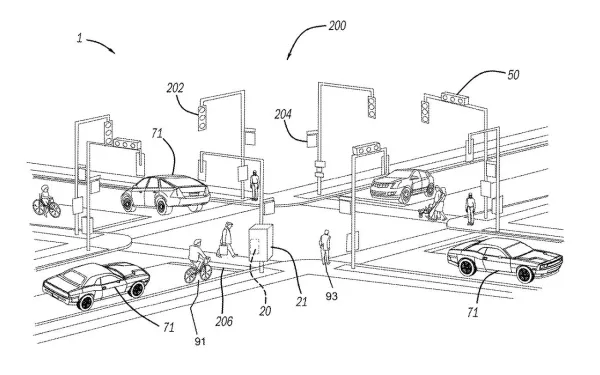 *The UMich patent is not a proprietary, in-car system aimed at insurance oversight, nor designed solely to produce forensic data, but rather relies on well-resourced edge computing nodes deployed at traffic intersections to provide immediate and actionable feedback, by collating data from roadside edge computing resources and from sensors installed in nearby vehicles.* Source: https://pdfaiw.uspto.gov/76/2021/50/012/1.pdf
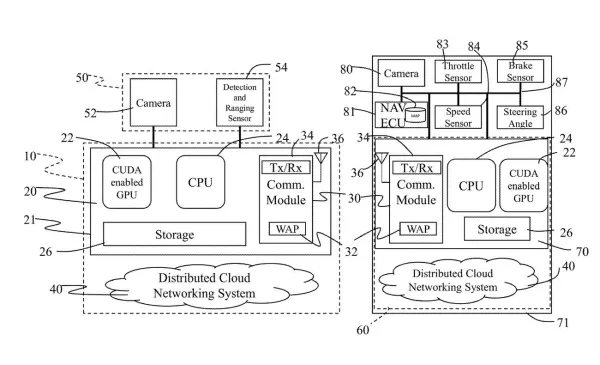
The proposed system isn't just reliant on civic infrastructure; it also necessitates in-vehicle technology, transforming cars into active sensors within the network. This means that every car equipped with the system becomes a node for traffic monitoring, while also being subject to the same scrutiny. The in-car setup requires direct access to data from the vehicle's brakes, throttle, steering wheel, odometer, and maps. Both the roadside and in-vehicle components feature CUDA-enabled GPUs and local storage, alongside cloud connectivity.
Warnings for Aggressive Drivers
When the system detects aggressive driving, it can issue immediate warnings through the vehicle's audiovisual devices. For instance, a message like the one shown in FIG. 8A might be displayed, urging the driver to slow down. Additionally, the system can alert drivers about their speed or oncoming vehicles.
 *Warnings depicted in the patent application.* Source: https://pdfaiw.uspto.gov/fdd/76/2021/50/012/0.pdf
In some scenarios, the system might use any available audio-visual devices, including the driver's smartphone, to issue warnings.
Driver-Specific Red Lights
Traffic light management is a known method for reducing accidents, but this system takes it a step further by potentially adjusting light timings based on individual driver behavior. The patent suggests that if the system predicts aggressive driving at one intersection, it could preemptively change the lights at subsequent intersections to red, encouraging the driver to slow down.
Inroads into Driver Privacy
While past proposals for in-car monitoring systems have focused on biometric indicators and emotion recognition to influence driver behavior, often linked to insurance premiums or accident investigations, the Michigan/Denso proposal leans towards state collaboration through changes in vehicle standards. Implementing such a system across state lines poses challenges, suggesting a need for federal or at least coordinated state action.
 *An illustration of the machine learning architecture proposed for the system, using Recurrent Neural Networks (RNN). The framework uses unsupervised learning and provides real-time feedback, but also makes provision for offline training to improve algorithms based on incoming data and events. The identification of aggressive driving behavior is facilitated by Dynamic Time Warping (DTW), an algorithm used in time series analysis to compare two temporal series or sequences of objects that may vary in speed.*
Revenue Stream
This system could be the first to offer real-time analysis of aggressive driving within a civic framework capable of automatically issuing fines or alerting authorities. However, there's a concern that it could be misused by municipalities eager for revenue. Neda Masoud, an assistant professor at the University of Michigan, highlighted the importance of safety over false alarms but emphasized the need for mechanisms to allow drivers to challenge wrongful accusations.
The system is designed to handle aggressive driving events even from vehicles without onboard units by observing equipped nearby vehicles and intersection installations. This might involve other methods like license plate recognition, though the patent does not explicitly mention this.
Intersections: A High Risk
The focus on intersections in the Michigan patent is strategic, given that these areas are hotspots for traffic incidents. This aligns with previous research, such as Chinese studies using support vector machines to detect dangerous lane changes or smartphone sensors to identify erratic driving. The US National Highway Traffic Safety Administration's 2010 estimate that 40% of 2008 US accidents occurred at intersections underscores the relevance of such initiatives.
Related article
 Bayer Leverages Iambic AI to Speed Drug Discovery
Juergen Eckhardt, M.D., serves as Head of Business Development and Licensing at Bayer Pharmaceuticals.Bayer is leveraging Iambic Therapeutics to deploy frontier AI models for drug discovery, alongside a major decarbonization project at its plant in S
Optimization-Driven AI Emerges as New Path to General-Purpose Models
Researchers from the University of Illinois Urbana-Champaign and the University of Virginia have created a new model architecture that could pave the way for more resilient AI systems with enhanced reasoning power.Named the energy-based transformer (
AI Boom Echoes Dot-Com Era Bubble Concerns
The influx of multi-billion dollar investments into AI has fueled a heated debate: is the industry headed for a dot-com style bubble?Investors are vigilant for any cooling of enthusiasm or signs that massive spending on chips and infrastructure isn't
Related Special Topic Recommendations
code
Bayer Leverages Iambic AI to Speed Drug Discovery
Juergen Eckhardt, M.D., serves as Head of Business Development and Licensing at Bayer Pharmaceuticals.Bayer is leveraging Iambic Therapeutics to deploy frontier AI models for drug discovery, alongside a major decarbonization project at its plant in S
Optimization-Driven AI Emerges as New Path to General-Purpose Models
Researchers from the University of Illinois Urbana-Champaign and the University of Virginia have created a new model architecture that could pave the way for more resilient AI systems with enhanced reasoning power.Named the energy-based transformer (
AI Boom Echoes Dot-Com Era Bubble Concerns
The influx of multi-billion dollar investments into AI has fueled a heated debate: is the industry headed for a dot-com style bubble?Investors are vigilant for any cooling of enthusiasm or signs that massive spending on chips and infrastructure isn't
Related Special Topic Recommendations
code
 AI Pull Request Review Tools for GitHub Teams Handling Refactors, Bugs, and Security Gaps
2026 Latest Best AI Pull Request Review Tools for GitHub Teams are here on XIX.AI! This top-rated curated list showcases powerful game-changing solutions that streamline refactoring, bug fixing, and security gap detection across all team workflows. Enjoy a free vs paid comparison along with real-world tests and detailed rankings to help you find the perfect tool that boosts productivity significantly. Explore now to unlock your AI edge!
 12 tools
 xix.ai
Text-to-speech
Best AI Text to Speech Tools for Natural Voiceovers
xix.ai
Text-to-speech
Best AI Text to Speech Tools for Natural Voiceovers
2026 Latest Best Top-rated AI Text to Speech Tools for Natural Voiceovers are here on XIX.AI! This curated list features powerful, game-changing options that deliver crystal-clear voices for every use case, backed by real-world tests and weekly updated rankings. Get a free vs paid comparison to find the must-try solution that boosts your productivity instantly. Explore now to Unlock your AI edge!
11 tools
xix.ai
Comic Creation
Manga AI Background Generators for Serialized Chapters, Covers, and Promo Art
2026 Latest Best Manga AI Background Generators Ranked Top-Rated! This curated collection showcases powerful game-changing tools perfect for creating high-quality chapter backgrounds, book covers, and promotional art. Every option has undergone rigorous real-world tests to ensure reliability. Get a free vs paid comparison along with detailed insights. Explore now to discover your perfect tool and unlock your AI edge in manga creation.
6 tools
xix.ai
Image editing
AI Object Removal Editors: Clean Up Portraits, Travel, and Product Shots
2026 Latest Best Top-rated AI Object Removal Editors for portraits travel product shots! XIX.AI curates a powerful game-changing collection regularly updated with weekly rankings. These tools offer real-world tests to help you quickly remove unwanted elements, boost content quality, and save tons of time without compromising results. Must-try for anyone aiming to unlock their AI creation edge. Explore now!
10 tools
xix.ai
Text-to-speech
Best AI Text to Speech Tools for Online Courses
2026 Latest Best Top-rated AI Text to Speech Tools for Online Courses are curated by XIX.AI based on rigorous real-world tests and weekly updated rankings. These powerful tools help creators deliver crystal-clear audio content effortlessly, boosting writing efficiency and streamlining course production. Check out the free vs paid comparison to find your perfect fit. Explore now to unlock your AI edge in online education.
10 tools
xix.ai
writing
AI Blog Title Tools for Higher Click Through Rates
2026 Latest Best Top-Rated AI Blog Title Tools for Higher Click Through Rates! XIX.AI has carefully curated a powerful, game-changing collection of top tools that go through rigorous real-world tests. You’ll find a free vs paid comparison, weekly updated rankings, and detailed insights to help you boost your blog’s traffic efficiently. Must-try options are highlighted to help you unlock your AI edge. Explore now!
10 tools
xix.ai

 Comments (16)
0/500
Comments (16)
0/500
![BillyRoberts]()
Interesting concept, but how do you differentiate between aggressive driving and defensive maneuvers? At a busy intersection, sudden braking might look aggressive on AI but could just be avoiding a pedestrian. Also, who gets access to this data? 🧐 The privacy implications here are huge if it's feeding back to insurers or law enforcement without clear rules.
![MatthewGonzalez]()
Este novo sistema para detectar direção agressiva usando computação de borda é bem legal! Já era hora de focarmos em soluções cívicas em vez de apenas tecnologia dentro do carro. A única desvantagem é que pode não funcionar bem em mau tempo. Ainda assim, um passo na direção certa! 👍
![KennethWalker]()
This new system for detecting aggressive driving using edge computing is pretty cool! It's about time we focus on civic solutions rather than just in-car tech. The only downside is it might not work well in bad weather. Still, a step in the right direction! 👍
![PaulBrown]()
エッジコンピューティングを使った攻撃的な運転の検出システムはかなりクールですね!車内の技術だけでなく、公共の解決策に焦点を当てる時が来たと思います。ただ、悪天候ではうまく機能しないかもしれません。それでも、正しい方向への一歩です!👍
![StevenGreen]()
¡Este nuevo sistema para detectar conducción agresiva usando computación de borde es bastante genial! Ya era hora de que nos enfocáramos en soluciones cívicas en lugar de solo en tecnología dentro del coche. La única desventaja es que puede no funcionar bien en mal tiempo. Aún así, un paso en la dirección correcta! 👍
![FrankClark]()
This aggressive driving detection system sounds cool, but using edge computing? That's next level! Hope it actually works to make roads safer. 🚗💨
A new patent application has been filed that introduces an innovative approach to curb aggressive driving at intersections. This system, utilizing machine learning algorithms integrated into civic edge computing devices, marks a shift from the typical focus on in-car systems designed for insurance analytics towards a more municipal-oriented solution. This proposal aims not only to penalize drivers who deviate from safe driving norms but also to provide them with immediate in-car audiovisual warnings to correct their behavior.
The patent, filed on April 29, 2021, at the US Patent and Trademark Office, is a collaborative effort between the Board of Regents of the University of Michigan and Denso Corporation, a subsidiary of Toyota. Unlike proprietary systems focused on insurance monitoring, this system leverages well-resourced edge computing nodes at traffic junctions. These nodes collect data from both roadside resources and sensors within nearby vehicles to offer real-time, actionable feedback to drivers.
*The UMich patent is not a proprietary, in-car system aimed at insurance oversight, nor designed solely to produce forensic data, but rather relies on well-resourced edge computing nodes deployed at traffic intersections to provide immediate and actionable feedback, by collating data from roadside edge computing resources and from sensors installed in nearby vehicles.* Source: https://pdfaiw.uspto.gov/76/2021/50/012/1.pdf
The proposed system isn't just reliant on civic infrastructure; it also necessitates in-vehicle technology, transforming cars into active sensors within the network. This means that every car equipped with the system becomes a node for traffic monitoring, while also being subject to the same scrutiny. The in-car setup requires direct access to data from the vehicle's brakes, throttle, steering wheel, odometer, and maps. Both the roadside and in-vehicle components feature CUDA-enabled GPUs and local storage, alongside cloud connectivity.
Warnings for Aggressive Drivers
When the system detects aggressive driving, it can issue immediate warnings through the vehicle's audiovisual devices. For instance, a message like the one shown in FIG. 8A might be displayed, urging the driver to slow down. Additionally, the system can alert drivers about their speed or oncoming vehicles.
*Warnings depicted in the patent application.* Source: https://pdfaiw.uspto.gov/fdd/76/2021/50/012/0.pdf
In some scenarios, the system might use any available audio-visual devices, including the driver's smartphone, to issue warnings.
Driver-Specific Red Lights
Traffic light management is a known method for reducing accidents, but this system takes it a step further by potentially adjusting light timings based on individual driver behavior. The patent suggests that if the system predicts aggressive driving at one intersection, it could preemptively change the lights at subsequent intersections to red, encouraging the driver to slow down.
Inroads into Driver Privacy
While past proposals for in-car monitoring systems have focused on biometric indicators and emotion recognition to influence driver behavior, often linked to insurance premiums or accident investigations, the Michigan/Denso proposal leans towards state collaboration through changes in vehicle standards. Implementing such a system across state lines poses challenges, suggesting a need for federal or at least coordinated state action.
*An illustration of the machine learning architecture proposed for the system, using Recurrent Neural Networks (RNN). The framework uses unsupervised learning and provides real-time feedback, but also makes provision for offline training to improve algorithms based on incoming data and events. The identification of aggressive driving behavior is facilitated by Dynamic Time Warping (DTW), an algorithm used in time series analysis to compare two temporal series or sequences of objects that may vary in speed.*
Revenue Stream
This system could be the first to offer real-time analysis of aggressive driving within a civic framework capable of automatically issuing fines or alerting authorities. However, there's a concern that it could be misused by municipalities eager for revenue. Neda Masoud, an assistant professor at the University of Michigan, highlighted the importance of safety over false alarms but emphasized the need for mechanisms to allow drivers to challenge wrongful accusations.
The system is designed to handle aggressive driving events even from vehicles without onboard units by observing equipped nearby vehicles and intersection installations. This might involve other methods like license plate recognition, though the patent does not explicitly mention this.
Intersections: A High Risk
The focus on intersections in the Michigan patent is strategic, given that these areas are hotspots for traffic incidents. This aligns with previous research, such as Chinese studies using support vector machines to detect dangerous lane changes or smartphone sensors to identify erratic driving. The US National Highway Traffic Safety Administration's 2010 estimate that 40% of 2008 US accidents occurred at intersections underscores the relevance of such initiatives.








 Bayer Leverages Iambic AI to Speed Drug Discovery
Juergen Eckhardt, M.D., serves as Head of Business Development and Licensing at Bayer Pharmaceuticals.Bayer is leveraging Iambic Therapeutics to deploy frontier AI models for drug discovery, alongside a major decarbonization project at its plant in S
Bayer Leverages Iambic AI to Speed Drug Discovery
Juergen Eckhardt, M.D., serves as Head of Business Development and Licensing at Bayer Pharmaceuticals.Bayer is leveraging Iambic Therapeutics to deploy frontier AI models for drug discovery, alongside a major decarbonization project at its plant in S
 Optimization-Driven AI Emerges as New Path to General-Purpose Models
Researchers from the University of Illinois Urbana-Champaign and the University of Virginia have created a new model architecture that could pave the way for more resilient AI systems with enhanced reasoning power.Named the energy-based transformer (
Optimization-Driven AI Emerges as New Path to General-Purpose Models
Researchers from the University of Illinois Urbana-Champaign and the University of Virginia have created a new model architecture that could pave the way for more resilient AI systems with enhanced reasoning power.Named the energy-based transformer (
 AI Boom Echoes Dot-Com Era Bubble Concerns
The influx of multi-billion dollar investments into AI has fueled a heated debate: is the industry headed for a dot-com style bubble?Investors are vigilant for any cooling of enthusiasm or signs that massive spending on chips and infrastructure isn't
AI Boom Echoes Dot-Com Era Bubble Concerns
The influx of multi-billion dollar investments into AI has fueled a heated debate: is the industry headed for a dot-com style bubble?Investors are vigilant for any cooling of enthusiasm or signs that massive spending on chips and infrastructure isn't

2026 Latest Best AI Pull Request Review Tools for GitHub Teams are here on XIX.AI! This top-rated curated list showcases powerful game-changing solutions that streamline refactoring, bug fixing, and security gap detection across all team workflows. Enjoy a free vs paid comparison along with real-world tests and detailed rankings to help you find the perfect tool that boosts productivity significantly. Explore now to unlock your AI edge!
12 tools
xix.ai

2026 Latest Best Top-rated AI Text to Speech Tools for Natural Voiceovers are here on XIX.AI! This curated list features powerful, game-changing options that deliver crystal-clear voices for every use case, backed by real-world tests and weekly updated rankings. Get a free vs paid comparison to find the must-try solution that boosts your productivity instantly. Explore now to Unlock your AI edge!
11 tools
xix.ai

2026 Latest Best Manga AI Background Generators Ranked Top-Rated! This curated collection showcases powerful game-changing tools perfect for creating high-quality chapter backgrounds, book covers, and promotional art. Every option has undergone rigorous real-world tests to ensure reliability. Get a free vs paid comparison along with detailed insights. Explore now to discover your perfect tool and unlock your AI edge in manga creation.
6 tools
xix.ai

2026 Latest Best Top-rated AI Object Removal Editors for portraits travel product shots! XIX.AI curates a powerful game-changing collection regularly updated with weekly rankings. These tools offer real-world tests to help you quickly remove unwanted elements, boost content quality, and save tons of time without compromising results. Must-try for anyone aiming to unlock their AI creation edge. Explore now!
10 tools
xix.ai

2026 Latest Best Top-rated AI Text to Speech Tools for Online Courses are curated by XIX.AI based on rigorous real-world tests and weekly updated rankings. These powerful tools help creators deliver crystal-clear audio content effortlessly, boosting writing efficiency and streamlining course production. Check out the free vs paid comparison to find your perfect fit. Explore now to unlock your AI edge in online education.
10 tools
xix.ai

2026 Latest Best Top-Rated AI Blog Title Tools for Higher Click Through Rates! XIX.AI has carefully curated a powerful, game-changing collection of top tools that go through rigorous real-world tests. You’ll find a free vs paid comparison, weekly updated rankings, and detailed insights to help you boost your blog’s traffic efficiently. Must-try options are highlighted to help you unlock your AI edge. Explore now!
10 tools
xix.ai

Interesting concept, but how do you differentiate between aggressive driving and defensive maneuvers? At a busy intersection, sudden braking might look aggressive on AI but could just be avoiding a pedestrian. Also, who gets access to this data? 🧐 The privacy implications here are huge if it's feeding back to insurers or law enforcement without clear rules.
Este novo sistema para detectar direção agressiva usando computação de borda é bem legal! Já era hora de focarmos em soluções cívicas em vez de apenas tecnologia dentro do carro. A única desvantagem é que pode não funcionar bem em mau tempo. Ainda assim, um passo na direção certa! 👍
This new system for detecting aggressive driving using edge computing is pretty cool! It's about time we focus on civic solutions rather than just in-car tech. The only downside is it might not work well in bad weather. Still, a step in the right direction! 👍
エッジコンピューティングを使った攻撃的な運転の検出システムはかなりクールですね!車内の技術だけでなく、公共の解決策に焦点を当てる時が来たと思います。ただ、悪天候ではうまく機能しないかもしれません。それでも、正しい方向への一歩です!👍
¡Este nuevo sistema para detectar conducción agresiva usando computación de borde es bastante genial! Ya era hora de que nos enfocáramos en soluciones cívicas en lugar de solo en tecnología dentro del coche. La única desventaja es que puede no funcionar bien en mal tiempo. Aún así, un paso en la dirección correcta! 👍
This aggressive driving detection system sounds cool, but using edge computing? That's next level! Hope it actually works to make roads safer. 🚗💨












