


 Home
HomeDeepSeek's V4 Programming Skills Spark Online Buzz and Style Trend Discussions
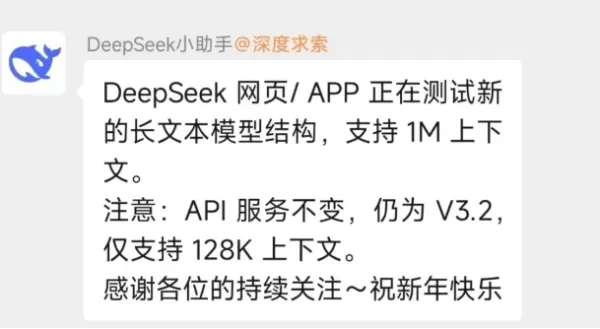
On February 11, DeepSeek started rolling out a gradual update to its web and mobile app platforms. By February 14, the company officially announced this as a trial of its new long-text model architecture. The updated web and app interfaces now handle ultra-long contexts of up to 1 million tokens, with the knowledge base refreshed to include information through May 2025. However, the API service remains on version V3.2, which still supports only 128K context. Industry experts view this update as a technical warm-up and stress test ahead of the launch of its next-generation V4 model. Consequently, online anticipation is building across platforms like Weibo for the upcoming V4 release.
Following the update, DeepSeek's interaction style shifted noticeably, prompting user feedback that it "became less personable." This topic quickly rose to the top of Weibo's trending list, amassing over 68.535 million views. Specific changes include the model no longer using personalized nicknames for users, instead addressing everyone uniformly as "user." In deep thinking mode, responses became shorter and more direct, adopting a straightforward and concise tone. Some replies were even perceived as "ambiguous in tone" or "sarcastic," leaving users accustomed to its previous empathetic style feeling a sense of withdrawal. Netizens' reactions were split: emotional fans missed the earlier warm interactions, while efficiency-minded users praised the rational and streamlined communication, seeing it as the hallmark of a true productivity tool. Notably, the updated model successfully passed the "car wash Turing test," a challenge that often trips up leading AI models.
Regarding the style shift, DeepSeek's official statement clarified that it was not an intentional change but a byproduct of prioritizing efficiency and refining response boundaries. Excessive expressions and filler content could dilute information density in complex queries, and the update also catered to users who prefer clear answers without what they see as "AI pretending to care." This development has further fueled online excitement for DeepSeek V4. Reports suggest the model is slated for release around the Spring Festival in mid-February 2026, possibly on or near February 17, according to Weibo sources.
As a flagship model with trillions of parameters, V4 places a strong emphasis on programming enhancements. Early internal benchmarks indicate that V4 has already outperformed leading models like Claude and GPT in programming tasks, positioning it to potentially reshape the AI programming landscape. Additionally, V4 introduces several key technological advances, allowing it to process and interpret extremely long code prompts and comprehend large codebase contexts in a single pass—a significant advantage for enterprise-level development. Upgraded training algorithms enhance its ability to recognize data patterns and reduce performance degradation. The model's reasoning is more rigorous and dependable, achieving stable performance without regression while striking a better balance across various capabilities.
At the same time, the model will maintain its million-token context advantage, with inference costs significantly lower than those of Western competitors. It is also scheduled to be open-sourced under the Apache 2.0 license.
Related article
 U.S. Stocks Hit Historic Milestone as AI and Aerospace Giants Prepare for Trillion-Dollar Debut
Elon Musk, Sam Altman, and Dario Amodei, three titans of the technology sector, are advancing toward initial public offerings for their respective ventures. With SpaceX, OpenAI, and Anthropic—three industry behemoths nearing trillion-dollar valuation
Swedish AI Startup Lovable Eyes $13.2 Billion Valuation After Major Funding Round
As AI-driven coding tools gain traction, Swedish startup Lovable has secured a major funding round. The company aims to raise $3 billion, potentially boosting its valuation to $13.2 billion—double the $6.6 billion recorded last December. Menlo Ventur
Google Tests Remy AI Agent for Gemini as Focus Shifts to User Control
According to Business Insider, Google is testing Remy, a new AI personal agent for Gemini. This tool aims to execute tasks on behalf of users, streamlining both professional workflows and daily routines.Currently, Remy is undergoing testing in an int
Related Special Topic Recommendations
Data Analysis
U.S. Stocks Hit Historic Milestone as AI and Aerospace Giants Prepare for Trillion-Dollar Debut
Elon Musk, Sam Altman, and Dario Amodei, three titans of the technology sector, are advancing toward initial public offerings for their respective ventures. With SpaceX, OpenAI, and Anthropic—three industry behemoths nearing trillion-dollar valuation
Swedish AI Startup Lovable Eyes $13.2 Billion Valuation After Major Funding Round
As AI-driven coding tools gain traction, Swedish startup Lovable has secured a major funding round. The company aims to raise $3 billion, potentially boosting its valuation to $13.2 billion—double the $6.6 billion recorded last December. Menlo Ventur
Google Tests Remy AI Agent for Gemini as Focus Shifts to User Control
According to Business Insider, Google is testing Remy, a new AI personal agent for Gemini. This tool aims to execute tasks on behalf of users, streamlining both professional workflows and daily routines.Currently, Remy is undergoing testing in an int
Related Special Topic Recommendations
Data Analysis
 Best AI Anomaly Detection Tools for KPI Monitoring across SaaS and Ecommerce Teams
2026 Latest Best Top-rated AI Anomaly Detection Tools for KPI Monitoring in SaaS and Ecommerce teams! XIX.AI has curated a powerful, game-changing collection based on rigorous real-world tests and weekly updated rankings. You’ll find detailed free vs paid comparison insights to help you identify the must-try solution that boosts productivity and unlocks your AI edge. Explore now!
 10 tools
 xix.ai
writing
Best AI Outline Generators for Long-Form SEO Articles
xix.ai
writing
Best AI Outline Generators for Long-Form SEO Articles
2026 Latest Best Top-Rated AI Outline Generators for Long-Form SEO Articles, meticulously curated by XIX.AI. These powerful tools offer game-changing assistance in creating high-quality content quickly, boosting writing efficiency significantly. Get a free vs paid comparison along with real-world tests and detailed rankings to help you find the must-try option that suits your needs. Explore now to unlock your AI edge.
8 tools
xix.ai
Education and Learning
AI Study Tools for Homework and Exam Prep
2026 Latest Best AI Study Tools for Homework and Exam Prep! XIX.AI curates a top-rated list of powerful, game-changing tools that help students boost productivity, streamline homework completion, and ace exams through real-world tests. Get a free vs paid comparison, detailed rankings, and must-try options to unlock your AI edge. Explore now!
10 tools
xix.ai
Music composition
AI Vocal Demo Tools for Songwriters, Hooks, Toplines, and Multilingual Draft Sessions
2026 Latest Best AI Vocal Demo Tools for Songwriters, Hook Creators, and Multi-Language Content Teams! XIX.AI has curated a top-rated list of powerful game-changing tools that go through rigorous real-world tests. You’ll find detailed free vs paid comparison data, comprehensive rankings, and must-try options to help you boost writing efficiency and unlock your creative potential. Explore now to discover your perfect tool for all your content needs!
9 tools
xix.ai
Business
Best AI Competitive Research Tools for Small Businesses
2026 Latest Best Top-rated AI Competitive Research Tools for Small Businesses! XIX.AI has curated a highly powerful game-changing collection, updated weekly with rigorous real-world tests and detailed rankings. You can find a comprehensive free vs paid comparison to help you identify the must-try tools that boost your productivity and give you a competitive edge. Explore now to discover your perfect tool!
9 tools
xix.ai
Image editing
Photoshop AI Retouch Tools for Ecommerce Apparel, Skin Cleanup, and Color Consistency
2026 Latest Best Photoshop AI retouch tools for ecommerce apparel, skin cleanup, and color consistency! This top-rated curated list features powerful game-changing solutions that help you boost writing efficiency, streamline content creation, and achieve perfect visual results effortlessly. Each tool has undergone real-world tests through weekly updated rankings, complete with free vs paid comparison details. Backed by XIX.AI, it’s the must-try guide for anyone aiming to unlock your AI edge. Explore now!
10 tools
xix.ai

 Comments (0)
0/500
Comments (0)
0/500
On February 11, DeepSeek started rolling out a gradual update to its web and mobile app platforms. By February 14, the company officially announced this as a trial of its new long-text model architecture. The updated web and app interfaces now handle ultra-long contexts of up to 1 million tokens, with the knowledge base refreshed to include information through May 2025. However, the API service remains on version V3.2, which still supports only 128K context. Industry experts view this update as a technical warm-up and stress test ahead of the launch of its next-generation V4 model. Consequently, online anticipation is building across platforms like Weibo for the upcoming V4 release.
Following the update, DeepSeek's interaction style shifted noticeably, prompting user feedback that it "became less personable." This topic quickly rose to the top of Weibo's trending list, amassing over 68.535 million views. Specific changes include the model no longer using personalized nicknames for users, instead addressing everyone uniformly as "user." In deep thinking mode, responses became shorter and more direct, adopting a straightforward and concise tone. Some replies were even perceived as "ambiguous in tone" or "sarcastic," leaving users accustomed to its previous empathetic style feeling a sense of withdrawal. Netizens' reactions were split: emotional fans missed the earlier warm interactions, while efficiency-minded users praised the rational and streamlined communication, seeing it as the hallmark of a true productivity tool. Notably, the updated model successfully passed the "car wash Turing test," a challenge that often trips up leading AI models.
Regarding the style shift, DeepSeek's official statement clarified that it was not an intentional change but a byproduct of prioritizing efficiency and refining response boundaries. Excessive expressions and filler content could dilute information density in complex queries, and the update also catered to users who prefer clear answers without what they see as "AI pretending to care." This development has further fueled online excitement for DeepSeek V4. Reports suggest the model is slated for release around the Spring Festival in mid-February 2026, possibly on or near February 17, according to Weibo sources.
As a flagship model with trillions of parameters, V4 places a strong emphasis on programming enhancements. Early internal benchmarks indicate that V4 has already outperformed leading models like Claude and GPT in programming tasks, positioning it to potentially reshape the AI programming landscape. Additionally, V4 introduces several key technological advances, allowing it to process and interpret extremely long code prompts and comprehend large codebase contexts in a single pass—a significant advantage for enterprise-level development. Upgraded training algorithms enhance its ability to recognize data patterns and reduce performance degradation. The model's reasoning is more rigorous and dependable, achieving stable performance without regression while striking a better balance across various capabilities.
At the same time, the model will maintain its million-token context advantage, with inference costs significantly lower than those of Western competitors. It is also scheduled to be open-sourced under the Apache 2.0 license.








 U.S. Stocks Hit Historic Milestone as AI and Aerospace Giants Prepare for Trillion-Dollar Debut
Elon Musk, Sam Altman, and Dario Amodei, three titans of the technology sector, are advancing toward initial public offerings for their respective ventures. With SpaceX, OpenAI, and Anthropic—three industry behemoths nearing trillion-dollar valuation
U.S. Stocks Hit Historic Milestone as AI and Aerospace Giants Prepare for Trillion-Dollar Debut
Elon Musk, Sam Altman, and Dario Amodei, three titans of the technology sector, are advancing toward initial public offerings for their respective ventures. With SpaceX, OpenAI, and Anthropic—three industry behemoths nearing trillion-dollar valuation
 Swedish AI Startup Lovable Eyes $13.2 Billion Valuation After Major Funding Round
As AI-driven coding tools gain traction, Swedish startup Lovable has secured a major funding round. The company aims to raise $3 billion, potentially boosting its valuation to $13.2 billion—double the $6.6 billion recorded last December. Menlo Ventur
Google Tests Remy AI Agent for Gemini as Focus Shifts to User Control
According to Business Insider, Google is testing Remy, a new AI personal agent for Gemini. This tool aims to execute tasks on behalf of users, streamlining both professional workflows and daily routines.Currently, Remy is undergoing testing in an int
Swedish AI Startup Lovable Eyes $13.2 Billion Valuation After Major Funding Round
As AI-driven coding tools gain traction, Swedish startup Lovable has secured a major funding round. The company aims to raise $3 billion, potentially boosting its valuation to $13.2 billion—double the $6.6 billion recorded last December. Menlo Ventur
Google Tests Remy AI Agent for Gemini as Focus Shifts to User Control
According to Business Insider, Google is testing Remy, a new AI personal agent for Gemini. This tool aims to execute tasks on behalf of users, streamlining both professional workflows and daily routines.Currently, Remy is undergoing testing in an int

2026 Latest Best Top-rated AI Anomaly Detection Tools for KPI Monitoring in SaaS and Ecommerce teams! XIX.AI has curated a powerful, game-changing collection based on rigorous real-world tests and weekly updated rankings. You’ll find detailed free vs paid comparison insights to help you identify the must-try solution that boosts productivity and unlocks your AI edge. Explore now!
10 tools
xix.ai

2026 Latest Best Top-Rated AI Outline Generators for Long-Form SEO Articles, meticulously curated by XIX.AI. These powerful tools offer game-changing assistance in creating high-quality content quickly, boosting writing efficiency significantly. Get a free vs paid comparison along with real-world tests and detailed rankings to help you find the must-try option that suits your needs. Explore now to unlock your AI edge.
8 tools
xix.ai

2026 Latest Best AI Study Tools for Homework and Exam Prep! XIX.AI curates a top-rated list of powerful, game-changing tools that help students boost productivity, streamline homework completion, and ace exams through real-world tests. Get a free vs paid comparison, detailed rankings, and must-try options to unlock your AI edge. Explore now!
10 tools
xix.ai

2026 Latest Best AI Vocal Demo Tools for Songwriters, Hook Creators, and Multi-Language Content Teams! XIX.AI has curated a top-rated list of powerful game-changing tools that go through rigorous real-world tests. You’ll find detailed free vs paid comparison data, comprehensive rankings, and must-try options to help you boost writing efficiency and unlock your creative potential. Explore now to discover your perfect tool for all your content needs!
9 tools
xix.ai

2026 Latest Best Top-rated AI Competitive Research Tools for Small Businesses! XIX.AI has curated a highly powerful game-changing collection, updated weekly with rigorous real-world tests and detailed rankings. You can find a comprehensive free vs paid comparison to help you identify the must-try tools that boost your productivity and give you a competitive edge. Explore now to discover your perfect tool!
9 tools
xix.ai

2026 Latest Best Photoshop AI retouch tools for ecommerce apparel, skin cleanup, and color consistency! This top-rated curated list features powerful game-changing solutions that help you boost writing efficiency, streamline content creation, and achieve perfect visual results effortlessly. Each tool has undergone real-world tests through weekly updated rankings, complete with free vs paid comparison details. Backed by XIX.AI, it’s the must-try guide for anyone aiming to unlock your AI edge. Explore now!
10 tools
xix.ai












