


 Home
HomeDeepSeek Unveils First Agent Framework, Harnessing AI with Plug-and-Play Execution Engine
Following its recent API pricing updates, DeepSeek unveiled DeepSeek Harness v0.1 Developer Preview on August 13, open-sourcing the project on GitHub under the MIT license. This initiative, championed by Liang Wenfeng, shifts focus from the model itself to the supporting infrastructure that enables AI to execute real-world tasks. The team defines this relationship with a simple formula: Model + Harness = Agent, where the model handles reasoning and Harness manages execution.
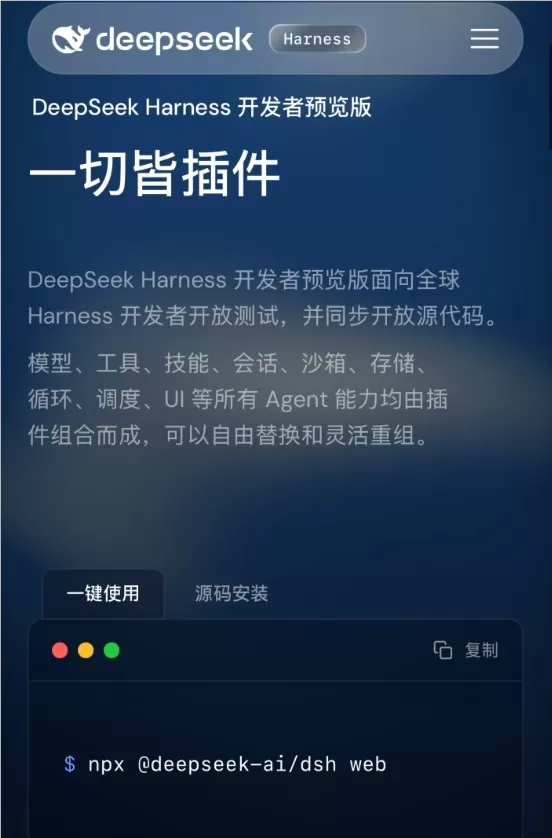
Harness provides a comprehensive local agent workspace, featuring project management, long-term task collaboration, multi-agent orchestration, context handling, online retrieval, and external skill integration. This allows developers to run complex tasks immediately without assembling disparate tools. As an early preview, Harness operates on the principle that "Everything is a plugin," redefining Agent development through an open architecture.
Four Operational Modes, Configured via Assembly
The core strength of Harness is its plugin-based open architecture. Every component—models, tools, skills, sessions, sandboxes, storage, loops, scheduling, and UI—is a plugin that can be swapped or reassembled freely. Built on the Cordis plugin meta-framework, Harness handles only low-level tasks like loading and dependency management. All business logic consists of independent Cordis plugins that interact via services and events, allowing developers to reconfigure the system at the configuration level without altering source code.
Harness supports four predefined operational modes, each loading a specific plugin set: Standard mode includes a full toolset for general development; PTC (Programmatic Tool Call) mode enables the model to generate code and orchestrate multi-turn tool chains; Minimal mode restricts tools to Shell and file editing for baseline testing in constrained environments; and Creative mode offers runtime status viewing, memory debugging plugins, and support for custom operational modes. Developers can quickly launch a Web interface locally using the npx command after deploying a Node.js toolchain.
As DeepSeek’s foundation for the Agent arena, v0.1 is still in its early stages, yet its "disassemble-and-reconfigure" philosophy addresses current fragmentation in the intelligent agent ecosystem. While competitors like OpenAI push for Agent Plugins standards and vie for influence, DeepSeek’s decision to open the entire stack under the MIT license lowers barriers for developers building custom Agents, significantly boosting the domestic open-source Agent ecosystem.
Related article
 Swedish AI Startup Lovable Eyes $13.2 Billion Valuation After Major Funding Round
As AI-driven coding tools gain traction, Swedish startup Lovable has secured a major funding round. The company aims to raise $3 billion, potentially boosting its valuation to $13.2 billion—double the $6.6 billion recorded last December. Menlo Ventur
Google Tests Remy AI Agent for Gemini as Focus Shifts to User Control
According to Business Insider, Google is testing Remy, a new AI personal agent for Gemini. This tool aims to execute tasks on behalf of users, streamlining both professional workflows and daily routines.Currently, Remy is undergoing testing in an int
How to fix Core Web Vitals for better SEO rankings
Streamline Report Card Comments with AI ToolsIntroductionAI Tools for Generating Report Card CommentsMagic SchoolAlmanac AIChat GPTUsing Magic School to Generate Report Card CommentsLogging into Magic SchoolSelecting the Report Card Comments ToolCust
Related Special Topic Recommendations
writing
Swedish AI Startup Lovable Eyes $13.2 Billion Valuation After Major Funding Round
As AI-driven coding tools gain traction, Swedish startup Lovable has secured a major funding round. The company aims to raise $3 billion, potentially boosting its valuation to $13.2 billion—double the $6.6 billion recorded last December. Menlo Ventur
Google Tests Remy AI Agent for Gemini as Focus Shifts to User Control
According to Business Insider, Google is testing Remy, a new AI personal agent for Gemini. This tool aims to execute tasks on behalf of users, streamlining both professional workflows and daily routines.Currently, Remy is undergoing testing in an int
How to fix Core Web Vitals for better SEO rankings
Streamline Report Card Comments with AI ToolsIntroductionAI Tools for Generating Report Card CommentsMagic SchoolAlmanac AIChat GPTUsing Magic School to Generate Report Card CommentsLogging into Magic SchoolSelecting the Report Card Comments ToolCust
Related Special Topic Recommendations
writing
 Best AI Outline Generators for Long-Form SEO Articles
2026 Latest Best Top-Rated AI Outline Generators for Long-Form SEO Articles, meticulously curated by XIX.AI. These powerful tools offer game-changing assistance in creating high-quality content quickly, boosting writing efficiency significantly. Get a free vs paid comparison along with real-world tests and detailed rankings to help you find the must-try option that suits your needs. Explore now to unlock your AI edge.
 8 tools
 xix.ai
Education and Learning
AI Study Tools for Homework and Exam Prep
xix.ai
Education and Learning
AI Study Tools for Homework and Exam Prep
2026 Latest Best AI Study Tools for Homework and Exam Prep! XIX.AI curates a top-rated list of powerful, game-changing tools that help students boost productivity, streamline homework completion, and ace exams through real-world tests. Get a free vs paid comparison, detailed rankings, and must-try options to unlock your AI edge. Explore now!
10 tools
xix.ai
Music composition
AI Vocal Demo Tools for Songwriters, Hooks, Toplines, and Multilingual Draft Sessions
2026 Latest Best AI Vocal Demo Tools for Songwriters, Hook Creators, and Multi-Language Content Teams! XIX.AI has curated a top-rated list of powerful game-changing tools that go through rigorous real-world tests. You’ll find detailed free vs paid comparison data, comprehensive rankings, and must-try options to help you boost writing efficiency and unlock your creative potential. Explore now to discover your perfect tool for all your content needs!
9 tools
xix.ai
Business
Best AI Competitive Research Tools for Small Businesses
2026 Latest Best Top-rated AI Competitive Research Tools for Small Businesses! XIX.AI has curated a highly powerful game-changing collection, updated weekly with rigorous real-world tests and detailed rankings. You can find a comprehensive free vs paid comparison to help you identify the must-try tools that boost your productivity and give you a competitive edge. Explore now to discover your perfect tool!
9 tools
xix.ai
Image editing
Photoshop AI Retouch Tools for Ecommerce Apparel, Skin Cleanup, and Color Consistency
2026 Latest Best Photoshop AI retouch tools for ecommerce apparel, skin cleanup, and color consistency! This top-rated curated list features powerful game-changing solutions that help you boost writing efficiency, streamline content creation, and achieve perfect visual results effortlessly. Each tool has undergone real-world tests through weekly updated rankings, complete with free vs paid comparison details. Backed by XIX.AI, it’s the must-try guide for anyone aiming to unlock your AI edge. Explore now!
10 tools
xix.ai
Prompt
Best AI Prompt Libraries for ChatGPT Workflows
2026 Latest Best Top-Rated AI Prompt Libraries for optimizing all types of ChatGPT workflows. XIX.AI has curated a powerful, game-changing collection that goes through rigorous real-world tests to ensure top performance. You can find detailed free vs paid comparisons and expert rankings to help you choose the must-try tools that boost your productivity and unlock your AI edge. Explore now!
11 tools
xix.ai

 Comments (0)
0/500
Comments (0)
0/500
Following its recent API pricing updates, DeepSeek unveiled DeepSeek Harness v0.1 Developer Preview on August 13, open-sourcing the project on GitHub under the MIT license. This initiative, championed by Liang Wenfeng, shifts focus from the model itself to the supporting infrastructure that enables AI to execute real-world tasks. The team defines this relationship with a simple formula: Model + Harness = Agent, where the model handles reasoning and Harness manages execution.
Harness provides a comprehensive local agent workspace, featuring project management, long-term task collaboration, multi-agent orchestration, context handling, online retrieval, and external skill integration. This allows developers to run complex tasks immediately without assembling disparate tools. As an early preview, Harness operates on the principle that "Everything is a plugin," redefining Agent development through an open architecture.
Four Operational Modes, Configured via Assembly
The core strength of Harness is its plugin-based open architecture. Every component—models, tools, skills, sessions, sandboxes, storage, loops, scheduling, and UI—is a plugin that can be swapped or reassembled freely. Built on the Cordis plugin meta-framework, Harness handles only low-level tasks like loading and dependency management. All business logic consists of independent Cordis plugins that interact via services and events, allowing developers to reconfigure the system at the configuration level without altering source code.
Harness supports four predefined operational modes, each loading a specific plugin set: Standard mode includes a full toolset for general development; PTC (Programmatic Tool Call) mode enables the model to generate code and orchestrate multi-turn tool chains; Minimal mode restricts tools to Shell and file editing for baseline testing in constrained environments; and Creative mode offers runtime status viewing, memory debugging plugins, and support for custom operational modes. Developers can quickly launch a Web interface locally using the npx command after deploying a Node.js toolchain.
As DeepSeek’s foundation for the Agent arena, v0.1 is still in its early stages, yet its "disassemble-and-reconfigure" philosophy addresses current fragmentation in the intelligent agent ecosystem. While competitors like OpenAI push for Agent Plugins standards and vie for influence, DeepSeek’s decision to open the entire stack under the MIT license lowers barriers for developers building custom Agents, significantly boosting the domestic open-source Agent ecosystem.








 Swedish AI Startup Lovable Eyes $13.2 Billion Valuation After Major Funding Round
As AI-driven coding tools gain traction, Swedish startup Lovable has secured a major funding round. The company aims to raise $3 billion, potentially boosting its valuation to $13.2 billion—double the $6.6 billion recorded last December. Menlo Ventur
Google Tests Remy AI Agent for Gemini as Focus Shifts to User Control
According to Business Insider, Google is testing Remy, a new AI personal agent for Gemini. This tool aims to execute tasks on behalf of users, streamlining both professional workflows and daily routines.Currently, Remy is undergoing testing in an int
Swedish AI Startup Lovable Eyes $13.2 Billion Valuation After Major Funding Round
As AI-driven coding tools gain traction, Swedish startup Lovable has secured a major funding round. The company aims to raise $3 billion, potentially boosting its valuation to $13.2 billion—double the $6.6 billion recorded last December. Menlo Ventur
Google Tests Remy AI Agent for Gemini as Focus Shifts to User Control
According to Business Insider, Google is testing Remy, a new AI personal agent for Gemini. This tool aims to execute tasks on behalf of users, streamlining both professional workflows and daily routines.Currently, Remy is undergoing testing in an int
 How to fix Core Web Vitals for better SEO rankings
Streamline Report Card Comments with AI ToolsIntroductionAI Tools for Generating Report Card CommentsMagic SchoolAlmanac AIChat GPTUsing Magic School to Generate Report Card CommentsLogging into Magic SchoolSelecting the Report Card Comments ToolCust
How to fix Core Web Vitals for better SEO rankings
Streamline Report Card Comments with AI ToolsIntroductionAI Tools for Generating Report Card CommentsMagic SchoolAlmanac AIChat GPTUsing Magic School to Generate Report Card CommentsLogging into Magic SchoolSelecting the Report Card Comments ToolCust

2026 Latest Best Top-Rated AI Outline Generators for Long-Form SEO Articles, meticulously curated by XIX.AI. These powerful tools offer game-changing assistance in creating high-quality content quickly, boosting writing efficiency significantly. Get a free vs paid comparison along with real-world tests and detailed rankings to help you find the must-try option that suits your needs. Explore now to unlock your AI edge.
8 tools
xix.ai

2026 Latest Best AI Study Tools for Homework and Exam Prep! XIX.AI curates a top-rated list of powerful, game-changing tools that help students boost productivity, streamline homework completion, and ace exams through real-world tests. Get a free vs paid comparison, detailed rankings, and must-try options to unlock your AI edge. Explore now!
10 tools
xix.ai

2026 Latest Best AI Vocal Demo Tools for Songwriters, Hook Creators, and Multi-Language Content Teams! XIX.AI has curated a top-rated list of powerful game-changing tools that go through rigorous real-world tests. You’ll find detailed free vs paid comparison data, comprehensive rankings, and must-try options to help you boost writing efficiency and unlock your creative potential. Explore now to discover your perfect tool for all your content needs!
9 tools
xix.ai

2026 Latest Best Top-rated AI Competitive Research Tools for Small Businesses! XIX.AI has curated a highly powerful game-changing collection, updated weekly with rigorous real-world tests and detailed rankings. You can find a comprehensive free vs paid comparison to help you identify the must-try tools that boost your productivity and give you a competitive edge. Explore now to discover your perfect tool!
9 tools
xix.ai

2026 Latest Best Photoshop AI retouch tools for ecommerce apparel, skin cleanup, and color consistency! This top-rated curated list features powerful game-changing solutions that help you boost writing efficiency, streamline content creation, and achieve perfect visual results effortlessly. Each tool has undergone real-world tests through weekly updated rankings, complete with free vs paid comparison details. Backed by XIX.AI, it’s the must-try guide for anyone aiming to unlock your AI edge. Explore now!
10 tools
xix.ai
2026 Latest Best Top-Rated AI Prompt Libraries for optimizing all types of ChatGPT workflows. XIX.AI has curated a powerful, game-changing collection that goes through rigorous real-world tests to ensure top performance. You can find detailed free vs paid comparisons and expert rankings to help you choose the must-try tools that boost your productivity and unlock your AI edge. Explore now!
11 tools
xix.ai












