


 Home
HomeDeepMind's AI Outperforms IMO Gold Medalists
Google DeepMind's latest AI, AlphaGeometry2, has made waves by outperforming the average gold medalist in solving geometry problems at the International Mathematical Olympiad (IMO). This advanced version of the previously released AlphaGeometry, introduced just last January, reportedly solved 84% of geometry problems from the last 25 years of IMO competitions.
You might wonder why DeepMind is focusing on a high school math contest. Well, they believe that cracking these challenging Euclidean geometry problems could be a stepping stone to developing more advanced AI. Solving these problems requires both logical reasoning and the ability to navigate through various solution paths, skills that could be crucial for future general-purpose AI systems.
This summer, DeepMind showcased a system that combined AlphaGeometry2 with AlphaProof, another AI model designed for formal math reasoning. Together, they tackled four out of six problems from the 2024 IMO. This approach could potentially extend beyond geometry to other areas of math and science, like complex engineering calculations.
AlphaGeometry2 is powered by a few key components, including a language model from Google's Gemini family and a "symbolic engine." The Gemini model assists the symbolic engine, which applies mathematical rules to find solutions, in creating feasible proofs for geometry theorems.
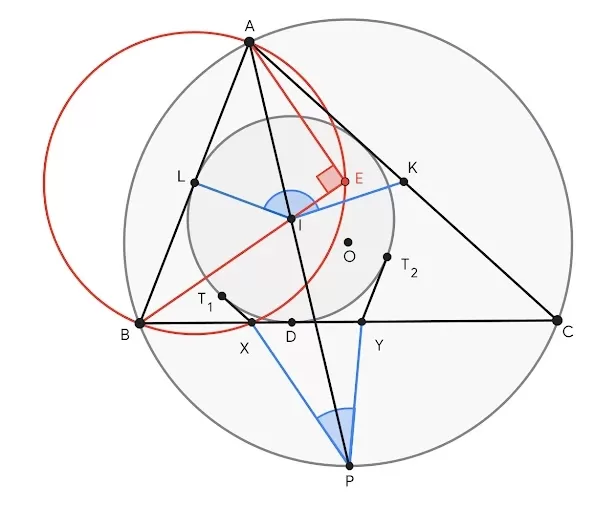
A typical geometry problem diagram in an IMO exam.Image Credits:Google (opens in a new window)
In the IMO, geometry problems often require adding "constructs" like points, lines, or circles to diagrams before solving them. AlphaGeometry2's Gemini model predicts which constructs might be helpful, guiding the symbolic engine to make deductions.
Here's how it works: The Gemini model suggests steps and constructions in a formal mathematical language, which the engine then checks for logical consistency. AlphaGeometry2 uses a search algorithm to explore multiple solution paths simultaneously and stores potentially useful findings in a shared knowledge base.
A problem is considered "solved" when AlphaGeometry2 combines the Gemini model's suggestions with the symbolic engine's known principles to form a complete proof.
Due to the scarcity of usable geometry training data, DeepMind created synthetic data to train AlphaGeometry2's language model, generating over 300 million theorems and proofs of varying complexity.
The DeepMind team tested AlphaGeometry2 on 45 geometry problems from IMO competitions spanning 2000 to 2024, which they expanded into 50 problems. AlphaGeometry2 solved 42 of these, surpassing the average gold medalist score of 40.9.
However, AlphaGeometry2 has its limitations. It struggles with problems involving a variable number of points, nonlinear equations, and inequalities. While it's not the first AI to reach gold-medal-level performance in geometry, it's the first to do so with such a large problem set.
When faced with a tougher set of 29 IMO-nominated problems that haven't yet appeared in competitions, AlphaGeometry2 could only solve 20.
The study's results are likely to spark further debate about the best approach to building AI systems. Should we focus on symbol manipulation, where AI uses rules to manipulate symbols representing knowledge, or on neural networks, which mimic the human brain's structure and learn from data?
AlphaGeometry2 takes a hybrid approach, combining the neural network architecture of the Gemini model with the rules-based symbolic engine.
Supporters of neural networks argue that intelligent behavior can emerge from vast amounts of data and computing power. In contrast, symbolic AI proponents believe it's better suited for encoding knowledge, reasoning through complex scenarios, and explaining solutions.
Vince Conitzer, a Carnegie Mellon University computer science professor specializing in AI, commented on the contrast between the impressive progress on benchmarks like the IMO and the ongoing struggles of language models with simple commonsense problems. He emphasized the need to better understand these systems and the risks they pose.
AlphaGeometry2 suggests that combining symbol manipulation and neural networks might be a promising way forward in the quest for generalizable AI. Interestingly, the DeepMind team found that AlphaGeometry2's language model could generate partial solutions to problems without the symbolic engine's help, hinting at the potential for language models to become self-sufficient in the future.
However, the team noted that until language model speed improves and hallucinations are resolved, tools like symbolic engines will remain essential for math applications.
Related article
 Google Tests Remy AI Agent for Gemini as Focus Shifts to User Control
According to Business Insider, Google is testing Remy, a new AI personal agent for Gemini. This tool aims to execute tasks on behalf of users, streamlining both professional workflows and daily routines.Currently, Remy is undergoing testing in an int
Ollie bets privacy focus to win AI assistant race
To be genuinely helpful, an AI assistant must understand its user deeply. Ollie, a personal assistant designed for daily life, operates on the premise that this doesn’t require surrendering your data or compromising your privacy.While certain enterpr
How AI LIVE: London Will Explore AI & Industrial Automation
The summit will convene C-suite executives from around the globe to address pressing challenges in global industries, ranging from AI-driven disruption to economic volatility.AI LIVE: The London Summit will gather over 2,000 international leaders und
Related Special Topic Recommendations
writing
Google Tests Remy AI Agent for Gemini as Focus Shifts to User Control
According to Business Insider, Google is testing Remy, a new AI personal agent for Gemini. This tool aims to execute tasks on behalf of users, streamlining both professional workflows and daily routines.Currently, Remy is undergoing testing in an int
Ollie bets privacy focus to win AI assistant race
To be genuinely helpful, an AI assistant must understand its user deeply. Ollie, a personal assistant designed for daily life, operates on the premise that this doesn’t require surrendering your data or compromising your privacy.While certain enterpr
How AI LIVE: London Will Explore AI & Industrial Automation
The summit will convene C-suite executives from around the globe to address pressing challenges in global industries, ranging from AI-driven disruption to economic volatility.AI LIVE: The London Summit will gather over 2,000 international leaders und
Related Special Topic Recommendations
writing
 Best AI Outline Generators for Long-Form SEO Articles
2026 Latest Best Top-Rated AI Outline Generators for Long-Form SEO Articles, meticulously curated by XIX.AI. These powerful tools offer game-changing assistance in creating high-quality content quickly, boosting writing efficiency significantly. Get a free vs paid comparison along with real-world tests and detailed rankings to help you find the must-try option that suits your needs. Explore now to unlock your AI edge.
 8 tools
 xix.ai
Education and Learning
AI Study Tools for Homework and Exam Prep
xix.ai
Education and Learning
AI Study Tools for Homework and Exam Prep
2026 Latest Best AI Study Tools for Homework and Exam Prep! XIX.AI curates a top-rated list of powerful, game-changing tools that help students boost productivity, streamline homework completion, and ace exams through real-world tests. Get a free vs paid comparison, detailed rankings, and must-try options to unlock your AI edge. Explore now!
10 tools
xix.ai
Music composition
AI Vocal Demo Tools for Songwriters, Hooks, Toplines, and Multilingual Draft Sessions
2026 Latest Best AI Vocal Demo Tools for Songwriters, Hook Creators, and Multi-Language Content Teams! XIX.AI has curated a top-rated list of powerful game-changing tools that go through rigorous real-world tests. You’ll find detailed free vs paid comparison data, comprehensive rankings, and must-try options to help you boost writing efficiency and unlock your creative potential. Explore now to discover your perfect tool for all your content needs!
9 tools
xix.ai
Business
Best AI Competitive Research Tools for Small Businesses
2026 Latest Best Top-rated AI Competitive Research Tools for Small Businesses! XIX.AI has curated a highly powerful game-changing collection, updated weekly with rigorous real-world tests and detailed rankings. You can find a comprehensive free vs paid comparison to help you identify the must-try tools that boost your productivity and give you a competitive edge. Explore now to discover your perfect tool!
9 tools
xix.ai
Image editing
Photoshop AI Retouch Tools for Ecommerce Apparel, Skin Cleanup, and Color Consistency
2026 Latest Best Photoshop AI retouch tools for ecommerce apparel, skin cleanup, and color consistency! This top-rated curated list features powerful game-changing solutions that help you boost writing efficiency, streamline content creation, and achieve perfect visual results effortlessly. Each tool has undergone real-world tests through weekly updated rankings, complete with free vs paid comparison details. Backed by XIX.AI, it’s the must-try guide for anyone aiming to unlock your AI edge. Explore now!
10 tools
xix.ai
Prompt
Best AI Prompt Libraries for ChatGPT Workflows
2026 Latest Best Top-Rated AI Prompt Libraries for optimizing all types of ChatGPT workflows. XIX.AI has curated a powerful, game-changing collection that goes through rigorous real-world tests to ensure top performance. You can find detailed free vs paid comparisons and expert rankings to help you choose the must-try tools that boost your productivity and unlock your AI edge. Explore now!
11 tools
xix.ai

 Comments (34)
0/500
Comments (34)
0/500
![DonaldAdams]()
AlphaGeometry2這表現也太猛了吧!直接超越IMO金牌平均水準,感覺數學競賽的未來要徹底改寫了。不過AI在幾何證明上這麼強,以後學生還需要苦練那些輔助線技巧嗎?🤔 既期待又怕被取代啊...
![AnthonyMoore]()
C'est impressionnant de voir à quelle vitesse AlphaGeometry2 a été développé après la première version ! 😮 Mais je me demande comment cela se traduirait dans le monde réel, au-delà des compétitions. Peut-être pour la conception d'algorithmes complexes ? Cela donne aussi un peu peur pour l'avenir des métiers très spécialisés...
![BenHernández]()
AlphaGeometry2って前回のバージョンからかなり進化してるんですね。IMO金メダリストを超えるって凄すぎる😳 でもこれがどんどん研究が進んで、いずれ人間が解けない問題もAIが解く時代が来るのかな?ちょっと怖いかも
![KevinBrown]()
Impressionnant mais un peu flippant... Si une IA peut battre des médaillés d'or aux Olympiades, qu'est-ce qui nous reste comme domaines où les humains sont encore les meilleurs ? 😅 J'espère qu'on va pas tous devenir obsolètes !
![GregoryWalker]()
This AI beating IMO champs is wild! 🧠 Geometry’s tough, but AlphaGeometry2’s out here crushing it. Makes me wonder if it’ll start tutoring kids soon! 😄
![AnthonyMoore]()
Incroyable, AlphaGeometry2 dépasse les médaillés d'or de l'IMO en géométrie ! 😲 Ça montre à quel point l'IA avance vite, mais je me demande si elle pourrait un jour résoudre des problèmes plus... humains, comme gérer mes impôts !
Google DeepMind's latest AI, AlphaGeometry2, has made waves by outperforming the average gold medalist in solving geometry problems at the International Mathematical Olympiad (IMO). This advanced version of the previously released AlphaGeometry, introduced just last January, reportedly solved 84% of geometry problems from the last 25 years of IMO competitions.
You might wonder why DeepMind is focusing on a high school math contest. Well, they believe that cracking these challenging Euclidean geometry problems could be a stepping stone to developing more advanced AI. Solving these problems requires both logical reasoning and the ability to navigate through various solution paths, skills that could be crucial for future general-purpose AI systems.
This summer, DeepMind showcased a system that combined AlphaGeometry2 with AlphaProof, another AI model designed for formal math reasoning. Together, they tackled four out of six problems from the 2024 IMO. This approach could potentially extend beyond geometry to other areas of math and science, like complex engineering calculations.
AlphaGeometry2 is powered by a few key components, including a language model from Google's Gemini family and a "symbolic engine." The Gemini model assists the symbolic engine, which applies mathematical rules to find solutions, in creating feasible proofs for geometry theorems.
In the IMO, geometry problems often require adding "constructs" like points, lines, or circles to diagrams before solving them. AlphaGeometry2's Gemini model predicts which constructs might be helpful, guiding the symbolic engine to make deductions.
Here's how it works: The Gemini model suggests steps and constructions in a formal mathematical language, which the engine then checks for logical consistency. AlphaGeometry2 uses a search algorithm to explore multiple solution paths simultaneously and stores potentially useful findings in a shared knowledge base.
A problem is considered "solved" when AlphaGeometry2 combines the Gemini model's suggestions with the symbolic engine's known principles to form a complete proof.
Due to the scarcity of usable geometry training data, DeepMind created synthetic data to train AlphaGeometry2's language model, generating over 300 million theorems and proofs of varying complexity.
The DeepMind team tested AlphaGeometry2 on 45 geometry problems from IMO competitions spanning 2000 to 2024, which they expanded into 50 problems. AlphaGeometry2 solved 42 of these, surpassing the average gold medalist score of 40.9.
However, AlphaGeometry2 has its limitations. It struggles with problems involving a variable number of points, nonlinear equations, and inequalities. While it's not the first AI to reach gold-medal-level performance in geometry, it's the first to do so with such a large problem set.
When faced with a tougher set of 29 IMO-nominated problems that haven't yet appeared in competitions, AlphaGeometry2 could only solve 20.
The study's results are likely to spark further debate about the best approach to building AI systems. Should we focus on symbol manipulation, where AI uses rules to manipulate symbols representing knowledge, or on neural networks, which mimic the human brain's structure and learn from data?
AlphaGeometry2 takes a hybrid approach, combining the neural network architecture of the Gemini model with the rules-based symbolic engine.
Supporters of neural networks argue that intelligent behavior can emerge from vast amounts of data and computing power. In contrast, symbolic AI proponents believe it's better suited for encoding knowledge, reasoning through complex scenarios, and explaining solutions.
Vince Conitzer, a Carnegie Mellon University computer science professor specializing in AI, commented on the contrast between the impressive progress on benchmarks like the IMO and the ongoing struggles of language models with simple commonsense problems. He emphasized the need to better understand these systems and the risks they pose.
AlphaGeometry2 suggests that combining symbol manipulation and neural networks might be a promising way forward in the quest for generalizable AI. Interestingly, the DeepMind team found that AlphaGeometry2's language model could generate partial solutions to problems without the symbolic engine's help, hinting at the potential for language models to become self-sufficient in the future.
However, the team noted that until language model speed improves and hallucinations are resolved, tools like symbolic engines will remain essential for math applications.







 Google Tests Remy AI Agent for Gemini as Focus Shifts to User Control
According to Business Insider, Google is testing Remy, a new AI personal agent for Gemini. This tool aims to execute tasks on behalf of users, streamlining both professional workflows and daily routines.Currently, Remy is undergoing testing in an int
Google Tests Remy AI Agent for Gemini as Focus Shifts to User Control
According to Business Insider, Google is testing Remy, a new AI personal agent for Gemini. This tool aims to execute tasks on behalf of users, streamlining both professional workflows and daily routines.Currently, Remy is undergoing testing in an int
 Ollie bets privacy focus to win AI assistant race
To be genuinely helpful, an AI assistant must understand its user deeply. Ollie, a personal assistant designed for daily life, operates on the premise that this doesn’t require surrendering your data or compromising your privacy.While certain enterpr
Ollie bets privacy focus to win AI assistant race
To be genuinely helpful, an AI assistant must understand its user deeply. Ollie, a personal assistant designed for daily life, operates on the premise that this doesn’t require surrendering your data or compromising your privacy.While certain enterpr
 How AI LIVE: London Will Explore AI & Industrial Automation
The summit will convene C-suite executives from around the globe to address pressing challenges in global industries, ranging from AI-driven disruption to economic volatility.AI LIVE: The London Summit will gather over 2,000 international leaders und
How AI LIVE: London Will Explore AI & Industrial Automation
The summit will convene C-suite executives from around the globe to address pressing challenges in global industries, ranging from AI-driven disruption to economic volatility.AI LIVE: The London Summit will gather over 2,000 international leaders und

2026 Latest Best Top-Rated AI Outline Generators for Long-Form SEO Articles, meticulously curated by XIX.AI. These powerful tools offer game-changing assistance in creating high-quality content quickly, boosting writing efficiency significantly. Get a free vs paid comparison along with real-world tests and detailed rankings to help you find the must-try option that suits your needs. Explore now to unlock your AI edge.
8 tools
xix.ai

2026 Latest Best AI Study Tools for Homework and Exam Prep! XIX.AI curates a top-rated list of powerful, game-changing tools that help students boost productivity, streamline homework completion, and ace exams through real-world tests. Get a free vs paid comparison, detailed rankings, and must-try options to unlock your AI edge. Explore now!
10 tools
xix.ai

2026 Latest Best AI Vocal Demo Tools for Songwriters, Hook Creators, and Multi-Language Content Teams! XIX.AI has curated a top-rated list of powerful game-changing tools that go through rigorous real-world tests. You’ll find detailed free vs paid comparison data, comprehensive rankings, and must-try options to help you boost writing efficiency and unlock your creative potential. Explore now to discover your perfect tool for all your content needs!
9 tools
xix.ai

2026 Latest Best Top-rated AI Competitive Research Tools for Small Businesses! XIX.AI has curated a highly powerful game-changing collection, updated weekly with rigorous real-world tests and detailed rankings. You can find a comprehensive free vs paid comparison to help you identify the must-try tools that boost your productivity and give you a competitive edge. Explore now to discover your perfect tool!
9 tools
xix.ai

2026 Latest Best Photoshop AI retouch tools for ecommerce apparel, skin cleanup, and color consistency! This top-rated curated list features powerful game-changing solutions that help you boost writing efficiency, streamline content creation, and achieve perfect visual results effortlessly. Each tool has undergone real-world tests through weekly updated rankings, complete with free vs paid comparison details. Backed by XIX.AI, it’s the must-try guide for anyone aiming to unlock your AI edge. Explore now!
10 tools
xix.ai

2026 Latest Best Top-Rated AI Prompt Libraries for optimizing all types of ChatGPT workflows. XIX.AI has curated a powerful, game-changing collection that goes through rigorous real-world tests to ensure top performance. You can find detailed free vs paid comparisons and expert rankings to help you choose the must-try tools that boost your productivity and unlock your AI edge. Explore now!
11 tools
xix.ai

AlphaGeometry2這表現也太猛了吧!直接超越IMO金牌平均水準,感覺數學競賽的未來要徹底改寫了。不過AI在幾何證明上這麼強,以後學生還需要苦練那些輔助線技巧嗎?🤔 既期待又怕被取代啊...
C'est impressionnant de voir à quelle vitesse AlphaGeometry2 a été développé après la première version ! 😮 Mais je me demande comment cela se traduirait dans le monde réel, au-delà des compétitions. Peut-être pour la conception d'algorithmes complexes ? Cela donne aussi un peu peur pour l'avenir des métiers très spécialisés...
AlphaGeometry2って前回のバージョンからかなり進化してるんですね。IMO金メダリストを超えるって凄すぎる😳 でもこれがどんどん研究が進んで、いずれ人間が解けない問題もAIが解く時代が来るのかな?ちょっと怖いかも
Impressionnant mais un peu flippant... Si une IA peut battre des médaillés d'or aux Olympiades, qu'est-ce qui nous reste comme domaines où les humains sont encore les meilleurs ? 😅 J'espère qu'on va pas tous devenir obsolètes !
This AI beating IMO champs is wild! 🧠 Geometry’s tough, but AlphaGeometry2’s out here crushing it. Makes me wonder if it’ll start tutoring kids soon! 😄
Incroyable, AlphaGeometry2 dépasse les médaillés d'or de l'IMO en géométrie ! 😲 Ça montre à quel point l'IA avance vite, mais je me demande si elle pourrait un jour résoudre des problèmes plus... humains, comme gérer mes impôts !












