


 Home
HomeCursor Composer 2 vs Claude Opus 4.6: Benchmark Test Ignites Fresh AI Coding Debate
On March 19, Cursor officially released its in-house coding model, Composer 2. The announcement sparked immediate discussion in the developer community – according to Cursor, Composer 2 scored 61.7% on Terminal-Bench 2.0, notably surpassing Claude Opus 4.6's 58.0% under identical test conditions.
Did Anthropic's flagship model get outperformed by a model built into its own IDE? As the news circulated, debates quickly emerged.
Three Key Benchmark Results
Cursor published three sets of benchmark results, all made public:
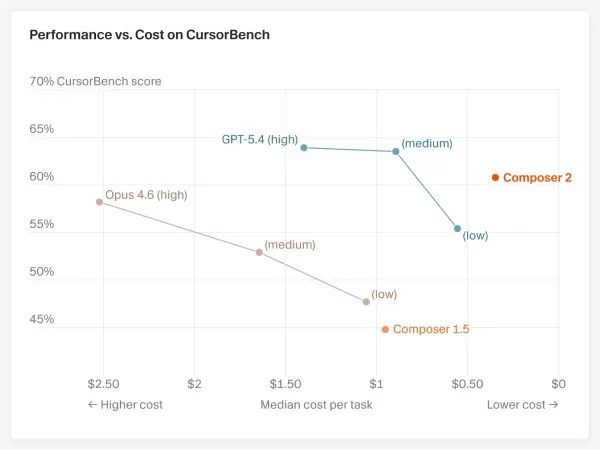
Terminal-Bench 2.0 (agent-style terminal coding tasks): Composer 2 scored 61.7%, beating Claude Opus 4.6's 58.0%. However, OpenAI GPT-5.4 remains ahead at 75.1%.CursorBench (real-world coding scenarios within Cursor): Composer 2 reached 61.3%, a substantial jump from the previous Composer 1.5's 44.2%, and also higher than Claude Opus 4.6's 58.2%.SWE-bench Multilingual (multilingual software engineering): Composer 2 achieved 73.7%, a notable improvement over its predecessor.However, one detail is worth noting: Anthropic previously reported that Claude Opus 4.6 scored 65.4% on Terminal-Bench 2.0 under optimized settings, much higher than the 58.0% cited by Cursor. The discrepancy stems from the testing framework – Cursor used third-party agent environments like Harbor and averaged results over five runs, while Anthropic's numbers came from its own optimized configuration. These two sets of figures are not directly comparable, as they use different reference systems. Cursor did not shy away from this; the announcement explicitly stated that "the results depend on the agent, harness, and settings."
Cost at Just One-Tenth of Opus 4.6
Cost-effectiveness is Composer 2's true hidden advantage.
Priced at $0.50 / $2.50 per million input/output tokens, versus Claude Opus 4.6's $5 / $25 and GPT-5.4's $2.5 / $15, the contrast is stark. Cursor explains that Composer 2 was built from the ground up for long-horizon coding tasks, using its proprietary RL training and "self-summarization" technology to lower both latency and cost – what they describe as "frontier intelligence + extreme speed."
Composer 2 is Cursor's third in-house model, succeeding Composer 1 (October 2025) and version 1.5 (February 2026). This release emphasizes "long-horizon tasks" and makes a faster, lighter variant the default model in Cursor IDE.
What This "Rise from the Ashes" Means
Cursor's decision to directly compare its model with Opus 4.6 signals a shift in the broader AI coding tools landscape.
OpenAI and Anthropic compete on general frontier capabilities, while vertical tool providers like Cursor have taken a different route: honing performance on specific tasks to an exceptional level and then using price advantages to stand out. Media outlets such as VentureBeat and The New Stack noted that Composer 2 will speed up the practical rollout of "multi-model routing" – using Opus or GPT for complex reasoning and switching to Composer 2 for everyday, high-frequency coding, gaining benefits on both sides.
Claude Opus 4.6 launched on February 5 and led in several benchmarks including Terminal-Bench 2.0, Humanity's Last Exam, and GDPval-AA. Cursor's new results at least raise questions about that dominance in the specialized coding segment.
Developer response has been largely positive so far, but many say they want to see real-world project performance before drawing conclusions – a fair stance, since benchmarks are only benchmarks. Cursor has already made Composer 2 available for free trial within the IDE for subscription users.
Data source: Official Cursor announcements and major tech media, as of March 20, 2026. Current rankings can be viewed at tbench.ai or Cursor's website.
Related article
 Musk Admits Grok Build Leaked User Code, Promises to Erase All Historical Data
Elon Musk directly addressed the privacy controversy surrounding Grok Build, beginning with a simple "True" to confirm the incident's validity. He pledged that all user data previously uploaded to SpaceXAI would be permanently erased, stating, "not a
U.S. Stocks Hit Historic Milestone as AI and Aerospace Giants Prepare for Trillion-Dollar Debut
Elon Musk, Sam Altman, and Dario Amodei, three titans of the technology sector, are advancing toward initial public offerings for their respective ventures. With SpaceX, OpenAI, and Anthropic—three industry behemoths nearing trillion-dollar valuation
Swedish AI Startup Lovable Eyes $13.2 Billion Valuation After Major Funding Round
As AI-driven coding tools gain traction, Swedish startup Lovable has secured a major funding round. The company aims to raise $3 billion, potentially boosting its valuation to $13.2 billion—double the $6.6 billion recorded last December. Menlo Ventur
Related Special Topic Recommendations
SEO
Musk Admits Grok Build Leaked User Code, Promises to Erase All Historical Data
Elon Musk directly addressed the privacy controversy surrounding Grok Build, beginning with a simple "True" to confirm the incident's validity. He pledged that all user data previously uploaded to SpaceXAI would be permanently erased, stating, "not a
U.S. Stocks Hit Historic Milestone as AI and Aerospace Giants Prepare for Trillion-Dollar Debut
Elon Musk, Sam Altman, and Dario Amodei, three titans of the technology sector, are advancing toward initial public offerings for their respective ventures. With SpaceX, OpenAI, and Anthropic—three industry behemoths nearing trillion-dollar valuation
Swedish AI Startup Lovable Eyes $13.2 Billion Valuation After Major Funding Round
As AI-driven coding tools gain traction, Swedish startup Lovable has secured a major funding round. The company aims to raise $3 billion, potentially boosting its valuation to $13.2 billion—double the $6.6 billion recorded last December. Menlo Ventur
Related Special Topic Recommendations
SEO
 Best AI SERP Analysis Tools for Search Strategy
2026 Latest Best Top-rated AI SERP Analysis Tools for Search Strategy are curated by XIX.AI through rigorous real-world tests and weekly updated rankings. These powerful tools help you unlock hidden optimization opportunities, boost content performance, and gain a competitive edge in search. Discover your perfect tool to elevate your search strategy today. Explore now!
 13 tools
 xix.ai
Data Analysis
Best AI Anomaly Detection Tools for KPI Monitoring across SaaS and Ecommerce Teams
xix.ai
Data Analysis
Best AI Anomaly Detection Tools for KPI Monitoring across SaaS and Ecommerce Teams
2026 Latest Best Top-rated AI Anomaly Detection Tools for KPI Monitoring in SaaS and Ecommerce teams! XIX.AI has curated a powerful, game-changing collection based on rigorous real-world tests and weekly updated rankings. You’ll find detailed free vs paid comparison insights to help you identify the must-try solution that boosts productivity and unlocks your AI edge. Explore now!
10 tools
xix.ai
writing
Best AI Outline Generators for Long-Form SEO Articles
2026 Latest Best Top-Rated AI Outline Generators for Long-Form SEO Articles, meticulously curated by XIX.AI. These powerful tools offer game-changing assistance in creating high-quality content quickly, boosting writing efficiency significantly. Get a free vs paid comparison along with real-world tests and detailed rankings to help you find the must-try option that suits your needs. Explore now to unlock your AI edge.
8 tools
xix.ai
Education and Learning
AI Study Tools for Homework and Exam Prep
2026 Latest Best AI Study Tools for Homework and Exam Prep! XIX.AI curates a top-rated list of powerful, game-changing tools that help students boost productivity, streamline homework completion, and ace exams through real-world tests. Get a free vs paid comparison, detailed rankings, and must-try options to unlock your AI edge. Explore now!
10 tools
xix.ai
Music composition
AI Vocal Demo Tools for Songwriters, Hooks, Toplines, and Multilingual Draft Sessions
2026 Latest Best AI Vocal Demo Tools for Songwriters, Hook Creators, and Multi-Language Content Teams! XIX.AI has curated a top-rated list of powerful game-changing tools that go through rigorous real-world tests. You’ll find detailed free vs paid comparison data, comprehensive rankings, and must-try options to help you boost writing efficiency and unlock your creative potential. Explore now to discover your perfect tool for all your content needs!
9 tools
xix.ai
Business
Best AI Competitive Research Tools for Small Businesses
2026 Latest Best Top-rated AI Competitive Research Tools for Small Businesses! XIX.AI has curated a highly powerful game-changing collection, updated weekly with rigorous real-world tests and detailed rankings. You can find a comprehensive free vs paid comparison to help you identify the must-try tools that boost your productivity and give you a competitive edge. Explore now to discover your perfect tool!
9 tools
xix.ai

 Comments (0)
0/500
Comments (0)
0/500
On March 19, Cursor officially released its in-house coding model, Composer 2. The announcement sparked immediate discussion in the developer community – according to Cursor, Composer 2 scored 61.7% on Terminal-Bench 2.0, notably surpassing Claude Opus 4.6's 58.0% under identical test conditions.
Did Anthropic's flagship model get outperformed by a model built into its own IDE? As the news circulated, debates quickly emerged.
Three Key Benchmark Results
Cursor published three sets of benchmark results, all made public:
Terminal-Bench 2.0 (agent-style terminal coding tasks): Composer 2 scored 61.7%, beating Claude Opus 4.6's 58.0%. However, OpenAI GPT-5.4 remains ahead at 75.1%.CursorBench (real-world coding scenarios within Cursor): Composer 2 reached 61.3%, a substantial jump from the previous Composer 1.5's 44.2%, and also higher than Claude Opus 4.6's 58.2%.SWE-bench Multilingual (multilingual software engineering): Composer 2 achieved 73.7%, a notable improvement over its predecessor.However, one detail is worth noting: Anthropic previously reported that Claude Opus 4.6 scored 65.4% on Terminal-Bench 2.0 under optimized settings, much higher than the 58.0% cited by Cursor. The discrepancy stems from the testing framework – Cursor used third-party agent environments like Harbor and averaged results over five runs, while Anthropic's numbers came from its own optimized configuration. These two sets of figures are not directly comparable, as they use different reference systems. Cursor did not shy away from this; the announcement explicitly stated that "the results depend on the agent, harness, and settings."
Cost at Just One-Tenth of Opus 4.6
Cost-effectiveness is Composer 2's true hidden advantage.
Priced at $0.50 / $2.50 per million input/output tokens, versus Claude Opus 4.6's $5 / $25 and GPT-5.4's $2.5 / $15, the contrast is stark. Cursor explains that Composer 2 was built from the ground up for long-horizon coding tasks, using its proprietary RL training and "self-summarization" technology to lower both latency and cost – what they describe as "frontier intelligence + extreme speed."
Composer 2 is Cursor's third in-house model, succeeding Composer 1 (October 2025) and version 1.5 (February 2026). This release emphasizes "long-horizon tasks" and makes a faster, lighter variant the default model in Cursor IDE.
What This "Rise from the Ashes" Means
Cursor's decision to directly compare its model with Opus 4.6 signals a shift in the broader AI coding tools landscape.
OpenAI and Anthropic compete on general frontier capabilities, while vertical tool providers like Cursor have taken a different route: honing performance on specific tasks to an exceptional level and then using price advantages to stand out. Media outlets such as VentureBeat and The New Stack noted that Composer 2 will speed up the practical rollout of "multi-model routing" – using Opus or GPT for complex reasoning and switching to Composer 2 for everyday, high-frequency coding, gaining benefits on both sides.
Claude Opus 4.6 launched on February 5 and led in several benchmarks including Terminal-Bench 2.0, Humanity's Last Exam, and GDPval-AA. Cursor's new results at least raise questions about that dominance in the specialized coding segment.
Developer response has been largely positive so far, but many say they want to see real-world project performance before drawing conclusions – a fair stance, since benchmarks are only benchmarks. Cursor has already made Composer 2 available for free trial within the IDE for subscription users.
Data source: Official Cursor announcements and major tech media, as of March 20, 2026. Current rankings can be viewed at tbench.ai or Cursor's website.








 Musk Admits Grok Build Leaked User Code, Promises to Erase All Historical Data
Elon Musk directly addressed the privacy controversy surrounding Grok Build, beginning with a simple "True" to confirm the incident's validity. He pledged that all user data previously uploaded to SpaceXAI would be permanently erased, stating, "not a
Musk Admits Grok Build Leaked User Code, Promises to Erase All Historical Data
Elon Musk directly addressed the privacy controversy surrounding Grok Build, beginning with a simple "True" to confirm the incident's validity. He pledged that all user data previously uploaded to SpaceXAI would be permanently erased, stating, "not a
 U.S. Stocks Hit Historic Milestone as AI and Aerospace Giants Prepare for Trillion-Dollar Debut
Elon Musk, Sam Altman, and Dario Amodei, three titans of the technology sector, are advancing toward initial public offerings for their respective ventures. With SpaceX, OpenAI, and Anthropic—three industry behemoths nearing trillion-dollar valuation
U.S. Stocks Hit Historic Milestone as AI and Aerospace Giants Prepare for Trillion-Dollar Debut
Elon Musk, Sam Altman, and Dario Amodei, three titans of the technology sector, are advancing toward initial public offerings for their respective ventures. With SpaceX, OpenAI, and Anthropic—three industry behemoths nearing trillion-dollar valuation
 Swedish AI Startup Lovable Eyes $13.2 Billion Valuation After Major Funding Round
As AI-driven coding tools gain traction, Swedish startup Lovable has secured a major funding round. The company aims to raise $3 billion, potentially boosting its valuation to $13.2 billion—double the $6.6 billion recorded last December. Menlo Ventur
Swedish AI Startup Lovable Eyes $13.2 Billion Valuation After Major Funding Round
As AI-driven coding tools gain traction, Swedish startup Lovable has secured a major funding round. The company aims to raise $3 billion, potentially boosting its valuation to $13.2 billion—double the $6.6 billion recorded last December. Menlo Ventur

2026 Latest Best Top-rated AI SERP Analysis Tools for Search Strategy are curated by XIX.AI through rigorous real-world tests and weekly updated rankings. These powerful tools help you unlock hidden optimization opportunities, boost content performance, and gain a competitive edge in search. Discover your perfect tool to elevate your search strategy today. Explore now!
13 tools
xix.ai

2026 Latest Best Top-rated AI Anomaly Detection Tools for KPI Monitoring in SaaS and Ecommerce teams! XIX.AI has curated a powerful, game-changing collection based on rigorous real-world tests and weekly updated rankings. You’ll find detailed free vs paid comparison insights to help you identify the must-try solution that boosts productivity and unlocks your AI edge. Explore now!
10 tools
xix.ai

2026 Latest Best Top-Rated AI Outline Generators for Long-Form SEO Articles, meticulously curated by XIX.AI. These powerful tools offer game-changing assistance in creating high-quality content quickly, boosting writing efficiency significantly. Get a free vs paid comparison along with real-world tests and detailed rankings to help you find the must-try option that suits your needs. Explore now to unlock your AI edge.
8 tools
xix.ai

2026 Latest Best AI Study Tools for Homework and Exam Prep! XIX.AI curates a top-rated list of powerful, game-changing tools that help students boost productivity, streamline homework completion, and ace exams through real-world tests. Get a free vs paid comparison, detailed rankings, and must-try options to unlock your AI edge. Explore now!
10 tools
xix.ai

2026 Latest Best AI Vocal Demo Tools for Songwriters, Hook Creators, and Multi-Language Content Teams! XIX.AI has curated a top-rated list of powerful game-changing tools that go through rigorous real-world tests. You’ll find detailed free vs paid comparison data, comprehensive rankings, and must-try options to help you boost writing efficiency and unlock your creative potential. Explore now to discover your perfect tool for all your content needs!
9 tools
xix.ai

2026 Latest Best Top-rated AI Competitive Research Tools for Small Businesses! XIX.AI has curated a highly powerful game-changing collection, updated weekly with rigorous real-world tests and detailed rankings. You can find a comprehensive free vs paid comparison to help you identify the must-try tools that boost your productivity and give you a competitive edge. Explore now to discover your perfect tool!
9 tools
xix.ai












