


 Home
HomeAI Content Copyright Rules: How to Keep Your 'Clean Room' Protected
As generative AI becomes more widespread, the legal complexities of copyright and data privacy are intensifying. Safeguarding training data and the integrity of AI outputs is fundamental for responsible development. This article examines differential privacy methods and the "clean room" strategy for copyright protection, detailing how these frameworks help secure AI models and their users.
Key Points
Understanding how differential privacy applies to generative AI.
Examining the 'clean room' methodology for copyright protection.
Addressing the difficulty of applying conventional copyright law to AI-generated material.
Deploying tactics to stop AI models from memorizing and reusing copyrighted content.
Debating the legal and ethical consequences of data lineage in AI training.
Reviewing techniques for watermarking AI outputs to establish copyright ownership.
Assessing how differential privacy and copyright safeguards influence the creation and implementation of Large Language Models (LLMs).
The Intersection of Differential Privacy and Copyright
Differential Privacy: Protecting Data in Generative AI
Differential privacy is a framework that enables data analysis while protecting individual information. It works by introducing statistical noise into datasets, which helps conceal any single entry. For generative AI, this prevents models from memorizing and reproducing protected content. Multiple factors, including training methods, influence the effectiveness of differential privacy.
Why is differential privacy essential for generative AI?
Its benefits include:
- Preventing the accidental replication of copyrighted works.
- Maintaining the confidentiality of user data utilized in training.
- Promoting the creation of ethically sound AI systems.
Differential privacy serves as the foundation for data security and ethical operations in generative AI. Implementing the following techniques is vital for building a successful differentially private model:
Technique Description Adding Noise Introducing statistical variations to data points to mask individual records. This makes it challenging for the AI to memorize specific details, forming the basis of differential privacy. Clipping Gradients Restricting the size of gradient updates during model training. This step ensures no single data point overly shapes the model, reducing the risk of memorization or overfitting. Parameter Sanitization Removing model parameters associated with copyrighted material. The model learns to recognize and exclude such elements, resulting in a cleaner final version.
Applying these methods is particularly important for ethical AI advancement.
The Clean Room Approach: A Secure Environment for AI Development
The 'clean room' concept, borrowed from software engineering, provides a protected, isolated space for safeguarding intellectual property in AI projects.
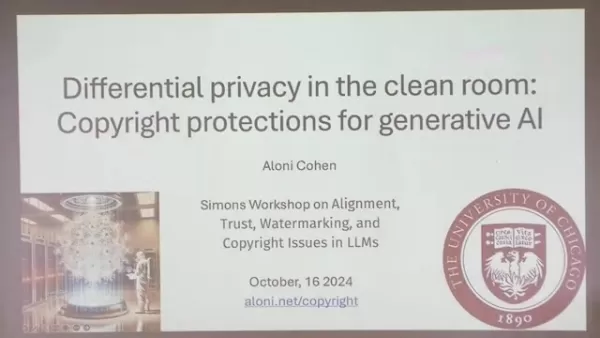
This setup lets developers handle sensitive or copyrighted information while minimizing the chance of its unauthorized use in AI results. It typically incorporates systems specifically built to avoid copyright infringement.
Recommended Clean Room Practices:
- Dedicated, segregated spaces with restricted entry.
- Rigorous procedures for data import and export.
- External validation of AI outputs for copyright adherence.
- Continuous assessment of AI behavior for indications of data retention or copying.
Training models in a zero-trust architecture.
A clean room setup offers strong assurance that intellectual property and security are central to the AI development process.
Why Copyright is So Important
Balancing copyright safeguards and watermarking with the demands of AI training is critical. Properly calibrated models help reduce risks and enhance societal benefits.

Several organizations, including The New York Times, have initiated copyright lawsuits against OpenAI.
Key Allegations in The New York Times Case:
- GPT-4 can replicate New York Times articles verbatim.
- Training data previously included content from Hoan Ton-That.
How do Watermarks Help Copyright Claims?
Watermarking aids in content protection and builds trust in AI training processes. Common varieties include:
- Visible watermarks
- Invisible watermarks
- Robust watermarks – resistant to alterations like compression
- Fragile watermarks
It's worth noting that no watermarking solution is entirely foolproof. Advanced methods can sometimes bypass, circumvent, or remove them. Differential privacy offers a more direct way to secure user data.
Ultimately, these approaches aim to protect both the AI system and the rights of copyright holders.
Key Challenges
The Ethical Minefield
How can we verify data quality and trace its origins to an accepted level? What constitutes fair and practical copyright protection? Given the abundance of freely available copyrighted material online, what criteria should guide its inclusion or exclusion? These are complex legal and moral questions that require careful navigation.
Differential Privacy Implementation
Pros
Secures user data throughout the AI training cycle.
Reduces the likelihood of AI models retaining copyrighted information.
Encourages the creation of ethically aligned AI systems.
Potentially lowers exposure to copyright lawsuits.
Cons
May diminish the precision and quality of AI outputs because of introduced noise.
Deployment can demand considerable computing power.
Requires specialized technical knowledge for setup and maintenance.
FAQ
What is differential privacy in AI?
Differential privacy in AI involves adding carefully calibrated noise to datasets, allowing models to learn general patterns without accessing or remembering specific, sensitive details. This maintains statistical usefulness while ensuring individual privacy.
How does the 'clean room' approach protect copyright in generative AI?
The clean room method establishes a secure, isolated development space with strict data controls. It prevents direct exposure to copyrighted sources, ensuring AI outputs are original and legally compliant.
What are some of the challenges with adapting existing copyright frameworks to generative AI?
Key issues involve defining authorship for AI-generated works, clarifying fair use exceptions for model training, and enforcing copyright when AI systems might replicate protected content. Many legal and economic aspects remain unresolved.
Related Questions
Are AI-generated images copyrightable?
Currently, no universal standard exists. Legislation is evolving quickly across most jurisdictions. A comprehensive legal and ethical structure is expected to emerge in the near future.
How do watermarks function to protect copyright in AI-generated content?
Watermarks are digital markers embedded within AI-generated material to signify ownership. They can be either visible or hidden, and robust versions persist through edits like compression. Fragile watermarks break upon tampering, signaling potential misuse.
What are large language models(LLMs)?
LLMs are AI systems trained on massive datasets, typically used for generating text and imagery. Their extensive data requirements are a primary reason copyright and data privacy have become such pressing concerns.
Related article
 U.S. Stocks Hit Historic Milestone as AI and Aerospace Giants Prepare for Trillion-Dollar Debut
Elon Musk, Sam Altman, and Dario Amodei, three titans of the technology sector, are advancing toward initial public offerings for their respective ventures. With SpaceX, OpenAI, and Anthropic—three industry behemoths nearing trillion-dollar valuation
Swedish AI Startup Lovable Eyes $13.2 Billion Valuation After Major Funding Round
As AI-driven coding tools gain traction, Swedish startup Lovable has secured a major funding round. The company aims to raise $3 billion, potentially boosting its valuation to $13.2 billion—double the $6.6 billion recorded last December. Menlo Ventur
Google Tests Remy AI Agent for Gemini as Focus Shifts to User Control
According to Business Insider, Google is testing Remy, a new AI personal agent for Gemini. This tool aims to execute tasks on behalf of users, streamlining both professional workflows and daily routines.Currently, Remy is undergoing testing in an int
Related Special Topic Recommendations
Data Analysis
U.S. Stocks Hit Historic Milestone as AI and Aerospace Giants Prepare for Trillion-Dollar Debut
Elon Musk, Sam Altman, and Dario Amodei, three titans of the technology sector, are advancing toward initial public offerings for their respective ventures. With SpaceX, OpenAI, and Anthropic—three industry behemoths nearing trillion-dollar valuation
Swedish AI Startup Lovable Eyes $13.2 Billion Valuation After Major Funding Round
As AI-driven coding tools gain traction, Swedish startup Lovable has secured a major funding round. The company aims to raise $3 billion, potentially boosting its valuation to $13.2 billion—double the $6.6 billion recorded last December. Menlo Ventur
Google Tests Remy AI Agent for Gemini as Focus Shifts to User Control
According to Business Insider, Google is testing Remy, a new AI personal agent for Gemini. This tool aims to execute tasks on behalf of users, streamlining both professional workflows and daily routines.Currently, Remy is undergoing testing in an int
Related Special Topic Recommendations
Data Analysis
 Best AI Anomaly Detection Tools for KPI Monitoring across SaaS and Ecommerce Teams
2026 Latest Best Top-rated AI Anomaly Detection Tools for KPI Monitoring in SaaS and Ecommerce teams! XIX.AI has curated a powerful, game-changing collection based on rigorous real-world tests and weekly updated rankings. You’ll find detailed free vs paid comparison insights to help you identify the must-try solution that boosts productivity and unlocks your AI edge. Explore now!
 10 tools
 xix.ai
writing
Best AI Outline Generators for Long-Form SEO Articles
xix.ai
writing
Best AI Outline Generators for Long-Form SEO Articles
2026 Latest Best Top-Rated AI Outline Generators for Long-Form SEO Articles, meticulously curated by XIX.AI. These powerful tools offer game-changing assistance in creating high-quality content quickly, boosting writing efficiency significantly. Get a free vs paid comparison along with real-world tests and detailed rankings to help you find the must-try option that suits your needs. Explore now to unlock your AI edge.
8 tools
xix.ai
Education and Learning
AI Study Tools for Homework and Exam Prep
2026 Latest Best AI Study Tools for Homework and Exam Prep! XIX.AI curates a top-rated list of powerful, game-changing tools that help students boost productivity, streamline homework completion, and ace exams through real-world tests. Get a free vs paid comparison, detailed rankings, and must-try options to unlock your AI edge. Explore now!
10 tools
xix.ai
Music composition
AI Vocal Demo Tools for Songwriters, Hooks, Toplines, and Multilingual Draft Sessions
2026 Latest Best AI Vocal Demo Tools for Songwriters, Hook Creators, and Multi-Language Content Teams! XIX.AI has curated a top-rated list of powerful game-changing tools that go through rigorous real-world tests. You’ll find detailed free vs paid comparison data, comprehensive rankings, and must-try options to help you boost writing efficiency and unlock your creative potential. Explore now to discover your perfect tool for all your content needs!
9 tools
xix.ai
Business
Best AI Competitive Research Tools for Small Businesses
2026 Latest Best Top-rated AI Competitive Research Tools for Small Businesses! XIX.AI has curated a highly powerful game-changing collection, updated weekly with rigorous real-world tests and detailed rankings. You can find a comprehensive free vs paid comparison to help you identify the must-try tools that boost your productivity and give you a competitive edge. Explore now to discover your perfect tool!
9 tools
xix.ai
Image editing
Photoshop AI Retouch Tools for Ecommerce Apparel, Skin Cleanup, and Color Consistency
2026 Latest Best Photoshop AI retouch tools for ecommerce apparel, skin cleanup, and color consistency! This top-rated curated list features powerful game-changing solutions that help you boost writing efficiency, streamline content creation, and achieve perfect visual results effortlessly. Each tool has undergone real-world tests through weekly updated rankings, complete with free vs paid comparison details. Backed by XIX.AI, it’s the must-try guide for anyone aiming to unlock your AI edge. Explore now!
10 tools
xix.ai

 Comments (2)
0/500
Comments (2)
0/500
![DavidLewis]()
Is the 'clean room' approach actually viable when models are trained on billions of scraped datasets? It feels like trying to keep a pool clean while dumping sewage upstream. 🌊 The article's point about differential privacy is crucial, but enforcement remains a nightmare for developers. We need clearer legal frameworks, not just technical workarounds, before this becomes a legal minefield for startups. 🚫⚖️
![SebastianAnderson]()
¿Has pensado en cómo el copyright cambia la industria ahora con la IA? En cierto modo, esto me recuerda a cuando se popularizó la fotografía y la gente debatía si violaba derechos de autor 🔍. En mi opinión, es clave que las empresas sean transparentes con los datos de entrenamiento. Esto no solo evita demandas, sino que construye confianza. Personalmente, trato de usar solo herramientas que especifiquen el origen de sus datos… aunque a veces no es fácil encontrarlas 🧐.
As generative AI becomes more widespread, the legal complexities of copyright and data privacy are intensifying. Safeguarding training data and the integrity of AI outputs is fundamental for responsible development. This article examines differential privacy methods and the "clean room" strategy for copyright protection, detailing how these frameworks help secure AI models and their users.
Key Points
Understanding how differential privacy applies to generative AI.
Examining the 'clean room' methodology for copyright protection.
Addressing the difficulty of applying conventional copyright law to AI-generated material.
Deploying tactics to stop AI models from memorizing and reusing copyrighted content.
Debating the legal and ethical consequences of data lineage in AI training.
Reviewing techniques for watermarking AI outputs to establish copyright ownership.
Assessing how differential privacy and copyright safeguards influence the creation and implementation of Large Language Models (LLMs).
The Intersection of Differential Privacy and Copyright
Differential Privacy: Protecting Data in Generative AI
Differential privacy is a framework that enables data analysis while protecting individual information. It works by introducing statistical noise into datasets, which helps conceal any single entry. For generative AI, this prevents models from memorizing and reproducing protected content. Multiple factors, including training methods, influence the effectiveness of differential privacy.
Why is differential privacy essential for generative AI?
Its benefits include:
- Preventing the accidental replication of copyrighted works.
- Maintaining the confidentiality of user data utilized in training.
- Promoting the creation of ethically sound AI systems.
Differential privacy serves as the foundation for data security and ethical operations in generative AI. Implementing the following techniques is vital for building a successful differentially private model:
| Technique | Description |
|---|---|
| Adding Noise | Introducing statistical variations to data points to mask individual records. This makes it challenging for the AI to memorize specific details, forming the basis of differential privacy. |
| Clipping Gradients | Restricting the size of gradient updates during model training. This step ensures no single data point overly shapes the model, reducing the risk of memorization or overfitting. |
| Parameter Sanitization | Removing model parameters associated with copyrighted material. The model learns to recognize and exclude such elements, resulting in a cleaner final version. |
Applying these methods is particularly important for ethical AI advancement.
The Clean Room Approach: A Secure Environment for AI Development
The 'clean room' concept, borrowed from software engineering, provides a protected, isolated space for safeguarding intellectual property in AI projects.
This setup lets developers handle sensitive or copyrighted information while minimizing the chance of its unauthorized use in AI results. It typically incorporates systems specifically built to avoid copyright infringement.
Recommended Clean Room Practices:
- Dedicated, segregated spaces with restricted entry.
- Rigorous procedures for data import and export.
- External validation of AI outputs for copyright adherence.
- Continuous assessment of AI behavior for indications of data retention or copying.
Training models in a zero-trust architecture.
A clean room setup offers strong assurance that intellectual property and security are central to the AI development process.
Why Copyright is So Important
Balancing copyright safeguards and watermarking with the demands of AI training is critical. Properly calibrated models help reduce risks and enhance societal benefits.
Several organizations, including The New York Times, have initiated copyright lawsuits against OpenAI.
Key Allegations in The New York Times Case:
- GPT-4 can replicate New York Times articles verbatim.
- Training data previously included content from Hoan Ton-That.
How do Watermarks Help Copyright Claims?
Watermarking aids in content protection and builds trust in AI training processes. Common varieties include:
- Visible watermarks
- Invisible watermarks
- Robust watermarks – resistant to alterations like compression
- Fragile watermarks
It's worth noting that no watermarking solution is entirely foolproof. Advanced methods can sometimes bypass, circumvent, or remove them. Differential privacy offers a more direct way to secure user data.
Ultimately, these approaches aim to protect both the AI system and the rights of copyright holders.
Key Challenges
The Ethical Minefield
How can we verify data quality and trace its origins to an accepted level? What constitutes fair and practical copyright protection? Given the abundance of freely available copyrighted material online, what criteria should guide its inclusion or exclusion? These are complex legal and moral questions that require careful navigation.
Differential Privacy Implementation
Pros
Secures user data throughout the AI training cycle.
Reduces the likelihood of AI models retaining copyrighted information.
Encourages the creation of ethically aligned AI systems.
Potentially lowers exposure to copyright lawsuits.
Cons
May diminish the precision and quality of AI outputs because of introduced noise.
Deployment can demand considerable computing power.
Requires specialized technical knowledge for setup and maintenance.
FAQ
What is differential privacy in AI?
Differential privacy in AI involves adding carefully calibrated noise to datasets, allowing models to learn general patterns without accessing or remembering specific, sensitive details. This maintains statistical usefulness while ensuring individual privacy.
How does the 'clean room' approach protect copyright in generative AI?
The clean room method establishes a secure, isolated development space with strict data controls. It prevents direct exposure to copyrighted sources, ensuring AI outputs are original and legally compliant.
What are some of the challenges with adapting existing copyright frameworks to generative AI?
Key issues involve defining authorship for AI-generated works, clarifying fair use exceptions for model training, and enforcing copyright when AI systems might replicate protected content. Many legal and economic aspects remain unresolved.
Related Questions
Are AI-generated images copyrightable?
Currently, no universal standard exists. Legislation is evolving quickly across most jurisdictions. A comprehensive legal and ethical structure is expected to emerge in the near future.
How do watermarks function to protect copyright in AI-generated content?
Watermarks are digital markers embedded within AI-generated material to signify ownership. They can be either visible or hidden, and robust versions persist through edits like compression. Fragile watermarks break upon tampering, signaling potential misuse.
What are large language models(LLMs)?
LLMs are AI systems trained on massive datasets, typically used for generating text and imagery. Their extensive data requirements are a primary reason copyright and data privacy have become such pressing concerns.








 U.S. Stocks Hit Historic Milestone as AI and Aerospace Giants Prepare for Trillion-Dollar Debut
Elon Musk, Sam Altman, and Dario Amodei, three titans of the technology sector, are advancing toward initial public offerings for their respective ventures. With SpaceX, OpenAI, and Anthropic—three industry behemoths nearing trillion-dollar valuation
U.S. Stocks Hit Historic Milestone as AI and Aerospace Giants Prepare for Trillion-Dollar Debut
Elon Musk, Sam Altman, and Dario Amodei, three titans of the technology sector, are advancing toward initial public offerings for their respective ventures. With SpaceX, OpenAI, and Anthropic—three industry behemoths nearing trillion-dollar valuation
 Swedish AI Startup Lovable Eyes $13.2 Billion Valuation After Major Funding Round
As AI-driven coding tools gain traction, Swedish startup Lovable has secured a major funding round. The company aims to raise $3 billion, potentially boosting its valuation to $13.2 billion—double the $6.6 billion recorded last December. Menlo Ventur
Google Tests Remy AI Agent for Gemini as Focus Shifts to User Control
According to Business Insider, Google is testing Remy, a new AI personal agent for Gemini. This tool aims to execute tasks on behalf of users, streamlining both professional workflows and daily routines.Currently, Remy is undergoing testing in an int
Swedish AI Startup Lovable Eyes $13.2 Billion Valuation After Major Funding Round
As AI-driven coding tools gain traction, Swedish startup Lovable has secured a major funding round. The company aims to raise $3 billion, potentially boosting its valuation to $13.2 billion—double the $6.6 billion recorded last December. Menlo Ventur
Google Tests Remy AI Agent for Gemini as Focus Shifts to User Control
According to Business Insider, Google is testing Remy, a new AI personal agent for Gemini. This tool aims to execute tasks on behalf of users, streamlining both professional workflows and daily routines.Currently, Remy is undergoing testing in an int

2026 Latest Best Top-rated AI Anomaly Detection Tools for KPI Monitoring in SaaS and Ecommerce teams! XIX.AI has curated a powerful, game-changing collection based on rigorous real-world tests and weekly updated rankings. You’ll find detailed free vs paid comparison insights to help you identify the must-try solution that boosts productivity and unlocks your AI edge. Explore now!
10 tools
xix.ai

2026 Latest Best Top-Rated AI Outline Generators for Long-Form SEO Articles, meticulously curated by XIX.AI. These powerful tools offer game-changing assistance in creating high-quality content quickly, boosting writing efficiency significantly. Get a free vs paid comparison along with real-world tests and detailed rankings to help you find the must-try option that suits your needs. Explore now to unlock your AI edge.
8 tools
xix.ai

2026 Latest Best AI Study Tools for Homework and Exam Prep! XIX.AI curates a top-rated list of powerful, game-changing tools that help students boost productivity, streamline homework completion, and ace exams through real-world tests. Get a free vs paid comparison, detailed rankings, and must-try options to unlock your AI edge. Explore now!
10 tools
xix.ai

2026 Latest Best AI Vocal Demo Tools for Songwriters, Hook Creators, and Multi-Language Content Teams! XIX.AI has curated a top-rated list of powerful game-changing tools that go through rigorous real-world tests. You’ll find detailed free vs paid comparison data, comprehensive rankings, and must-try options to help you boost writing efficiency and unlock your creative potential. Explore now to discover your perfect tool for all your content needs!
9 tools
xix.ai

2026 Latest Best Top-rated AI Competitive Research Tools for Small Businesses! XIX.AI has curated a highly powerful game-changing collection, updated weekly with rigorous real-world tests and detailed rankings. You can find a comprehensive free vs paid comparison to help you identify the must-try tools that boost your productivity and give you a competitive edge. Explore now to discover your perfect tool!
9 tools
xix.ai

2026 Latest Best Photoshop AI retouch tools for ecommerce apparel, skin cleanup, and color consistency! This top-rated curated list features powerful game-changing solutions that help you boost writing efficiency, streamline content creation, and achieve perfect visual results effortlessly. Each tool has undergone real-world tests through weekly updated rankings, complete with free vs paid comparison details. Backed by XIX.AI, it’s the must-try guide for anyone aiming to unlock your AI edge. Explore now!
10 tools
xix.ai

Is the 'clean room' approach actually viable when models are trained on billions of scraped datasets? It feels like trying to keep a pool clean while dumping sewage upstream. 🌊 The article's point about differential privacy is crucial, but enforcement remains a nightmare for developers. We need clearer legal frameworks, not just technical workarounds, before this becomes a legal minefield for startups. 🚫⚖️
¿Has pensado en cómo el copyright cambia la industria ahora con la IA? En cierto modo, esto me recuerda a cuando se popularizó la fotografía y la gente debatía si violaba derechos de autor 🔍. En mi opinión, es clave que las empresas sean transparentes con los datos de entrenamiento. Esto no solo evita demandas, sino que construye confianza. Personalmente, trato de usar solo herramientas que especifiquen el origen de sus datos… aunque a veces no es fácil encontrarlas 🧐.












