


 Home
HomeUnderstanding Context Engineering vs Prompt Engineering in AI Conversations
The evolution of AI interaction began with a groundbreaking insight: phrasing matters profoundly. Developers and practitioners found that strategic prompt formulation could unlock transformative capabilities from language models, elevating generic replies to nuanced, targeted responses. This revelation sparked the prompt engineering movement that dominated AI optimization discussions through 2023.
However, emerging trends reveal an important transition. As AI applications grow increasingly sophisticated, we're recognizing that meticulously crafted prompts alone cannot solve complex challenges. This realization heralds the rise of context engineering—representing a fundamental transformation in how we approach AI systems.
Understanding Prompt Engineering
To appreciate current advancements, we must first examine foundational concepts. Prompt engineering originated from observing AI models' sensitivity to input phrasing—demonstrating that carefully structured requests yield vastly superior outputs.
Consider these contrasting approaches:
- Simple request: "Explain machine learning"
- Engineered prompt: "As a senior MIT professor specializing in neural networks, deliver a concise yet comprehensive explanation of machine learning fundamentals tailored for first-year computer science students, emphasizing practical applications and historical context"
The second formulation produces dramatically better results by establishing clear parameters—role definition, target audience, scope boundaries, and stylistic preferences. This breakthrough ignited widespread adoption, birthing dedicated prompt engineering roles and specialized marketplaces.
The Emergence of Context Engineering
As enterprises deployed AI for mission-critical operations, limitations of prompt-only approaches became apparent. Excellence in prompting frequently collided with another challenge—AI systems lacking the contextual understanding human professionals naturally possess.
Imagine onboarding a new customer service representative. Providing perfect scripts matters little without access to customer histories, product documentation, and internal policies. Context engineering solves precisely this limitation—shifting focus from optimizing questions to equipping AI with comprehensive situational awareness.
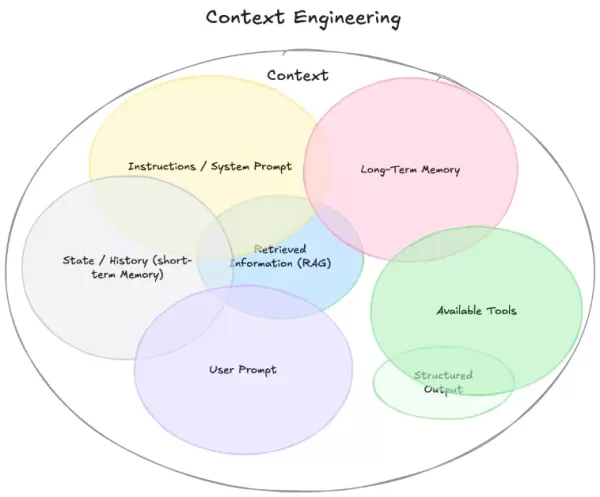
This represents a fundamental paradigm shift—from crafting impeccable instructions to architecting intelligent systems that dynamically furnish AI with relevant knowledge.
A Tale of Two Approaches
The distinction crystallizes through practical examples. Consider developing an AI assistant for financial advisory services:
Traditional Prompt Engineering
After extensive refinement, prompts might read: "As a certified financial planner, provide personalized investment recommendations considering client risk tolerance and time horizons..."
Limitations surface immediately when clients ask follow-up questions requiring transaction histories, portfolio compositions, or market context absent from prompts alone.
Modern Context Engineering
The same system integrates with:
- Client investment profiles
- Portfolio performance metrics
- Market condition analyses
- Regulatory guidelines
- Historical advisory notes
Equipped with this multidimensional context, the AI can instantly process requests like "How should I adjust my international allocations?" with informed, personalized recommendations.
Understanding Context Layers
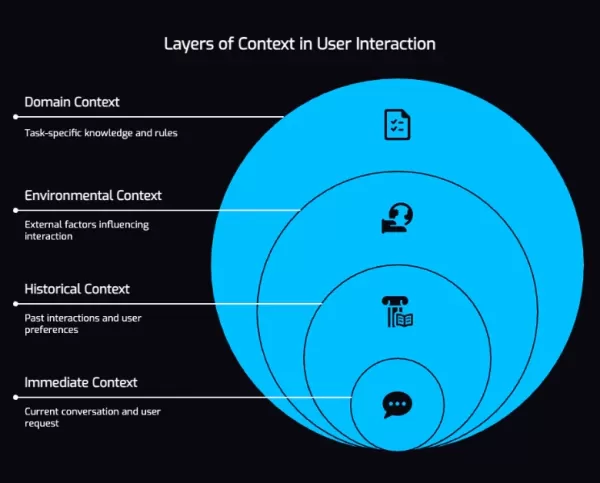
Effective context engineering recognizes that situational awareness comprises interdependent layers:
- Immediate Context: Current dialog state and direct user intent
- Temporal Context: Interaction history and evolving patterns
- Environmental Context: Location, device, timing variables
- Domain Context: Specialized knowledge frameworks
Core Principles of Modern Context Engineering
1. Adaptive Information Architecture
Context must fluidly reconfigure based on evolving needs—different tasks require distinct contextual elements.
2. Intelligent Signal Filtering
Advanced systems must discern relevance hierarchies—including vital information while excluding distracting noise.
3. Continuous Context Evolution
Effective systems learn from interactions—identifying knowledge gaps and adapting information prioritization.
4. Transparent Contextual Integration
Optimal implementations feel invisible—users experience intuitive understanding rather than explicit context management.
Strategic Considerations
Several critical factors drive context engineering's rising importance:
- Enterprise AI now handles mission-critical workflows requiring comprehensive situational awareness
- User expectations have evolved—people anticipate AI systems that "remember" and "understand" interactions holistically
- The consequences of context failures have escalated—medical, financial, and operational AI requires precision
Forward-Looking Perspectives
As context engineering matures, anticipate:
- AI systems demonstrating genuine contextual learning
- Proactive anticipation of user needs
- Seamless interoperability between specialized AI agents
- Tighter cognitive coupling between artificial and human intelligence
Key Recommendations
- Developers: Architect comprehensive information ecosystems—design persistent memory layers, dynamic retrieval mechanisms, and intelligent context assembly
- Executives: Evaluate context capabilities alongside prompt quality—sustainable advantage stems from superior contextual integration
- Practitioners: Recognize context's decisive role—when AI falters, analyze situational awareness gaps before concluding intelligence limitations
Conclusion
The progression from prompt to context engineering mirrors AI's broader maturation—akin to websites evolving from static pages to reactive applications. While prompt engineering unlocked AI's potential, context engineering realizes its practical utility across complex, real-world scenarios.
The future belongs to organizations building AI systems that don't just respond skillfully—but understand situations comprehensively.
Context Engineering FAQs
What fundamentally distinguishes context engineering from prompt engineering?
Context engineering creates intelligent ecosystems providing dynamic situational awareness, while prompt engineering focuses exclusively on perfecting instruction phrasing.
Why does contextual depth outweigh prompt perfection?
Even flawless prompts fail when AI lacks essential background—like expecting expert diagnoses without medical charts or patient histories.
What constitutes mature context engineering implementations?
Sophisticated systems integrate real-time data streams, historical interaction patterns, domain-specific knowledge frameworks, and environmental variables into coherent awareness models.
How does robust context improve AI reliability?
Dynamic context supplementation reduces hallucination risks, enables multi-step reasoning, and supports complex decision-making that exceeds static prompt capabilities.
Why does information structuring matter?
Well-organized context eliminates cognitive overload while ensuring rapid access to mission-critical information—dramatically improving response precision.
Related article
 Apple, Google Partner With Anthropic to Address 27-Year-Old Vulnerability via Glass Wing Protection
As artificial intelligence advances rapidly in code generation and logical reasoning, the cybersecurity landscape faces unprecedented challenges. Recently, the prominent AI startup Anthropic officially launched a cross-industry collaboration called *
OpenAI Chief Scientist Addresses AI Reasoning Transparency Debate: Complexity Steady, No Sudden Jump
On September 2, Jakub Pachocki, OpenAI’s Chief Scientist, addressed public concerns on X regarding the AI model Astra, clarifying claims that it operates without oversight and lacks transparent reasoning.Why the Controversy Erupted: Deep Recurrence O
U.S. Navy Selects Blue Water Autonomy for Deep-Sea Survey Missions
Blue Water Autonomy’s Liberty Class is a 190-foot steel autonomous ship. | Source: Blue Water AutonomyBoston-based technology and shipbuilding firm Blue Water Autonomy has secured a multiple-award contract with the Naval Oceanographic Office (NAVOCEA
Related Special Topic Recommendations
Text-to-speech
Apple, Google Partner With Anthropic to Address 27-Year-Old Vulnerability via Glass Wing Protection
As artificial intelligence advances rapidly in code generation and logical reasoning, the cybersecurity landscape faces unprecedented challenges. Recently, the prominent AI startup Anthropic officially launched a cross-industry collaboration called *
OpenAI Chief Scientist Addresses AI Reasoning Transparency Debate: Complexity Steady, No Sudden Jump
On September 2, Jakub Pachocki, OpenAI’s Chief Scientist, addressed public concerns on X regarding the AI model Astra, clarifying claims that it operates without oversight and lacks transparent reasoning.Why the Controversy Erupted: Deep Recurrence O
U.S. Navy Selects Blue Water Autonomy for Deep-Sea Survey Missions
Blue Water Autonomy’s Liberty Class is a 190-foot steel autonomous ship. | Source: Blue Water AutonomyBoston-based technology and shipbuilding firm Blue Water Autonomy has secured a multiple-award contract with the Naval Oceanographic Office (NAVOCEA
Related Special Topic Recommendations
Text-to-speech
 Best AI Text to Speech Tools for Online Courses
2026 Latest Best Top-rated AI Text to Speech Tools for Online Courses are curated by XIX.AI based on rigorous real-world tests and weekly updated rankings. These powerful tools help creators deliver crystal-clear audio content effortlessly, boosting writing efficiency and streamlining course production. Check out the free vs paid comparison to find your perfect fit. Explore now to unlock your AI edge in online education.
 10 tools
 xix.ai
writing
AI Blog Title Tools for Higher Click Through Rates
xix.ai
writing
AI Blog Title Tools for Higher Click Through Rates
2026 Latest Best Top-Rated AI Blog Title Tools for Higher Click Through Rates! XIX.AI has carefully curated a powerful, game-changing collection of top tools that go through rigorous real-world tests. You’ll find a free vs paid comparison, weekly updated rankings, and detailed insights to help you boost your blog’s traffic efficiently. Must-try options are highlighted to help you unlock your AI edge. Explore now!
10 tools
xix.ai
automation
Best AI Task Routing Tools for Support Workflows
2026 Latest Best Top-rated AI Task Routing Tools for Support Workflows! XIX.AI has curated a highly powerful game-changing collection of must-try solutions, all undergoing rigorous real-world tests and updated weekly. These tools streamline workflows, boost productivity, and help teams deliver faster, more efficient support. Explore now to discover your perfect tool and unlock your AI edge!
17 tools
xix.ai
Academic Research
AI Citation and Paper Summary Tools
2026 Latest Best Top-Rated AI Citation and Paper Summary Tools Curated by XIX.AI. Get powerful game-changing solutions for quick content creation, improved writing efficiency, and boosting productivity. We offer a free vs paid comparison along with real-world tests and weekly updated rankings to help you find the must-try tool that fits your needs perfectly. Explore now to Unlock your AI edge.
10 tools
xix.ai
Productivity
Best AI Productivity Tools for Daily Work
2026 Latest Best Top-Rated AI Productivity Tools for Daily Work! XIX.AI has curated a powerful, game-changing selection based on rigorous weekly updated rankings and real-world tests. You’ll find must-try options that boost writing efficiency, streamline content creation, and help you overcome daily work challenges. Get a free vs paid comparison to find the perfect fit for your needs. Explore now to unlock your AI edge!
9 tools
xix.ai
Academic Research
AI Systematic Review Tools for Research Screening
2026 Latest Best Top-Rated AI Systematic Review Tools for Research Screening are here on XIX.AI! This curated collection includes powerful, game-changing solutions that go through rigorous real-world tests to deliver accurate results. We also offer a free vs paid comparison along with weekly updated rankings to help you find the must-try option that boosts your research efficiency significantly. Explore now to unlock your AI edge in academic work!
11 tools
xix.ai

 Comments (0)
0/500
Comments (0)
0/500
The evolution of AI interaction began with a groundbreaking insight: phrasing matters profoundly. Developers and practitioners found that strategic prompt formulation could unlock transformative capabilities from language models, elevating generic replies to nuanced, targeted responses. This revelation sparked the prompt engineering movement that dominated AI optimization discussions through 2023.
However, emerging trends reveal an important transition. As AI applications grow increasingly sophisticated, we're recognizing that meticulously crafted prompts alone cannot solve complex challenges. This realization heralds the rise of context engineering—representing a fundamental transformation in how we approach AI systems.
Understanding Prompt Engineering
To appreciate current advancements, we must first examine foundational concepts. Prompt engineering originated from observing AI models' sensitivity to input phrasing—demonstrating that carefully structured requests yield vastly superior outputs.
Consider these contrasting approaches:
- Simple request: "Explain machine learning"
- Engineered prompt: "As a senior MIT professor specializing in neural networks, deliver a concise yet comprehensive explanation of machine learning fundamentals tailored for first-year computer science students, emphasizing practical applications and historical context"
The second formulation produces dramatically better results by establishing clear parameters—role definition, target audience, scope boundaries, and stylistic preferences. This breakthrough ignited widespread adoption, birthing dedicated prompt engineering roles and specialized marketplaces.
The Emergence of Context Engineering
As enterprises deployed AI for mission-critical operations, limitations of prompt-only approaches became apparent. Excellence in prompting frequently collided with another challenge—AI systems lacking the contextual understanding human professionals naturally possess.
Imagine onboarding a new customer service representative. Providing perfect scripts matters little without access to customer histories, product documentation, and internal policies. Context engineering solves precisely this limitation—shifting focus from optimizing questions to equipping AI with comprehensive situational awareness.
This represents a fundamental paradigm shift—from crafting impeccable instructions to architecting intelligent systems that dynamically furnish AI with relevant knowledge.
A Tale of Two Approaches
The distinction crystallizes through practical examples. Consider developing an AI assistant for financial advisory services:
Traditional Prompt Engineering
After extensive refinement, prompts might read: "As a certified financial planner, provide personalized investment recommendations considering client risk tolerance and time horizons..."
Limitations surface immediately when clients ask follow-up questions requiring transaction histories, portfolio compositions, or market context absent from prompts alone.
Modern Context Engineering
The same system integrates with:
- Client investment profiles
- Portfolio performance metrics
- Market condition analyses
- Regulatory guidelines
- Historical advisory notes
Equipped with this multidimensional context, the AI can instantly process requests like "How should I adjust my international allocations?" with informed, personalized recommendations.
Understanding Context Layers
Effective context engineering recognizes that situational awareness comprises interdependent layers:
- Immediate Context: Current dialog state and direct user intent
- Temporal Context: Interaction history and evolving patterns
- Environmental Context: Location, device, timing variables
- Domain Context: Specialized knowledge frameworks
Core Principles of Modern Context Engineering
1. Adaptive Information Architecture
Context must fluidly reconfigure based on evolving needs—different tasks require distinct contextual elements.
2. Intelligent Signal Filtering
Advanced systems must discern relevance hierarchies—including vital information while excluding distracting noise.
3. Continuous Context Evolution
Effective systems learn from interactions—identifying knowledge gaps and adapting information prioritization.
4. Transparent Contextual Integration
Optimal implementations feel invisible—users experience intuitive understanding rather than explicit context management.
Strategic Considerations
Several critical factors drive context engineering's rising importance:
- Enterprise AI now handles mission-critical workflows requiring comprehensive situational awareness
- User expectations have evolved—people anticipate AI systems that "remember" and "understand" interactions holistically
- The consequences of context failures have escalated—medical, financial, and operational AI requires precision
Forward-Looking Perspectives
As context engineering matures, anticipate:
- AI systems demonstrating genuine contextual learning
- Proactive anticipation of user needs
- Seamless interoperability between specialized AI agents
- Tighter cognitive coupling between artificial and human intelligence
Key Recommendations
- Developers: Architect comprehensive information ecosystems—design persistent memory layers, dynamic retrieval mechanisms, and intelligent context assembly
- Executives: Evaluate context capabilities alongside prompt quality—sustainable advantage stems from superior contextual integration
- Practitioners: Recognize context's decisive role—when AI falters, analyze situational awareness gaps before concluding intelligence limitations
Conclusion
The progression from prompt to context engineering mirrors AI's broader maturation—akin to websites evolving from static pages to reactive applications. While prompt engineering unlocked AI's potential, context engineering realizes its practical utility across complex, real-world scenarios.
The future belongs to organizations building AI systems that don't just respond skillfully—but understand situations comprehensively.
Context Engineering FAQs
What fundamentally distinguishes context engineering from prompt engineering?
Context engineering creates intelligent ecosystems providing dynamic situational awareness, while prompt engineering focuses exclusively on perfecting instruction phrasing.
Why does contextual depth outweigh prompt perfection?
Even flawless prompts fail when AI lacks essential background—like expecting expert diagnoses without medical charts or patient histories.
What constitutes mature context engineering implementations?
Sophisticated systems integrate real-time data streams, historical interaction patterns, domain-specific knowledge frameworks, and environmental variables into coherent awareness models.
How does robust context improve AI reliability?
Dynamic context supplementation reduces hallucination risks, enables multi-step reasoning, and supports complex decision-making that exceeds static prompt capabilities.
Why does information structuring matter?
Well-organized context eliminates cognitive overload while ensuring rapid access to mission-critical information—dramatically improving response precision.








 Apple, Google Partner With Anthropic to Address 27-Year-Old Vulnerability via Glass Wing Protection
As artificial intelligence advances rapidly in code generation and logical reasoning, the cybersecurity landscape faces unprecedented challenges. Recently, the prominent AI startup Anthropic officially launched a cross-industry collaboration called *
Apple, Google Partner With Anthropic to Address 27-Year-Old Vulnerability via Glass Wing Protection
As artificial intelligence advances rapidly in code generation and logical reasoning, the cybersecurity landscape faces unprecedented challenges. Recently, the prominent AI startup Anthropic officially launched a cross-industry collaboration called *
 OpenAI Chief Scientist Addresses AI Reasoning Transparency Debate: Complexity Steady, No Sudden Jump
On September 2, Jakub Pachocki, OpenAI’s Chief Scientist, addressed public concerns on X regarding the AI model Astra, clarifying claims that it operates without oversight and lacks transparent reasoning.Why the Controversy Erupted: Deep Recurrence O
OpenAI Chief Scientist Addresses AI Reasoning Transparency Debate: Complexity Steady, No Sudden Jump
On September 2, Jakub Pachocki, OpenAI’s Chief Scientist, addressed public concerns on X regarding the AI model Astra, clarifying claims that it operates without oversight and lacks transparent reasoning.Why the Controversy Erupted: Deep Recurrence O
 U.S. Navy Selects Blue Water Autonomy for Deep-Sea Survey Missions
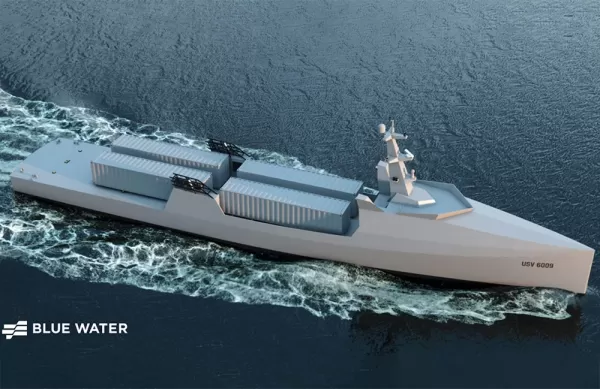
Blue Water Autonomy’s Liberty Class is a 190-foot steel autonomous ship. | Source: Blue Water AutonomyBoston-based technology and shipbuilding firm Blue Water Autonomy has secured a multiple-award contract with the Naval Oceanographic Office (NAVOCEA
U.S. Navy Selects Blue Water Autonomy for Deep-Sea Survey Missions
Blue Water Autonomy’s Liberty Class is a 190-foot steel autonomous ship. | Source: Blue Water AutonomyBoston-based technology and shipbuilding firm Blue Water Autonomy has secured a multiple-award contract with the Naval Oceanographic Office (NAVOCEA

2026 Latest Best Top-rated AI Text to Speech Tools for Online Courses are curated by XIX.AI based on rigorous real-world tests and weekly updated rankings. These powerful tools help creators deliver crystal-clear audio content effortlessly, boosting writing efficiency and streamlining course production. Check out the free vs paid comparison to find your perfect fit. Explore now to unlock your AI edge in online education.
10 tools
xix.ai

2026 Latest Best Top-Rated AI Blog Title Tools for Higher Click Through Rates! XIX.AI has carefully curated a powerful, game-changing collection of top tools that go through rigorous real-world tests. You’ll find a free vs paid comparison, weekly updated rankings, and detailed insights to help you boost your blog’s traffic efficiently. Must-try options are highlighted to help you unlock your AI edge. Explore now!
10 tools
xix.ai

2026 Latest Best Top-rated AI Task Routing Tools for Support Workflows! XIX.AI has curated a highly powerful game-changing collection of must-try solutions, all undergoing rigorous real-world tests and updated weekly. These tools streamline workflows, boost productivity, and help teams deliver faster, more efficient support. Explore now to discover your perfect tool and unlock your AI edge!
17 tools
xix.ai
2026 Latest Best Top-Rated AI Citation and Paper Summary Tools Curated by XIX.AI. Get powerful game-changing solutions for quick content creation, improved writing efficiency, and boosting productivity. We offer a free vs paid comparison along with real-world tests and weekly updated rankings to help you find the must-try tool that fits your needs perfectly. Explore now to Unlock your AI edge.
10 tools
xix.ai

2026 Latest Best Top-Rated AI Productivity Tools for Daily Work! XIX.AI has curated a powerful, game-changing selection based on rigorous weekly updated rankings and real-world tests. You’ll find must-try options that boost writing efficiency, streamline content creation, and help you overcome daily work challenges. Get a free vs paid comparison to find the perfect fit for your needs. Explore now to unlock your AI edge!
9 tools
xix.ai

2026 Latest Best Top-Rated AI Systematic Review Tools for Research Screening are here on XIX.AI! This curated collection includes powerful, game-changing solutions that go through rigorous real-world tests to deliver accurate results. We also offer a free vs paid comparison along with weekly updated rankings to help you find the must-try option that boosts your research efficiency significantly. Explore now to unlock your AI edge in academic work!
11 tools
xix.ai












