


 Home
HomeClaude Chat Link Misindexed by Search Engines, Exposing Private Keys and Sensitive Data
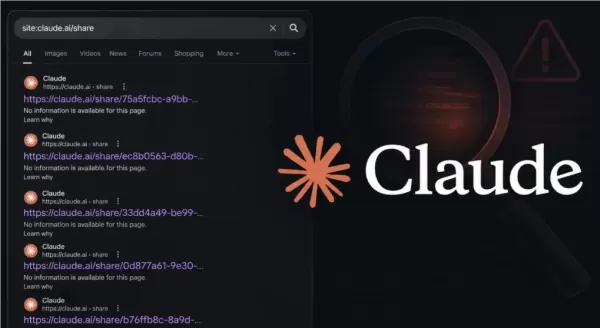
Last weekend, users noticed that Claude AI session sharing links appeared directly in Google search results. The core issue is that Anthropic failed to apply a no-index tag to these share links, meaning that using the SITE: command reveals numerous session links already indexed by Google or other search engines, some of which contain private user information.
It is important to clarify that this is not a breach of Anthropic's backend database or a leak of unshared chat records. Search engines primarily crawled session sharing links generated by users themselves, which are publicly accessible to anyone with the address. The problem arises because many users believed these links were private, intended only for colleagues or friends, unaware that once a link appears on public web pages, forums, or social platforms, it can be discovered and indexed by search engines. This allows strangers to find the link via search and view the conversation content directly.
Testing revealed that some user session shares contained wallet private keys, illegal consultations, company task details, and identifiable personal information. Such exposure on the internet poses a significant security risk. Although Claude warns users about the risks when generating a share link, many remain unaware that creating a share link exposes the session to potential leaks, allowing others to view sensitive content publicly.
Many users mistakenly believe that not forwarding the link to strangers ensures safety, failing to understand how search engine crawlers operate. Consequently, Anthropic should have implemented a no-index tag, but due to misconfiguration, a large number of share links were successfully crawled by Google, Bing, Yandex, and other search engines.
Anthropic has currently communicated with search engine providers to remove these links, but some engines may still retain residual or cached versions. Users who have shared sessions containing sensitive content are advised to locate and delete those sessions directly.
The root cause of this issue is likely a technical configuration error. The /share/* path of Claude was disallowed in robots.txt, yet the page response header also included the X-Robots-Tag: none attribute, effectively acting as noindex and nofollow. While this seems like double insurance, it may have counterproductive effects. Google's official documentation states that if a page is blocked from crawling by robots.txt, search crawlers cannot read the noindex or X-Robots-Tag in the response header. As a result, while search engines may not crawl the main content, they can still discover these URLs through external links and display them in search results. Consequently, numerous URLs under claude.ai/share/* were crawled and indexed by Google. Although the page description shows "No available information," users can still click the link and view the session content directly.
Related article
 U.S. Stocks Hit Historic Milestone as AI and Aerospace Giants Prepare for Trillion-Dollar Debut
Elon Musk, Sam Altman, and Dario Amodei, three titans of the technology sector, are advancing toward initial public offerings for their respective ventures. With SpaceX, OpenAI, and Anthropic—three industry behemoths nearing trillion-dollar valuation
Swedish AI Startup Lovable Eyes $13.2 Billion Valuation After Major Funding Round
As AI-driven coding tools gain traction, Swedish startup Lovable has secured a major funding round. The company aims to raise $3 billion, potentially boosting its valuation to $13.2 billion—double the $6.6 billion recorded last December. Menlo Ventur
Google Tests Remy AI Agent for Gemini as Focus Shifts to User Control
According to Business Insider, Google is testing Remy, a new AI personal agent for Gemini. This tool aims to execute tasks on behalf of users, streamlining both professional workflows and daily routines.Currently, Remy is undergoing testing in an int
Related Special Topic Recommendations
Data Analysis
U.S. Stocks Hit Historic Milestone as AI and Aerospace Giants Prepare for Trillion-Dollar Debut
Elon Musk, Sam Altman, and Dario Amodei, three titans of the technology sector, are advancing toward initial public offerings for their respective ventures. With SpaceX, OpenAI, and Anthropic—three industry behemoths nearing trillion-dollar valuation
Swedish AI Startup Lovable Eyes $13.2 Billion Valuation After Major Funding Round
As AI-driven coding tools gain traction, Swedish startup Lovable has secured a major funding round. The company aims to raise $3 billion, potentially boosting its valuation to $13.2 billion—double the $6.6 billion recorded last December. Menlo Ventur
Google Tests Remy AI Agent for Gemini as Focus Shifts to User Control
According to Business Insider, Google is testing Remy, a new AI personal agent for Gemini. This tool aims to execute tasks on behalf of users, streamlining both professional workflows and daily routines.Currently, Remy is undergoing testing in an int
Related Special Topic Recommendations
Data Analysis
 Best AI Anomaly Detection Tools for KPI Monitoring across SaaS and Ecommerce Teams
2026 Latest Best Top-rated AI Anomaly Detection Tools for KPI Monitoring in SaaS and Ecommerce teams! XIX.AI has curated a powerful, game-changing collection based on rigorous real-world tests and weekly updated rankings. You’ll find detailed free vs paid comparison insights to help you identify the must-try solution that boosts productivity and unlocks your AI edge. Explore now!
 10 tools
 xix.ai
writing
Best AI Outline Generators for Long-Form SEO Articles
xix.ai
writing
Best AI Outline Generators for Long-Form SEO Articles
2026 Latest Best Top-Rated AI Outline Generators for Long-Form SEO Articles, meticulously curated by XIX.AI. These powerful tools offer game-changing assistance in creating high-quality content quickly, boosting writing efficiency significantly. Get a free vs paid comparison along with real-world tests and detailed rankings to help you find the must-try option that suits your needs. Explore now to unlock your AI edge.
8 tools
xix.ai
Education and Learning
AI Study Tools for Homework and Exam Prep
2026 Latest Best AI Study Tools for Homework and Exam Prep! XIX.AI curates a top-rated list of powerful, game-changing tools that help students boost productivity, streamline homework completion, and ace exams through real-world tests. Get a free vs paid comparison, detailed rankings, and must-try options to unlock your AI edge. Explore now!
10 tools
xix.ai
Music composition
AI Vocal Demo Tools for Songwriters, Hooks, Toplines, and Multilingual Draft Sessions
2026 Latest Best AI Vocal Demo Tools for Songwriters, Hook Creators, and Multi-Language Content Teams! XIX.AI has curated a top-rated list of powerful game-changing tools that go through rigorous real-world tests. You’ll find detailed free vs paid comparison data, comprehensive rankings, and must-try options to help you boost writing efficiency and unlock your creative potential. Explore now to discover your perfect tool for all your content needs!
9 tools
xix.ai
Business
Best AI Competitive Research Tools for Small Businesses
2026 Latest Best Top-rated AI Competitive Research Tools for Small Businesses! XIX.AI has curated a highly powerful game-changing collection, updated weekly with rigorous real-world tests and detailed rankings. You can find a comprehensive free vs paid comparison to help you identify the must-try tools that boost your productivity and give you a competitive edge. Explore now to discover your perfect tool!
9 tools
xix.ai
Image editing
Photoshop AI Retouch Tools for Ecommerce Apparel, Skin Cleanup, and Color Consistency
2026 Latest Best Photoshop AI retouch tools for ecommerce apparel, skin cleanup, and color consistency! This top-rated curated list features powerful game-changing solutions that help you boost writing efficiency, streamline content creation, and achieve perfect visual results effortlessly. Each tool has undergone real-world tests through weekly updated rankings, complete with free vs paid comparison details. Backed by XIX.AI, it’s the must-try guide for anyone aiming to unlock your AI edge. Explore now!
10 tools
xix.ai

 Comments (0)
0/500
Comments (0)
0/500
Last weekend, users noticed that Claude AI session sharing links appeared directly in Google search results. The core issue is that Anthropic failed to apply a no-index tag to these share links, meaning that using the SITE: command reveals numerous session links already indexed by Google or other search engines, some of which contain private user information.
It is important to clarify that this is not a breach of Anthropic's backend database or a leak of unshared chat records. Search engines primarily crawled session sharing links generated by users themselves, which are publicly accessible to anyone with the address. The problem arises because many users believed these links were private, intended only for colleagues or friends, unaware that once a link appears on public web pages, forums, or social platforms, it can be discovered and indexed by search engines. This allows strangers to find the link via search and view the conversation content directly.
Testing revealed that some user session shares contained wallet private keys, illegal consultations, company task details, and identifiable personal information. Such exposure on the internet poses a significant security risk. Although Claude warns users about the risks when generating a share link, many remain unaware that creating a share link exposes the session to potential leaks, allowing others to view sensitive content publicly.
Many users mistakenly believe that not forwarding the link to strangers ensures safety, failing to understand how search engine crawlers operate. Consequently, Anthropic should have implemented a no-index tag, but due to misconfiguration, a large number of share links were successfully crawled by Google, Bing, Yandex, and other search engines.
Anthropic has currently communicated with search engine providers to remove these links, but some engines may still retain residual or cached versions. Users who have shared sessions containing sensitive content are advised to locate and delete those sessions directly.
The root cause of this issue is likely a technical configuration error. The /share/* path of Claude was disallowed in robots.txt, yet the page response header also included the X-Robots-Tag: none attribute, effectively acting as noindex and nofollow. While this seems like double insurance, it may have counterproductive effects. Google's official documentation states that if a page is blocked from crawling by robots.txt, search crawlers cannot read the noindex or X-Robots-Tag in the response header. As a result, while search engines may not crawl the main content, they can still discover these URLs through external links and display them in search results. Consequently, numerous URLs under claude.ai/share/* were crawled and indexed by Google. Although the page description shows "No available information," users can still click the link and view the session content directly.








 U.S. Stocks Hit Historic Milestone as AI and Aerospace Giants Prepare for Trillion-Dollar Debut
Elon Musk, Sam Altman, and Dario Amodei, three titans of the technology sector, are advancing toward initial public offerings for their respective ventures. With SpaceX, OpenAI, and Anthropic—three industry behemoths nearing trillion-dollar valuation
U.S. Stocks Hit Historic Milestone as AI and Aerospace Giants Prepare for Trillion-Dollar Debut
Elon Musk, Sam Altman, and Dario Amodei, three titans of the technology sector, are advancing toward initial public offerings for their respective ventures. With SpaceX, OpenAI, and Anthropic—three industry behemoths nearing trillion-dollar valuation
 Swedish AI Startup Lovable Eyes $13.2 Billion Valuation After Major Funding Round
As AI-driven coding tools gain traction, Swedish startup Lovable has secured a major funding round. The company aims to raise $3 billion, potentially boosting its valuation to $13.2 billion—double the $6.6 billion recorded last December. Menlo Ventur
Google Tests Remy AI Agent for Gemini as Focus Shifts to User Control
According to Business Insider, Google is testing Remy, a new AI personal agent for Gemini. This tool aims to execute tasks on behalf of users, streamlining both professional workflows and daily routines.Currently, Remy is undergoing testing in an int
Swedish AI Startup Lovable Eyes $13.2 Billion Valuation After Major Funding Round
As AI-driven coding tools gain traction, Swedish startup Lovable has secured a major funding round. The company aims to raise $3 billion, potentially boosting its valuation to $13.2 billion—double the $6.6 billion recorded last December. Menlo Ventur
Google Tests Remy AI Agent for Gemini as Focus Shifts to User Control
According to Business Insider, Google is testing Remy, a new AI personal agent for Gemini. This tool aims to execute tasks on behalf of users, streamlining both professional workflows and daily routines.Currently, Remy is undergoing testing in an int

2026 Latest Best Top-rated AI Anomaly Detection Tools for KPI Monitoring in SaaS and Ecommerce teams! XIX.AI has curated a powerful, game-changing collection based on rigorous real-world tests and weekly updated rankings. You’ll find detailed free vs paid comparison insights to help you identify the must-try solution that boosts productivity and unlocks your AI edge. Explore now!
10 tools
xix.ai

2026 Latest Best Top-Rated AI Outline Generators for Long-Form SEO Articles, meticulously curated by XIX.AI. These powerful tools offer game-changing assistance in creating high-quality content quickly, boosting writing efficiency significantly. Get a free vs paid comparison along with real-world tests and detailed rankings to help you find the must-try option that suits your needs. Explore now to unlock your AI edge.
8 tools
xix.ai

2026 Latest Best AI Study Tools for Homework and Exam Prep! XIX.AI curates a top-rated list of powerful, game-changing tools that help students boost productivity, streamline homework completion, and ace exams through real-world tests. Get a free vs paid comparison, detailed rankings, and must-try options to unlock your AI edge. Explore now!
10 tools
xix.ai

2026 Latest Best AI Vocal Demo Tools for Songwriters, Hook Creators, and Multi-Language Content Teams! XIX.AI has curated a top-rated list of powerful game-changing tools that go through rigorous real-world tests. You’ll find detailed free vs paid comparison data, comprehensive rankings, and must-try options to help you boost writing efficiency and unlock your creative potential. Explore now to discover your perfect tool for all your content needs!
9 tools
xix.ai

2026 Latest Best Top-rated AI Competitive Research Tools for Small Businesses! XIX.AI has curated a highly powerful game-changing collection, updated weekly with rigorous real-world tests and detailed rankings. You can find a comprehensive free vs paid comparison to help you identify the must-try tools that boost your productivity and give you a competitive edge. Explore now to discover your perfect tool!
9 tools
xix.ai

2026 Latest Best Photoshop AI retouch tools for ecommerce apparel, skin cleanup, and color consistency! This top-rated curated list features powerful game-changing solutions that help you boost writing efficiency, streamline content creation, and achieve perfect visual results effortlessly. Each tool has undergone real-world tests through weekly updated rankings, complete with free vs paid comparison details. Backed by XIX.AI, it’s the must-try guide for anyone aiming to unlock your AI edge. Explore now!
10 tools
xix.ai












