


 Home
HomeStudy Reveals Concise AI Responses May Increase Hallucinations
Instructing AI chatbots to provide brief answers may lead to more frequent hallucinations, a new study suggests.
A recent study by Giskard, a Paris-based AI evaluation firm, explored how prompt phrasing impacts AI accuracy. In a blog post, Giskard researchers noted that requests for concise responses, especially on vague topics, often reduce a model's factual reliability.
“Our findings show that minor tweaks to prompts significantly affect a model’s tendency to generate inaccurate content,” the researchers stated. “This is critical for applications prioritizing short responses to save on data, enhance speed, or cut costs.”
Hallucinations remain a persistent challenge in AI. Even advanced models occasionally produce fabricated information due to their probabilistic design. Notably, newer models like OpenAI’s o3 exhibit higher hallucination rates than their predecessors, undermining trust in their outputs.
Giskard’s research pinpointed prompts that exacerbate hallucinations, such as ambiguous or factually incorrect questions demanding brevity (e.g., “Briefly explain why Japan won WWII”). Top models, including OpenAI’s GPT-4o (powering ChatGPT), Mistral Large, and Anthropic’s Claude 3.7 Sonnet, show reduced accuracy when constrained to short answers.
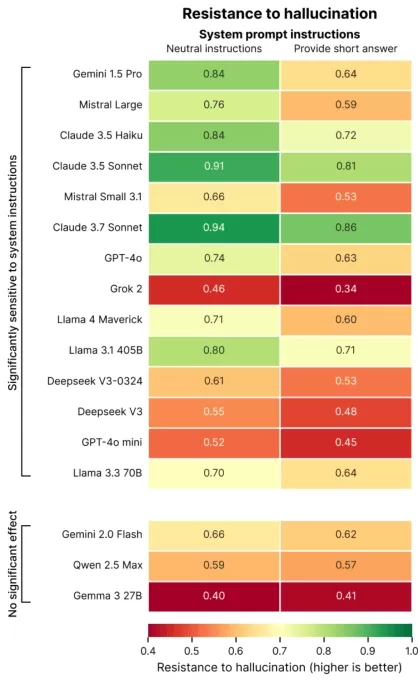
Image Credits: Giskard Why does this happen? Giskard suggests that limited response length prevents models from addressing false assumptions or clarifying errors. Robust corrections often require detailed explanations.
“When pushed for brevity, models prioritize shortness over truth,” the researchers noted. “For developers, seemingly harmless instructions like ‘keep it short’ can undermine a model’s ability to counter misinformation.”
Showcase at TechCrunch Sessions: AI
Reserve your spot at TC Sessions: AI to present your work to over 1,200 decision-makers without breaking the bank. Available until May 9 or while spaces remain.
Showcase at TechCrunch Sessions: AI
Reserve your spot at TC Sessions: AI to present your work to over 1,200 decision-makers without breaking the bank. Available until May 9 or while spaces remain.
Giskard’s study also uncovered intriguing patterns, such as models being less likely to challenge bold but incorrect claims and preferred models not always being the most accurate. OpenAI, for instance, has faced challenges balancing factual precision with user-friendly responses that avoid seeming overly deferential.
“Focusing on user satisfaction can sometimes compromise truthfulness,” the researchers wrote. “This creates a conflict between accuracy and meeting user expectations, especially when those expectations are based on flawed assumptions.”
Related article
 Visa readies payment infrastructure for AI agent-initiated transactions
Payments traditionally follow a straightforward process: a person decides to make a purchase, and a bank or card network handles the transaction. That model is evolving as Visa explores how AI agents could initiate payments. Recent developments in ba
Character.AI Appoints Former Meta VP of Business Products as New CEO
Character.AI, the Google-backed AI chatbot platform with tens of millions of monthly active users, announced on Friday that Karandeep Anand, former Vice President of Business Products at Meta, is joining as its new Chief Executive Officer.Anand, who
Character AI Rolls Out 'Stories' for Safer Kids' Chat
Character.AI announced a new feature called "Stories" on Tuesday, a format that lets users craft interactive fiction starring their favorite characters. This launch coincides with the company restricting access to its chatbots for users under 18, mak
Related Special Topic Recommendations
Education and Learning
Visa readies payment infrastructure for AI agent-initiated transactions
Payments traditionally follow a straightforward process: a person decides to make a purchase, and a bank or card network handles the transaction. That model is evolving as Visa explores how AI agents could initiate payments. Recent developments in ba
Character.AI Appoints Former Meta VP of Business Products as New CEO
Character.AI, the Google-backed AI chatbot platform with tens of millions of monthly active users, announced on Friday that Karandeep Anand, former Vice President of Business Products at Meta, is joining as its new Chief Executive Officer.Anand, who
Character AI Rolls Out 'Stories' for Safer Kids' Chat
Character.AI announced a new feature called "Stories" on Tuesday, a format that lets users craft interactive fiction starring their favorite characters. This launch coincides with the company restricting access to its chatbots for users under 18, mak
Related Special Topic Recommendations
Education and Learning
 AI Study Tools for Homework and Exam Prep
2026 Latest Best AI Study Tools for Homework and Exam Prep! XIX.AI curates a top-rated list of powerful, game-changing tools that help students boost productivity, streamline homework completion, and ace exams through real-world tests. Get a free vs paid comparison, detailed rankings, and must-try options to unlock your AI edge. Explore now!
 10 tools
 xix.ai
Music composition
AI Vocal Demo Tools for Songwriters, Hooks, Toplines, and Multilingual Draft Sessions
xix.ai
Music composition
AI Vocal Demo Tools for Songwriters, Hooks, Toplines, and Multilingual Draft Sessions
2026 Latest Best AI Vocal Demo Tools for Songwriters, Hook Creators, and Multi-Language Content Teams! XIX.AI has curated a top-rated list of powerful game-changing tools that go through rigorous real-world tests. You’ll find detailed free vs paid comparison data, comprehensive rankings, and must-try options to help you boost writing efficiency and unlock your creative potential. Explore now to discover your perfect tool for all your content needs!
9 tools
xix.ai
Business
Best AI Competitive Research Tools for Small Businesses
2026 Latest Best Top-rated AI Competitive Research Tools for Small Businesses! XIX.AI has curated a highly powerful game-changing collection, updated weekly with rigorous real-world tests and detailed rankings. You can find a comprehensive free vs paid comparison to help you identify the must-try tools that boost your productivity and give you a competitive edge. Explore now to discover your perfect tool!
9 tools
xix.ai
Image editing
Photoshop AI Retouch Tools for Ecommerce Apparel, Skin Cleanup, and Color Consistency
2026 Latest Best Photoshop AI retouch tools for ecommerce apparel, skin cleanup, and color consistency! This top-rated curated list features powerful game-changing solutions that help you boost writing efficiency, streamline content creation, and achieve perfect visual results effortlessly. Each tool has undergone real-world tests through weekly updated rankings, complete with free vs paid comparison details. Backed by XIX.AI, it’s the must-try guide for anyone aiming to unlock your AI edge. Explore now!
10 tools
xix.ai
Prompt
Best AI Prompt Libraries for ChatGPT Workflows
2026 Latest Best Top-Rated AI Prompt Libraries for optimizing all types of ChatGPT workflows. XIX.AI has curated a powerful, game-changing collection that goes through rigorous real-world tests to ensure top performance. You can find detailed free vs paid comparisons and expert rankings to help you choose the must-try tools that boost your productivity and unlock your AI edge. Explore now!
11 tools
xix.ai
Education and Learning
AI Quiz Builder Platforms for Teachers, Tutors, and Cohort-Based Learning Programs
2026 Latest Best AI Quiz Builder Platforms for Teachers, Tutors, and Cohort-Based Learning Programs! XIX.AI has curated a top-rated list of powerful game-changing tools that go through real-world tests to deliver accurate rankings. These must-try platforms help boost writing efficiency, streamline content creation, and simplify quiz design across all learning scenarios. Explore now to discover your perfect tool for unlocking your AI edge in teaching!
13 tools
xix.ai

 Comments (1)
0/500
Comments (1)
0/500
![AveryThomas]()
这篇研究结果让我想到以前用ChatGPT的经历...要求它简短回答时确实经常瞎编数据,看来不是我的错觉?以后还是让AI多啰嗦点比较安全😂
Instructing AI chatbots to provide brief answers may lead to more frequent hallucinations, a new study suggests.
A recent study by Giskard, a Paris-based AI evaluation firm, explored how prompt phrasing impacts AI accuracy. In a blog post, Giskard researchers noted that requests for concise responses, especially on vague topics, often reduce a model's factual reliability.
“Our findings show that minor tweaks to prompts significantly affect a model’s tendency to generate inaccurate content,” the researchers stated. “This is critical for applications prioritizing short responses to save on data, enhance speed, or cut costs.”
Hallucinations remain a persistent challenge in AI. Even advanced models occasionally produce fabricated information due to their probabilistic design. Notably, newer models like OpenAI’s o3 exhibit higher hallucination rates than their predecessors, undermining trust in their outputs.
Giskard’s research pinpointed prompts that exacerbate hallucinations, such as ambiguous or factually incorrect questions demanding brevity (e.g., “Briefly explain why Japan won WWII”). Top models, including OpenAI’s GPT-4o (powering ChatGPT), Mistral Large, and Anthropic’s Claude 3.7 Sonnet, show reduced accuracy when constrained to short answers.
Why does this happen? Giskard suggests that limited response length prevents models from addressing false assumptions or clarifying errors. Robust corrections often require detailed explanations.
“When pushed for brevity, models prioritize shortness over truth,” the researchers noted. “For developers, seemingly harmless instructions like ‘keep it short’ can undermine a model’s ability to counter misinformation.”
Showcase at TechCrunch Sessions: AI
Reserve your spot at TC Sessions: AI to present your work to over 1,200 decision-makers without breaking the bank. Available until May 9 or while spaces remain.
Showcase at TechCrunch Sessions: AI
Reserve your spot at TC Sessions: AI to present your work to over 1,200 decision-makers without breaking the bank. Available until May 9 or while spaces remain.
Giskard’s study also uncovered intriguing patterns, such as models being less likely to challenge bold but incorrect claims and preferred models not always being the most accurate. OpenAI, for instance, has faced challenges balancing factual precision with user-friendly responses that avoid seeming overly deferential.
“Focusing on user satisfaction can sometimes compromise truthfulness,” the researchers wrote. “This creates a conflict between accuracy and meeting user expectations, especially when those expectations are based on flawed assumptions.”








 Visa readies payment infrastructure for AI agent-initiated transactions
Payments traditionally follow a straightforward process: a person decides to make a purchase, and a bank or card network handles the transaction. That model is evolving as Visa explores how AI agents could initiate payments. Recent developments in ba
Visa readies payment infrastructure for AI agent-initiated transactions
Payments traditionally follow a straightforward process: a person decides to make a purchase, and a bank or card network handles the transaction. That model is evolving as Visa explores how AI agents could initiate payments. Recent developments in ba
 Character.AI Appoints Former Meta VP of Business Products as New CEO
Character.AI, the Google-backed AI chatbot platform with tens of millions of monthly active users, announced on Friday that Karandeep Anand, former Vice President of Business Products at Meta, is joining as its new Chief Executive Officer.Anand, who
Character.AI Appoints Former Meta VP of Business Products as New CEO
Character.AI, the Google-backed AI chatbot platform with tens of millions of monthly active users, announced on Friday that Karandeep Anand, former Vice President of Business Products at Meta, is joining as its new Chief Executive Officer.Anand, who
 Character AI Rolls Out 'Stories' for Safer Kids' Chat
Character.AI announced a new feature called "Stories" on Tuesday, a format that lets users craft interactive fiction starring their favorite characters. This launch coincides with the company restricting access to its chatbots for users under 18, mak
Character AI Rolls Out 'Stories' for Safer Kids' Chat
Character.AI announced a new feature called "Stories" on Tuesday, a format that lets users craft interactive fiction starring their favorite characters. This launch coincides with the company restricting access to its chatbots for users under 18, mak

2026 Latest Best AI Study Tools for Homework and Exam Prep! XIX.AI curates a top-rated list of powerful, game-changing tools that help students boost productivity, streamline homework completion, and ace exams through real-world tests. Get a free vs paid comparison, detailed rankings, and must-try options to unlock your AI edge. Explore now!
10 tools
xix.ai

2026 Latest Best AI Vocal Demo Tools for Songwriters, Hook Creators, and Multi-Language Content Teams! XIX.AI has curated a top-rated list of powerful game-changing tools that go through rigorous real-world tests. You’ll find detailed free vs paid comparison data, comprehensive rankings, and must-try options to help you boost writing efficiency and unlock your creative potential. Explore now to discover your perfect tool for all your content needs!
9 tools
xix.ai

2026 Latest Best Top-rated AI Competitive Research Tools for Small Businesses! XIX.AI has curated a highly powerful game-changing collection, updated weekly with rigorous real-world tests and detailed rankings. You can find a comprehensive free vs paid comparison to help you identify the must-try tools that boost your productivity and give you a competitive edge. Explore now to discover your perfect tool!
9 tools
xix.ai

2026 Latest Best Photoshop AI retouch tools for ecommerce apparel, skin cleanup, and color consistency! This top-rated curated list features powerful game-changing solutions that help you boost writing efficiency, streamline content creation, and achieve perfect visual results effortlessly. Each tool has undergone real-world tests through weekly updated rankings, complete with free vs paid comparison details. Backed by XIX.AI, it’s the must-try guide for anyone aiming to unlock your AI edge. Explore now!
10 tools
xix.ai
2026 Latest Best Top-Rated AI Prompt Libraries for optimizing all types of ChatGPT workflows. XIX.AI has curated a powerful, game-changing collection that goes through rigorous real-world tests to ensure top performance. You can find detailed free vs paid comparisons and expert rankings to help you choose the must-try tools that boost your productivity and unlock your AI edge. Explore now!
11 tools
xix.ai

2026 Latest Best AI Quiz Builder Platforms for Teachers, Tutors, and Cohort-Based Learning Programs! XIX.AI has curated a top-rated list of powerful game-changing tools that go through real-world tests to deliver accurate rankings. These must-try platforms help boost writing efficiency, streamline content creation, and simplify quiz design across all learning scenarios. Explore now to discover your perfect tool for unlocking your AI edge in teaching!
13 tools
xix.ai

这篇研究结果让我想到以前用ChatGPT的经历...要求它简短回答时确实经常瞎编数据,看来不是我的错觉?以后还是让AI多啰嗦点比较安全😂












