


 Home
HomeBinance lets AI agents trade, but users keep them in check
Binance, the world’s largest cryptocurrency exchange with over 300 million registered users, launched a new platform on Thursday that enables AI agents to analyze markets and execute trades on behalf of users, bringing autonomous artificial intelligence directly into the management of real funds.
Named Agent OS, this platform allows developers to connect AI applications and agents to Binance’s financial infrastructure. It integrates the exchange’s existing tools and services, including Binance APIs, the Binance Wallet Agentic Hub, the Binance x402 transaction verification and payment facilitator API, and the Binance Skill Hub, along with newly introduced support for the Model Context Protocol (MCP). The platform also supports tools such as OpenAI’s ChatGPT and Codex, Anthropic’s Claude Code, and Cursor, enabling users to authorize agents to access market data, view account information, and execute trades.
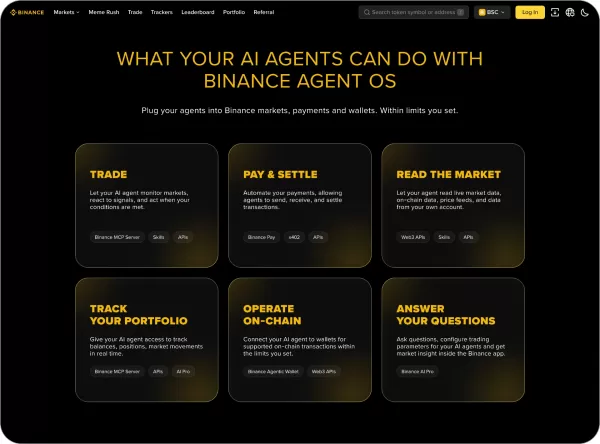
Binance’s Agent OS enables agents to trade on behalf of usersImage Credits:Binance
As the AI industry shifts from chatbots that answer questions to agents capable of taking action, Binance places significant responsibility for oversight on users, who must determine what agents can access and trade, as well as set limits on their activities.
“Instead of granting total freedom, we empower users with granular access control over what agents can do,” said Jeff Li, vice president of product at Binance, in an interview. “We have implemented control at the account level to safeguard users’ funds.”
Binance achieves this primarily through dedicated “sub-accounts,” which users can assign to agents and configure for specific activities, such as spot or futures trading. Withdrawals from these sub-accounts are disabled by default, Li told TechCrunch, creating a sandbox around an agent’s activity.
Users can also choose whether an AI agent must seek approval for every order or can execute trades autonomously once its permissions are configured, a Binance representative said. Binance does not impose a separate cap on how much an AI agent can trade or lose, so the amount a user transfers into the sub-account effectively serves as the limit.
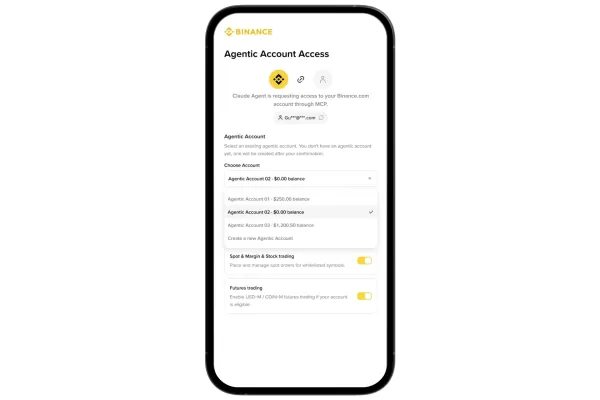
Binance’s sub-accounts can have specific transaction limits and permissionsImage Credits:Binance
When asked whether Binance can see what leads an agent to make a particular trade, Li said the reasoning happens outside its systems, either on the user’s computer or within their chosen AI application. “We really cannot see the reasoning of what the user’s action is,” he said.
This means Binance can monitor an agent’s resulting trading activity, but has limited visibility into whether a decision was influenced by faulty information or manipulation.
Li again pointed to the sub-account as the main line of defense when asked what would happen if an agent were manipulated through a prompt-injection attack or otherwise compromised. Binance also said its existing security, risk-control, and anti-money-laundering policies for subaccount APIs apply to Agent OS at launch.
Trading is one of the first use cases Binance is targeting. Nonetheless, Li said agents could monitor markets, conduct research and risk analysis, react to signals, and autonomously place orders or execute strategies such as arbitrage.
Agent OS is also designed to connect agents to payments and on-chain activity. Through Binance’s x402 integration, agents can send and settle payments, while its Agentic Wallet allows them to interact with tokens and decentralized-finance protocols.
Unlike exchange trading, where Binance does not impose a separate cap on how much an agent can trade or lose within its subaccount, Agentic Wallet transactions carry Binance-set daily limits. Regular swaps are capped at $50,000 a day, DeFi transactions have a default $100,000 daily limit, and x402 payments are limited to $20 a day, according to the company.
Li said Agent OS was Binance’s “first step” toward giving developers a platform to build AI-powered applications that can act across crypto and traditional markets.
Binance is not alone in opening its infrastructure to AI agents. Rival crypto exchanges have been moving in the same direction, using MCP and other developer tools to give AI applications direct access to market data and trading systems.
In March, Kraken launched an open-source command-line tool with a built-in MCP server that allows AI agents to execute actions including spot and futures trades. Coinbase followed in June with Coinbase for Agents, which connects AI agents directly to users’ accounts and allows them to trade, make payments and execute other financial workflows within user-set limits. Similarly, OKX enabled agentic trading on its platform by bringing an open-source MCP toolkit earlier this year.
Related article
 Google Tests Remy AI Agent for Gemini as Focus Shifts to User Control
According to Business Insider, Google is testing Remy, a new AI personal agent for Gemini. This tool aims to execute tasks on behalf of users, streamlining both professional workflows and daily routines.Currently, Remy is undergoing testing in an int
Sesame, AI Startup by Oculus Founders, Debuts on iOS
On Thursday, Sesame, an AI startup founded by the creators of Oculus and other former Meta VR team members, unveiled a public preview of its conversational AI agents, which have been in development for over a year. Through its new iOS application, Se
NEA’s Tiffany Luck: Enterprises Still Grappling With AI ROI
Loading the player…Earlier this year, “tokenmaxxing” dominated Silicon Valley, with CEOs urging staff to maximize AI usage. That enthusiasm quickly met reality. Uber reportedly exceeded its annual AI budget within months, some firms reduced Claude li
Related Special Topic Recommendations
Data Analysis
Google Tests Remy AI Agent for Gemini as Focus Shifts to User Control
According to Business Insider, Google is testing Remy, a new AI personal agent for Gemini. This tool aims to execute tasks on behalf of users, streamlining both professional workflows and daily routines.Currently, Remy is undergoing testing in an int
Sesame, AI Startup by Oculus Founders, Debuts on iOS
On Thursday, Sesame, an AI startup founded by the creators of Oculus and other former Meta VR team members, unveiled a public preview of its conversational AI agents, which have been in development for over a year. Through its new iOS application, Se
NEA’s Tiffany Luck: Enterprises Still Grappling With AI ROI
Loading the player…Earlier this year, “tokenmaxxing” dominated Silicon Valley, with CEOs urging staff to maximize AI usage. That enthusiasm quickly met reality. Uber reportedly exceeded its annual AI budget within months, some firms reduced Claude li
Related Special Topic Recommendations
Data Analysis
 Best AI Anomaly Detection Tools for KPI Monitoring across SaaS and Ecommerce Teams
2026 Latest Best Top-rated AI Anomaly Detection Tools for KPI Monitoring in SaaS and Ecommerce teams! XIX.AI has curated a powerful, game-changing collection based on rigorous real-world tests and weekly updated rankings. You’ll find detailed free vs paid comparison insights to help you identify the must-try solution that boosts productivity and unlocks your AI edge. Explore now!
 10 tools
 xix.ai
writing
Best AI Outline Generators for Long-Form SEO Articles
xix.ai
writing
Best AI Outline Generators for Long-Form SEO Articles
2026 Latest Best Top-Rated AI Outline Generators for Long-Form SEO Articles, meticulously curated by XIX.AI. These powerful tools offer game-changing assistance in creating high-quality content quickly, boosting writing efficiency significantly. Get a free vs paid comparison along with real-world tests and detailed rankings to help you find the must-try option that suits your needs. Explore now to unlock your AI edge.
8 tools
xix.ai
Education and Learning
AI Study Tools for Homework and Exam Prep
2026 Latest Best AI Study Tools for Homework and Exam Prep! XIX.AI curates a top-rated list of powerful, game-changing tools that help students boost productivity, streamline homework completion, and ace exams through real-world tests. Get a free vs paid comparison, detailed rankings, and must-try options to unlock your AI edge. Explore now!
10 tools
xix.ai
Music composition
AI Vocal Demo Tools for Songwriters, Hooks, Toplines, and Multilingual Draft Sessions
2026 Latest Best AI Vocal Demo Tools for Songwriters, Hook Creators, and Multi-Language Content Teams! XIX.AI has curated a top-rated list of powerful game-changing tools that go through rigorous real-world tests. You’ll find detailed free vs paid comparison data, comprehensive rankings, and must-try options to help you boost writing efficiency and unlock your creative potential. Explore now to discover your perfect tool for all your content needs!
9 tools
xix.ai
Business
Best AI Competitive Research Tools for Small Businesses
2026 Latest Best Top-rated AI Competitive Research Tools for Small Businesses! XIX.AI has curated a highly powerful game-changing collection, updated weekly with rigorous real-world tests and detailed rankings. You can find a comprehensive free vs paid comparison to help you identify the must-try tools that boost your productivity and give you a competitive edge. Explore now to discover your perfect tool!
9 tools
xix.ai
Image editing
Photoshop AI Retouch Tools for Ecommerce Apparel, Skin Cleanup, and Color Consistency
2026 Latest Best Photoshop AI retouch tools for ecommerce apparel, skin cleanup, and color consistency! This top-rated curated list features powerful game-changing solutions that help you boost writing efficiency, streamline content creation, and achieve perfect visual results effortlessly. Each tool has undergone real-world tests through weekly updated rankings, complete with free vs paid comparison details. Backed by XIX.AI, it’s the must-try guide for anyone aiming to unlock your AI edge. Explore now!
10 tools
xix.ai

 Comments (0)
0/500
Comments (0)
0/500
Binance, the world’s largest cryptocurrency exchange with over 300 million registered users, launched a new platform on Thursday that enables AI agents to analyze markets and execute trades on behalf of users, bringing autonomous artificial intelligence directly into the management of real funds.
Named Agent OS, this platform allows developers to connect AI applications and agents to Binance’s financial infrastructure. It integrates the exchange’s existing tools and services, including Binance APIs, the Binance Wallet Agentic Hub, the Binance x402 transaction verification and payment facilitator API, and the Binance Skill Hub, along with newly introduced support for the Model Context Protocol (MCP). The platform also supports tools such as OpenAI’s ChatGPT and Codex, Anthropic’s Claude Code, and Cursor, enabling users to authorize agents to access market data, view account information, and execute trades.
Binance’s Agent OS enables agents to trade on behalf of usersImage Credits:Binance
As the AI industry shifts from chatbots that answer questions to agents capable of taking action, Binance places significant responsibility for oversight on users, who must determine what agents can access and trade, as well as set limits on their activities.
“Instead of granting total freedom, we empower users with granular access control over what agents can do,” said Jeff Li, vice president of product at Binance, in an interview. “We have implemented control at the account level to safeguard users’ funds.”
Binance achieves this primarily through dedicated “sub-accounts,” which users can assign to agents and configure for specific activities, such as spot or futures trading. Withdrawals from these sub-accounts are disabled by default, Li told TechCrunch, creating a sandbox around an agent’s activity.
Users can also choose whether an AI agent must seek approval for every order or can execute trades autonomously once its permissions are configured, a Binance representative said. Binance does not impose a separate cap on how much an AI agent can trade or lose, so the amount a user transfers into the sub-account effectively serves as the limit.
Binance’s sub-accounts can have specific transaction limits and permissionsImage Credits:Binance
When asked whether Binance can see what leads an agent to make a particular trade, Li said the reasoning happens outside its systems, either on the user’s computer or within their chosen AI application. “We really cannot see the reasoning of what the user’s action is,” he said.
This means Binance can monitor an agent’s resulting trading activity, but has limited visibility into whether a decision was influenced by faulty information or manipulation.
Li again pointed to the sub-account as the main line of defense when asked what would happen if an agent were manipulated through a prompt-injection attack or otherwise compromised. Binance also said its existing security, risk-control, and anti-money-laundering policies for subaccount APIs apply to Agent OS at launch.
Trading is one of the first use cases Binance is targeting. Nonetheless, Li said agents could monitor markets, conduct research and risk analysis, react to signals, and autonomously place orders or execute strategies such as arbitrage.
Agent OS is also designed to connect agents to payments and on-chain activity. Through Binance’s x402 integration, agents can send and settle payments, while its Agentic Wallet allows them to interact with tokens and decentralized-finance protocols.
Unlike exchange trading, where Binance does not impose a separate cap on how much an agent can trade or lose within its subaccount, Agentic Wallet transactions carry Binance-set daily limits. Regular swaps are capped at $50,000 a day, DeFi transactions have a default $100,000 daily limit, and x402 payments are limited to $20 a day, according to the company.
Li said Agent OS was Binance’s “first step” toward giving developers a platform to build AI-powered applications that can act across crypto and traditional markets.
Binance is not alone in opening its infrastructure to AI agents. Rival crypto exchanges have been moving in the same direction, using MCP and other developer tools to give AI applications direct access to market data and trading systems.
In March, Kraken launched an open-source command-line tool with a built-in MCP server that allows AI agents to execute actions including spot and futures trades. Coinbase followed in June with Coinbase for Agents, which connects AI agents directly to users’ accounts and allows them to trade, make payments and execute other financial workflows within user-set limits. Similarly, OKX enabled agentic trading on its platform by bringing an open-source MCP toolkit earlier this year.







 Google Tests Remy AI Agent for Gemini as Focus Shifts to User Control
According to Business Insider, Google is testing Remy, a new AI personal agent for Gemini. This tool aims to execute tasks on behalf of users, streamlining both professional workflows and daily routines.Currently, Remy is undergoing testing in an int
Google Tests Remy AI Agent for Gemini as Focus Shifts to User Control
According to Business Insider, Google is testing Remy, a new AI personal agent for Gemini. This tool aims to execute tasks on behalf of users, streamlining both professional workflows and daily routines.Currently, Remy is undergoing testing in an int
 Sesame, AI Startup by Oculus Founders, Debuts on iOS
On Thursday, Sesame, an AI startup founded by the creators of Oculus and other former Meta VR team members, unveiled a public preview of its conversational AI agents, which have been in development for over a year. Through its new iOS application, Se
Sesame, AI Startup by Oculus Founders, Debuts on iOS
On Thursday, Sesame, an AI startup founded by the creators of Oculus and other former Meta VR team members, unveiled a public preview of its conversational AI agents, which have been in development for over a year. Through its new iOS application, Se
 NEA’s Tiffany Luck: Enterprises Still Grappling With AI ROI
Loading the player…Earlier this year, “tokenmaxxing” dominated Silicon Valley, with CEOs urging staff to maximize AI usage. That enthusiasm quickly met reality. Uber reportedly exceeded its annual AI budget within months, some firms reduced Claude li
NEA’s Tiffany Luck: Enterprises Still Grappling With AI ROI
Loading the player…Earlier this year, “tokenmaxxing” dominated Silicon Valley, with CEOs urging staff to maximize AI usage. That enthusiasm quickly met reality. Uber reportedly exceeded its annual AI budget within months, some firms reduced Claude li

2026 Latest Best Top-rated AI Anomaly Detection Tools for KPI Monitoring in SaaS and Ecommerce teams! XIX.AI has curated a powerful, game-changing collection based on rigorous real-world tests and weekly updated rankings. You’ll find detailed free vs paid comparison insights to help you identify the must-try solution that boosts productivity and unlocks your AI edge. Explore now!
10 tools
xix.ai

2026 Latest Best Top-Rated AI Outline Generators for Long-Form SEO Articles, meticulously curated by XIX.AI. These powerful tools offer game-changing assistance in creating high-quality content quickly, boosting writing efficiency significantly. Get a free vs paid comparison along with real-world tests and detailed rankings to help you find the must-try option that suits your needs. Explore now to unlock your AI edge.
8 tools
xix.ai

2026 Latest Best AI Study Tools for Homework and Exam Prep! XIX.AI curates a top-rated list of powerful, game-changing tools that help students boost productivity, streamline homework completion, and ace exams through real-world tests. Get a free vs paid comparison, detailed rankings, and must-try options to unlock your AI edge. Explore now!
10 tools
xix.ai

2026 Latest Best AI Vocal Demo Tools for Songwriters, Hook Creators, and Multi-Language Content Teams! XIX.AI has curated a top-rated list of powerful game-changing tools that go through rigorous real-world tests. You’ll find detailed free vs paid comparison data, comprehensive rankings, and must-try options to help you boost writing efficiency and unlock your creative potential. Explore now to discover your perfect tool for all your content needs!
9 tools
xix.ai

2026 Latest Best Top-rated AI Competitive Research Tools for Small Businesses! XIX.AI has curated a highly powerful game-changing collection, updated weekly with rigorous real-world tests and detailed rankings. You can find a comprehensive free vs paid comparison to help you identify the must-try tools that boost your productivity and give you a competitive edge. Explore now to discover your perfect tool!
9 tools
xix.ai

2026 Latest Best Photoshop AI retouch tools for ecommerce apparel, skin cleanup, and color consistency! This top-rated curated list features powerful game-changing solutions that help you boost writing efficiency, streamline content creation, and achieve perfect visual results effortlessly. Each tool has undergone real-world tests through weekly updated rankings, complete with free vs paid comparison details. Backed by XIX.AI, it’s the must-try guide for anyone aiming to unlock your AI edge. Explore now!
10 tools
xix.ai












