


 Home
Anthropic’s Safety Warnings Backfire as Government Halts Its Most Powerful AI
On Friday, the U.S. government mandated that Anthropic immediately disable access to two of its most advanced AI systems, Claude Fable 5 and Claude Mythos 5, citing national security risks. Anthropic confirmed compliance via X but stated it believes the government’s decision was misguided.
According to Anthropic, the directive arrived at 5:21 pm ET on Friday, requiring the company to block both models for all global users, extending beyond the foreign nationals originally targeted by the export control order. Other Anthropic models remain unaffected.
Why does this matter? Mythos represents Anthropic’s most powerful AI, previewed in early April and kept under strict restriction due to its exceptional capacity to identify software security vulnerabilities. Anthropic reports that Mythos found flaws in every major operating system and web browser tested. Consequently, instead of a broad release, the company launched Project Glasswing, a controlled program distributing access to approximately 50 vetted organizations, including Amazon, Apple, Google, Microsoft, and CrowdStrike, for defensive cybersecurity purposes.
Fable 5, launched just three days ago, addresses commercial pressure by offering a version of Mythos with guardrails that block responses in high-risk sectors like cybersecurity and biology. Anthropic argues this makes it safe for general use, and benchmark tests by Vals AI, which tracks AI performance, confirm it is currently the most capable public AI model.
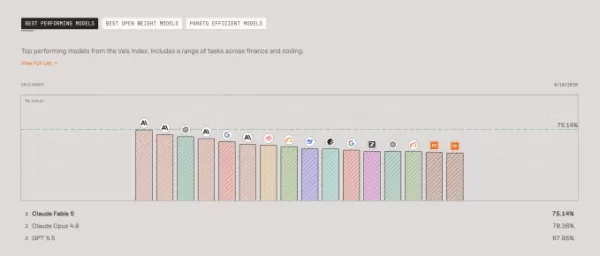
Image Credits:Vals AI /
While the government frames this as an export control measure limiting foreign access, Anthropic argues in a detailed blog post that the real issue is a claimed jailbreak of Fable 5. The company states the government has only provided verbal evidence of a “potential narrow, non-universal jailbreak,” which involves prompting the model to analyze a specific codebase for software flaws. Anthropic notes this capability is already widely available in other public models, such as OpenAI’s GPT-5.5, and is routinely used by cybersecurity professionals for defense.
Anthropic’s core argument is that its strongest safeguards rely on independent classifier systems separate from the model itself. This means that even if a user bypasses a refusal, underlying protections against dangerous outputs remain active.
Despite these safeguards, the government proceeded with its action, and Anthropic has openly expressed its frustration. “We disagree that the finding of a narrow potential jailbreak should be cause for recalling a commercial model deployed to hundreds of millions of people,” the company wrote. “If this standard was applied across the industry, we believe it would essentially halt all new model deployments for all frontier model providers.”
Anthropic is widely expected to pursue an IPO this year, positioning itself as the safety-conscious alternative to competitors. Observers note the irony that the caution Anthropic exercised in restricting Mythos — promoting it as too dangerous for public release — has now triggered the exact government scrutiny that could disrupt its business.
OpenAI’s Sam Altman appears to be enjoying the situation. In April, he told podcaster Ashlee Vance that Anthropic’s handling of Mythos was “fear-based marketing.” “It is clearly incredible marketing to say, ‘We have built a bomb. We were about to drop it on your head. We will sell you a bomb shelter for $100 million,’” Altman said. While Altman, whose company also plans an imminent IPO, did not predict a government shutdown, he highlighted a consequence of Anthropic’s strategy: by spending months warning that its AI is uniquely dangerous, the company ensured that the U.S. government would take notice.
Related article
 Sequoia-backed Empirik raises $21M to forecast outages before they strike
Before joining Sequoia Capital in 2020 as chief digital and information officer, Avon Puri spent over a decade running infrastructure at Rubrik and VMware. Three years ago, as large language models began showing their true potential, Puri, alongside
OpenAI launches GPT-5.5 Instant as ChatGPT’s new default model
OpenAI launched GPT-5.5 Instant on Monday, replacing GPT-5.3 Instant as the default ChatGPT model. The company states that this update minimizes hallucinations in high-stakes fields like law, medicine, and finance, while preserving the fast response
Librarians Host Viral 'Avoiding AI' Workshops For Those Fed Up With Big Tech
“Everyone is glued to their screens in my library program,” joked Charlie Bailey, a South Philadelphia librarian. He invited his audience to take out their phones so he could guide them through disabling Apple Intelligence and Gemini.Bailey stands in
Related Special Topic Recommendations
Design & Art
 Top AI Illustration Tools: Create Editorial Scenes and Cover Art Faster
2026 Latest Top-rated AI Illustration Tools: Our curated list features the best powerfully designed tools for creating stunning editorial scenes and eye-catching cover art quickly. Each option has gone through rigorous real-world tests, offering a free vs paid comparison to help you find the perfect match for your workflow. Try these must-try solutions today to unlock your AI edge and boost your creative productivity. Explore now at XIX.AI.
 10 tools
 xix.ai
Education and Learning
Top AI Tutors for Exam Prep: Practice Math, Science, and English
2026 Latest Top-Rated Best AI Tutors for Exam Prep are here on XIX.AI! Our curated list features powerful game-changing tools that offer free vs paid comparison, real-world tests, and weekly updated rankings. They help boost your writing efficiency, simplify complex topic learning, and unlock your academic potential. Explore now to Discover your perfect exam prep tool and Start creating today to Unlock your AI edge!
10 tools
xix.ai
Finance
AI Budget Planning Tools for Personal Money Management
2026 Latest Best Top-Rated AI Budget Planning Tools for Personal Money Management are here on XIX.AI! This curated collection features powerful, game-changing solutions that help you conduct real-world tests, understand spending habits, and create personalized plans to boost productivity. Enjoy a free vs paid comparison along with detailed rankings. Must-try tools designed to simplify money management and unlock your AI edge. Explore now!
11 tools
xix.ai
Health & Wellness
AI Sleep Tracking Assistants: Improve Recovery with Better Bedtime Habits
2026 Latest Best Top-Rated AI Sleep Tracking Assistants curated for ultimate recovery. This fully updated weekly guide features powerful tools that deliver real-world tests, free vs paid comparison, and detailed rankings to help you find the must-try solution that boosts sleep quality and supports better bedtime habits. Explore now at XIX.AI to Unlock your AI edge.
10 tools
xix.ai
Data Analysis
AI SQL Copilots for Product and Revenue Analytics
2026 Latest Best Top-Rated AI SQL Copilots for Product and Revenue Analytics! XIX.AI has curated a powerful, game-changing collection of must-try tools that undergo real-world tests through weekly updated rankings. These tools help users boost productivity significantly by accelerating data analysis, streamlining complex queries, and generating accurate insights to drive smarter business decisions. Explore now to Discover your perfect tool for unlocking your AI edge!
14 tools
xix.ai
Education and Learning
Best AI Homework Helpers That Teach: Learn Concepts, Not Just Answers
2026 Latest Best Top-Rated AI Homework Helpers That Teach Core Concepts Not Just Answers Powerful Tools for Students Must-Try Curated List Weekly Updated Free vs Paid Comparison Real-World Tests Accurate Rankings to Help You Unlock Your Full Learning Potential Explore now to Discover your perfect tool for smarter studying.
10 tools
xix.ai

 Comments (0)
0/500
On Friday, the U.S. government mandated that Anthropic immediately disable access to two of its most advanced AI systems, Claude Fable 5 and Claude Mythos 5, citing national security risks. Anthropic confirmed compliance via X but stated it believes the government’s decision was misguided.
According to Anthropic, the directive arrived at 5:21 pm ET on Friday, requiring the company to block both models for all global users, extending beyond the foreign nationals originally targeted by the export control order. Other Anthropic models remain unaffected.
Why does this matter? Mythos represents Anthropic’s most powerful AI, previewed in early April and kept under strict restriction due to its exceptional capacity to identify software security vulnerabilities. Anthropic reports that Mythos found flaws in every major operating system and web browser tested. Consequently, instead of a broad release, the company launched Project Glasswing, a controlled program distributing access to approximately 50 vetted organizations, including Amazon, Apple, Google, Microsoft, and CrowdStrike, for defensive cybersecurity purposes.
Fable 5, launched just three days ago, addresses commercial pressure by offering a version of Mythos with guardrails that block responses in high-risk sectors like cybersecurity and biology. Anthropic argues this makes it safe for general use, and benchmark tests by Vals AI, which tracks AI performance, confirm it is currently the most capable public AI model.
Image Credits:Vals AI /
While the government frames this as an export control measure limiting foreign access, Anthropic argues in a detailed blog post that the real issue is a claimed jailbreak of Fable 5. The company states the government has only provided verbal evidence of a “potential narrow, non-universal jailbreak,” which involves prompting the model to analyze a specific codebase for software flaws. Anthropic notes this capability is already widely available in other public models, such as OpenAI’s GPT-5.5, and is routinely used by cybersecurity professionals for defense.
Anthropic’s core argument is that its strongest safeguards rely on independent classifier systems separate from the model itself. This means that even if a user bypasses a refusal, underlying protections against dangerous outputs remain active.
Despite these safeguards, the government proceeded with its action, and Anthropic has openly expressed its frustration. “We disagree that the finding of a narrow potential jailbreak should be cause for recalling a commercial model deployed to hundreds of millions of people,” the company wrote. “If this standard was applied across the industry, we believe it would essentially halt all new model deployments for all frontier model providers.”
Anthropic is widely expected to pursue an IPO this year, positioning itself as the safety-conscious alternative to competitors. Observers note the irony that the caution Anthropic exercised in restricting Mythos — promoting it as too dangerous for public release — has now triggered the exact government scrutiny that could disrupt its business.
OpenAI’s Sam Altman appears to be enjoying the situation. In April, he told podcaster Ashlee Vance that Anthropic’s handling of Mythos was “fear-based marketing.” “It is clearly incredible marketing to say, ‘We have built a bomb. We were about to drop it on your head. We will sell you a bomb shelter for $100 million,’” Altman said. While Altman, whose company also plans an imminent IPO, did not predict a government shutdown, he highlighted a consequence of Anthropic’s strategy: by spending months warning that its AI is uniquely dangerous, the company ensured that the U.S. government would take notice.








 Sequoia-backed Empirik raises $21M to forecast outages before they strike
Before joining Sequoia Capital in 2020 as chief digital and information officer, Avon Puri spent over a decade running infrastructure at Rubrik and VMware. Three years ago, as large language models began showing their true potential, Puri, alongside
 OpenAI launches GPT-5.5 Instant as ChatGPT’s new default model
OpenAI launched GPT-5.5 Instant on Monday, replacing GPT-5.3 Instant as the default ChatGPT model. The company states that this update minimizes hallucinations in high-stakes fields like law, medicine, and finance, while preserving the fast response
 Librarians Host Viral 'Avoiding AI' Workshops For Those Fed Up With Big Tech
“Everyone is glued to their screens in my library program,” joked Charlie Bailey, a South Philadelphia librarian. He invited his audience to take out their phones so he could guide them through disabling Apple Intelligence and Gemini.Bailey stands in

2026 Latest Top-rated AI Illustration Tools: Our curated list features the best powerfully designed tools for creating stunning editorial scenes and eye-catching cover art quickly. Each option has gone through rigorous real-world tests, offering a free vs paid comparison to help you find the perfect match for your workflow. Try these must-try solutions today to unlock your AI edge and boost your creative productivity. Explore now at XIX.AI.
10 tools
xix.ai

2026 Latest Top-Rated Best AI Tutors for Exam Prep are here on XIX.AI! Our curated list features powerful game-changing tools that offer free vs paid comparison, real-world tests, and weekly updated rankings. They help boost your writing efficiency, simplify complex topic learning, and unlock your academic potential. Explore now to Discover your perfect exam prep tool and Start creating today to Unlock your AI edge!
10 tools
xix.ai

2026 Latest Best Top-Rated AI Budget Planning Tools for Personal Money Management are here on XIX.AI! This curated collection features powerful, game-changing solutions that help you conduct real-world tests, understand spending habits, and create personalized plans to boost productivity. Enjoy a free vs paid comparison along with detailed rankings. Must-try tools designed to simplify money management and unlock your AI edge. Explore now!
11 tools
xix.ai

2026 Latest Best Top-Rated AI Sleep Tracking Assistants curated for ultimate recovery. This fully updated weekly guide features powerful tools that deliver real-world tests, free vs paid comparison, and detailed rankings to help you find the must-try solution that boosts sleep quality and supports better bedtime habits. Explore now at XIX.AI to Unlock your AI edge.
10 tools
xix.ai

2026 Latest Best Top-Rated AI SQL Copilots for Product and Revenue Analytics! XIX.AI has curated a powerful, game-changing collection of must-try tools that undergo real-world tests through weekly updated rankings. These tools help users boost productivity significantly by accelerating data analysis, streamlining complex queries, and generating accurate insights to drive smarter business decisions. Explore now to Discover your perfect tool for unlocking your AI edge!
14 tools
xix.ai

2026 Latest Best Top-Rated AI Homework Helpers That Teach Core Concepts Not Just Answers Powerful Tools for Students Must-Try Curated List Weekly Updated Free vs Paid Comparison Real-World Tests Accurate Rankings to Help You Unlock Your Full Learning Potential Explore now to Discover your perfect tool for smarter studying.
10 tools
xix.ai












