


 Home
HomeClaude 4 Unveiled: Next-Gen AI Models Boost Coding and Agentic Performance
Anthropic has launched its Claude 4 model family, marking a significant advancement for developers crafting cutting-edge AI assistants and coding solutions. The lineup features Claude Opus 4, a top-tier performer, and Claude Sonnet 4, a versatile model for diverse applications.
Anthropic is bold about its goals, emphasizing that these models are designed to "elevate our clients' AI strategies comprehensively." Opus 4 is positioned as a leader in "coding, research, writing, and scientific exploration," while Sonnet 4 is described as a "major upgrade from Sonnet 3.7," delivering "top-tier performance for routine tasks."
Claude Opus 4: The Premier Coding Model
Anthropic touts Claude Opus 4 as its "most advanced model to date and the leading coding model globally," a claim supported by its impressive scores of 72.5% on SWE-bench and 43.2% on Terminal-bench.
Beyond speed, Opus 4 excels in endurance, built for "consistent performance on extended tasks requiring focused effort and thousands of steps." Picture an AI capable of "sustained work over hours"—that’s Anthropic’s promise.
This represents a significant leap from earlier Sonnet models, potentially redefining the scope of AI agents by tackling challenges demanding sustained effort.
Claude Sonnet 4: Versatile AI for Everyday Use
While Opus 4 is the flagship, Claude Sonnet 4 emerges as a dynamic all-purpose model, offering substantial improvements across a wide range of applications. Initial feedback from early users is highly positive.
For example, GitHub notes that "Claude Sonnet 4 excels in agentic scenarios" and is so impressed that they "plan to adopt it as the foundation for the new coding agent in GitHub Copilot." That’s a strong vote of confidence.
Tech analyst Manus praises its "enhanced ability to follow intricate instructions, deliver clear reasoning, and produce polished outputs."
iGent reports that Sonnet 4 "shines in autonomous multi-feature app development, with significantly improved problem-solving and near-zero navigation errors, down from 20%." This is a major win for development workflows.
Sourcegraph sees it as a "significant advancement in software development, maintaining focus longer, grasping problems deeply, and delivering cleaner code."
Augment Code highlights "higher success rates, precise code edits, and meticulous handling of complex tasks," making Sonnet 4 their "preferred primary model."
Hybrid Modes and Developer Tools
A standout feature of the Claude 4 family is its dual-mode capability. Both Opus 4 and Sonnet 4 offer rapid responses for quick tasks and a deeper reasoning mode for complex challenges.
This advanced reasoning mode is included in the Pro, Max, Team, and Enterprise Claude plans. Excitingly, Sonnet 4, with this enhanced reasoning, will also be accessible to free users, broadening access to high-quality AI.
Anthropic is also introducing powerful developer tools via its API to accelerate the development of advanced AI agents:
- Code execution tool: Enables models to run code, unlocking new possibilities for interactive and problem-solving applications.
- MCP connector: Anthropic’s new standard for seamless context exchange between AI assistants and software environments.
- Files API: Simplifies direct file interactions, a critical feature for practical tasks.
- Prompt caching: Allows developers to cache prompts for up to an hour, boosting speed and efficiency for frequent queries.
Top Performance in Real-World Applications
Anthropic highlights that its "Claude 4 models lead on SWE-bench Verified, a benchmark for real-world software engineering tasks." Beyond coding, they excel in "reasoning, multimodal capabilities, and agentic tasks."
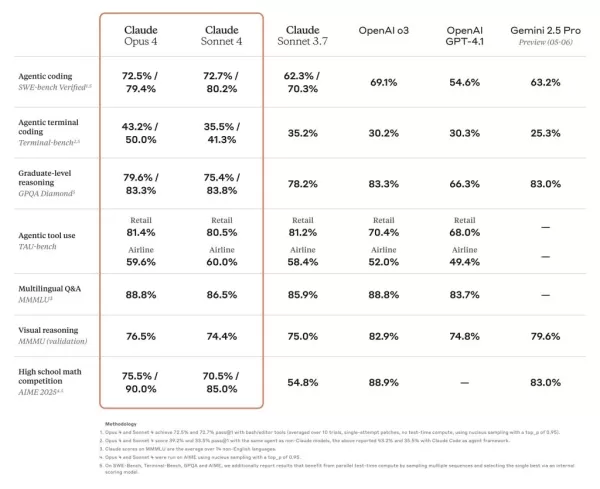
Despite these advancements, Anthropic maintains consistent pricing. Claude Opus 4 costs $15 per million input tokens and $75 per million output tokens. Claude Sonnet 4, the more affordable option, is priced at $3 per million input tokens and $15 per million output tokens, a relief for current users.
Both models are available through the Anthropic API, Amazon Bedrock, and Google Cloud’s Vertex AI, enabling global developers and businesses to integrate them seamlessly.
Anthropic is clearly focused on enhancing AI capabilities, particularly in complex coding and autonomous agent tasks. With these models and tools, the potential for innovation has been significantly amplified.
See also: Jony Ive’s OpenAI Device Details Surface
Discover more about AI and big data from industry experts at the AI & Big Data Expo in Amsterdam, California, and London. This event is co-located with the Intelligent Automation Conference, BlockX, Digital Transformation Week, and Cyber Security & Cloud Expo.
Check out other upcoming enterprise technology events and webinars by TechForge here.
Related article
 Ollie bets privacy focus to win AI assistant race
To be genuinely helpful, an AI assistant must understand its user deeply. Ollie, a personal assistant designed for daily life, operates on the premise that this doesn’t require surrendering your data or compromising your privacy.While certain enterpr
How AI LIVE: London Will Explore AI & Industrial Automation
The summit will convene C-suite executives from around the globe to address pressing challenges in global industries, ranging from AI-driven disruption to economic volatility.AI LIVE: The London Summit will gather over 2,000 international leaders und
Anthropic Enters AI Legal Tech Market as Competition Intensifies
Anthropic unveiled a suite of new chatbot capabilities on Tuesday, aimed at delivering automated support to legal practices. These enhancements expand upon Claude for Legal, the firm-specific platform introduced earlier this year, by adding specializ
Related Special Topic Recommendations
Education and Learning
Ollie bets privacy focus to win AI assistant race
To be genuinely helpful, an AI assistant must understand its user deeply. Ollie, a personal assistant designed for daily life, operates on the premise that this doesn’t require surrendering your data or compromising your privacy.While certain enterpr
How AI LIVE: London Will Explore AI & Industrial Automation
The summit will convene C-suite executives from around the globe to address pressing challenges in global industries, ranging from AI-driven disruption to economic volatility.AI LIVE: The London Summit will gather over 2,000 international leaders und
Anthropic Enters AI Legal Tech Market as Competition Intensifies
Anthropic unveiled a suite of new chatbot capabilities on Tuesday, aimed at delivering automated support to legal practices. These enhancements expand upon Claude for Legal, the firm-specific platform introduced earlier this year, by adding specializ
Related Special Topic Recommendations
Education and Learning
 AI Study Tools for Homework and Exam Prep
2026 Latest Best AI Study Tools for Homework and Exam Prep! XIX.AI curates a top-rated list of powerful, game-changing tools that help students boost productivity, streamline homework completion, and ace exams through real-world tests. Get a free vs paid comparison, detailed rankings, and must-try options to unlock your AI edge. Explore now!
 10 tools
 xix.ai
Music composition
AI Vocal Demo Tools for Songwriters, Hooks, Toplines, and Multilingual Draft Sessions
xix.ai
Music composition
AI Vocal Demo Tools for Songwriters, Hooks, Toplines, and Multilingual Draft Sessions
2026 Latest Best AI Vocal Demo Tools for Songwriters, Hook Creators, and Multi-Language Content Teams! XIX.AI has curated a top-rated list of powerful game-changing tools that go through rigorous real-world tests. You’ll find detailed free vs paid comparison data, comprehensive rankings, and must-try options to help you boost writing efficiency and unlock your creative potential. Explore now to discover your perfect tool for all your content needs!
9 tools
xix.ai
Business
Best AI Competitive Research Tools for Small Businesses
2026 Latest Best Top-rated AI Competitive Research Tools for Small Businesses! XIX.AI has curated a highly powerful game-changing collection, updated weekly with rigorous real-world tests and detailed rankings. You can find a comprehensive free vs paid comparison to help you identify the must-try tools that boost your productivity and give you a competitive edge. Explore now to discover your perfect tool!
9 tools
xix.ai
Image editing
Photoshop AI Retouch Tools for Ecommerce Apparel, Skin Cleanup, and Color Consistency
2026 Latest Best Photoshop AI retouch tools for ecommerce apparel, skin cleanup, and color consistency! This top-rated curated list features powerful game-changing solutions that help you boost writing efficiency, streamline content creation, and achieve perfect visual results effortlessly. Each tool has undergone real-world tests through weekly updated rankings, complete with free vs paid comparison details. Backed by XIX.AI, it’s the must-try guide for anyone aiming to unlock your AI edge. Explore now!
10 tools
xix.ai
Prompt
Best AI Prompt Libraries for ChatGPT Workflows
2026 Latest Best Top-Rated AI Prompt Libraries for optimizing all types of ChatGPT workflows. XIX.AI has curated a powerful, game-changing collection that goes through rigorous real-world tests to ensure top performance. You can find detailed free vs paid comparisons and expert rankings to help you choose the must-try tools that boost your productivity and unlock your AI edge. Explore now!
11 tools
xix.ai
Education and Learning
AI Quiz Builder Platforms for Teachers, Tutors, and Cohort-Based Learning Programs
2026 Latest Best AI Quiz Builder Platforms for Teachers, Tutors, and Cohort-Based Learning Programs! XIX.AI has curated a top-rated list of powerful game-changing tools that go through real-world tests to deliver accurate rankings. These must-try platforms help boost writing efficiency, streamline content creation, and simplify quiz design across all learning scenarios. Explore now to discover your perfect tool for unlocking your AI edge in teaching!
13 tools
xix.ai

 Comments (2)
0/500
Comments (2)
0/500
![EricRoberts]()
このClaude 4の発表、特にOpusのエージェント性能の向上はすごいね。開発者向けのツールとして、実際のコーディングワークフローにどう組み込まれるのか気になる。他のモデルとの差別化ポイントは何だろう?🤔 競合が激しい分野だけに、具体的なユースケースをもっと見てみたい。
![AnthonyMoore]()
Je suis un peu sceptique sur les annonces de "nouvelle génération" à chaque fois, mais pour le coup, les gains en code et en performance agentique semblent concrets d'après les premiers retours. C'est quand même moins bruyant que les autres 🤔. L'IA pour l'assistance au dev, c'est clairement l'avenir immédiat.
Anthropic has launched its Claude 4 model family, marking a significant advancement for developers crafting cutting-edge AI assistants and coding solutions. The lineup features Claude Opus 4, a top-tier performer, and Claude Sonnet 4, a versatile model for diverse applications.
Anthropic is bold about its goals, emphasizing that these models are designed to "elevate our clients' AI strategies comprehensively." Opus 4 is positioned as a leader in "coding, research, writing, and scientific exploration," while Sonnet 4 is described as a "major upgrade from Sonnet 3.7," delivering "top-tier performance for routine tasks."
Claude Opus 4: The Premier Coding Model
Anthropic touts Claude Opus 4 as its "most advanced model to date and the leading coding model globally," a claim supported by its impressive scores of 72.5% on SWE-bench and 43.2% on Terminal-bench.
Beyond speed, Opus 4 excels in endurance, built for "consistent performance on extended tasks requiring focused effort and thousands of steps." Picture an AI capable of "sustained work over hours"—that’s Anthropic’s promise.
This represents a significant leap from earlier Sonnet models, potentially redefining the scope of AI agents by tackling challenges demanding sustained effort.
Claude Sonnet 4: Versatile AI for Everyday Use
While Opus 4 is the flagship, Claude Sonnet 4 emerges as a dynamic all-purpose model, offering substantial improvements across a wide range of applications. Initial feedback from early users is highly positive.
For example, GitHub notes that "Claude Sonnet 4 excels in agentic scenarios" and is so impressed that they "plan to adopt it as the foundation for the new coding agent in GitHub Copilot." That’s a strong vote of confidence.
Tech analyst Manus praises its "enhanced ability to follow intricate instructions, deliver clear reasoning, and produce polished outputs."
iGent reports that Sonnet 4 "shines in autonomous multi-feature app development, with significantly improved problem-solving and near-zero navigation errors, down from 20%." This is a major win for development workflows.
Sourcegraph sees it as a "significant advancement in software development, maintaining focus longer, grasping problems deeply, and delivering cleaner code."
Augment Code highlights "higher success rates, precise code edits, and meticulous handling of complex tasks," making Sonnet 4 their "preferred primary model."
Hybrid Modes and Developer Tools
A standout feature of the Claude 4 family is its dual-mode capability. Both Opus 4 and Sonnet 4 offer rapid responses for quick tasks and a deeper reasoning mode for complex challenges.
This advanced reasoning mode is included in the Pro, Max, Team, and Enterprise Claude plans. Excitingly, Sonnet 4, with this enhanced reasoning, will also be accessible to free users, broadening access to high-quality AI.
Anthropic is also introducing powerful developer tools via its API to accelerate the development of advanced AI agents:
- Code execution tool: Enables models to run code, unlocking new possibilities for interactive and problem-solving applications.
- MCP connector: Anthropic’s new standard for seamless context exchange between AI assistants and software environments.
- Files API: Simplifies direct file interactions, a critical feature for practical tasks.
- Prompt caching: Allows developers to cache prompts for up to an hour, boosting speed and efficiency for frequent queries.
Top Performance in Real-World Applications
Anthropic highlights that its "Claude 4 models lead on SWE-bench Verified, a benchmark for real-world software engineering tasks." Beyond coding, they excel in "reasoning, multimodal capabilities, and agentic tasks."
Despite these advancements, Anthropic maintains consistent pricing. Claude Opus 4 costs $15 per million input tokens and $75 per million output tokens. Claude Sonnet 4, the more affordable option, is priced at $3 per million input tokens and $15 per million output tokens, a relief for current users.
Both models are available through the Anthropic API, Amazon Bedrock, and Google Cloud’s Vertex AI, enabling global developers and businesses to integrate them seamlessly.
Anthropic is clearly focused on enhancing AI capabilities, particularly in complex coding and autonomous agent tasks. With these models and tools, the potential for innovation has been significantly amplified.
See also: Jony Ive’s OpenAI Device Details Surface
Discover more about AI and big data from industry experts at the AI & Big Data Expo in Amsterdam, California, and London. This event is co-located with the Intelligent Automation Conference, BlockX, Digital Transformation Week, and Cyber Security & Cloud Expo.
Check out other upcoming enterprise technology events and webinars by TechForge here.








 Ollie bets privacy focus to win AI assistant race
To be genuinely helpful, an AI assistant must understand its user deeply. Ollie, a personal assistant designed for daily life, operates on the premise that this doesn’t require surrendering your data or compromising your privacy.While certain enterpr
Ollie bets privacy focus to win AI assistant race
To be genuinely helpful, an AI assistant must understand its user deeply. Ollie, a personal assistant designed for daily life, operates on the premise that this doesn’t require surrendering your data or compromising your privacy.While certain enterpr
 How AI LIVE: London Will Explore AI & Industrial Automation
The summit will convene C-suite executives from around the globe to address pressing challenges in global industries, ranging from AI-driven disruption to economic volatility.AI LIVE: The London Summit will gather over 2,000 international leaders und
How AI LIVE: London Will Explore AI & Industrial Automation
The summit will convene C-suite executives from around the globe to address pressing challenges in global industries, ranging from AI-driven disruption to economic volatility.AI LIVE: The London Summit will gather over 2,000 international leaders und
 Anthropic Enters AI Legal Tech Market as Competition Intensifies
Anthropic unveiled a suite of new chatbot capabilities on Tuesday, aimed at delivering automated support to legal practices. These enhancements expand upon Claude for Legal, the firm-specific platform introduced earlier this year, by adding specializ
Anthropic Enters AI Legal Tech Market as Competition Intensifies
Anthropic unveiled a suite of new chatbot capabilities on Tuesday, aimed at delivering automated support to legal practices. These enhancements expand upon Claude for Legal, the firm-specific platform introduced earlier this year, by adding specializ

2026 Latest Best AI Study Tools for Homework and Exam Prep! XIX.AI curates a top-rated list of powerful, game-changing tools that help students boost productivity, streamline homework completion, and ace exams through real-world tests. Get a free vs paid comparison, detailed rankings, and must-try options to unlock your AI edge. Explore now!
10 tools
xix.ai

2026 Latest Best AI Vocal Demo Tools for Songwriters, Hook Creators, and Multi-Language Content Teams! XIX.AI has curated a top-rated list of powerful game-changing tools that go through rigorous real-world tests. You’ll find detailed free vs paid comparison data, comprehensive rankings, and must-try options to help you boost writing efficiency and unlock your creative potential. Explore now to discover your perfect tool for all your content needs!
9 tools
xix.ai

2026 Latest Best Top-rated AI Competitive Research Tools for Small Businesses! XIX.AI has curated a highly powerful game-changing collection, updated weekly with rigorous real-world tests and detailed rankings. You can find a comprehensive free vs paid comparison to help you identify the must-try tools that boost your productivity and give you a competitive edge. Explore now to discover your perfect tool!
9 tools
xix.ai

2026 Latest Best Photoshop AI retouch tools for ecommerce apparel, skin cleanup, and color consistency! This top-rated curated list features powerful game-changing solutions that help you boost writing efficiency, streamline content creation, and achieve perfect visual results effortlessly. Each tool has undergone real-world tests through weekly updated rankings, complete with free vs paid comparison details. Backed by XIX.AI, it’s the must-try guide for anyone aiming to unlock your AI edge. Explore now!
10 tools
xix.ai
2026 Latest Best Top-Rated AI Prompt Libraries for optimizing all types of ChatGPT workflows. XIX.AI has curated a powerful, game-changing collection that goes through rigorous real-world tests to ensure top performance. You can find detailed free vs paid comparisons and expert rankings to help you choose the must-try tools that boost your productivity and unlock your AI edge. Explore now!
11 tools
xix.ai
2026 Latest Best AI Quiz Builder Platforms for Teachers, Tutors, and Cohort-Based Learning Programs! XIX.AI has curated a top-rated list of powerful game-changing tools that go through real-world tests to deliver accurate rankings. These must-try platforms help boost writing efficiency, streamline content creation, and simplify quiz design across all learning scenarios. Explore now to discover your perfect tool for unlocking your AI edge in teaching!
13 tools
xix.ai

このClaude 4の発表、特にOpusのエージェント性能の向上はすごいね。開発者向けのツールとして、実際のコーディングワークフローにどう組み込まれるのか気になる。他のモデルとの差別化ポイントは何だろう?🤔 競合が激しい分野だけに、具体的なユースケースをもっと見てみたい。
Je suis un peu sceptique sur les annonces de "nouvelle génération" à chaque fois, mais pour le coup, les gains en code et en performance agentique semblent concrets d'après les premiers retours. C'est quand même moins bruyant que les autres 🤔. L'IA pour l'assistance au dev, c'est clairement l'avenir immédiat.












